One voice, one kingdom, and the price of a name
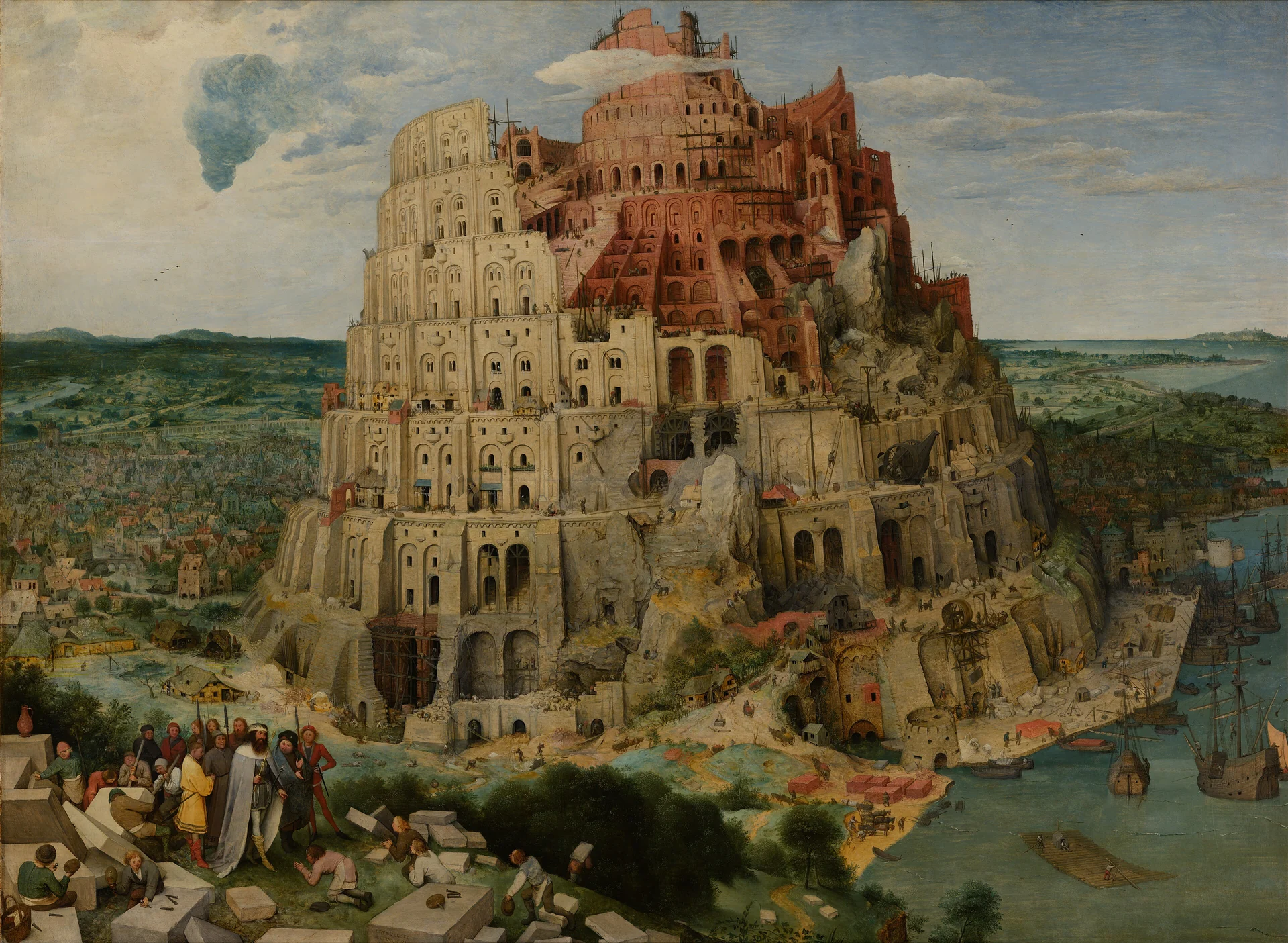
Opening illustration: Pieter Bruegel the Elder, The Tower of Babel, 1563. Kunsthistorisches Museum, Vienna. Public-domain reproduction via Wikimedia Commons. A sixteenth-century Flemish imagining of the tower, not a reconstruction of any building in ancient Babylon.
At Babel, humanity seeks a home that will keep its people together and a name that will outlive them.
And the whole earth was of one language, and of one speech.
And it came to pass, as they journeyed from the east, that they found a plain in the land of Shinar; and they dwelt there.
And they said one to another, Go to, let us make brick, and burn them throughly. And they had brick for stone, and slime had they for morter.
And they said, Go to, let us build us a city and a tower, whose top may reach unto heaven; and let us make us a name, lest we be scattered abroad upon the face of the whole earth.
— Genesis 11:1–4, King James Version.1
A name made of bricks
The builders begin with something more powerful than masonry: they can understand one another. Their common speech makes a common undertaking possible.
The Hebrew śāp̄āh, שָׂפָה, literally means “lip,” used here for language. Humanity has one lip and common words. The desired šēm, שֵׁם, is a name in the sense of reputation or renown. The people will speak together, build together, and become known together. Shinar places the scene in Babylonia; the “slime” of the older English translation is bitumen, binding their manufactured bricks.1–2
The tower belongs to a city: a place capable of gathering work, memory, and allegiance around one center. Its height will make that center visible. Its endurance will carry the builders’ name beyond their individual lifetimes.
Read sympathetically, this is a recognizable human hope. People want their children to inherit a community rather than its disappearance. They want their work to amount to something that death cannot immediately erase.
But the fear beneath the project is revealing. The builders are not only trying to establish a place to live. They are trying to prevent dispersal.
The distinction from Noah’s work is suggestive. An ark shelters its occupants until they can leave it. Babel is intended to keep its people together. The vessel preserves the possibility of departure; the city seeks security against it.
The tower rises upward so that humanity need not spread outward.
A tower against the waters
Genesis leaves the builders unnamed. Its preceding chapter places Babel within Nimrod’s realm, but the nine-verse tower episode does not assign him the role of architect or ruler. Josephus brings the ruler and the project together, and connects the tower explicitly with the memory of the flood.1, 3
In his account, the descendants fear renewed destruction. Nimrod encourages confidence in human strength and promises security through a structure beyond the waters’ reach. Josephus describes the authority developing around that promise:
He also gradually changed the government into tyranny; seeing no other way of turning men from the fear of God, but to bring them into a constant dependence on his own power. He also said, “He would be revenged on God, if he should have a mind to drown the world again: for that he would build a Tower too high for the waters to be able to reach; and that he would avenge himself on God for destroying their fore-fathers.”
— Josephus, Jewish Antiquities 1.4.2, translated by William Whiston.3
This tower is defensive and offensive at once. It will protect the descendants, but its protection is conceived as retaliation. Humanity will answer the destruction of its forebears by building beyond the destroyer’s reach.
The ark and tower can therefore be read as contrasting responses to catastrophe. Noah builds according to a warning. Nimrod’s project promises that no further warning will need to govern human conduct. The ark rises because the waters carry it; the tower is meant to stand where the waters cannot follow.
The fear is understandable. A people whose ancestral memory includes the loss of a world might find material protection more convincing than reassurance alone.
Josephus’s sharper criticism concerns what the promise of protection does to them. The independence Nimrod offers from heaven becomes dependence upon a human ruler. The people are promised freedom from one vulnerability through submission to another source of power.
In this retelling, the tower is more than a refuge. It is a claim about who can guarantee the future, and therefore whose voice should govern the present.
A related tower appears in the Qur’an, in the story of Moses rather than at Babel. Pharaoh tells Haman to fire clay into bricks and raise a lofty structure, a ṣarḥ, صَرْح, so that he may look upon Moses’s God, and Qur’an 40:36–37 repeats the ambition to reach “the roads of the heavens” while presenting the scheme as futile. Both rulers make height answer a challenge from heaven. The difference is the aim: Nimrod promises his people refuge from another flood, while Pharaoh wants to inspect the God whose messenger defies him.4
One voice, one kingdom
The phrase “one language” can be read at two levels. At the narrative level, Genesis describes shared speech. At the symbolic level, that shared speech can become the voice of a unified kingdom: one center able to make many people act together.
This does not require imagining that every household possesses an identical vocabulary. An imperial capital might contain many languages while still presenting one authoritative account of what must be built, whom it serves, and why everyone owes it labor. In such a reading, unity concerns not only the sounds people make but the authority to which their words and actions answer.
Babel can be imagined as a capital speaking for an entire world.
A Sumerian poem puts one speech in the same company. In Enmerkar and the Lord of Aratta, copied in the schools of Babylonia early in the second millennium BCE, the king of Uruk wants gold and precious metals from a distant mountain city to build his temple, and he tells his messenger to chant a spell of Enki, under his other name Nudimmud, before its ruler. The spell speaks of a day with no snake and no lion, when “man has no rival,” and the lands of Cubur and Hamazi, “the many-tongued,” with Sumer, Akkad and the Martu land, “may they all address Enlil together in a single language,” when Enki “shall change the speech in their mouths.” Samuel Noah Kramer called these lines a Sumerian Babel of Tongues: a lost age of one language, ended by a god. Bendt Alster and Herman Vanstiphout read them as a forecast, with the many lands brought to one speech in the time to come. On Kramer’s reading Enki does what YHWH does. On the other, one language is what a king holds out to a foreign city while he demands its gold.5
In his study of Sargon II’s inscriptions from Dūr-Šarrukīn, Samuel Boyd argues that expressions involving “one mouth” describe coordinated allegiance and action rather than demonstrating the imposition of a single spoken language. He brings that distinction to Genesis 11, emphasizing common purpose and its disruption. His argument offers a historical comparison, not a dictionary definition in which “language” simply means “empire.”6
The tower is the visible monument; beneath it stands an organization of human life. People know where to bring materials, whose instructions to follow, and which undertaking claims their time. The capital’s speech becomes effective because it can be turned into coordinated work.
A shared language can make cooperation easier. A dominant language can also become a condition of being heard within the institutions that organize that cooperation.
The question is not merely whether everyone can understand the command. It is whether anyone can refuse it.
The builders speak in the first-person plural: let us. Their words sound like agreement. Later storytellers ask what happens when someone no longer belongs to that us.
In John’s gospel Jesus prays for a unity of many people too, “That they all may be one; as thou, Father, art in me, and I in thee,” and says he has given his followers the glory the Father gave him. Both scenes imagine many becoming one. At Babel the unity is built, gathered around the builders’ own name and tower; in John it is received as a gift. The Christ-archetype reading sees the unity Babel tried to manufacture arriving as something given. The suspicious reading asks of every unity the question Babel raises: who speaks for the one, and what becomes of the person who will not belong.1
When the brick outweighs the builder
A later Jewish interpretation makes the cost of the project painfully concrete.
In Pirkei de-Rabbi Eliezer 24, workers carry bricks upward along one ascent and descend by another. The tower has become an undertaking whose continuation matters more than the lives sustaining it:
If a man fell and died they paid no heed to him, but if a brick fell they sat down and wept, and said: Woe is us! when will another one come in its stead?
— Pirkei de-Rabbi Eliezer 24, translated by Gerald Friedlander.7
Genesis does not say what was wrong with such impressive cooperation. This later answer is that the building has become more important than the people.
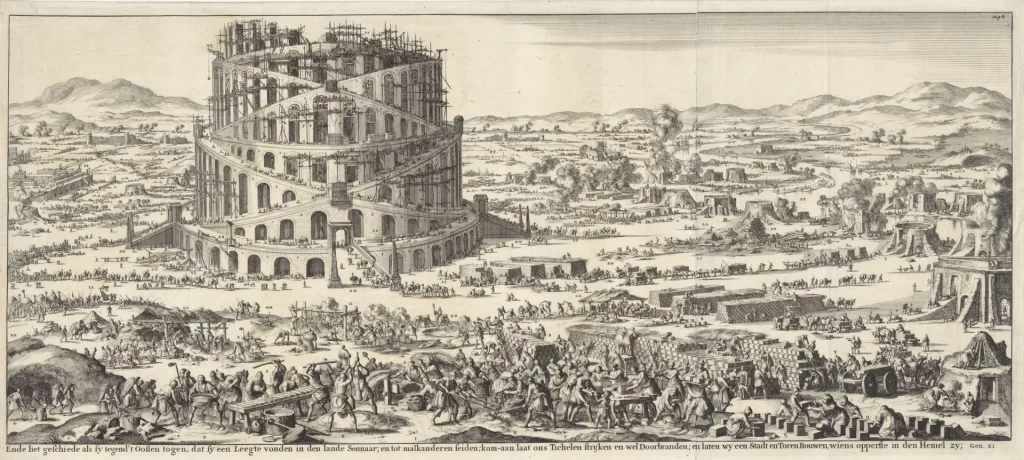
The brick has a recognized place in the project. The dead worker is treated as replaceable. A monument intended to preserve the human name becomes an undertaking beneath which a human death scarcely counts as a loss.
The contrast turns the tower’s ambition inside out. Its height measures achievement from a distance. The fallen worker reveals what that achievement costs from below.
Read through this tradition, the tower’s offense is not simply that it reaches too close to heaven. It is that the people raising it have ceased to look after one another on earth.
Another Jewish retelling takes the same danger further. What happens when a person does not fall by accident, but refuses to keep building?
The man who would not become a brick
In Pseudo-Philo’s Biblical Antiquities, the builders initially fear that dispersal will lead their descendants into conflict. A common monument is meant to prevent future division. The author even has the participants write their names on their bricks: personal identity becomes materially attached to the collective construction.8
But twelve men refuse to join. They include Abram, Nahor, and Lot. The narrative brings them before the authorities:
And the people of the land laid hands on them and brought them before their princes and said: These are the men that have transgressed our counsels and will not walk in our ways.
And the princes said unto them: Wherefore would ye not set every man your bricks with the people of the land? And they answered and said: We will not set bricks with you, neither will we be joined with your desire. One Lord know we, and him do we worship. And if ye should cast us into the fire with your bricks, we will not consent to you.
— Pseudo-Philo, Biblical Antiquities 6:4, translated by M. R. James.8
Their refusal exposes a difference between understanding and obedience. They understand the collective demand perfectly. They reject its claim upon them.
In this account, unity has begun to break before God confuses the languages. The problem is not that the dissenters cannot hear the common voice. It is that they acknowledge an authority beyond it.
Jectan, a sympathetic leader, secretly arranges an escape. Eleven men accept it. Abram remains, unwilling to flee the place where he has been confined. When the deadline passes, the authorities find him alone and prepare to carry out the threatened punishment.8
And they took him and built a furnace and kindled it with fire, and put bricks burned with fire into the furnace. Then Jectan the prince being amazed (lit. melted) in his mind took Abram and put him with the bricks into the furnace of fire.
— Pseudo-Philo, Biblical Antiquities 6:16, translated by M. R. James.8
The materials and the dissenter are placed together in the fire.
In the fallen-worker tradition the work goes on without mourning the man who dies. Here the man who refuses the work is put to death on purpose. Fire hardens the bricks into useful components. Abram’s ordeal asks whether a person must likewise be forced into the form the project requires, or destroyed for resisting it.
The tale ends with divine intervention. An earthquake shakes the scene, fire bursts from the furnace and kills those around it, while Abram emerges unharmed and rejoins his companions. Its rescue is therefore also a violent judgment, not a simple parable of tolerance.8
Genesis does not place Abram at Babel. This ancient retelling does so to give his separation a particular meaning: before he becomes a founder, he refuses to be absorbed into someone else’s foundation.
Heaven comes down
In Genesis, the answer to the builders begins with a change of perspective:
And the LORD came down to see the city and the tower, which the children of men builded.
And the LORD said, Behold, the people is one, and they have all one language; and this they begin to do: and now nothing will be restrained from them, which they have imagined to do.
Go to, let us go down, and there confound their language, that they may not understand one another’s speech.
— Genesis 11:5–7, King James Version.1
The divine name in these verses is YHWH, יְהוָה, rendered “the LORD” in the King James Version: the personal name of Israel’s God, not the Elohim of the creation account. The people’s “let us” is answered by YHWH’s own “let us go down.”
The tower is meant to reach heaven, yet God must come down to inspect it. The contrast permits an ironic reading: the builders’ achievement has not abolished the distance they imagine themselves crossing.
Nevertheless, the divine speech recognizes their power. They are one people, and the tower is only the beginning of what their coordination can accomplish.
This leaves a genuine tension. The later stories of the neglected worker and threatened dissenter make the intervention easy to understand as a limit upon destructive unity. Genesis itself offers fewer explanations. A sympathetic reading sees a necessary boundary placed upon human self-exaltation. A suspicious reading asks why growing human capability provokes divine restriction.
The narrative lets the question stand. It does not say that the builders are incapable. It says their shared capacity must be interrupted.
God answers their repeated invitation, let us, with another collective resolve. The people propose a city; the divine speech proposes the undoing of the coordination that makes it possible.
The interruption falls not first upon their masonry, but upon their understanding.
When the capital loses its voice
So the LORD scattered them abroad from thence upon the face of all the earth: and they left off to build the city.
Therefore is the name of it called Babel; because the LORD did there confound the language of all the earth: and from thence did the LORD scatter them abroad upon the face of all the earth.
— Genesis 11:8–9, King James Version.1
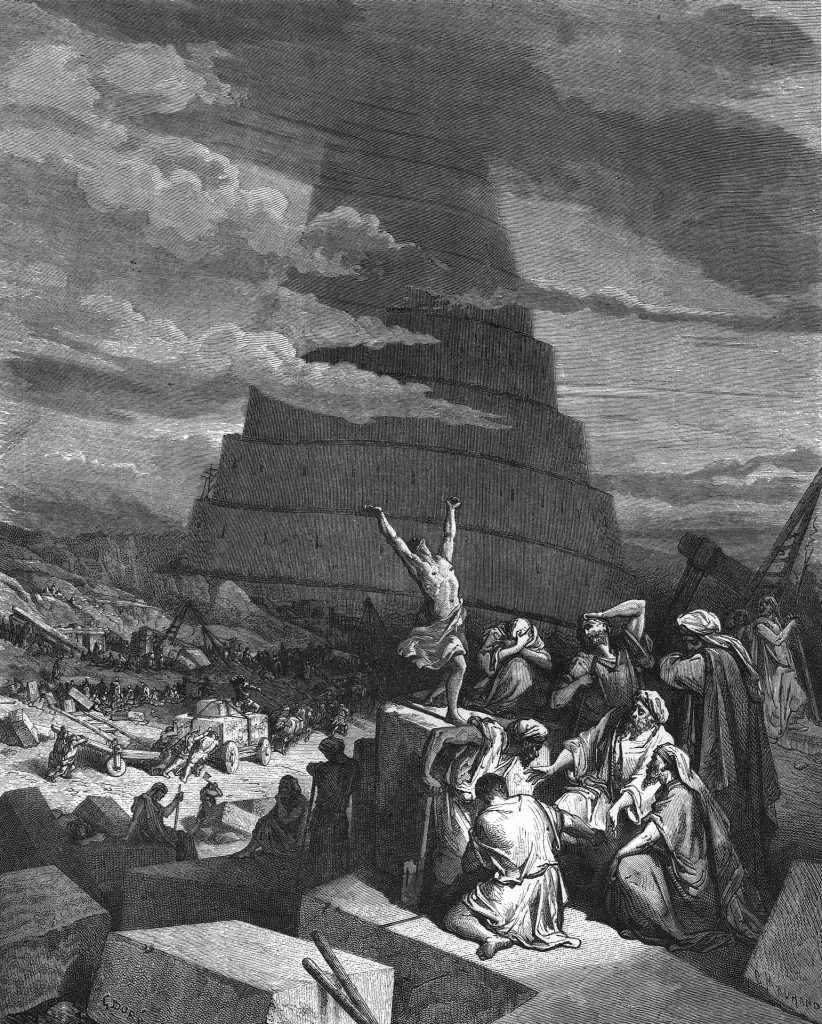
The outcome is precisely what the builders feared. Their attempt to prevent dispersal ends with scattering.
Genesis does not describe the tower collapsing. The builders cease their work. A later account in Jubilees 10:26 adds a mighty wind that overturns the structure, but the biblical narrative makes the breakdown of the human undertaking decisive.1, 9
That difference gives the imperial interpretation its force.
An unfinished tower can remain standing after the authority that sustained it has failed. The materials have not necessarily disappeared. What has disappeared is the common order that could make them serve one purpose.
Read as the fragmentation of a kingdom, Babel does not have to mean that its former inhabitants lose the physical ability to speak. It means that the capital can no longer speak effectively for all of them. Its instructions no longer gather the world into the same work.
The fall of an empire does not necessarily kill its language. Margaretha Folmer’s study follows Aramaic across successive imperial systems and beyond the Achaemenid period. A medium of communication can outlast a particular government.10
The stronger symbolic reading is therefore not that every scattered people invents its speech from nothing. It is that the old center loses its claim to make everyone answer with one voice. The language may survive, but the institutions, prestige, or obedience attached to it can change.
A common language can serve hospitality, learning, trade, and mutual care. The trouble comes when understanding cannot be had without submitting to one undertaking.
The tower loses its future when one city can no longer claim the future of everyone around it.
The name they could not control
The builders seek a name, and the narrative gives them one.
Bābel, בָּבֶל, is the Hebrew name for Babylon. Its conventional Babylonian interpretation connects it with bāb-ili, “gate of god.” Genesis instead associates the name with the Hebrew verb bālal, בָּלַל, “mix” or “confuse.” This is a Hebrew wordplay upon Babylon’s name, not its historical derivation from Hebrew.2
The reversal is exact. The place that can call itself a gate to divinity becomes, in this telling, the place where mutual understanding fails.
The builders wanted their name to testify to their achievement. They are remembered for the limit of that achievement instead.
Babel’s final irony is not that the city remains unknown. It is that the story takes possession of its fame. The people may build a monument to determine how they will be remembered, but they cannot finally command what later voices will say about it.
A name elsewhere
The narrative then turns from the gathered world to a departing household. Through the genealogy of Shem, Genesis reaches Terah and his family. Terah begins the journey from Ur with Abram, Sarai, and Lot, stopping at Haran. The next stage belongs to Abram’s calling and the promise that his name will become great.1
At Babel, a name is to be secured by raising a monument and refusing dispersal. Abram receives the promise of a name while being called away from the familiar center of his life. One future is built upward into heaven; the other must be sought elsewhere on earth.
Babel tries to secure a name by keeping everyone in place. The next story begins when a family leaves.
Sources and translation notes
The primary quotations preserve their selected passages; line-break and page-break artifacts from online editions have been removed.
1. Genesis 10–12, King James Version. Main narrative: Genesis 11:1–9. Closing bridge: Genesis 11:10–32 and 12:1–3. John 17:21–22 is quoted from the same version. en.wikisource.org ↩
2. NET Bible, Genesis 11, translation and study notes. Used for the explanations of “lip,” Shinar, bitumen, and the Babel–balal wordplay. Bible Gateway hosts the edition; these notes are modern commentary, not part of the ancient narrative. biblegateway.com ↩
3. Josephus, Jewish Antiquities 1.4.1–3, translated by William Whiston. The flood-resistant tower and Nimrod’s motives are Josephus’s account, not explicit statements in Genesis 11. penelope.uchicago.edu ↩
4. Qur’an 28:38 and 40:36–37, English of 40:37 from Marmaduke Pickthall, The Meaning of the Glorious Koran (1930). Pharaoh’s tower belongs to the Qur’an’s account of Moses, not to Babel. sacred-texts.com ↩
5. Enmerkar and the Lord of Aratta, lines 134–155, Electronic Text Corpus of Sumerian Literature, t.1.8.2.3. etcsl.orinst.ox.ac.uk. Samuel Noah Kramer, “The ‘Babel of Tongues’: A Sumerian Version,” Journal of the American Oriental Society 88 (1968): 108–111. Bendt Alster, “An Aspect of ‘Enmerkar and the Lord of Aratta,’” Revue d’Assyriologie 67 (1973). Herman Vanstiphout, Epics of Sumerian Kings (2003). ↩
6. Samuel L. Boyd, “Sargon’s Dūr-Šarrukīn Cylinder Inscription and Language Ideology: A Reconsideration and Connection to Genesis 11:1–9,” Journal of Near Eastern Studies 78 (2019): 87–111. The distinction between common speech and coordinated allegiance is Boyd’s. academia.edu ↩
7. Pirkei de-Rabbi Eliezer 24, translated by Gerald Friedlander, 1916. Source location: sefaria.org. The brick-and-worker passage is also reproduced verbatim in Arik Ascherman’s 2020 discussion: blogs.timesofisrael.com. The reproduced primary text was checked against Friedlander’s translation. ↩
8. Pseudo-Philo, Biblical Antiquities 6, translated by M. R. James, 1917. Relevant passages: 6:1–4 (names on bricks and refusal), 6:5–15 (threat and proposed escape), 6:16–18 (furnace and deliverance). The online edition calls him Abraham in the initial list and Abram later; prose here uses Abram consistently. sacred-texts.com ↩
9. Jubilees 10:26, translated by R. H. Charles. The mighty wind that overturns the tower belongs to this account; Genesis narrates cessation and scattering without describing its demolition. pseudepigrapha.com ↩
10. Margaretha Folmer, “Aramaic as Lingua Franca” (2020), pp. 373–399. Used for the survival of Aramaic across successive imperial systems. research.vu.nl ↩