Oral tradition, animal voices and the burden of bread
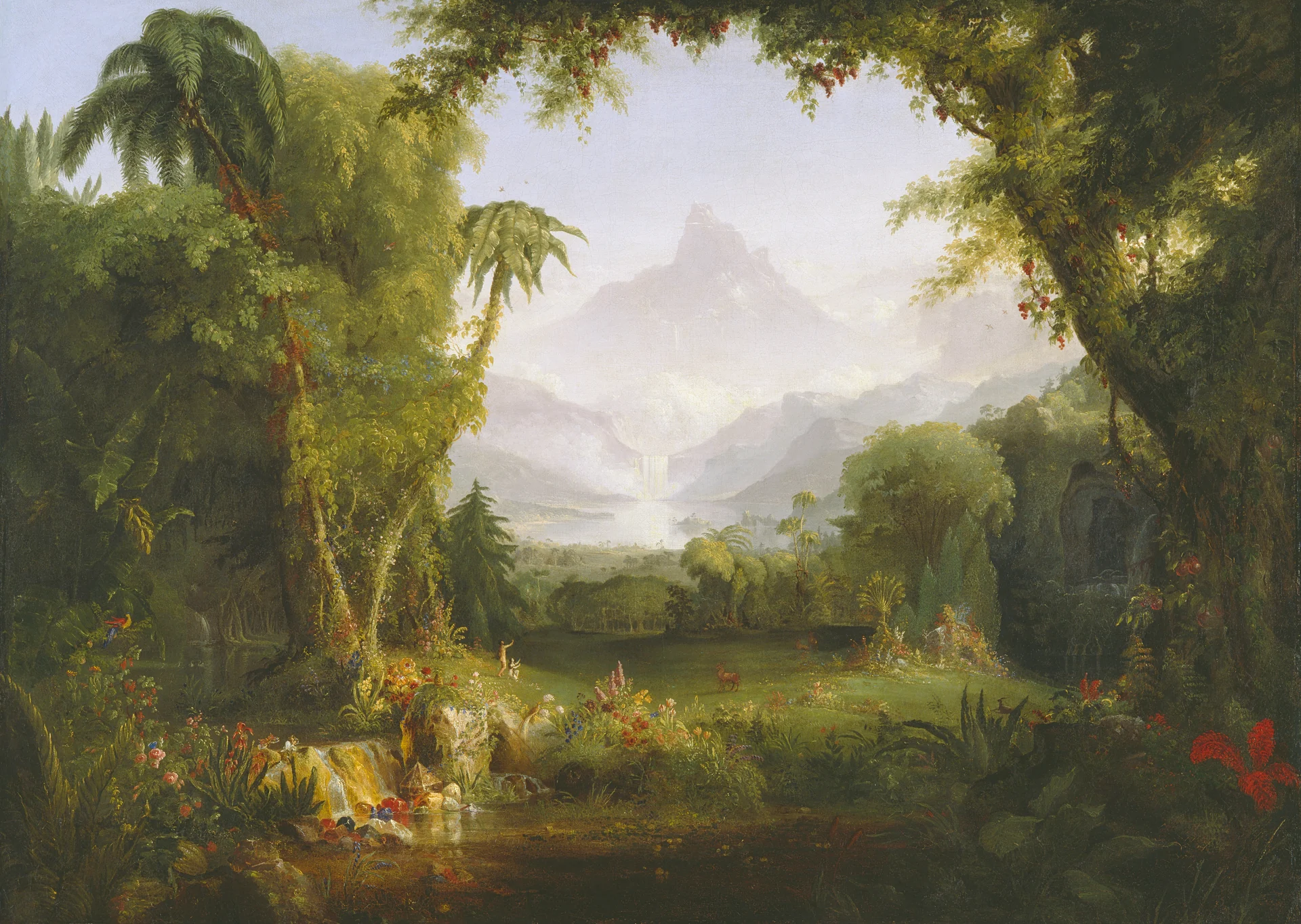
Opening illustration: Thomas Cole, The Garden of Eden, 1828. Amon Carter Museum of American Art, Fort Worth, 1990.10. Public domain.
A story told around a fire can outlive everyone who first heard it. The listeners die, their children grow old, the land changes, and the tale finds another voice. In it animals speak, the dead are still present, and ordinary things begin with the deed of someone extraordinary.
The anthropologist Polly Wiessner recorded 174 conversations among the Ju/’hoansi, a foraging people of southern Africa. By day they talked about food and work and complained of one another. By firelight they sang, danced and told stories, and the stories carried what nobody taught them formally: how marriage, kinship and exchange worked across a wide country.1
The garden of Eden is a story of that kind. It has food, a talking animal, a rule, and an account of why life is hard. Farmers wrote it down, in a book that later tithes their grain. My reading is that the story is older than the writing. It is about the life before the fields, and it was kept by people who no longer lived that life.
The Earthling in the Garden
Genesis begins the account with what the world lacked. No rain had fallen, “and there was not a man to till the ground,” ve-adam ayin la-ʿavod et ha-adamah, וְאָדָם אַיִן לַעֲבֹד אֶת־הָאֲדָמָה. The story ends by supplying him. At the gate of the garden the man is sent out “to till the ground,” in the same Hebrew words. Everything between the two verses happens in a world without a farmer.2
And the LORD God formed man of the dust of the ground, and breathed into his nostrils the breath of life; and man became a living soul. And the LORD God planted a garden eastward in Eden; and there he put the man whom he had formed. And out of the ground made the LORD God to grow every tree that is pleasant to the sight, and good for food; the tree of life also in the midst of the garden, and the tree of knowledge of good and evil. And a river went out of Eden to water the garden; and from thence it was parted, and became into four heads.
— Genesis 2:7–10, King James Version.3
The Hebrew ties the human to the earth by sound. He is adam, אָדָם, “human,” and he is made from adamah, אֲדָמָה, “ground.” Adam is the earthling. The ground gives him his body and the trees that feed it, and at the end it takes the body back.4
The name of the garden has two histories. Hebrew ears heard ʿeden, עֵדֶן, “delight,” and in the Greek Bible the man is sent ek tou paradeisou tēs tryphēs, ἐκ τοῦ παραδείσου τῆς τρυφῆς, “out of the park of luxury.” Paradeisos is the word Xenophon used for the walled parks of the Persian kings. Since Friedrich Delitzsch in 1881, Assyriologists have heard an older word behind the Hebrew: Sumerian edin, 𒂔, “the steppe,” the open country beyond the ploughed land. Alan Millard argued in 1984 for a Semitic root meaning “to make abundant” instead. One history names the garden for plenty and the other for land that no one has ploughed.5
God plants the garden before he puts the man in it. The food and the water are already there.
And the LORD God took the man, and put him into the garden of Eden to dress it and to keep it. And the LORD God commanded the man, saying, Of every tree of the garden thou mayest freely eat: But of the tree of the knowledge of good and evil, thou shalt not eat of it: for in the day that thou eatest thereof thou shalt surely die.
— Genesis 2:15–17, King James Version.3
The man has a task before any wrong is done. “To dress it and to keep it” is le-ʿovdah u-le-shomrah, לְעָבְדָהּ וּלְשָׁמְרָהּ, from ʿavad, עָבַד, “to work” or “to serve,” and shamar, שָׁמַר, “to keep” or “to guard.” Numbers uses the same pair for the Levites, who “keep all the instruments of the tabernacle” and “do the service” of it. Adam is a caretaker in someone else’s orchard. He eats from it freely, inside a limit set by the owner.6
A woman is made from his side, and the two are naked without shame. Then an animal speaks. The serpent asks about the rule, denies that they will die, and says that their eyes will open and they will be “as gods, knowing good and evil.”
From the planting to the gate the narrator calls God by a double name, YHWH Elohim, יְהוָה אֱלֹהִים, “the LORD God,” twenty times in two chapters. The rabbis read the four-letter name as mercy and Elohim as judgment, and the narrator keeps the two together. Only the serpent and the woman separate them. He asks, “Yea, hath God said,” af ki-amar Elohim, אַף כִּי־אָמַר אֱלֹהִים, and she answers with the same single name. On the rabbinic reading the two of them are discussing a judge, and the name of mercy is not spoken at the tree.7
And when the woman saw that the tree was good for food, and that it was pleasant to the eyes, and a tree to be desired to make one wise, she took of the fruit thereof, and did eat, and gave also unto her husband with her; and he did eat. And the eyes of them both were opened, and they knew that they were naked; and they sewed fig leaves together, and made themselves aprons.
— Genesis 3:6–7, King James Version.3
She wants the fruit as food, for its beauty and for wisdom. The first thing the new knowledge shows the pair is their own bodies. They cover themselves with leaves, and when God walks in the garden they hide among the trees.
Fruit, Thorns and Bread
Questioned, the man blames the woman and the woman blames the serpent. God condemns the serpent to crawl and sets enmity between its seed and hers, the sentence that The Serpent Slayers follows. Then he turns to the two humans.
Unto the woman he said, I will greatly multiply thy sorrow and thy conception; in sorrow thou shalt bring forth children; and thy desire shall be to thy husband, and he shall rule over thee. And unto Adam he said, Because thou hast hearkened unto the voice of thy wife, and hast eaten of the tree, of which I commanded thee, saying, Thou shalt not eat of it: cursed is the ground for thy sake; in sorrow shalt thou eat of it all the days of thy life; Thorns also and thistles shall it bring forth to thee; and thou shalt eat the herb of the field; In the sweat of thy face shalt thou eat bread, till thou return unto the ground; for out of it wast thou taken: for dust thou art, and unto dust shalt thou return.
— Genesis 3:16–19, King James Version.3

The woman and the man receive the same word. Her “sorrow” and his “sorrow” are both ʿitstsavon, עִצָּבוֹן, “pain” or “toil,” a noun the Hebrew Bible uses three times, each time of this sentence. Her labour and his are one judgment. It reaches into the house as well as the field: “he shall rule over thee.”8
The food changes too. In the garden he ate from trees. Now he will eat “the herb of the field,” ʿesev ha-sadeh, עֵשֶׂב הַשָּׂדֶה, the plant that Genesis 2:5 listed as not yet grown, and he will eat leḥem, לֶחֶם, “bread,” named here for the first time in the Bible. Thorns and thistles are a trouble only to someone who is trying to grow one crop on cleared ground. Bread comes at the end of a long chain of work: a field, a harvest, threshing, grinding and fire. Genesis names the punishment after a processed grain.9
The sentence also gives hardship a guilty ancestor. The farmer sweats because the first man disobeyed, and the wife is ruled because the first woman ate. A story told that way serves whoever eats the bread without the sweat. The Sumerians put it plainly. In their poem the gods are tired of digging canals and have humans made to carry the baskets, as Enki and Ninmah — The Gods Who Made Us Work tells. Genesis keeps the labour and leaves out the one who profits by it. Samuel names him when Israel asks for a king: “he will take your fields, and your vineyards,” and “he will take the tenth of your seed.”10
Then comes one act of care, and the gate.
Unto Adam also and to his wife did the LORD God make coats of skins, and clothed them. And the LORD God said, Behold, the man is become as one of us, to know good and evil: and now, lest he put forth his hand, and take also of the tree of life, and eat, and live for ever: Therefore the LORD God sent him forth from the garden of Eden, to till the ground from whence he was taken. So he drove out the man; and he placed at the east of the garden of Eden Cherubims, and a flaming sword which turned every way, to keep the way of the tree of life.
— Genesis 3:21–24, King James Version.3
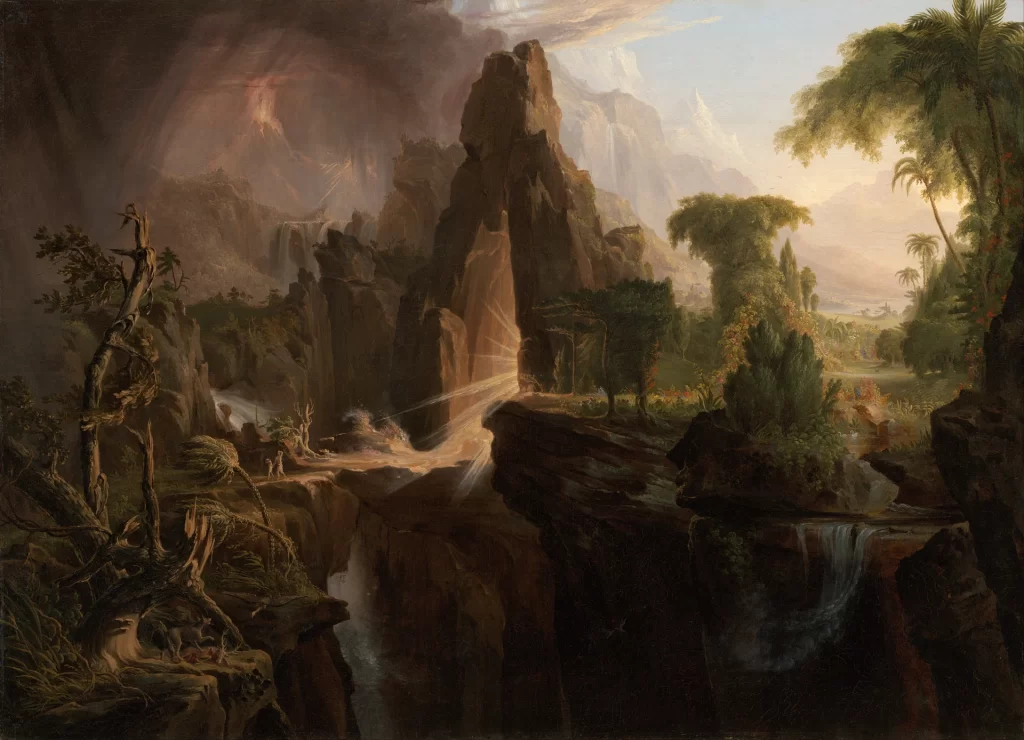
God grants what the serpent promised: “the man is become as one of us, to know good and evil.” Then he shuts the way to the other tree. The cherubim are set there li-shmor, לִשְׁמֹר, “to keep” the way, which is the verb of the man’s own task. The keeper of the garden is kept out of it. He leaves wearing kotnot ʿor, כָּתְנוֹת עוֹר, “coats of skins,” the first clothing in the Bible that comes from an animal, and nobody in the story hunts for it.11
Genesis never shows Adam killing or eating an animal. The food given at creation is “every herb bearing seed” and every fruit tree: “to you it shall be for meat,” where meat is the King James word for food. Flesh is allowed after the flood, “even as the green herb have I given you all things.” The people of Eden are gatherers, and the text leaves the hunter out.12
The Long Road into the Fields
The story moves from fruit that is picked to bread that is made, and it calls the move a punishment. The people who kept it were farmers. A story made to flatter its tellers would have treated the plough as a gift, as the Greeks said that Demeter gave wheat to Triptolemus to sow over the whole earth. Israel’s story makes the farmer’s work the sentence for the first offence, and its tellers went on ploughing and copying it out. I take that as the mark of something inherited. Farmers could also have dreamed of an easier past out of their own tiredness, and the two explanations do not exclude each other. A people can inherit a story and find its own complaint in it.13
The change from gathering to farming took thousands of years and went differently from valley to valley. Gathering wild plants, sowing plants that are still wild, and living on domesticated crops are three different things, and people combined them with hunting for a long time. Plant remains from across Southwest Asia show the growing of cereals and their domestication starting at different times in different regions.14
Bread is older than farming. At Shubayqa 1 in north-eastern Jordan, Natufian hunter-gatherers baked flat bread from wild cereals and club-rush tubers about 14,400 years ago, some four thousand years before farming began. The loaf in Genesis 3:19 therefore does not date the story. The verse describes dependence, a life arranged around growing, storing and guarding one staple food.15
The bones of early farmers record the price. At Çatalhöyük in south-central Anatolia, a crowded farming town lived in from about 7100 to 5950 BCE, the skeletons show more disease and heavier work as the people came to depend on grain. The town grew all the while. More bread fed more people, and each of them paid for it with the body.16
Göbekli Tepe: A World Gathered in Stone
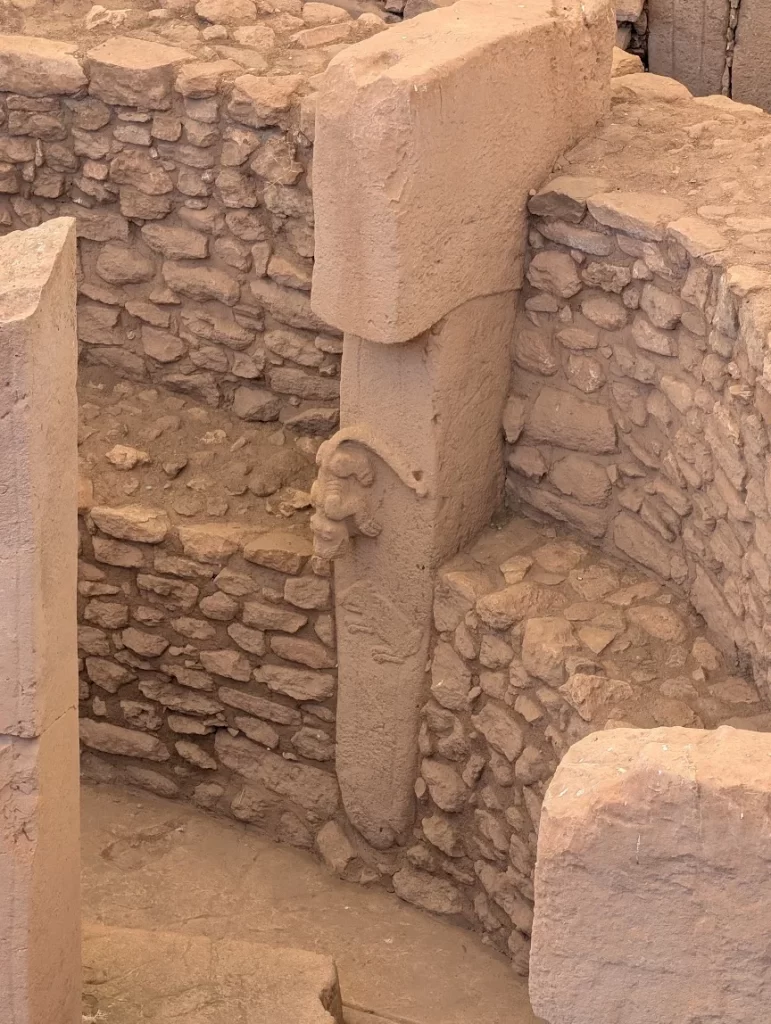
In the Germuş hills near Şanlıurfa in south-eastern Türkiye stands Göbekli Tepe, Turkish for “Potbelly Hill.” Between about 9600 and 8200 BCE, people who lived by hunting and gathering quarried limestone pillars up to five and a half metres tall, cut them in the shape of a capital T, and set them in rings inside stone walls. Some pillars wear carved belts and loincloths, so that the stone is a standing person. Wild animals are carved on the rest.17

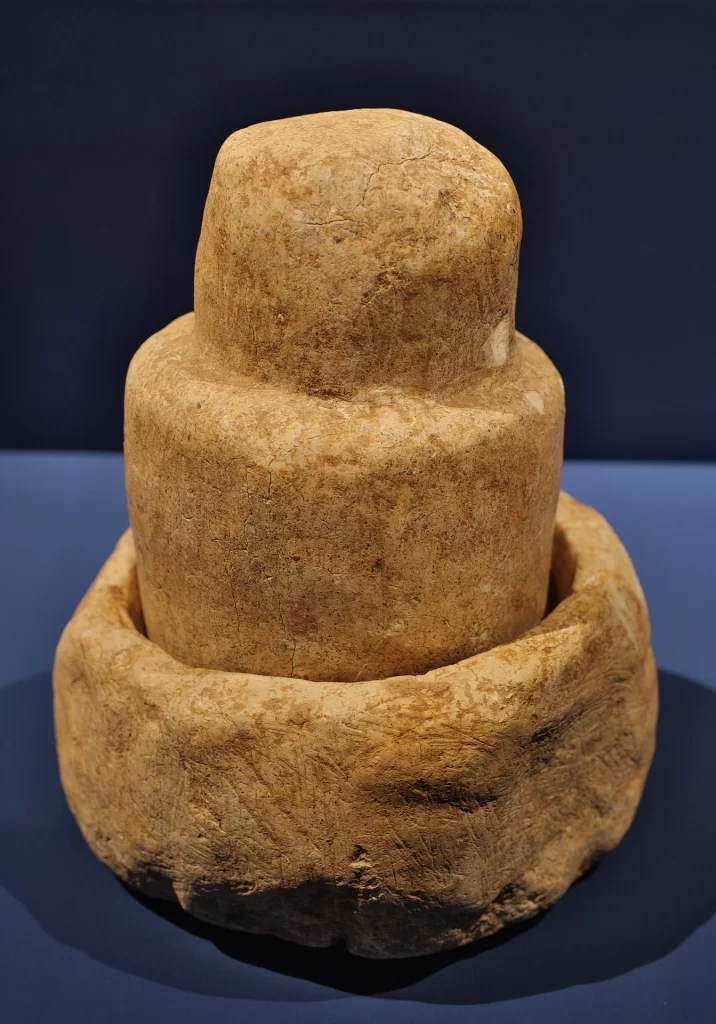
The builders ground grain. Beside the pillars the excavators found the tools of the kitchen, and Laura Dietrich and her colleagues studied more than seven thousand of them: grinding slabs, handstones, mortars and pestles. The wear on the stones and the plant residue in the soil show cereals processed in quantity. The people who raised the pillars already made their meals by long work at a stone.18
The place matters as much as the date. Genesis says that a river went out of Eden and parted into four, and it names two that are still on the map: Hiddekel, which is the Tigris, and the Euphrates. Göbekli Tepe stands in the hill country between the upper courses of those two rivers. In the same country, on the slopes of Karacadağ, grows the wild einkorn that a genetic study of 1997 identified as the likely ancestor of cultivated einkorn wheat. The other two rivers, Pison and Gihon, have never been found, and the verse is not a map reference. It does point upstream, to the country where the Tigris and the Euphrates rise, and that country is one of the places where gatherers of wild grain became farmers.19
People lived at the hill for many centuries, in houses as well as among the great buildings. The archaeologist Lee Clare sets its history in the period when the communities of the upper Euphrates and Tigris “transitioned from mobile hunter-foragers to settled agriculturalists.” He has also asked who led such a community. From a life-size statue of a wild boar found in one of the great buildings, and from finds at sister sites, he argues for leaders whom archaeology cannot see directly, and he names three kinds of people they came from: storytellers, hunters and ritual experts. Their work, on his account, was to uphold the old values while the old way of life was ending. He calls the period the “hunter-gatherer crisis.”20
That is the setting I propose for the first telling of Eden. A community of gatherers is becoming, generation by generation, a community that lives on grain. Its storytellers keep the old values. They have reason to tell of a time when food was picked from trees that nobody planted, and of how that time ended.
Scholars date the writing of Genesis 2 and 3 to the kingdom of Judah or later, more than seven thousand years after the hill was abandoned, and most treat the garden as a composition of that age built from Mesopotamian material. That dates the writing. A telling can be far older than its first copy, and stories have lasted that long. Aboriginal peoples at twenty-one places around the coast of Australia tell of a time when the shore lay farther out and the sea came in over it. The sea last stood at those lines between about 7,000 and 13,000 years ago, and the geographer Patrick Nunn and the linguist Nicholas Reid concluded that the stories have been handed down since then. No tablet or carving joins the hill to the book. What joins them is two river names, the wild wheat, and the subject of the story.21
When Animals Speak
Hunters have to know animals as characters with habits, and their stories let the animals talk. In a story of the Kalapuya of Oregon a pine squirrel tells a deer, “You are very much (always) afraid.” The deer runs from every noise and never looks back. The squirrel climbs a tree and then comes down to see what frightened it. Michelle Scalise Sugiyama, who has studied the stories of foraging peoples, reads such tales as teaching. The speech is invented and the behaviour is true.22
At Göbekli Tepe the animals are in stone. Each great building favours its own. In the building the excavators call A the snake prevails, in B the fox, in C the wild boar, and in D birds, above all vultures. The excavators take them for the emblems of different groups of people. The stories that went with them are lost.23
The serpent of Eden belongs to this company. Genesis introduces it as “more subtil than any beast of the field,” and it is the only animal in the garden that talks. It tells the woman something true about the tree, and she acts on what she has heard.
Farmers kept the device. Hesiod, a Boeotian farmer of about 700 BCE, puts a hawk and a nightingale into a poem about ploughing and debt, and he announces the story with the words nyn d’ ainon basileusin ereō, νῦν δ’ αἶνον βασιλεῦσιν ἐρέω, “now I will tell a fable for princes.” The hawk has the nightingale in his claws and tells her that the stronger does as he pleases. A talking animal does not make a story old. It marks a story made for telling aloud, in which an animal says what a person could not safely say.24
Other Beginnings
A Babylonian tablet of about 1800 BCE, more than a thousand years older than any surviving copy of Genesis, tells of a man who lived as Adam did and was led out of that life by a woman. The goddess Aruru pinches Enkidu out of clay in the open country. He feeds on grass with the gazelles and drinks with the herds. A woman of the city of Uruk is sent out to him, and after six days and seven nights with her the animals run from him. She says:
I gaze upon thee, O Enkidu, like a god art thou!
Why with the cattle
Dost thou roam across the field?
She covers him with one of her two garments and leads him to a shepherds’ camp, where food and drink are set before him.
Enkidu had not known
— The Epic of Gilgamesh, Old Babylonian tablet, columns 2 and 3, translated by Morris Jastrow and Albert T. Clay, 1920.25
To eat food.
To drink wine
He had not been taught.
The woman opened her mouth and
Spoke to Enkidu:
“Eat food, O Enkidu,
The provender of life!
Drink wine, the custom of the land!”
Jastrow and Clay wrote “food” and “wine” for the Akkadian aklam, “bread,” and šikaram, “beer.” Enkidu eats and drinks. He is rubbed with oil and dressed, and the tablet says, “He was like a man.” The open country he has left is, in Sumerian, the edin.
The pieces are those of Genesis: a man at home among the animals, a woman, the words “like a god,” clothing, and bread. The Babylonian poet counts the change as a gain. Bread is “the provender of life,” and the man who eats it becomes human. Genesis tells the same change as a loss, and its bread is a sentence. The poet of Uruk speaks for the city. Genesis takes the side of the life that was left behind.25
Hesiod sets the easy life under Kronos. His golden race lived “remote and free from toil and grief,” and the earth bore them fruit automatē, αὐτομάτη, “of its own accord.” His translator Evelyn-White writes “unforced.” Hesiod’s own age is iron, and his poem teaches ploughing. He too is a farmer who says that the life before farming was the better one.26
Imagined Beginnings, Lived Consequences
Whether there was a garden is one question. Whether people believed there was is a second, and what they did because of the story is a third. The second and the third have records.
The sentence on the ground runs through the chapters that follow. Cain is “a tiller of the ground,” and the ground takes his brother’s blood, as Cain and Abel — The Farmer and the Shepherd tells. In the tenth generation a father names his son for the hope of relief.
And he called his name Noah, saying, This same shall comfort us concerning our work and toil of our hands, because of the ground which the LORD hath cursed.
— Genesis 5:29, King James Version.27
“Toil” is the third and last ʿitstsavon, and Noah — Prophet and Builder follows what became of the hope. The law given at Sinai then makes the lost garden a date in the calendar.
Six years thou shalt sow thy field, and six years thou shalt prune thy vineyard, and gather in the fruit thereof; But in the seventh year shall be a sabbath of rest unto the land, a sabbath for the LORD: thou shalt neither sow thy field, nor prune thy vineyard. That which groweth of its own accord of thy harvest thou shalt not reap, neither gather the grapes of thy vine undressed: for it is a year of rest unto the land. And the sabbath of the land shall be meat for you; for thee, and for thy servant, and for thy maid, and for thy hired servant, and for thy stranger that sojourneth with thee, And for thy cattle, and for the beast that are in thy land, shall all the increase thereof be meat.
— Leviticus 25:3–7, King James Version.28
For one year in seven the farmer may not sow, prune or reap. He eats sefiaḥ qetsirkha, סְפִיחַ קְצִירְךָ, “that which groweth of its own accord of thy harvest,” which is Hesiod’s automatē in Hebrew. He eats it on the same terms as his servant, the stranger, his cattle and the wild animals, and Exodus adds the poor: “what they leave the beasts of the field shall eat.” Leviticus calls the year a sabbath, like the seventh day on which God rested. I read it as Eden kept by statute. The food is unsown, the animals share it, and for a year a farming people lives by gathering.28
The law was kept, and it cost something. Josephus copies a decree of Julius Caesar that fixes the tribute of Judea. The Jews are to pay every year “excepting the seventh, which they call the sabbatical year, because thereon they neither receive the fruits of their trees, nor do they sow their land.”29
Jesus preached the same economy to the farmers of Galilee.
Behold the fowls of the air: for they sow not, neither do they reap, nor gather into barns; yet your heavenly Father feedeth them. Are ye not much better than they?
— Matthew 6:26, King James Version.30
His three verbs are the farmer’s year: ou speirousin oude therizousin oude synagousin eis apothēkas, οὐ σπείρουσιν οὐδὲ θερίζουσιν οὐδὲ συνάγουσιν εἰς ἀποθήκας, “they sow not, neither do they reap, nor gather into barns.” He points to the creatures that do none of it, and to the lilies that “toil not,” and tells his hearers to take no thought for what they will eat. The law gave the garden back for one year in seven. The sermon sets no term. It asks of farmers, every day, the trust that the man and the woman gave up at the tree.30
The prayer he teaches in the same sermon asks for the food of the sentence on the terms of the garden: “Give us this day our daily bread.” In the Greek Bible the curse reads phagē ton arton sou, φαγῇ τὸν ἄρτον σου, “thou shalt eat thy bread,” and the prayer says ton arton hēmōn, τὸν ἄρτον ἡμῶν, “our bread.” Adam’s bread is to be sweated for until he goes back to the ground. This bread is asked for, a day at a time.31
Sources and Translation Notes
1. Polly W. Wiessner, “Embers of society: Firelight talk among the Ju/’hoansi Bushmen,” Proceedings of the National Academy of Sciences 111, no. 39 (2014): 14027–14035, doi.org/10.1073/pnas.1404212111. The study compares 174 day and night conversations, with 68 translated texts. ↩
2. Genesis 2:5 and 3:23, King James Version. Hebrew from Mechon Mamre: וְאָדָם אַיִן לַעֲבֹד אֶת־הָאֲדָמָה (2:5); וַיְשַׁלְּחֵהוּ יְהוָה אֱלֹהִים מִגַּן־עֵדֶן לַעֲבֹד אֶת־הָאֲדָמָה (3:23). ↩
3. Genesis 2 and 3, King James Version, Wikisource. Hebrew from Mechon Mamre, Genesis 2 and Genesis 3. Greek of the Septuagint from Greek Wikisource. ↩
4. Hebrew of Genesis 2:7: וַיִּיצֶר יְהוָה אֱלֹהִים אֶת־הָאָדָם עָפָר מִן־הָאֲדָמָה. Brown–Driver–Briggs: אָדָם, “man, mankind,” and אֲדָמָה, “ground (as tilled, yielding sustenance).” On the earthling, Jack M. Sasson, “What Really Happened in the Garden of Eden”, TheTorah.com, 2022. ↩
5. Brown–Driver–Briggs: עֵדֶן, “luxury, dainty, delight,” and the place name עֵדֶן, “probably associated by Hebrew” with it. Septuagint, Genesis 3:23: ἐξαπέστειλεν αὐτὸν Κύριος ὁ Θεὸς ἐκ τοῦ παραδείσου τῆς τρυφῆς. Liddell–Scott–Jones, παράδεισος, “enclosed park or pleasure-ground,” an “Oriental word first used by” Xenophon, “always in reference to the parks of the Persian kings and nobles.” Friedrich Delitzsch, Wo lag das Paradies? (Leipzig, 1881). A. R. Millard, “The Etymology of Eden,” Vetus Testamentum 34 (1984): 103–106. ↩
6. Hebrew of Genesis 2:15: וַיַּנִּחֵהוּ בְגַן־עֵדֶן לְעָבְדָהּ וּלְשָׁמְרָהּ. Brown–Driver–Briggs: עָבַד, “work, serve,” and שָׁמַר. Numbers 3:7–8, King James Version; Hebrew from Mechon Mamre: וְשָׁמְרוּ אֶת־כָּל־כְּלֵי אֹהֶל מוֹעֵד … לַעֲבֹד אֶת־עֲבֹדַת הַמִּשְׁכָּן. ↩
7. The double name occurs eleven times in Genesis 2:4–25 and nine times in chapter 3. Hebrew of Genesis 3:1: אַף כִּי־אָמַר אֱלֹהִים; the woman’s reply at 3:3: אָמַר אֱלֹהִים. Genesis Rabbah 33:3 on the two names. ↩
8. Hebrew of Genesis 3:16–17: הַרְבָּה אַרְבֶּה עִצְּבוֹנֵךְ וְהֵרֹנֵךְ; בְּעִצָּבוֹן תֹּאכְלֶנָּה. Brown–Driver–Briggs, עִצָּבוֹן, “pain, toil”: Genesis 3:17 and 5:29, “both of agriculture,” and 3:16, “of travail.” ↩
9. Hebrew of Genesis 3:18–19: וְאָכַלְתָּ אֶת־עֵשֶׂב הַשָּׂדֶה; בְּזֵעַת אַפֶּיךָ תֹּאכַל לֶחֶם. Genesis 2:5: וְכָל־עֵשֶׂב הַשָּׂדֶה טֶרֶם יִצְמָח. Brown–Driver–Briggs, לֶחֶם, “bread, food.” ↩
10. Enki and Ninmah, lines 1–37, Electronic Text Corpus of Sumerian Literature 1.1.2, a modern translation, retold here. 1 Samuel 8:14–15, King James Version. ↩
11. Hebrew of Genesis 3:21 and 3:24: כָּתְנוֹת עוֹר; לִשְׁמֹר אֶת־דֶּרֶךְ עֵץ הַחַיִּים. The serpent’s words are at 3:5 and God’s at 3:22. ↩
12. Genesis 1:29 and 9:3–4, King James Version. ↩
13. Apollodorus, Library 1.5.2, translated by J. G. Frazer (1921), Theoi. Readings of Eden beside the coming of agriculture: Samuel Z. Glaser, “The Evolution of Civilization: The Biblical Story”, TheTorah.com, 2015; Robert S. Kawashima, “Adam and Eve in the Garden of Eden: An Etiology for the Human Condition”, TheTorah.com, 2022, on the orchard and the field. ↩
14. Amaia Arranz-Otaegui and others, “Regional diversity on the timing for the initial appearance of cereal cultivation and domestication in southwest Asia,” Proceedings of the National Academy of Sciences 113, no. 49 (2016): 14001–14006, doi.org/10.1073/pnas.1612797113. ↩
15. Amaia Arranz-Otaegui and others, “Archaeobotanical evidence reveals the origins of bread 14,400 years ago in northeastern Jordan,” Proceedings of the National Academy of Sciences 115, no. 31 (2018): 7925–7930, doi.org/10.1073/pnas.1801071115. ↩
16. Clark Spencer Larsen and others, “Bioarchaeology of Neolithic Çatalhöyük reveals fundamental transitions in health, mobility, and lifestyle in early farmers,” Proceedings of the National Academy of Sciences 116, no. 26 (2019): 12615–12623, doi.org/10.1073/pnas.1904345116. The findings are those of one town. ↩
17. UNESCO World Heritage Centre, “Göbekli Tepe,” property 1572. ↩
18. Laura Dietrich and others, “Cereal processing at Early Neolithic Göbekli Tepe, southeastern Turkey,” PLOS ONE 14, no. 5 (2019): e0215214, doi.org/10.1371/journal.pone.0215214. The cereals processed there were wild. ↩
19. Genesis 2:10–14, King James Version. Manfred Heun and others, “Site of Einkorn Wheat Domestication Identified by DNA Fingerprinting,” Science 278 (1997): 1312–1314, doi.org/10.1126/science.278.5341.1312. ↩
20. Lee Clare, “Göbeklitepe in Palaeoclimate Context: Human Responses to Climate Change in the Upper Tigris and Euphrates Basins from the Younger Dryas to the Early Holocene,” Heritage 9, no. 5 (2026): 179, doi.org/10.3390/heritage9050179; Lee Clare, “Inspired individuals and charismatic leaders: Hunter-gatherer crisis and the rise and fall of invisible decision-makers at Göbeklitepe,” Documenta Praehistorica 51 (2024): 6–43, doi.org/10.4312/dp.51.16. The domestic buildings are noted in the UNESCO description. ↩
21. Patrick D. Nunn and Nicholas J. Reid, “Aboriginal Memories of Inundation of the Australian Coast Dating from More than 7000 Years Ago,” Australian Geographer 47, no. 1 (2016): 11–47, doi.org/10.1080/00049182.2015.1077539. ↩
22. Michelle Scalise Sugiyama, “Oral Storytelling as Evidence of Pedagogy in Forager Societies,” Frontiers in Psychology 8 (2017): 471, quoting Melville Jacobs, Santiam Kalapuya Ethnologic Texts, University of Washington Publications in Anthropology 11 (Seattle, 1945), pp. 132–133. ↩
23. Dietrich and others (2019), on the animals of buildings A to D. ↩
24. Hesiod, Works and Days 202–212, translated by H. G. Evelyn-White (Loeb Classical Library, 1914), Theoi; Greek from the Perseus Digital Library. ↩
25. Morris Jastrow and Albert T. Clay, An Old Babylonian Version of the Gilgamesh Epic (New Haven, 1920), the Pennsylvania tablet, columns 2 and 3, Project Gutenberg. Akkadian aklu is bread and šikaru is beer, and later translators render the line that way. The making of Enkidu and the flight of the animals are in Tablet I of the later version, R. Campbell Thompson, The Epic of Gilgamish (London, 1928), Sacred Texts. ↩
26. Hesiod, Works and Days 109–120 and 174–178, translated by H. G. Evelyn-White; Greek of 117–118: καρπὸν δ’ ἔφερε ζείδωρος ἄρουρα αὐτομάτη. ↩
27. Genesis 4:2 and 5:29, King James Version; Hebrew of 5:29: וּמֵעִצְּבוֹן יָדֵינוּ מִן־הָאֲדָמָה אֲשֶׁר אֵרְרָהּ יְהוָה. ↩
28. Leviticus 25:3–7 and Exodus 23:10–11, King James Version; Hebrew of Leviticus 25:5 from Mechon Mamre: אֵת סְפִיחַ קְצִירְךָ לֹא תִקְצוֹר. Brown–Driver–Briggs, סָפִיחַ, “growth from spilled kernels.” ↩
29. Josephus, Jewish Antiquities 14.202, translated by William Whiston (London, 1737), Lexundria. ↩
30. Matthew 6:25–28, King James Version; Greek from the SBL Greek New Testament, Bible Gateway. ↩
31. Matthew 6:11, King James Version; Greek from the SBL Greek New Testament, Bible Gateway: τὸν ἄρτον ἡμῶν τὸν ἐπιούσιον δὸς ἡμῖν σήμερον. Septuagint, Genesis 3:19: ἐν ἱδρῶτι τοῦ προσώπου σου φαγῇ τὸν ἄρτον σου. ↩