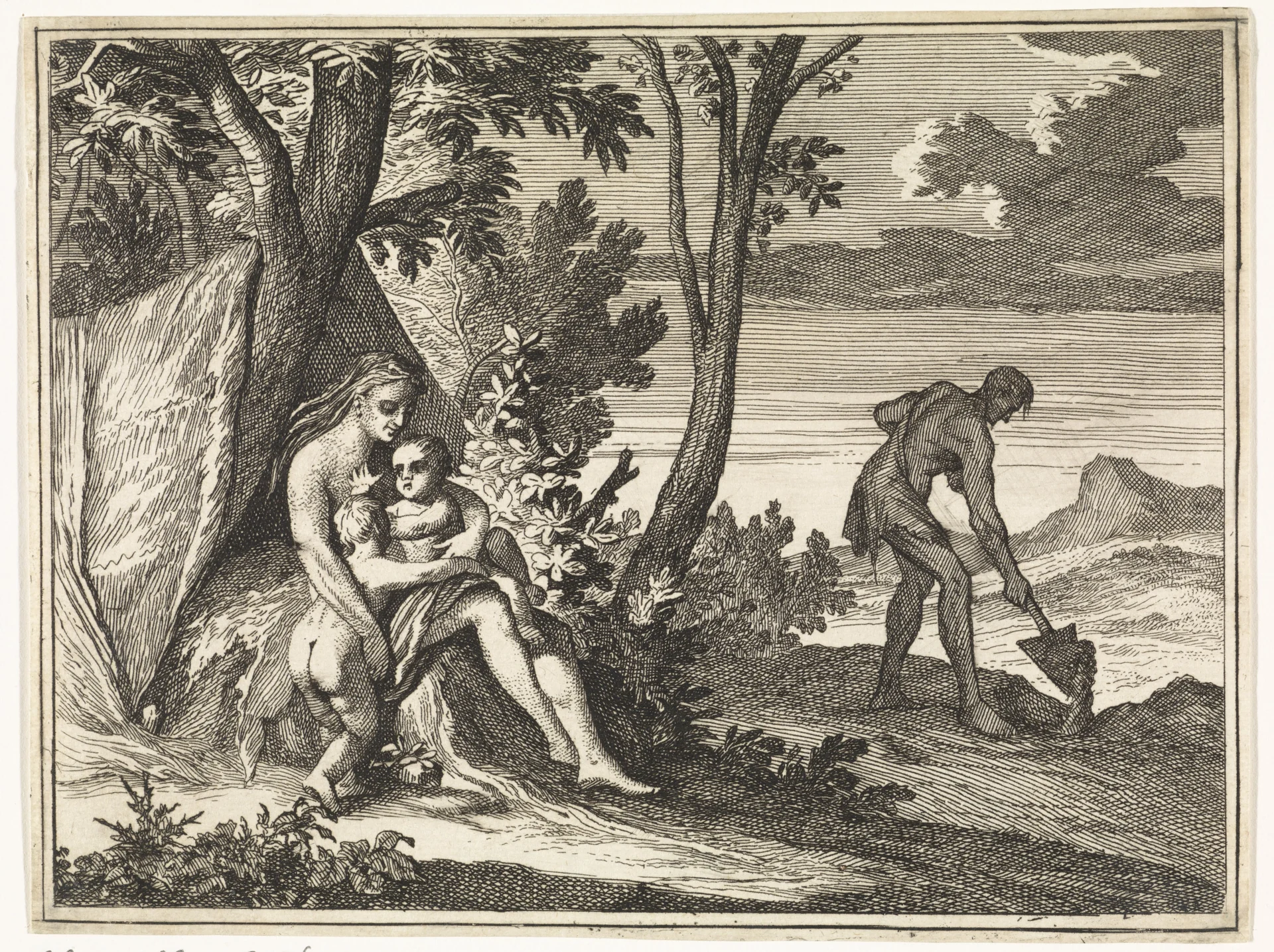
Fraternal strife at the moment hunter-gatherers became farmers and shepherds
Opening illustration: Caspar Luyken, Eve with Her Children While Adam Digs the Ground outside Paradise, etching, 1712. Rijksmuseum, Amsterdam, RP-P-OB-45.761. CC0.
The first two brothers in the Bible take the two trades that replaced hunting and gathering, and one of them kills the other.
And Adam knew Eve his wife; and she conceived, and bare Cain, and said, I have gotten a man from the LORD. And she again bare his brother Abel. And Abel was a keeper of sheep, but Cain was a tiller of the ground.
— Genesis 4:1–2, King James Version.1
A Man from the LORD
Their father had lived in a garden where food was picked from the trees. He was sent out of it la-ʿavod et ha-adamah, לַעֲבֹד אֶת־הָאֲדָמָה, “to till the ground,” and told that he would eat bread in the sweat of his face. Genesis sets the brothers at that change. People who had gathered what grew now planted it or herded it, and the chapter gives one trade to each son. Cain is ʿoved adamah, עֹבֵד אֲדָמָה, “a tiller of the ground,” which makes him the heir of his father’s sentence. Abel is roʿeh tson, רֹעֵה צֹאן, “a keeper of sheep.”2
Eve’s sentence is the first thing a mother says about a child in the Bible. In Hebrew it is qaniti ish et-YHWH, קָנִיתִי אִישׁ אֶת־יְהוָה. The verb is qanah, קָנָה, “to get” or “to acquire,” and the name Qayin, קַיִן, is made to sound like it. Josephus says the name “signifies a possession.” The difficulty is the small word et, אֶת. It marks the object of a verb, and it can also mean “with.” The King James smooths it to “from the LORD.” The Greek Bible has dia tou Theou, διὰ τοῦ Θεοῦ, “through God.” Read without smoothing, the words say “I have gotten a man, the LORD.”3
An Aramaic paraphrase of Genesis, the Targum called Pseudo-Jonathan, took the grammar at its word and gave the boy another father: “And Adam knew Hava his wife, who had desired the Angel; and she conceived, and bare Kain; and she said, I have acquired a man, the Angel of the Lord.” The First Letter of John says that Cain “was of that wicked one.” Two chapters later Genesis tells of sons of God who take the daughters of men, as the Nephilim article tells, and these readers found the first case here.3
Luke gives the same claim to another mother. An angel tells Mary that the child she will bear “shall be called the Son of God.” Eve makes her claim herself, before the boy has done anything, and nothing in Genesis confirms it. She seems to think she has borne the seed promised in the garden, the one who will bruise the serpent’s head, as the Serpent Slayers article tells. The first woman to expect a deliverer gets a murderer.3
Nobody explains the second name. Abel is Hevel, הֶבֶל, “vapour” or “breath,” the word for what is here and then gone. One son is named for what was got and the other for what does not last. Luke’s genealogy ends with Adam, “which was the son of God.” The two boys are the sons of a son of God, and their quarrel is over which of them the Father prefers.4
The Offering God Would Not Look At
And in process of time it came to pass, that Cain brought of the fruit of the ground an offering unto the LORD. And Abel, he also brought of the firstlings of his flock and of the fat thereof. And the LORD had respect unto Abel and to his offering: But unto Cain and to his offering he had not respect. And Cain was very wroth, and his countenance fell.
— Genesis 4:3–5, King James Version.1
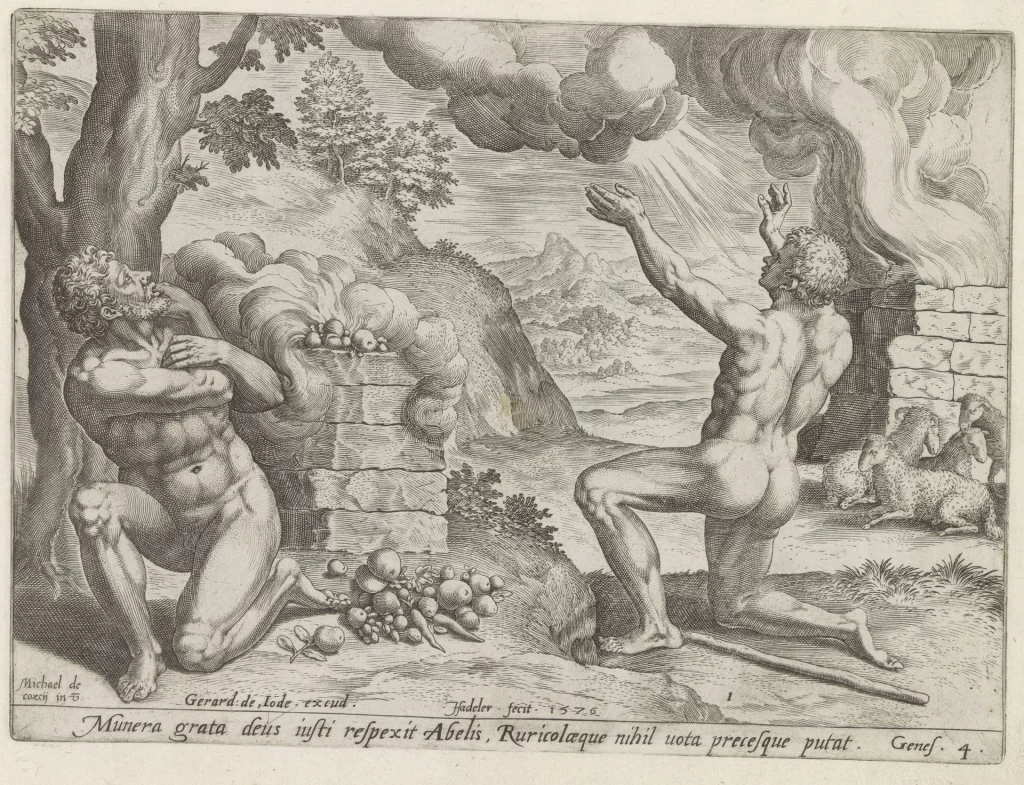
Genesis gives no reason. “Had respect” is va-yishaʿ, וַיִּשַׁע, from a verb that means to gaze. The LORD looked at Abel and his offering, and at Cain and his offering lo shaʿah, לֹא שָׁעָה, he did not look. Readers have supplied the reason ever since. The Letter to the Hebrews supplies faith: “By faith Abel offered unto God a more excellent sacrifice than Cain.” Others point to the gifts. Abel brings “the firstlings of his flock and of the fat thereof,” and Cain brings “of the fruit of the ground,” with no word about the first or the best of it. Leviticus accepts grain at the altar, so the fault cannot be the kind of gift.5
Josephus, writing for Greek and Roman readers in the first century, put the fault in farming itself:
But Cain was not only very wicked in other respects, but was wholly intent upon getting; and he first contrived to plough the ground.
Now Cain brought the fruits of the earth, and of his husbandry; but Abel brought milk, and the first-fruits of his flocks: but God was more delighted with the latter oblation, when he was honored with what grew naturally of its own accord, than he was with what was the invention of a covetous man, and gotten by forcing the ground.
— Josephus, Jewish Antiquities 1.53–54, translated by William Whiston, 1737.6
On this reading the plough is the offence. The shepherd offers what grew by itself, and the farmer offers what he forced out of the soil. “Wholly intent upon getting” is Cain’s name turned into his character.
Genesis does not say that grain is the lesser gift. It says that God looked at the animal, in a book kept by a people whose founders are all herdsmen. Abraham, Isaac and Jacob keep flocks, and Moses and David are both called from the sheep.
Sumer had the same quarrel and settled it without a death. In the poem of Dumuzid and Enkimdu, which the Inanna and Dumuzi article tells, Inanna says she would rather marry the farmer, the man of dykes and canals, than the shepherd. The shepherd sets his milk and wool against the farmer’s grain and wins her. The farmer does not fight. He offers his fields for grazing and is asked to the wedding. In the land of irrigated grain the farmer loses the argument and keeps his standing. In Genesis he becomes a murderer.7
Sin at the Door
And the LORD said unto Cain, Why art thou wroth? and why is thy countenance fallen? If thou doest well, shalt thou not be accepted? and if thou doest not well, sin lieth at the door. And unto thee shall be his desire, and thou shalt rule over him.
— Genesis 4:6–7, King James Version.1
This is the first time the word “sin” appears in the Bible, and it appears as an animal. La-petaḥ ḥaṭṭat rovets, לַפֶּתַח חַטָּאת רֹבֵץ, is “sin lieth at the door,” and rovets is from a verb that means to “lie stretched out,” as a beast does. The next clause has been spoken once before. To Eve God said, “thy desire shall be to thy husband, and he shall rule over thee.” To Cain he says, “unto thee shall be his desire, and thou shalt rule over him.” The word for desire is teshuqah, תְּשׁוּקָה, and the Brown–Driver–Briggs lexicon lists this use of it as the longing “of beast to devour.”8
Painters gave each brother an altar and a fire, though Genesis mentions neither, and they let the smoke answer the question the text leaves open. Abel’s rises. Cain’s is beaten down along the ground. Under that light a man also throws a shadow, and God’s warning describes one: something of Cain’s own, lying behind him at the door, that wants him. Jung used the word shadow for the part of a person that he will not admit is his, and wrote that seeing it takes moral effort. Cain is told that he can still master it. He does not answer.9

Cain has a grievance, and the chapter lets a reader feel it. Their parents had lost the garden, and the offerings are the first attempt in the Bible to win favour back. His is the harder work. The ground was cursed for his father’s sake, and bread comes out of it “in the sweat of thy face.” He is the firstborn, and he brings the produce of that labour and is passed over for a younger brother who walks behind sheep.
Genesis does this to elder brothers again and again. Isaac inherits and Ishmael is sent into the desert. Jacob takes the blessing that was Esau’s by birth, as the Jacob and Esau article tells. Samuel passes over seven sons of Jesse for David, who was out with the sheep. The law in the same books gives the firstborn “a double portion of all that he hath.” A people who keep telling stories in which the junior line wins know that they are a junior line. Cain and Abel is the first of these stories and the only one with a death in it. Ishmael becomes a nation and Esau grows rich. Here the elder brother kills.10
Jesus tells the scene from inside the elder brother. In his parable a father kills the fatted calf for a younger son, and “his elder son was in the field.” He hears the feast, “and he was angry, and would not go in: therefore came his father out, and intreated him.” The father comes out to the angry elder son as the LORD comes to Cain, and says what Cain is never told: “Son, thou art ever with me, and all that I have is thine.” The parable stops there, before the elder brother answers.10
The Murder in the Field
And Cain talked with Abel his brother: and it came to pass, when they were in the field, that Cain rose up against Abel his brother, and slew him.
— Genesis 4:8, King James Version.1
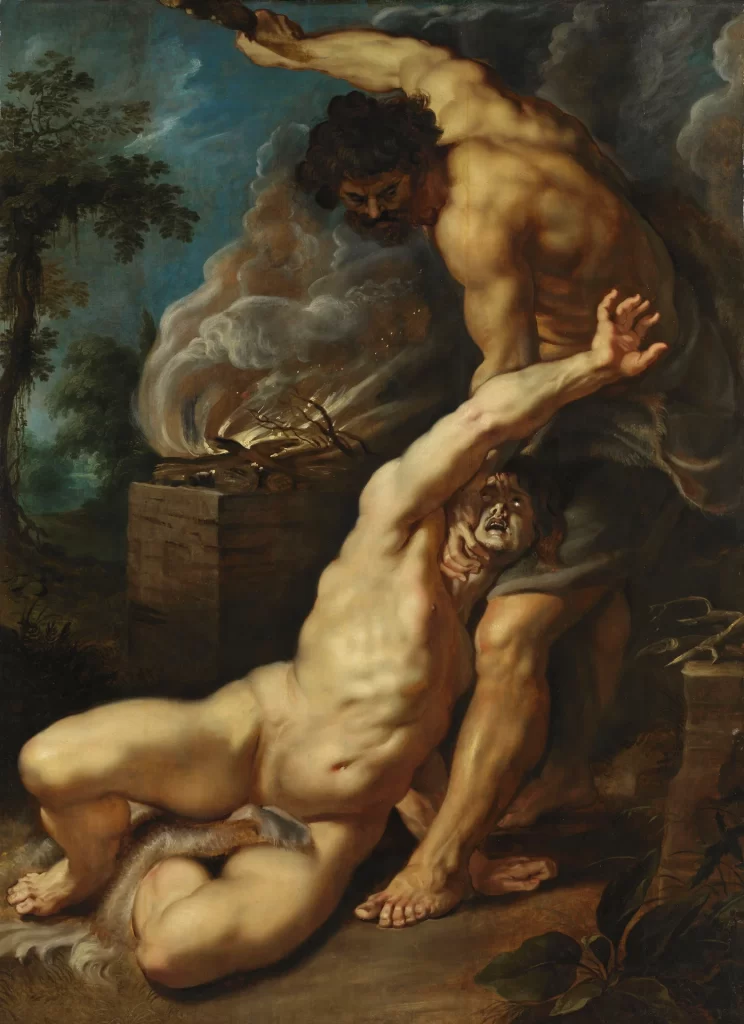
The Hebrew of this verse has a hole in it. It reads va-yomer Qayin el-Hevel aḥiv, וַיֹּאמֶר קַיִן אֶל־הֶבֶל אָחִיו, “and Cain said to Abel his brother,” and then gives nothing that he said. The King James covers the gap with “talked with.” The Greek Bible fills it: dielthōmen eis to pedion, διέλθωμεν εἰς τὸ πεδίον, “let us go out into the field.” The Targum fills it with an argument. In the field Cain tells his brother, “There is neither judgment nor Judge, nor another world; nor will good reward be given to the righteous, nor vengeance be taken of the wicked.” Abel says that there is, and Cain “drave a stone into his forehead, and killed him.”11
Abel is alive for seven verses and speaks in none of them. His name is the first word the Preacher speaks in Ecclesiastes: havel havalim, ha-kol havel, הֲבֵל הֲבָלִים הַכֹּל הָבֶל, “vanity of vanities; all is vanity,” breath of breaths, all of it breath. The Preacher spends twelve chapters on what it means for a life to be vapour, and the word he uses is the murdered boy’s name. By killing him Cain acts out both names. The one who gets takes, and the breath is gone.12
Luke’s account of the crucifixion ends on a breath as well. Jesus says, “Father, into thy hands I commend my spirit: and having said thus, he gave up the ghost.” “Gave up the ghost” is exepneusen, ἐξέπνευσεν, “he breathed out.” Both men lose their breath in the open with people standing near. Abel has no warning and no line to speak. The other death is announced beforehand by the man it happens to, and he speaks through it.12
Egypt told the murder with the trades reversed. In Plutarch’s account Osiris is the brother who showed the Egyptians “the fruits of cultivation,” and Set, who kills him, is the god of the desert beyond the fields. In the oldest grain kingdom the farmer is the victim. In the herdsmen’s book he holds the weapon. Osiris is gathered up and made king of the dead, and his son Horus wins the case against Set before the gods. Abel has no son. All that is left of him to plead is his blood.13
The Blood That Cries from the Ground
And the LORD said unto Cain, Where is Abel thy brother? And he said, I know not: Am I my brother’s keeper? And he said, What hast thou done? the voice of thy brother’s blood crieth unto me from the ground. And now art thou cursed from the earth, which hath opened her mouth to receive thy brother’s blood from thy hand; When thou tillest the ground, it shall not henceforth yield unto thee her strength; a fugitive and a vagabond shalt thou be in the earth.
— Genesis 4:9–12, King James Version.1
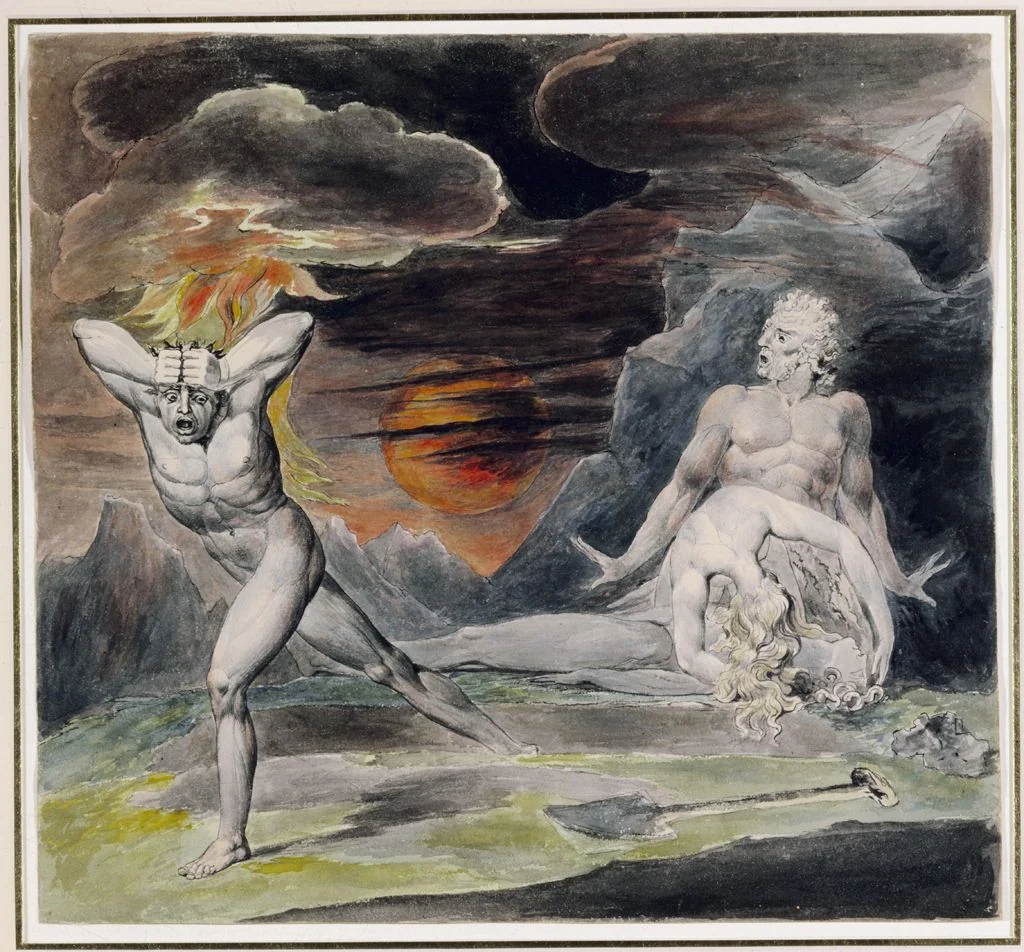
Cain’s answer uses a word from the garden. Adam was put in Eden le-ʿovdah u-le-shomrah, לְעָבְדָהּ וּלְשָׁמְרָהּ, “to dress it and to keep it,” and the two verbs are the ones for serving and guarding. Cain has taken the first as his trade. Asked about his brother, he refuses the second: ha-shomer aḥi anokhi, הֲשֹׁמֵר אָחִי אָנֹכִי, “Am I my brother’s keeper?”14
Abel never speaks in the Bible, and the first sound he makes is his blood. Qol demei aḥikha tsoʿaqim, קוֹל דְּמֵי אָחִיךָ צֹעֲקִים, is literally “the voice of thy brother’s bloods, crying.” The noun is plural, and the rabbis of the Mishnah took the plural to mean Abel’s blood and the blood of every descendant he would have had. From it they drew the rule that whoever destroys one life has destroyed a whole world. Job asks for the same hearing: “O earth, cover not thou my blood.”15
The sentence fits the trade. The ground that drank the blood “shall not henceforth yield unto thee her strength,” and the tiller becomes naʿ va-nad, נָע וָנָד, “a fugitive and a vagabond.” The Greek Bible has stenōn kai tremōn, στένων καὶ τρέμων, “groaning and trembling.”15
The New Testament keeps Abel’s blood talking. Jesus dates every innocent death from it, “from the blood of righteous Abel unto the blood of Zacharias.” The Letter to the Hebrews says of Abel that “he being dead yet speaketh,” and then sets another blood beside his: its readers have come “to Jesus the mediator of the new covenant, and to the blood of sprinkling, that speaketh better things than that of Abel.” Both are the blood of an innocent man killed by his own people, and both are said to speak. Abel’s asks for a reckoning and gets one. The other, in that letter, asks for something better than the killer’s ruin. Jesus calls himself “the good shepherd” who “giveth his life for the sheep.” Abel the shepherd gives nothing. He does not know what is coming, and Genesis never calls his death a sacrifice.16
The Mark
And Cain said unto the LORD, My punishment is greater than I can bear. Behold, thou hast driven me out this day from the face of the earth; and from thy face shall I be hid; and I shall be a fugitive and a vagabond in the earth; and it shall come to pass, that every one that findeth me shall slay me. And the LORD said unto him, Therefore whosoever slayeth Cain, vengeance shall be taken on him sevenfold. And the LORD set a mark upon Cain, lest any finding him should kill him.
— Genesis 4:13–15, King James Version.1
There is nobody to find him. On the plain reading the world holds Adam, Eve, Cain and a grave. Cain fears a population Genesis has not mentioned, and two verses later he has a wife. The article on the people outside the garden takes up that question.
God’s answer is protection. The mark is ot, אוֹת, “a sign,” the word used of the blood on the doorposts in Egypt: “the blood shall be to you for a token.” Later tradition made the mark a brand of shame. In the verse it is a safe conduct, and whoever touches the man who carries it pays seven times over.17
The name carries a second meaning. In the one place where the Hebrew Bible uses qayin as a common noun it is a weapon. The giant who nearly kills David carries one of three hundred shekels: qeno, קֵינוֹ, “the weight of whose spear.” Cain’s descendant Tubal-cain is “an instructer of every artificer in brass and iron.” And Qayin is the Hebrew name of a people. When Balaam looks on the Kenites and says “the Kenite shall be wasted,” the Hebrew word is Qayin, קָיִן. Brown–Driver–Briggs glosses them with a question mark: “tribe of smiths?”18
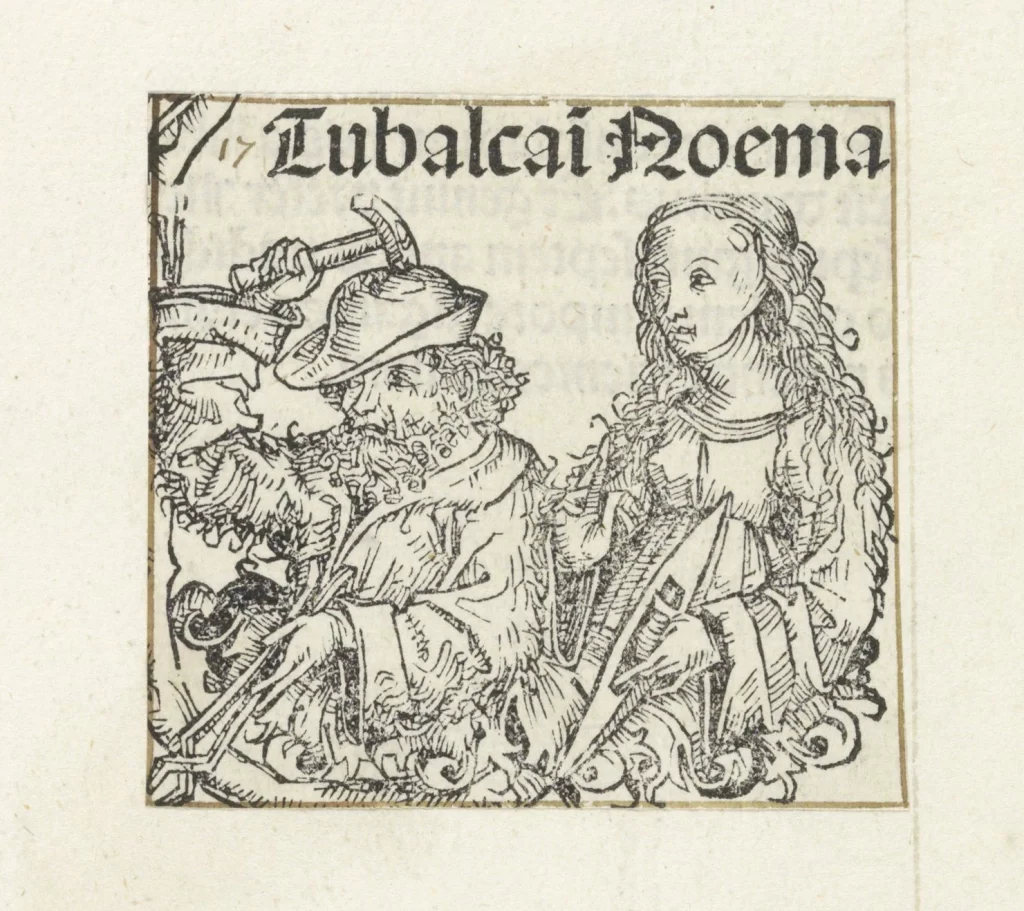
These Kenites live among Israel without being Israel. Moses marries into them. “The children of the Kenite, Moses’ father in law,” go up with Judah and dwell among the people. Israel needed such people. In Saul’s day “there was no smith found throughout all the land of Israel: for the Philistines said, Lest the Hebrews make them swords or spears.” Read with suspicion, the mark of Cain is a village’s account of the armed strangers it depended on: wanderers who make blades, who belong to no one’s land, and whom it is forbidden to kill.18
The City That Cain Built
And Cain went out from the presence of the LORD, and dwelt in the land of Nod, on the east of Eden. And Cain knew his wife; and she conceived, and bare Enoch: and he builded a city, and called the name of the city, after the name of his son, Enoch.
— Genesis 4:16–17, King James Version.1
Nod, נוֹד, is the nad, “vagabond,” of his sentence made into a place name. The man condemned to wander settles in a land called Wandering and builds the first city in the Bible. A harvest has to be stored, and a store has to be walled and guarded, which a flock does not. Josephus makes Cain the inventor of everything that follows from a full granary:19
He also introduced a change in that way of simplicity wherein men lived before; and was the author of measures and weights. And whereas they lived innocently and generously while they knew nothing of such arts, he changed the world into cunning craftiness. He first of all set boundaries about lands: he built a city, and fortified it with walls, and he compelled his family to come together to it.
— Josephus, Jewish Antiquities 1.61–62, Whiston.6
Jesus gives the warning in the terms of Cain’s name: “Take heed, and beware of covetousness: for a man’s life consisteth not in the abundance of the things which he possesseth.” The story he tells next is about a farmer and his barns, as the Erysichthon article tells.19
Rome told the same founding and kept it as a boast. Romulus and Remus quarrel over which of them the birds have chosen to found the city, and Livy gives the commoner story of what happened next:
Remus contemptuously jumped over the newly raised walls and was forthwith killed by the enraged Romulus, who exclaimed, “So shall it be henceforth with every one who leaps over my walls.” Romulus thus became sole ruler, and the city was called after him, its founder.
— Livy, History of Rome 1.7, translated by Canon Roberts, 1912.20
The Latin is Sic deinde, quicumque alius transiliet moenia mea. In both stories a city is begun and a brother dies. Rome honours the killer and teaches the story to its children as the origin of their walls. Genesis curses him, and his city is where he lives out the sentence.20
Israel knew the custom behind such stories. The book of Kings reports that when Hiel rebuilt Jericho “he laid the foundation thereof in Abiram his firstborn, and set up the gates thereof in his youngest son Segub.” Read beside that verse, the first city in the Bible is raised by a man whose brother is in the ground, and the ground has already informed on him.20
Seventy and Sevenfold
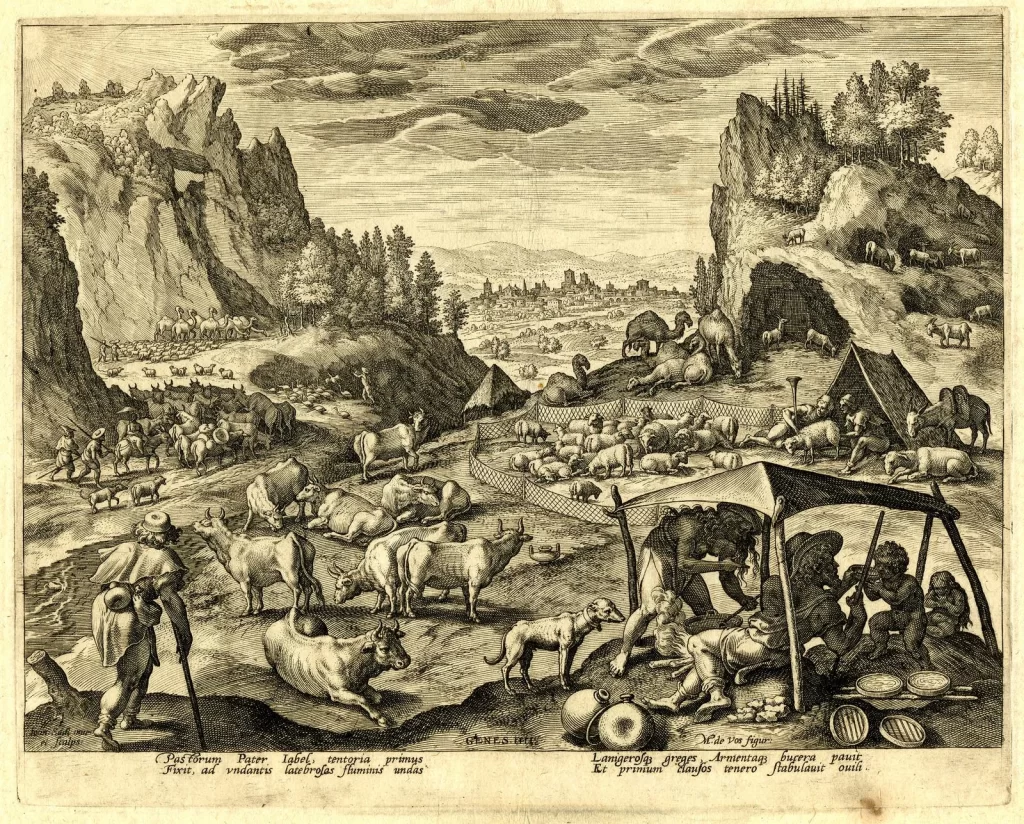
And Lamech took unto him two wives: the name of the one was Adah, and the name of the other Zillah. And Adah bare Jabal: he was the father of such as dwell in tents, and of such as have cattle. And his brother’s name was Jubal: he was the father of all such as handle the harp and organ. And Zillah, she also bare Tubal-cain, an instructer of every artificer in brass and iron: and the sister of Tubal-cain was Naamah.
— Genesis 4:19–22, King James Version.1
The family of the murderer invents the tent and the herd, the harp and the pipe, and the forge. Genesis gives the whole inventory of settled life to Cain’s line. The shepherd of this chapter did the priest’s work at the altar, and the farmer’s descendants end by making weapons.
And Lamech said unto his wives, Adah and Zillah, Hear my voice; ye wives of Lamech, hearken unto my speech: for I have slain a man to my wounding, and a young man to my hurt. If Cain shall be avenged sevenfold, truly Lamech seventy and sevenfold.
— Genesis 4:23–24, King James Version.1
The line ends in a song about killing. God had promised sevenfold vengeance for Cain, and Lamech claims seventy-sevenfold for a wound. In the Greek Bible the number is hebdomēkontakis hepta, ἑβδομηκοντάκις ἑπτά. Matthew uses the same two words once. Peter asks how often he must forgive his brother, “till seven times?” and Jesus answers, “I say not unto thee, Until seven times: but, Until seventy times seven.” Lamech’s arithmetic of revenge is taken over whole and spent on forgiving a brother.21
The people who carried this story call their God a shepherd and themselves his flock, and they remembered taking a land of walled farming towns by force. In their telling the farmer commits the first murder, is refused at the altar, loses his soil and founds the city. It is the herdsman’s case against the granary, told as family history.
Seth, the Substitute
And Adam knew his wife again; and she bare a son, and called his name Seth: For God, said she, hath appointed me another seed instead of Abel, whom Cain slew. And to Seth, to him also there was born a son; and he called his name Enos: then began men to call upon the name of the LORD.
— Genesis 4:25–26, King James Version.1
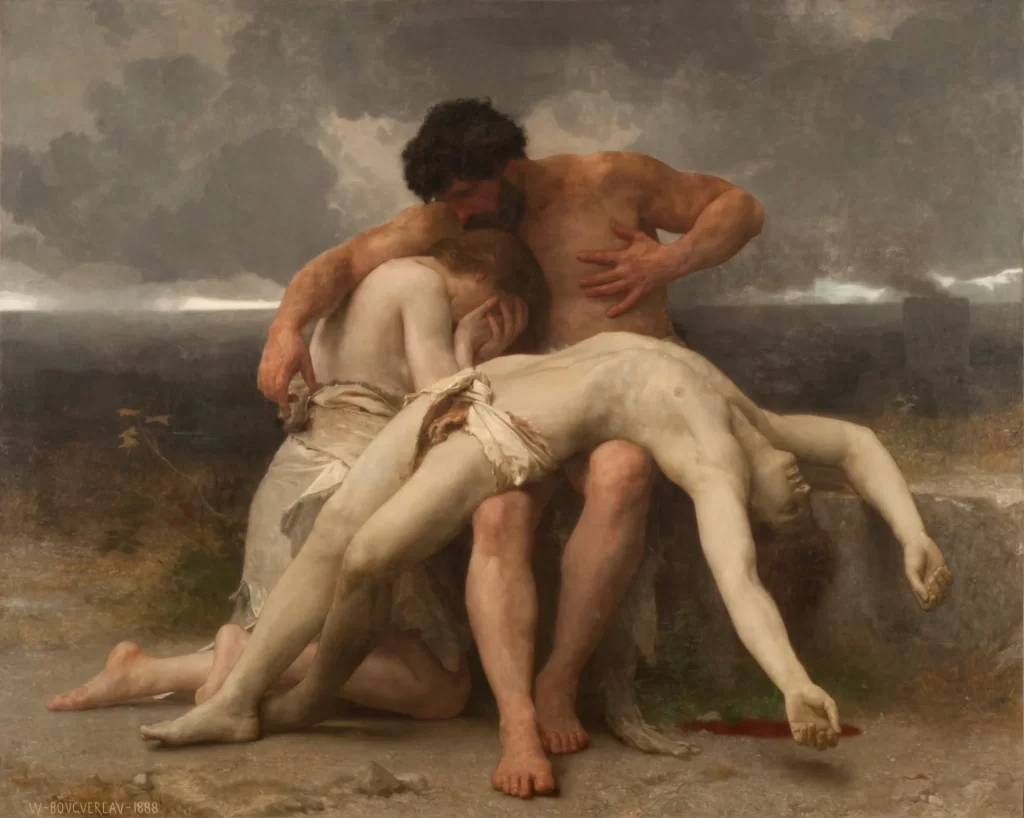
Shet, שֵׁת, is explained by the verb beside it: shat li Elohim zeraʿ aḥer, שָׁת־לִי אֱלֹהִים זֶרַע אַחֵר, “God hath appointed me another seed.” He comes taḥat Hevel, תַּחַת הֶבֶל, “instead of Abel,” and taḥat is the word for the ram that Abraham offers “in the stead of his son.” The ram arrives before the knife falls and a death is prevented. Seth arrives afterwards. He replaces Abel and does not ransom him. Abel had brought a substitute himself, the firstling that stands in for the man who offers it, and then died in a field where no lamb was offered for him.22
Eve’s two birth speeches use two names. Over Cain she says the four-letter name, YHWH, יְהוָה, printed “the LORD,” and she is the first person in the Bible to speak it. Over Seth, after the murder, she says Elohim, אֱלֹהִים, “God.” The rabbis read the four-letter name as mercy and Elohim as judgment. On that reading the mother who claimed a man from the LORD of mercy has learned the other name. The chapter then dates the first name to her grandson’s time: “then began men to call upon the name of the LORD.”22
Luke runs the ancestry of Jesus back through this child: “which was the son of Seth, which was the son of Adam, which was the son of God.” The title given to the first man goes down a line that exists because a murder made room for it. Cain is not in it, and Abel left no one. Genesis says the same in the words of the creation. Adam “begat a son in his own likeness, after his image; and called his name Seth.”22
The Nearest City
Israel’s law later made a rule for a body found in a field with no one to answer for it.
If one be found slain in the land which the LORD thy God giveth thee to possess it, lying in the field, and it be not known who hath slain him: Then thy elders and thy judges shall come forth, and they shall measure unto the cities which are round about him that is slain: And it shall be, that the city which is next unto the slain man, even the elders of that city shall take an heifer, which hath not been wrought with, and which hath not drawn in the yoke; And the elders of that city shall bring down the heifer unto a rough valley, which is neither eared nor sown, and shall strike off the heifer’s neck there in the valley.
And all the elders of that city, that are next unto the slain man, shall wash their hands over the heifer that is beheaded in the valley: And they shall answer and say, Our hands have not shed this blood, neither have our eyes seen it.
— Deuteronomy 21:1–4, 6–7, King James Version.23
The nearest city answers for the dead man. “Eared” is old English for ploughed. The elders take an animal that has never drawn a plough to ground that no farmer has touched, and there they wash their hands and say what Cain could not.
Matthew shows the rite once, in a city, performed by its governor over a man who is still alive. Pilate’s wife has sent word to him about “that just man,” tō dikaiō ekeinō, τῷ δικαίῳ ἐκείνῳ, and the word is the one Jesus had used of “righteous Abel,” Habel tou dikaiou, Ἅβελ τοῦ δικαίου. Then Pilate “took water, and washed his hands before the multitude, saying, I am innocent of the blood of this just person.” The elders washed for a killing no one had seen. Pilate washes in front of a crowd, before the killing is done.23
Sources and Translation Notes
1. Genesis 4, King James Version, Wikisource. Hebrew from Mechon Mamre. Greek of the Septuagint from Greek Wikisource. Verse 18, the four generations between Enoch and Lamech, is not quoted. ↩
2. Genesis 2:15–16, 3:17–19 and 3:23, King James Version; Hebrew from Mechon Mamre: וַיְשַׁלְּחֵהוּ יְהוָה אֱלֹהִים מִגַּן־עֵדֶן לַעֲבֹד אֶת־הָאֲדָמָה (3:23); וַיְהִי־הֶבֶל רֹעֵה צֹאן וְקַיִן הָיָה עֹבֵד אֲדָמָה (4:2). ↩
3. Brown–Driver–Briggs, קָנָה, “get, acquire.” Septuagint, Genesis 4:1: ἐκτησάμην ἄνθρωπον διὰ τοῦ Θεοῦ. Josephus, Jewish Antiquities 1.52. Targum Pseudo-Jonathan on Genesis 4:1, translated by J. W. Etheridge, The Targums of Onkelos and Jonathan ben Uzziel on the Pentateuch (London, 1862), Sefaria. 1 John 3:12 and Luke 1:35, King James Version; Genesis 3:15. ↩
4. Brown–Driver–Briggs, הֶבֶל, “vapour, breath,” and in a figure “vanity.” Josephus heard a different word in the name and says it “signifies sorrow.” Luke 3:38, King James Version. ↩
5. Brown–Driver–Briggs, שָׁעָה, “gaze (steadily, with interest, etc.).” Hebrews 11:4, King James Version. Grain offerings: Leviticus 2. ↩
6. Josephus, Jewish Antiquities 1.52–62, translated by William Whiston (London, 1737), Lexundria. ↩
7. Dumuzid and Enkimdu, Electronic Text Corpus of Sumerian Literature 4.08.33, a modern translation, retold here. ↩
8. Hebrew of Genesis 4:7: לַפֶּתַח חַטָּאת רֹבֵץ וְאֵלֶיךָ תְּשׁוּקָתוֹ וְאַתָּה תִּמְשָׁל־בּוֹ; of 3:16: וְאֶל־אִישֵׁךְ תְּשׁוּקָתֵךְ וְהוּא יִמְשָׁל־בָּךְ. Brown–Driver–Briggs: רָבַץ, “stretch oneself out, lie down, lie stretched out”; תְּשׁוּקָה, “longing,” used “of woman for man” at Genesis 3:16 and “of beast to devour” here. ↩
9. C. G. Jung, Aion (1951), Collected Works 9, part 2, paragraph 14, retold. Gustave Doré’s plate is from La Sainte Bible (Tours, 1866). ↩
10. Genesis 21:9–21 and 27:1–40; 1 Samuel 16:6–13; Deuteronomy 21:17 and Luke 15:25–32, King James Version. ↩
11. Hebrew of Genesis 4:8: וַיֹּאמֶר קַיִן אֶל־הֶבֶל אָחִיו וַיְהִי בִּהְיוֹתָם בַּשָּׂדֶה. Septuagint: καὶ εἶπε Κάϊν πρὸς Ἄβελ τὸν ἀδελφὸν αὐτοῦ· διέλθωμεν εἰς τὸ πεδίον. Targum Pseudo-Jonathan on Genesis 4:8, Etheridge, Sefaria. ↩
12. Ecclesiastes 1:2, King James Version; Hebrew from Mechon Mamre. Luke 23:46, King James Version; Greek from the SBL Greek New Testament, Bible Gateway: τοῦτο δὲ εἰπὼν ἐξέπνευσεν. ↩
13. Plutarch, Isis and Osiris 13 and 18–19, translated by F. C. Babbitt (Loeb Classical Library, 1936), LacusCurtius, retold; three words are quoted. ↩
14. Hebrew of Genesis 2:15 from Mechon Mamre: וַיַּנִּחֵהוּ בְגַן־עֵדֶן לְעָבְדָהּ וּלְשָׁמְרָהּ. Brown–Driver–Briggs, עָבַד and שָׁמַר. ↩
15. Mishnah Sanhedrin 4:5, Sefaria. Job 16:18, King James Version. Septuagint, Genesis 4:12: στένων καὶ τρέμων ἔσῃ ἐπὶ τῆς γῆς. ↩
16. Matthew 23:35, Hebrews 11:4, Hebrews 12:24 and John 10:11, King James Version. ↩
17. Brown–Driver–Briggs, אוֹת, “sign, pledge, token,” citing Genesis 4:15 and the “blood of passover” at Exodus 12:13. Hebrew of Exodus 12:13: וְהָיָה הַדָּם לָכֶם לְאֹת. ↩
18. Brown–Driver–Briggs: קַיִן, “spear,” found once, at 2 Samuel 21:16, וּמִשְׁקַל קֵינוֹ; קַיִן as the name of a people, the “tribe of Mose’s father-in-law.” Numbers 24:21–22, Hebrew כִּי אִם־יִהְיֶה לְבָעֵר קָיִן; Judges 1:16 and 4:11; 1 Samuel 13:19, King James Version. The woodcut of Tubal-cain is from Hartmann Schedel’s Liber Chronicarum (Nuremberg, 1493). ↩
19. Brown–Driver–Briggs, נוֹד, the “region into which Cain wandered,” and נוּד, “move to and fro, wander.” Luke 12:15, King James Version. ↩
20. Livy, History of Rome 1.6–7, translated by Canon Roberts (London, 1912), Wikisource; Latin from The Latin Library. 1 Kings 16:34, King James Version. ↩
21. Septuagint, Genesis 4:24: ὅτι ἑπτάκις ἐκδεδίκηται ἐκ Κάϊν, ἐκ δὲ Λάμεχ ἑβδομηκοντάκις ἑπτά. Matthew 18:21–22, King James Version; Greek from the SBL Greek New Testament, Bible Gateway: ἕως ἑβδομηκοντάκις ἑπτά. ↩
22. Hebrew of Genesis 4:25: כִּי שָׁת־לִי אֱלֹהִים זֶרַע אַחֵר תַּחַת הֶבֶל; of 22:13: וַיַּעֲלֵהוּ לְעֹלָה תַּחַת בְּנוֹ. Brown–Driver–Briggs, שִׁית, “put, set,” and שֵׁת. Genesis Rabbah 33:3 on the two names. Luke 3:38 and Genesis 5:3, King James Version. ↩
23. Deuteronomy 21:1–9 and Matthew 27:19–24, King James Version. Greek from the SBL Greek New Testament: Matthew 27:19 and Matthew 23:35, ἀπὸ τοῦ αἵματος Ἅβελ τοῦ δικαίου. ↩