The man who preserved a world he could not make innocent
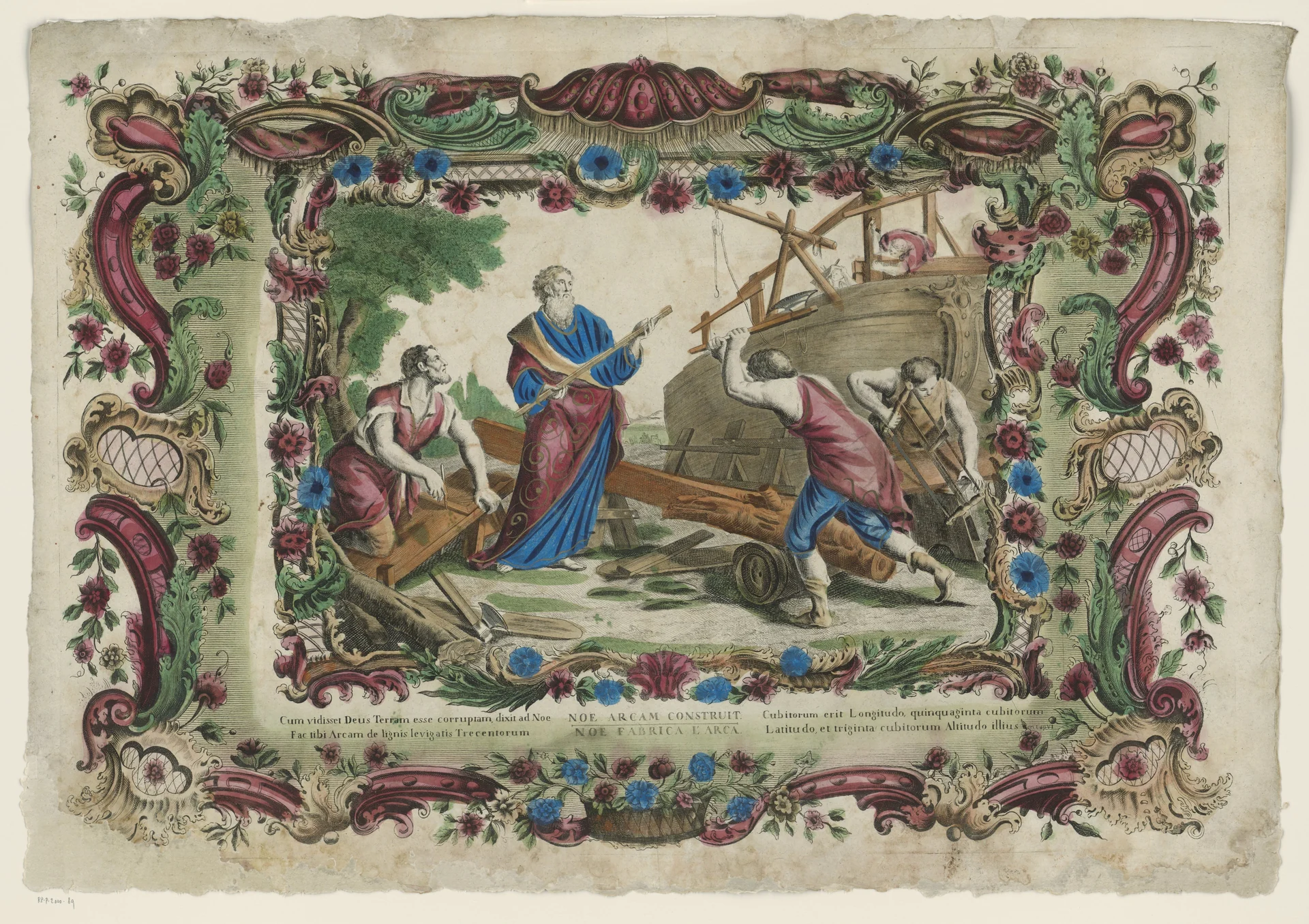
Opening illustration: The Building of Noah’s Ark, engraving, possibly by Giovanni Volpato, eighteenth century. Rijksmuseum, Amsterdam, RP-P-2000-89. Public domain.
Noah is the first child in Genesis whose name is explained by a wish.
And Lamech lived an hundred eighty and two years, and begat a son: And he called his name Noah, saying, This same shall comfort us concerning our work and toil of our hands, because of the ground which the LORD hath cursed.
— Genesis 5:28–29, King James Version.1
A Child Named Rest
The father does not ask for a conqueror. He asks for someone to lighten the work of living on cursed ground.
The name Noaḥ, נֹחַ, belongs with the verb nuaḥ, נוּחַ, “to rest.” Lamech explains it by a different verb that sounds like it: zeh yenaḥamenu, זֶה יְנַחֲמֵנוּ, “this one shall comfort us.” The Greek Bible keeps the name’s own sense and has him say houtos dianapausei hēmas, οὗτος διαναπαύσει ἡμᾶς, “this one shall give us rest.” Jesus makes the same offer with the same verb: “Come unto me, all ye that labour and are heavy laden, and I will give you rest,” kagō anapausō hymas, κἀγὼ ἀναπαύσω ὑμᾶς. Lamech’s hope for his son is the promise the Gospel puts in the mouth of the Son.1
Lamech’s verb comes back in the next chapter with a different subject:
And GOD saw that the wickedness of man was great in the earth, and that every imagination of the thoughts of his heart was only evil continually. And it repented the LORD that he had made man on the earth, and it grieved him at his heart. And the LORD said, I will destroy man whom I have created from the face of the earth; both man, and beast, and the creeping thing, and the fowls of the air; for it repenteth me that I have made them. But Noah found grace in the eyes of the LORD.
— Genesis 6:5–8, King James Version.1
“It repented the LORD” is va-yinnaḥem YHWH, וַיִּנָּחֶם יְהוָה, the verb of “shall comfort us.” The father hoped the child would bring relief. The next time the verb appears, God is regretting that he made anyone. The last sentence has a second play on the name. “Noah found grace” is ve-Noaḥ matsa ḥen, וְנֹחַ מָצָא חֵן, and ḥen, “grace,” is Noah’s name written backwards.1
The World of the Giants
The earth also was corrupt before God, and the earth was filled with violence. And God looked upon the earth, and, behold, it was corrupt; for all flesh had corrupted his way upon the earth. And God said unto Noah, The end of all flesh is come before me; for the earth is filled with violence through them; and, behold, I will destroy them with the earth.
— Genesis 6:11–13, King James Version.2
One Hebrew root does the work of two English words. “The earth was corrupt” is va-tishaḥet ha-arets, וַתִּשָּׁחֵת הָאָרֶץ, and “I will destroy them” is mashḥitam, מַשְׁחִיתָם. The ruined world is to be ruined. What fills it is ḥamas, חָמָס, “violence.”2
Just before this, Genesis says who was living in that world: “There were giants in the earth in those days; and also after that.” The Nephilim article follows them. “Also after that” is a strange thing for the book to say before a flood that kills “all flesh,” and the spies sent into Canaan report the same people still there: “we saw the giants, the sons of Anak, which come of the giants.” Genesis sends a flood on a world of giants and tells the reader in advance that the giants outlast it.2
The Book of the Watchers, one of the oldest parts of 1 Enoch, says where they came from. Heavenly beings called Watchers take human wives:
And they became pregnant, and they bare great giants, whose height was three thousand ells: Who consumed all the acquisitions of men. And when men could no longer sustain them, the giants turned against them and devoured mankind. And they began to sin against birds, and beasts, and reptiles, and fish, and to devour one another’s flesh, and drink the blood. Then the earth laid accusation against the lawless ones.
— 1 Enoch 7:2–6, translated by R. H. Charles, 1917.3
The giants eat what men grow, then the men, then each other. In Enoch it is angels who bind the Watchers. Noah is given only a warning, and his part is the reverse of the giants’. They consume the world. He has to make room for it.3
The Preacher
Genesis calls Noah righteous and gives him no sermon. Later writers supplied one. The Second Letter of Peter calls him “a preacher of righteousness,” and Josephus describes what the preaching cost:
But Noah was very uneasy at what they did; and being displeased at their conduct, persuaded them to change their dispositions and their acts for the better: but seeing they did not yield to him, but were slaves to their wicked pleasures, he was afraid they would kill him, together with his wife and children, and those they had married; so he departed out of that land.
— Josephus, Jewish Antiquities 1.74, translated by William Whiston, 1737.4
In Genesis his answer to the warning is a building. A warning spoken once is gone. A hull that rises day after day commits the man who is building it.
The New Testament reads the building as a verdict: Noah “prepared an ark to the saving of his house; by the which he condemned the world.” Jesus uses the story for himself, and the part he takes is the flood’s: “For as in the days that were before the flood they were eating and drinking, marrying and giving in marriage, until the day that Noe entered into the ark, And knew not until the flood came, and took them all away; so shall also the coming of the Son of man be.” Lamech’s son was to bring rest. In this saying the Son of man comes as the water.4
The Chest
Make thee an ark of gopher wood; rooms shalt thou make in the ark, and shalt pitch it within and without with pitch. And this is the fashion which thou shalt make it of: The length of the ark shall be three hundred cubits, the breadth of it fifty cubits, and the height of it thirty cubits. A window shalt thou make to the ark, and in a cubit shalt thou finish it above; and the door of the ark shalt thou set in the side thereof; with lower, second, and third stories shalt thou make it.
— Genesis 6:14–16, King James Version.5
“Ark” is tevah, תֵּבָה, a chest. The Hebrew Bible uses the word of two objects only, this one and the basket in which the infant Moses is set among the reeds. Each is a box with a life in it, put on water that is killing everyone else. Genesis gives it no mast, no sail and no rudder, because it is not going anywhere. It has to keep its occupants until there is a world to come out into.5
“Pitch it … with pitch” is ve-khafarta … ba-kofer, וְכָפַרְתָּ … בַּכֹּפֶר. The verb means “to pitch” in this verse alone. Everywhere else the same three letters, k-p-r, make the verb “to atone,” the root of Yom Kippur, and kofer is elsewhere a ransom, “the price of a life.” A Hebrew reader hears atonement in the caulking of the chest that carries life through the judgment.5
Then the provisions:
And take thou unto thee of all food that is eaten, and thou shalt gather it to thee; and it shall be for food for thee, and for them. Thus did Noah; according to all that God commanded him, so did he.
— Genesis 6:21–22, King James Version.5
Genesis gives no building diary. The wood called “gopher” is unidentified, and the text names no workmen and no length of time. What it does say is that the animals come with a duty attached. Whoever keeps them alive has to feed them.
The First Letter of Peter turns the chest into a pattern. In the days of Noah “the ark was a preparing, wherein few, that is, eight souls were saved by water. The like figure whereunto even baptism doth also now save us.” “The like figure” is antitypon, ἀντίτυπον, “antitype,” and “ark” is kibōtos, κιβωτός, the word the Greek Bible also uses for the Ark of the Covenant. The letter counts the household: oktō psychai, ὀκτὼ ψυχαί, “eight souls.”6
The Household and the Door
The eight are Noah, his wife, Shem, Ham and Japheth, and the sons’ three wives. Genesis names the men and leaves the four women without names or speeches, though the future of the family depends on them. A household that enters the chest is leaving every other person it has known.
And they that went in, went in male and female of all flesh, as God had commanded him: and the LORD shut him in.
— Genesis 7:16, King James Version.7
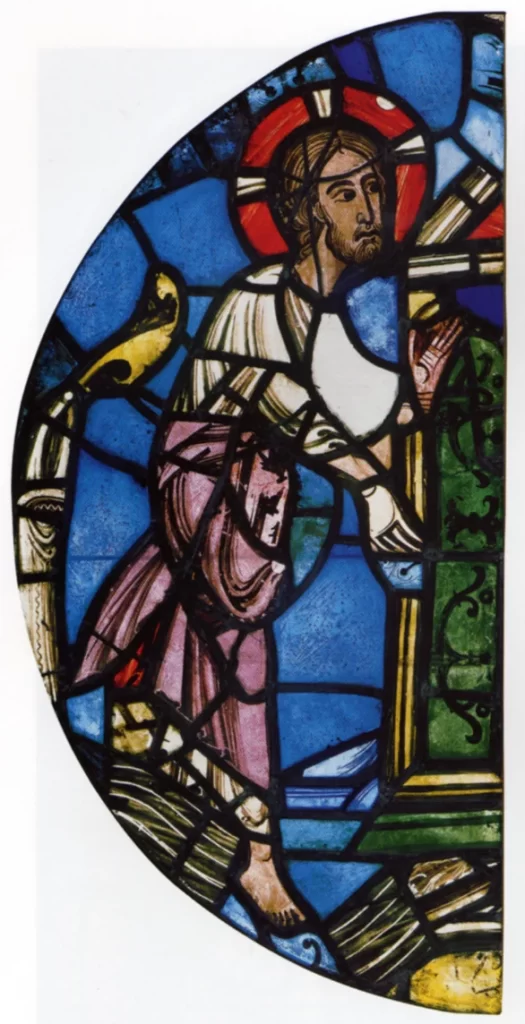
The door protects and confines. What is inside will go on. What is outside is everything the eight have known.
The verse uses two names. Elohim, אֱלֹהִים, “God,” gives the command, and the four-letter name YHWH, יְהוָה, printed “the LORD,” closes the door: va-yisgor YHWH baʿado, וַיִּסְגֹּר יְהוָה בַּעֲדוֹ, “and the LORD shut him in.” The flood story alternates the two from beginning to end. The LORD grieves, and Noah finds grace in his eyes. God orders the ark. The LORD smells the offering. God sets the bow in the cloud. The rabbis read the two names as two attributes, the four-letter name for mercy and Elohim for judgment, and Genesis Rabbah 33:3 argues from this story that either can turn. The name of mercy says “I will destroy.” The name of judgment is the one in “God remembered Noah.” Source critics read the same alternation as two flood accounts woven into one.7
The Qur’an puts one of the family on the wrong side of the door. As the ship moves off, Noah calls to a son who is standing apart:
He said: I shall betake me to some mountain that will save me from the water. (Noah) said: This day there is none that saveth from the commandment of Allah save him on whom He hath had mercy. And the wave came in between them, so he was among the drowned.
— Qur’an 11:43, translated by Marmaduke Pickthall, 1930.8
Noah pleads that the boy is of his household, and is told that he is not. In Genesis all three of Noah’s sons come through the flood, and the trouble with a son comes afterwards. In the Qur’an the father can build the refuge and cannot make his son enter it.8
When Creation Comes Undone
In the six hundredth year of Noah’s life, in the second month, the seventeenth day of the month, the same day were all the fountains of the great deep broken up, and the windows of heaven were opened. And the rain was upon the earth forty days and forty nights.
— Genesis 7:11–12, King James Version.9
The water comes from below and from above. On the second day of creation God divided the waters, and on the third the dry land appeared. Here the divisions fail and the land goes back under the deep.
And all flesh died that moved upon the earth, both of fowl, and of cattle, and of beast, and of every creeping thing that creepeth upon the earth, and every man: All in whose nostrils was the breath of life, of all that was in the dry land, died. And every living substance was destroyed which was upon the face of the ground, both man, and cattle, and the creeping things, and the fowl of the heaven; and they were destroyed from the earth: and Noah only remained alive, and they that were with him in the ark.
— Genesis 7:21–23, King James Version.9
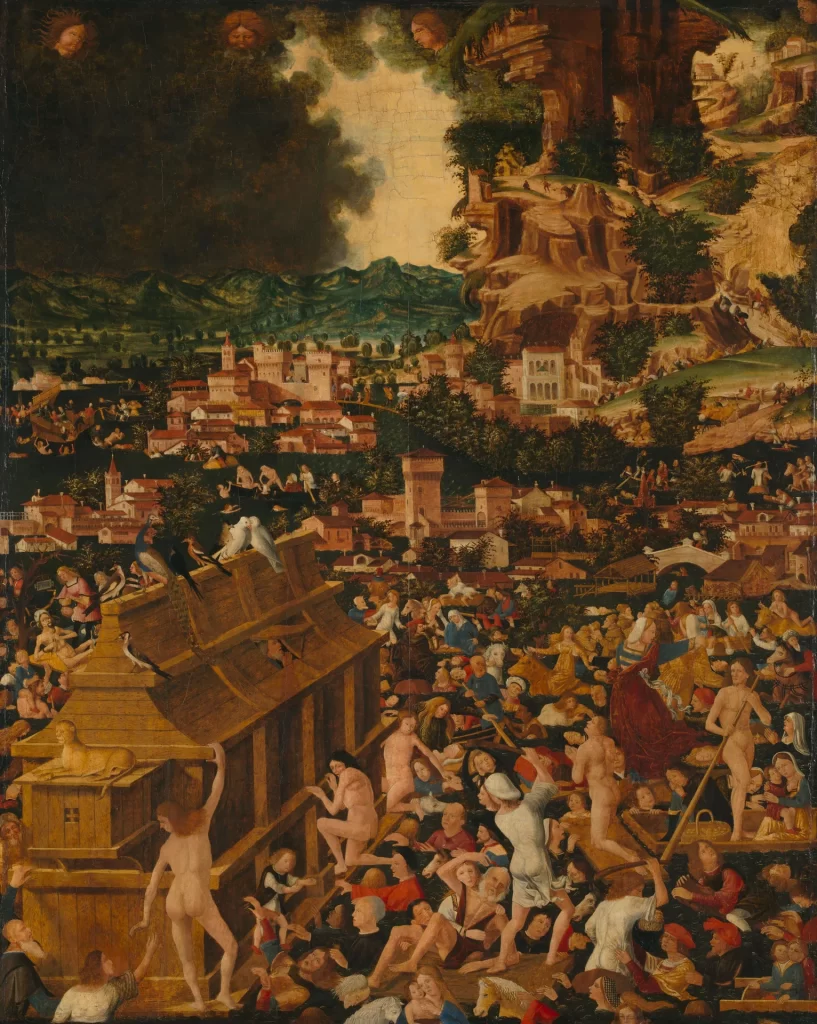
Genesis calls this judgment on a world filled with violence, and it gives no account of any single creature that died. The animals that drowned were of the same kinds as the animals in the ark.
One ancient reader drew the conclusion that the god who did this could not be the true one. The Secret Book of John, a Christian text of the second century, makes the flood the plan of the chief ruler of the lower world. A higher power, the light of foreknowledge, warns Noah, and the saved are hidden in a bright cloud. The book contradicts Genesis in so many words: “It is not as Moses said.” Genesis has one God drown the world and save the family. The Secret Book gives the drowning to one power and the saving to another.10
The Work Inside the Walls
The rain lasts forty days, and the family does not come out when it stops. The waters “prevailed upon the earth an hundred and fifty days,” and the dates Genesis gives, from the seventeenth day of the second month to the twenty-seventh day of the second month a year later, make the stay in the chest a little over a year.9
The rabbis asked what the eight did in that time. In the Talmud, Shem tells Abraham’s servant:
The animals which are usually fed by day we fed by day; and those normally fed by night we fed by night.
— Babylonian Talmud, Sanhedrin 108b, Soncino translation, 1935.11
The giants made others serve their hunger. Noah spends a year serving the hunger of every other creature.
The Return of the Dove
And God remembered Noah, and every living thing, and all the cattle that was with him in the ark: and God made a wind to pass over the earth, and the waters asswaged.
— Genesis 8:1, King James Version.12
“Wind” is ruaḥ, רוּחַ, which is also “breath” and “spirit,” the word for what moved on the face of the waters at the creation. Then the chest comes to ground on the mountains of Ararat, and the verb is Noah’s name: va-tanaḥ ha-tevah, וַתָּנַח הַתֵּבָה, “and the ark rested.”12
Also he sent forth a dove from him, to see if the waters were abated from off the face of the ground; But the dove found no rest for the sole of her foot, and she returned unto him into the ark, for the waters were on the face of the whole earth: then he put forth his hand, and took her, and pulled her in unto him into the ark. And he stayed yet other seven days; and again he sent forth the dove out of the ark; And the dove came in to him in the evening; and, lo, in her mouth was an olive leaf pluckt off: so Noah knew that the waters were abated from off the earth. And he stayed yet other seven days; and sent forth the dove; which returned not again unto him any more.
— Genesis 8:8–12, King James Version.12
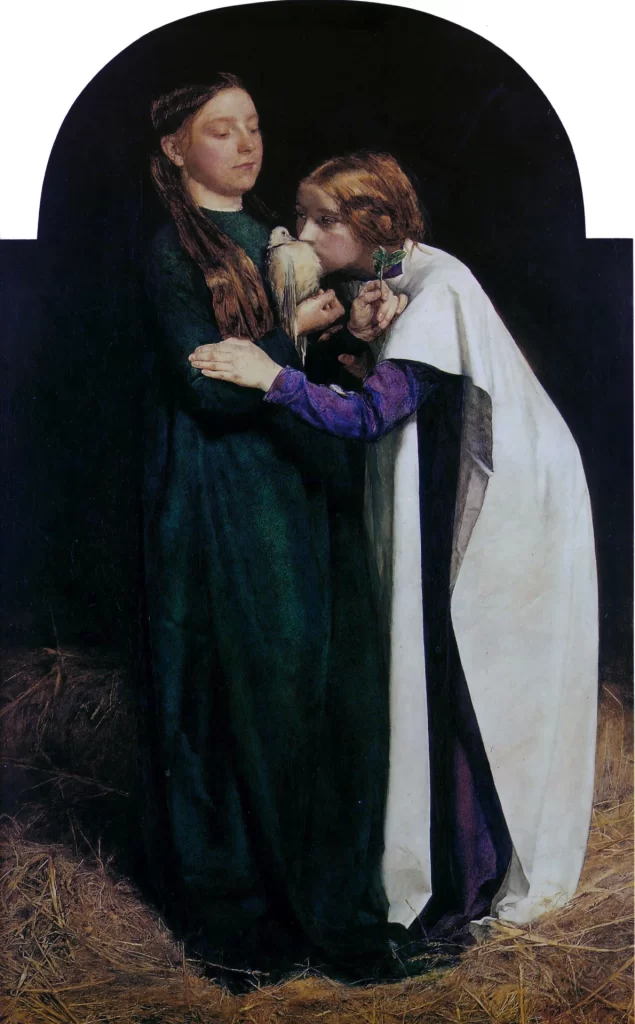
“No rest” is manoaḥ, מָנוֹחַ, from the same root again. The man called Rest puts out his hand for the bird that can find none. The second time she brings a leaf. The third time she does not come back, and her absence means that the shelter is no longer needed.
The dove is yonah, יוֹנָה, the name of the prophet in the Jonah article, who is sent to a violent city that repents and is spared.
Babylon told the scene first. In the eleventh tablet of the Epic of Gilgamesh, Uta-napishtim, the man who lived through the gods’ flood, describes his boat aground on a mountain:
(Then), when the seventh day dawn’d, I put forth a dove, and released (her), (But) to and fro went the dove, and return’d (for) a resting-place was not. (Then) I a swallow put forth and released; to and fro went the swallow, She (too) return’d, (for) a resting-place was not; I put forth a raven, Her, (too,) releasing; the raven went, too, and th’ abating of waters Saw; and she ate as she waded (and) splash’d, (unto me) not returning.
— Epic of Gilgamesh, Tablet XI, 145–154, translated by R. Campbell Thompson, 1928.13
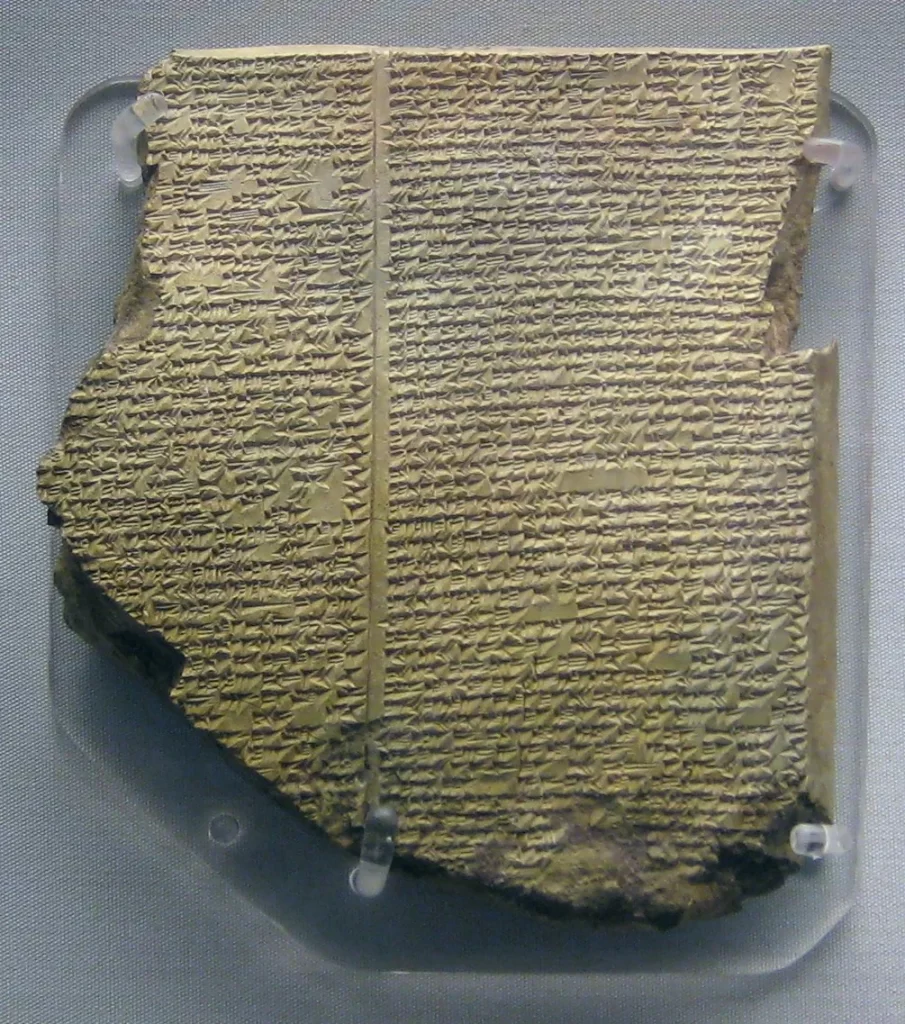
Both boats are aground on a mountain when the birds go out, and in both the dove finds no resting-place. In the Babylonian telling the raven brings the news, by not returning. In Genesis the raven goes out first and tells Noah nothing, and the dove is the one that matters.13
Mark opens the life of Jesus with the same three things: water, the Spirit, and a dove. “And straightway coming up out of the water, he saw the heavens opened, and the Spirit like a dove descending upon him,” to pneuma hōs peristeran katabainon, τὸ πνεῦμα ὡς περιστερὰν καταβαῖνον. Noah’s dove goes out from the saved to look for dry ground. This one comes down from heaven onto a man.14
The Altar and the Unchanged Heart
God tells Noah to leave the chest, and it empties: “Every beast, every creeping thing, and every fowl, and whatsoever creepeth upon the earth, after their kinds, went forth out of the ark.”15
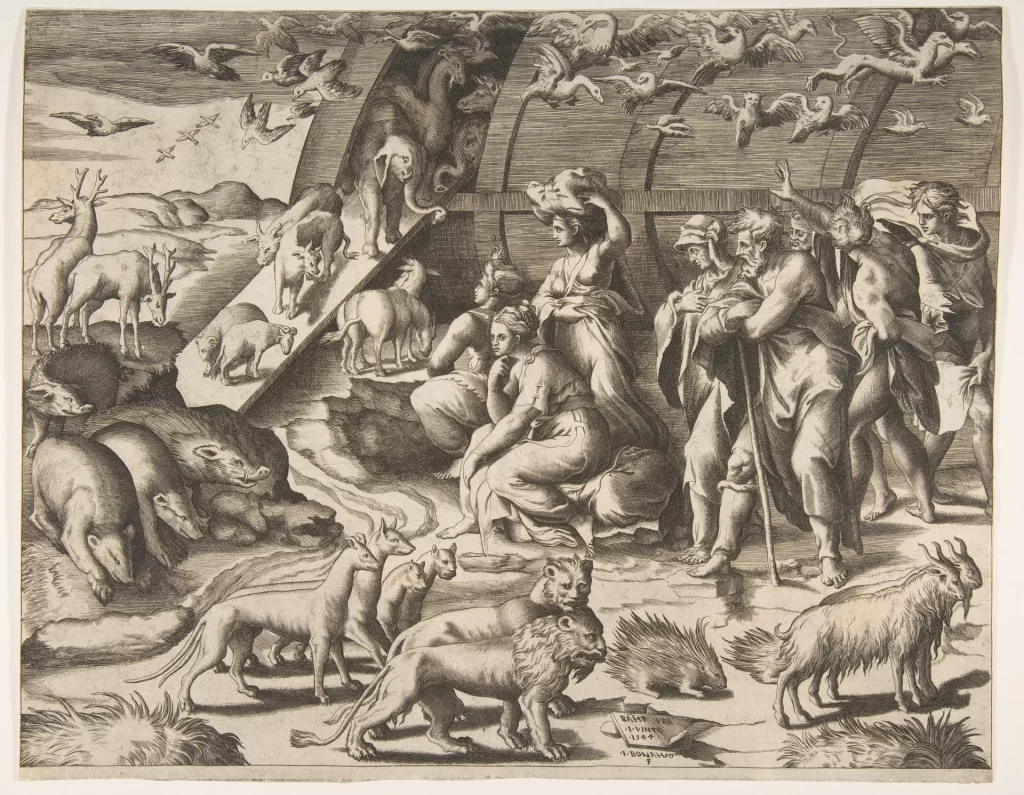
And Noah builded an altar unto the LORD; and took of every clean beast, and of every clean fowl, and offered burnt offerings on the altar. And the LORD smelled a sweet savour; and the LORD said in his heart, I will not again curse the ground any more for man’s sake; for the imagination of man’s heart is evil from his youth; neither will I again smite any more every thing living, as I have done. While the earth remaineth, seedtime and harvest, and cold and heat, and summer and winter, and day and night shall not cease.
— Genesis 8:20–22, King James Version.15
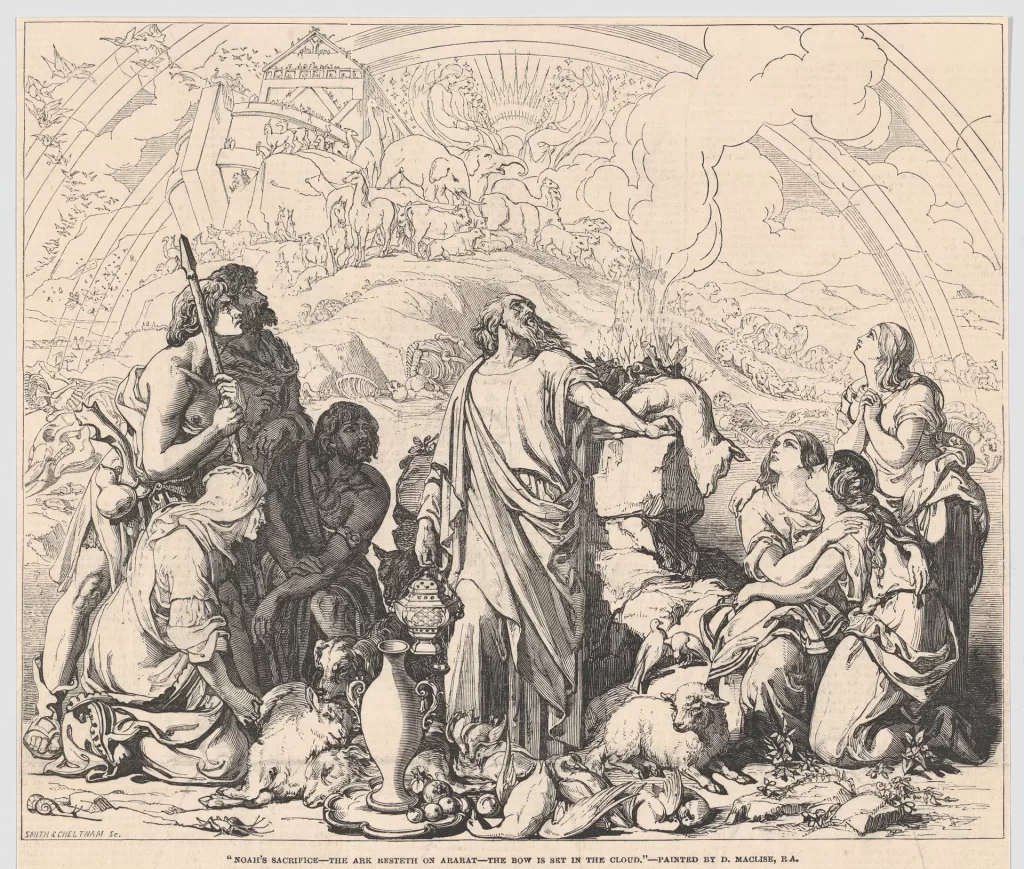
Some of the animals pass from the ark to the altar. “A sweet savour” is reaḥ ha-niḥoaḥ, רֵיחַ הַנִּיחֹחַ, “the savour of rest,” and it is the fourth time the story has sounded Noah’s name: the child called Rest, the chest that rested, the dove with no rest, and now the smell that settles God.15
Uta-napishtim sacrifices too, and his gods are hungrier:
the gods smelt the savour, the gods the sweet savour Smelt; (aye,) the gods did assemble like flies o’er him making the off’ring.
— Epic of Gilgamesh, Tablet XI, 160–161, Thompson.13
The reason God gives for sparing the world is the reason he gave for drowning it. Before the flood “every imagination of the thoughts of his heart was only evil continually,” and the answer was destruction. After it “the imagination of man’s heart is evil from his youth,” and the answer is a promise. The people have not changed, and the decision has. What the earth is given is the calendar: a farmer can plant because another season will come.
The Bow
God blesses Noah and his sons in the words of the first blessing, “Be fruitful, and multiply,” and adds what Eden did not need. Animals will fear men. Men may eat meat, without the blood. Whoever sheds a man’s blood will have his own shed. The new world is given rules because the violence is still in it.16
I do set my bow in the cloud, and it shall be for a token of a covenant between me and the earth. And it shall come to pass, when I bring a cloud over the earth, that the bow shall be seen in the cloud: And I will remember my covenant, which is between me and you and every living creature of all flesh; and the waters shall no more become a flood to destroy all flesh.
— Genesis 9:13–15, King James Version.16
“My bow” is qashti, קַשְׁתִּי, and qeshet is the ordinary word for an archer’s bow. The sign is a weapon hung up. It is put there for God to look at: “I will look upon it, that I may remember.” The parties to the covenant include every animal that came out of the ark, none of which can make a promise in return.16
The Vineyard and the Curse
And Noah began to be an husbandman, and he planted a vineyard: And he drank of the wine, and was drunken; and he was uncovered within his tent. And Ham, the father of Canaan, saw the nakedness of his father, and told his two brethren without. And Shem and Japheth took a garment, and laid it upon both their shoulders, and went backward, and covered the nakedness of their father; and their faces were backward, and they saw not their father’s nakedness. And Noah awoke from his wine, and knew what his younger son had done unto him. And he said, Cursed be Canaan; a servant of servants shall he be unto his brethren. And he said, Blessed be the LORD God of Shem; and Canaan shall be his servant. God shall enlarge Japheth, and he shall dwell in the tents of Shem; and Canaan shall be his servant.
— Genesis 9:20–27, King James Version.17
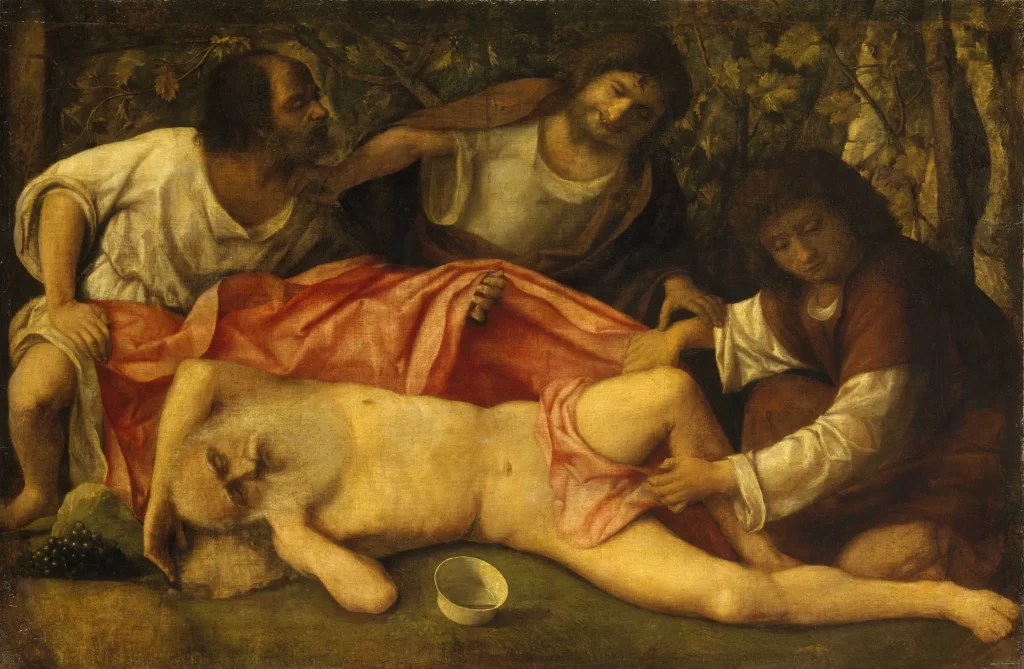
“An husbandman” is ish ha-adamah, אִישׁ הָאֲדָמָה, “a man of the ground.” The ground is adamah, the word in Lamech’s complaint at his birth, and wine is the relief it finally yields. The man who kept a household alive through the flood lies drunk and uncovered in his tent.
Shem and Japheth walk in backwards and cover him. Ham had looked and told. Then Noah speaks. They are the first words Genesis gives him. Through the warning, the building, the year afloat and the sacrifice he has not said a sentence, and his first sentence is arur Kenaʿan, ʿeved ʿavadim, אָרוּר כְּנָעַן עֶבֶד עֲבָדִים, “Cursed be Canaan; a servant of servants.”17
The offender was Ham. The curse falls on Ham’s son, and Genesis has prepared for it by twice calling Ham “the father of Canaan.” Read with suspicion, the story exists for that name. Canaan is the people whose land Israel will take, and here, before any Canaanite has been born, their slavery is pronounced by the father of all mankind. God does not speak the curse. A man waking from a drunken sleep does, and the book lets it stand.17
Augustine read the same scene as a picture of Christ. Noah planted a vineyard and drank its cup, “and he was drunken, that is, He suffered; and was naked, that is, His weakness appeared in His suffering.” Ham, who goes out to tell it, is the mocker, and the brothers who cover their father are those who honour the Passion. The reading turns the story’s most shameful moment into its holiest, and it leaves the curse where it was.18
Unto This Day
And Noah lived after the flood three hundred and fifty years. And all the days of Noah were nine hundred and fifty years: and he died.
— Genesis 9:28–29, King James Version.17
The curse had work to do. When Joshua conquers Canaan, one Canaanite town, Gibeon, escapes the sword by a trick, and he sentences it in Noah’s words: “Now therefore ye are cursed, and there shall none of you be freed from being bondmen, and hewers of wood and drawers of water for the house of my God.” Under Solomon the rest of the old peoples of the land, those “whom the children of Israel also were not able utterly to destroy,” are put to forced labour, “a tribute of bondservice unto this day.”19
Sources and Translation Notes
1. Genesis 5:28–29 and 6:5–8, King James Version, Wikisource. The main narrative follows Genesis 5–9. Hebrew from Mechon Mamre: וַיִּקְרָא אֶת־שְׁמוֹ נֹחַ לֵאמֹר זֶה יְנַחֲמֵנוּ מִמַּעֲשֵׂנוּ (5:29); וַיִּנָּחֶם יְהוָה כִּי־עָשָׂה אֶת־הָאָדָם בָּאָרֶץ (6:6); וְנֹחַ מָצָא חֵן בְּעֵינֵי יְהוָה (6:8). Brown–Driver–Briggs, נוּחַ, “rest,” and נָחַם, “be sorry, console oneself.” Greek of the Septuagint, Genesis 5:29, from Greek Wikisource. Matthew 11:28, King James Version; Greek from the SBL Greek New Testament, Bible Gateway. ↩
2. Genesis 6:4 and 6:11–13, King James Version; Numbers 13:33. Hebrew from Mechon Mamre: וַתִּשָּׁחֵת הָאָרֶץ לִפְנֵי הָאֱלֹהִים וַתִּמָּלֵא הָאָרֶץ חָמָס (6:11); וְהִנְנִי מַשְׁחִיתָם אֶת־הָאָרֶץ (6:13). Brown–Driver–Briggs, שָׁחַת and חָמָס, “violence, wrong.” ↩
3. 1 Enoch 6–10, translated by R. H. Charles, The Book of Enoch (London, 1917), chapter 7, chapter 8 and chapter 10. The quotation keeps Charles’s reading of the giants’ height. ↩
4. 2 Peter 2:5, Hebrews 11:7 and Matthew 24:38–39, King James Version; Greek of Matthew from the SBL Greek New Testament, Bible Gateway: ἕως ἦλθεν ὁ κατακλυσμὸς. Josephus, Jewish Antiquities 1.74, translated by William Whiston (London, 1737), Lexundria. ↩
5. Genesis 6:14–16 and 6:21–22, King James Version; Exodus 2:3. Hebrew from Mechon Mamre: עֲשֵׂה לְךָ תֵּבַת עֲצֵי־גֹפֶר קִנִּים תַּעֲשֶׂה אֶת־הַתֵּבָה וְכָפַרְתָּ אֹתָהּ מִבַּיִת וּמִחוּץ בַּכֹּפֶר (6:14). Brown–Driver–Briggs: תֵּבָה, “ark,” properly a chest or box, probably a loan-word from Egyptian; כָּפַר, where the verb of this verse, “and thou shalt pitch it with pitch,” is entered apart from the verb “cover over (figurative), pacify, make propitiation”; כֹּפֶר, “the price of a life, ransom,” and as a separate word “pitch.” ↩
6. 1 Peter 3:20–21, King James Version; Greek from the SBL Greek New Testament, Bible Gateway: κατασκευαζομένης κιβωτοῦ εἰς ἣν ὀλίγοι, τοῦτ’ ἔστιν ὀκτὼ ψυχαί, διεσώθησαν δι’ ὕδατος. ὃ καὶ ὑμᾶς ἀντίτυπον νῦν σῴζει βάπτισμα. ↩
7. Genesis 7:16, King James Version; Hebrew from Mechon Mamre. The clean and unclean animals are distinguished at 7:2–3. Genesis Rabbah 33:3 on the two names. ↩
8. Qur’an 11:42–46, translated by Marmaduke Pickthall, The Meaning of the Glorious Koran (1930), sacred-texts. The son is not named. ↩
9. Genesis 7:11–12, 7:21–24 and 8:13–14, King James Version; compare Genesis 1:6–10. ↩
10. The Secret Book of John (Apocryphon of John), translated by Frederik Wisse in The Nag Hammadi Library in English, Early Christian Writings. A modern translation, retold here; one sentence is quoted. ↩
11. Babylonian Talmud, Sanhedrin 108b, Soncino translation (London, 1935), halakhah.com. ↩
12. Genesis 8:1–12, King James Version. Hebrew from Mechon Mamre: וַיַּעֲבֵר אֱלֹהִים רוּחַ עַל־הָאָרֶץ (8:1); וַתָּנַח הַתֵּבָה בַּחֹדֶשׁ הַשְּׁבִיעִי (8:4); וְלֹא־מָצְאָה הַיּוֹנָה מָנוֹחַ לְכַף־רַגְלָהּ (8:9). Brown–Driver–Briggs: רוּחַ; מָנוֹחַ, “resting-place”; יוֹנָה, “dove.” ↩
13. The Epic of Gilgamish, Tablet XI, translated by R. Campbell Thompson (London, 1928), sacred-texts. Thompson’s brackets mark words he supplied. He spells the survivor’s name Uta-Napishtim. The raven is sent before the dove at Genesis 8:7. ↩
14. Mark 1:10, King James Version; Greek from the SBL Greek New Testament, Bible Gateway. ↩
15. Genesis 8:19–22, King James Version; Hebrew from Mechon Mamre: וַיָּרַח יְהוָה אֶת־רֵיחַ הַנִּיחֹחַ (8:21). The word is from the root of נוּחַ. ↩
16. Genesis 9:1–17, King James Version; Hebrew from Mechon Mamre: אֶת־קַשְׁתִּי נָתַתִּי בֶּעָנָן (9:13). Brown–Driver–Briggs, קֶשֶׁת, “bow.” ↩
17. Genesis 9:18–29, King James Version; Hebrew from Mechon Mamre: וַיָּחֶל נֹחַ אִישׁ הָאֲדָמָה וַיִּטַּע כָּרֶם (9:20); אָרוּר כְּנָעַן עֶבֶד עֲבָדִים יִהְיֶה לְאֶחָיו (9:25). Ham is “the father of Canaan” at 9:18 and 9:22. The curse names Canaan, a people of the Levant. It says nothing of skin or of Africa. ↩
18. Augustine, City of God 16.2, translated by Marcus Dods (Edinburgh, 1871), New Advent. ↩
19. Joshua 9:22–27 and 1 Kings 9:20–21, King James Version. ↩
Modern point of departure. Jill Eileen Smith’s novel The Ark and the Dove: The Story of Noah’s Wife prompted Joel Alan’s questions about the household, the preparation and the separation from the old world.