Were we created to flourish—or to carry a burden that someone else no longer wished to bear?
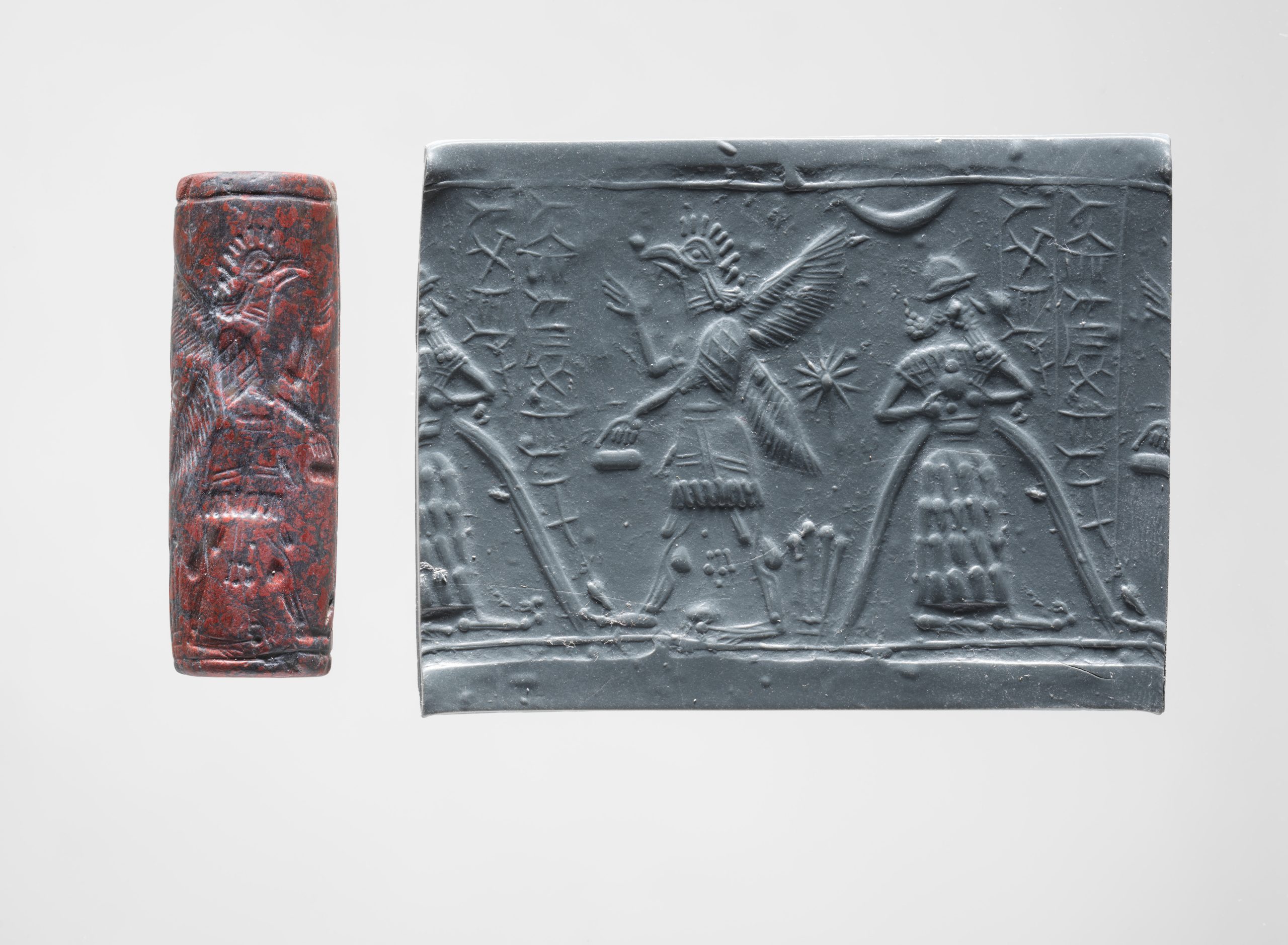
Opening illustration: Cylinder seal and modern impression: a god with the flowing vase, and a griffin demon. Jasper and marble, Middle Assyrian, about the twelfth century BCE. The vase pouring two streams is the water emblem long associated with Enki, called Ea in Akkadian. It is contextual iconography from many centuries after this Sumerian poem, not an illustration of the contest. The Metropolitan Museum of Art, Bequest of W. Gedney Beatty, 1941 (41.160.217). Public domain / CC0.
Before humanity existed, the gods already had a labor problem. Some supervised. Others dug. The complaint that finally reached the creator did not concern human wickedness, because there were no humans yet to blame. It concerned exhaustion.
In the Sumerian composition known as Enki and Ninmah, humanity enters the world as an answer to someone else’s suffering. But the story does not end when the new workers are made. A feast becomes a contest, and the gods begin to dispute whether the body with which a person is born must determine the life that person can lead.1
The first question is why we were created. The second is what happens when we cannot fulfill the purpose assigned to us.
Source note: This poem survives in manuscripts from the Old Babylonian period and later. The longer verse quotations below are Samuel Noah Kramer’s early translation, reproduced in his revised Sumerian Mythology (1961); the connecting narrative also uses later readings. Spaced dots preserve gaps in Kramer’s translation, and his explanatory parentheses remain his own. The damaged ending is not reconstructed into a certainty the surviving text cannot support.12
When the gods carried the burden
The divine world is already inhabited and organized. Its members marry, give birth, and have to provide for themselves. Yet their obligations are unequal: senior gods oversee the work while lesser gods perform the exhausting labor of digging canals and moving silt.
Their creator, Enki, is asleep in the watery depths. The workers complain; he does not wake. It is Namma, the primeval mother and Enki’s own mother, who carries their distress to him.1
Her appeal is practical. She does not ask for a sermon on endurance. She asks for a solution:
O my son, rise from thy bed, from thy . . . work what is wise, Fashion servants of the gods, may they produce their . . ,
Enki and Ninmah, translated by Samuel Noah Kramer.2
Enki rises and considers what must be done. The answer is to fashion a new kind of being. The gods will be relieved because someone else will carry the burden.
Humanity is therefore conceived neither after a rebellion of its own nor as punishment for an ancestral offense. Its work precedes its opportunity to disobey. The task comes before the worker; the place is prepared before anyone exists to occupy it.
Clay, birth, and an assigned fate
Enki instructs Namma to use clay associated with the abzu, 𒍪𒀊, the deep freshwater realm. But this is not a scene in which a solitary male creator makes everything unaided. Namma is to bring the form into existence; Ninmah and the birth goddesses participate in the work.1
Kramer renders part of the instruction:
Mix the heart of the clay that is over the abyss,
Kramer, Sumerian Mythology, p. 70.2
The good and princely fashioners will thicken the clay,
Thou, do thou bring the limbs into existence;
Ninmah (the earth-mother goddess) will work above thee,
. . . (goddesses of birth) will stand by thee at thy fashioning;
O my mother, decree thou its (the new-born’s) fate,
Ninmah will bind upon it the . . . of the gods,
. . . as man . . .

Body and destiny are fashioned together. The creature will have limbs, but also obligations. In the Oxford translation, the command is unmistakable:
Impose on him the work of carrying baskets.
Enki and Ninmah, lines 24–37, ETCSL translation.1
The imagery invites a double reading. Clay is a substance that can receive form; a newborn receives a place among others. Yet a form can also be an imposed shape. The hands that make humanity also decide what humanity is for.
Creation here is a gift of existence with a task already attached.
A feast becomes a contest
The gods celebrate. Enki honors Namma and Ninmah with a feast, and the assembled deities praise his wisdom. Enki and Ninmah drink beer. Their high spirits turn toward rivalry: Ninmah claims authority over the condition and destiny of the humans she fashions, while Enki maintains that he can counter whatever condition she produces.1

The agreement establishes two kinds of creative power. One fashions the body. The other determines how that body can inhabit a world.
Ninmah begins making people with differing bodily conditions. Enki responds to each. A person with impaired hands enters royal service. Another, whose eye condition is uncertain but commonly understood as blindness, receives a musical role. A person with disabled feet is associated, in a damaged passage, with metalworking. Someone unable to control urination receives a different response: Enki uses enchanted water and expels a disease-causing demon.3
These are not all cures, and they are not all jobs. Enki’s answers include both healing and the assignment of a livelihood.
Then Ninmah fashions a woman who cannot bear children:
The . . . she (Ninmah) made into a woman who cannot give birth. Enki upon seeing the woman who cannot give birth, Decreed her fate, destined her to be stationed in the “woman house.”
Kramer, Sumerian Mythology, p. 71.2
The later Oxford translation places her in the queen’s household; a manuscript variant specifies weaving. The distinction matters. Her inability to give birth does not bring the search for a place to an end. Another form of participation remains possible.3
Ninmah next produces a person whom the poem describes through the absence of the expected male and female organs:
The . . . she (Ninmah) made into one who has no male organ, who has no female organ. Enki, upon seeing him who has no male organ, who has no female organ, To stand before the king, decreed as his fate.
Kramer, Sumerian Mythology, p. 71.2
The description does not establish a precise modern medical diagnosis or gender identity. What is clear within the episode is the response: this person, too, is assigned a place rather than simply discarded.
The poem groups different conditions together for its contest. We need not accept that grouping as a judgment that every bodily difference is an illness. We can still recognize the question dramatized by the sequence: how much of a person’s fate belongs to the body, and how much belongs to those who organize the world around it?
The life Ninmah cannot place
Ninmah throws down the clay. The contest changes direction. Enki has answered her creations; now she must answer his.
Kramer translates his challenge:
Of him whom thy hand has fashioned, I have decreed the fate,
Kramer, Sumerian Mythology, p. 71.2
Have given him bread to eat;
Do thou decree the fate of him whom my hand has fashioned,
Do thou give him bread to eat.
Enki brings forth Umul. The account of this creation is damaged, but includes conception and birth rather than an unambiguous repetition of clay modeling. Umul has extensive bodily difficulties and cannot feed or support himself. Some scholars interpret the figure as an incompletely developed or premature infant, but neither that identification nor the meaning of the name is settled.4
Ninmah approaches. She questions Umul and receives no answer. She offers bread, but he cannot reach for it. The ordinary arrangements of independent bodily life do not seem available to him.
Notice what the challenge has become. Enki did not merely demand that she label his creation. He demanded that she provide bread. A declared destiny must somehow become a livable existence.
The closing exchange is fragmentary and unsettling. Ninmah laments a ruined city, a destroyed house, and a captive child. The connection between this lament and the contest cannot be securely recovered. Enki’s reply includes praise of his own generative power and language that may reaffirm hers; another broken line may envisage a role for Umul. We should not turn these fragments into either a definite happy ending or a definite sentence of abandonment.4
What survives clearly is the poem’s final verdict:
Ninmah could not rival the great lord Enki. Father Enki, your praise is sweet!
Enki and Ninmah, lines 140–141, ETCSL translation.1
The contest has a declared winner. Its human consequences are less neatly resolved.
What the names reveal—and what they do not
Enki, 𒀭𒂗𒆠, conventionally read as en, 𒂗, “lord,” and ki, 𒆠, “earth,” is commonly glossed “Lord of the Earth.” Ninmah, more precisely Nin-maḫ, 𒀭𒊩𒌆𒈤, means “Exalted Lady”: nin, 𒊩𒌆, supplies the title “lady,” while maḫ, 𒈤, expresses greatness or exaltation. These conventional readings help orient us; they should not be treated as miniature explanations of everything the gods represent.5
Namma, also written Nammu in older scholarship, must not be confused with Ninmah. In this poem she is Enki’s mother and the initiator of humanity’s creation. Ninmah is a distinct participant and later his opponent.1

The important place-name is the abzu, the freshwater deep associated with Enki and with the clay of creation. In our interpretation, water and earth are not merely a setting: they supply an image of life as something formed out of an existing world, not dropped into it from outside.5
The poem’s repeated concern with decreeing a fate is equally concrete. Fate is not only an unseen future. It becomes an occupation, a household, a relationship of service, a way to obtain bread.
The generous reading: wisdom makes room
Read sympathetically, Enki’s wisdom lies in refusing to treat an unfamiliar body as the end of the inquiry.
The first response need not be to erase every difference. A person who cannot perform one task may still contribute through another. A life unable to follow one expected course may find a different place within a household or community. This is why scholars have read the contest as evidence for thinking about disability through social roles as well as bodily conditions.5
On this reading, creation remains unfinished until there is somewhere for the created being to live.
To fashion a body is one achievement. To sustain a life requires another. Bread has to be available; institutions must admit the person; a community must recognize possibilities that a narrow expectation would overlook.
The woman who cannot bear children offers an especially clear example. The solution is not to insist that only motherhood could justify her existence. The narrative provides another place. Whatever limitations remain in that arrangement, it refuses to end her story with the capacity she lacks.
This does not make the poem a declaration of modern equality. Nor does it establish that everyone with a disability in ancient Mesopotamia received adequate care. A myth can imagine an arrangement without proving its universal practice.
Nevertheless, a humane possibility is present: the inadequacy may lie partly in the arrangement of the world, not simply in the person who struggles within it.
That is an interpretation of what Enki’s responses make visible, not a modern doctrine secretly quoted from a Sumerian tablet.
The suspicious reading: a purpose is not consent
But the same narrative can be read from the other side.
The gods’ suffering is real within the story. Their need for relief is understandable. The question is whether their solution ends the injustice or merely changes who must endure it.
Humanity is made to assume a burden that another group no longer wishes to carry. From the gods’ perspective, this is a successful act of creation. From the workers’ perspective, it is the beginning of an obligation they did not choose.
To possess a purpose is not necessarily to have chosen one.
This is not an argument that work itself is degrading. Work can sustain a household, deepen a skill, and connect a person to others. The suspicious question concerns the terms: who allocates the labor, who receives its benefits, and who has the authority to call the arrangement humanity’s destiny?
The contest sharpens that question. Royal service can mean recognition and provision. It also places a person within a hierarchy. A position near the king is not the same thing as authority over one’s own life.
Enki may be making room for people. He is also deciding where they belong.
The generous and suspicious readings therefore need not cancel each other. An institution can support someone and restrict them at the same time. A role can protect against exclusion while making acceptance conditional on usefulness.
The moral hinge is not simply whether someone receives a function. It is whether their right to be sustained would survive the loss of that function.
Who receives the glory?
There is another imbalance to notice. Namma hears the complaint and initiates the response. Ninmah and the birth goddesses participate in creation. Yet the final acclamation belongs to Enki.
That does not prove that the poem records the overthrow of an earlier matriarchal society. A theory about an entire civilization cannot be extracted from a contest’s winner. It does, however, invite us to ask how a story distributes recognition among those whose work makes its outcome possible.
The final praise tells us what the composition wants celebrated. It does not require us to forget everyone who helped make the achievement possible.
The drinking contest also need not be read as solemn doctrine at every moment. Manuel Ceccarelli’s study emphasizes humorous and satirical aspects of the composition. Rivalry, boasting, and the exposure of a deity’s limits can coexist with an account of human origins.6
But humor does not dissolve the moral problem. For the gods, these lives are the means of proving a point. For the lives brought into being, the consequences are not merely part of a game.
A joke among creators may still be a serious matter for the created.
Other bodies, other beginnings
Genesis offers both a resemblance and a distinction. Adam is formed from the ground and placed in a garden that requires his work. Work itself therefore precedes the disobedience; the later judgment brings painful toil and a resistant earth. The comparison with Enki and Ninmah is not between a Hebrew humanity originally doing nothing and a Sumerian humanity originally laboring. Both narratives connect human beginnings to work, but explain the burden differently. Similar imagery does not, by itself, establish a direct borrowing between these particular passages.7
Hephaestus offers a different comparison. In the Iliad, the divine craftsman recalls his mother’s rejection because of his impaired legs and his rescue by Thetis and Eurynome. The god who was rejected becomes a maker of extraordinary things; he also receives support from golden attendants when he moves. His story joins bodily limitation, dependence, and creative power without requiring bodily conformity as the price of greatness. Read beside Enki’s contest, it unsettles any easy equation between an ideal body and an accomplished life.8
These parallels do not erase the differences between the traditions. They bring the same question into different light: whether a body arrives with its destiny already sealed, or whether relationships can alter what becomes possible.
A place beyond usefulness

Umul leaves the hardest question at the threshold.
It would be comforting to end with the proposition that everyone has a hidden talent and only needs the right occupation. But that would evade the life the poem has made difficult to place. Some people need forms of care that cannot be justified by pointing to a compensating achievement. Dependence is not always a temporary obstacle on the road to productivity.
Here our moral question goes beyond the poem’s explicit conclusion.
Enki wins the contest. We can still ask whether winning a contest over another being’s fate is the highest form of wisdom.
A society may begin by asking what each person can do for it. A more searching question is what it owes to those who cannot do what it expects.
Were we created to live, or merely to be useful?
The basket is one answer. The bread is another. Between them lies the question of whether the world we build will demand that every life earn its place—or learn to make a place for life.
Sources and textual notes
1. Enki and Ninmah, ETCSL 1.1.2, University of Oxford, edited and translated by the Electronic Text Corpus of Sumerian Literature team. Relevant sections: lines 1–37 (divine labor and creation), 44–82 (feast and contest), and 140–141 (final praise). Complete translation. For manuscript history, see Isabel Gomes de Almeida, “Enki and Ninmaḫ,” Database of Religious History, published 4 April 2024, especially p. 1. Open-access survey. The surviving manuscript dates do not establish a precise date of initial composition. ↩
2. Samuel Noah Kramer, Sumerian Mythology: A Study of Spiritual and Literary Achievement in the Third Millennium B.C., first published 1944, revised edition, Philadelphia: University of Pennsylvania Press, 1961, “The Creation of Man,” pp. 68–72, especially pp. 70–71 for all five longer verse excerpts. Digitized chapter. This is an early, incomplete reconstruction, not a substitute for later philological work. The article does not adopt all of Kramer’s accompanying explanations or chronological claims. The creation instruction is a continuous excerpt beginning with “Mix the heart”; it is not presented as the entire speech. Archive attribution and rights notice: “Scanned at sacred-texts.com, October 2004. John Bruno Hare, redactor. This text is in the public domain in the US because it was not renewed in a timely fashion at the US Copyright Office as required by law at the time. These files can be used for any non-commercial purpose, provided this notice of attribution is left intact.” Archive title page and notice. ↩
3. ETCSL 1.1.2, lines 56–78, for the individual cases. Its translation presents six cases and treats the intellectual-impairment passage as a variant of the feet episode. Other reconstructions count seven; Almeida’s survey follows the seven-figure arrangement. This article follows the Oxford narrative arrangement without presenting the count as settled. The eye description and the metalworking passage remain uncertain; weaving belongs to a manuscript variant. The final anatomical description should not be equated confidently with one modern diagnosis or identity. ↩
4. ETCSL 1.1.2, lines 83–139, for Umul, Ninmah’s response, the lament, and the damaged final exchange. Almeida, p. 1, summarizes the premature/undeveloped-infant interpretation. See also Gökhan Kağnıcı, “Insights from Sumerian Mythology: The Myth of Enki and Ninmaḫ and the History of Disability,” Tarih İncelemeleri Dergisi 33/2 (2018), 429–450, especially the discussion of Umul and competing interpretations. DOI: 10.18513/egetid.502714. Article PDF. “Umul” is intentionally left untranslated. ↩
5. Kağnıcı, 2018, especially p. 430, n. 4, for conventional readings of the divine names and Enki’s freshwater associations, and the discussion of bodily difference, livelihood, and social participation throughout the article. The interpretation here is narrower than a claim that ancient Mesopotamian society was generally egalitarian. The analysis of clay, institutional dependence, and conditional usefulness is this article’s philosophical reading, not a quotation from an ancient doctrine of rights. ↩
6. Manuel Ceccarelli, Enki und Ninmaḫ: Eine mythische Erzählung in sumerischer Sprache, Orientalische Religionen in der Antike 16, Tübingen: Mohr Siebeck, 2016. DOI: 10.1628/978-3-16-154692-1. Publisher’s description. For the emphasis on humor and satire, see the publisher’s description of the study. ↩
7. Genesis 2:7, 2:15, and 3:17–19, King James Version. Genesis 2 and Genesis 3. The comparison distinguishes pre-disobedience cultivation from the subsequent curse and intensified hardship. It does not assert that one of these particular texts directly copied the other. ↩
8. Homer, Iliad 18.393–420, translated by A. T. Murray, Iliad, vol. II, Loeb Classical Library, 1925. Book 18. The comparison uses the account told by Hephaestus in this passage, without merging it with other versions of his fall from Olympus. ↩