Genesis 3:15 is usually called the first messianic prophecy, and the reading is old and serious. God turns to the serpent, promises lasting hostility between its offspring and the woman’s, and says that one will be struck on the head and the other on the heel. Christian tradition has read that as the announcement of the entire plan, made in the third chapter, to the defendant’s face.
What gets less attention is that every nation around Israel was already telling a version of this story, and telling it as history rather than prophecy. A god fights a serpent. The serpent is enormous, usually connected with the sea, and frequently has more than one head. The god wins, and by winning he becomes king. That last part is not decoration. In the versions we can read, the kingship is the entire reason the fight was worth writing down.
Set Genesis 3:15 beside them and the shared parts are obvious. So are the missing ones. There is no battle in it, no weapon, no corpse and no coronation, and the verse never says the serpent dies. Everybody else’s version is a report of something finished. This one is a promise.
Two lines of offspring set against each other
And I will put enmity between thee and the woman, and between thy seed and her seed; it shall bruise thy head, and thou shalt bruise his heel. (Genesis 3:15)
The verse is spoken to the serpent, in the middle of the sentencing that follows the eating of the fruit in the garden. It sets two lines of descent against each other and promises they will be at war permanently.
Two things in it carry an enormous amount of weight. The first is the word seed, singular in Hebrew, which can mean one descendant or a whole posterity exactly as offspring does in English. Read it as a collective and the verse describes an endless feud between snakes and people. Read it as one person and the verse is pointing at somebody in particular, and the messianic reading follows from taking the singular seriously.
The second is the pair of blows. Head and heel are not symmetrical injuries and everyone has always noticed it. A strike to the head of a snake ends the argument. A strike to a man’s heel is what a snake does from ground level, and it can kill, but it is a wound taken in passing by someone walking somewhere. One of these two parties has more to lose from the exchange, and the asymmetry is the verse’s whole engine.
The Latin tradition pushed it further. Jerome’s Vulgate made the pronoun feminine, so that she shall crush thy head, which moved the victory from the offspring to the woman and shaped a great deal of later Marian art. Neither the Hebrew nor the Greek supports it. The mistake is interesting mainly for how much got built on top of it.
What the verse does not do is describe an event. It predicts hostility, and the hostility is its subject. Hold that, and go next door, because next door nobody was predicting anything. They were commemorating.
The god who had to be made king first
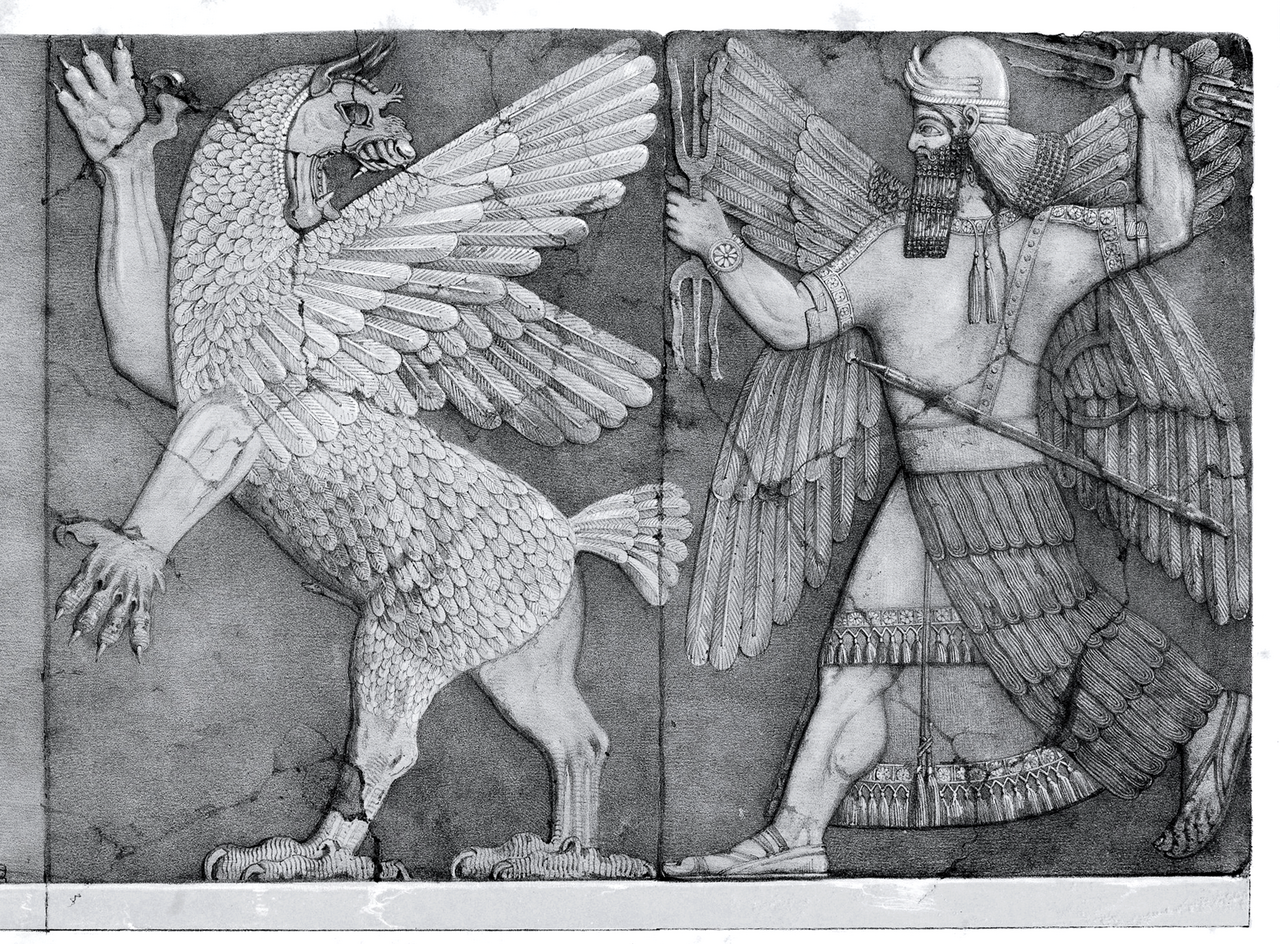
The Babylonian creation poem, the Enuma Elish, is the fullest version of the story anyone wrote down. Tiamat is salt water and the mother of the gods. Her children are born inside her and disturb her consort Apsu, who proposes killing them. Worth noting, because it is usually told the other way round, that Tiamat’s first reaction to that plan is fury against it. She is provoked into the war rather than starting it. Apsu is killed by the god Ea, who then builds his own house on top of the corpse, and only after that does Tiamat raise an army and put a commander named Kingu at its head with the Tablets of Destiny strapped to his chest.
Then the older gods go out against her and come back. In L. W. King’s 1902 translation, which is the public domain edition and the one quoted throughout here, Anshar reports the failure plainly: I sent Anu, but he could not withstand her; Nudimmud was afraid and turned back. The sky god fails, the wisdom god runs away, and a vacancy opens at the top.
Marduk volunteers, and this is the part the article turns on. He does not fight and then get rewarded. He names his price first and refuses to move until it is paid. He demands that the assembly grant him supreme and permanent authority, that his word rather than theirs should fix destinies, and that whatever he decrees should stand unaltered. The gods agree, and then they test the grant before they rely on it. They set a garment in their midst and tell him to destroy it by speaking and to restore it by speaking, and he does both, and only then do they shout that Marduk is king.
The fight comes seventy-five lines later. That gap is the argument of this article in a single measurable quantity. The kingship is conferred at Tablet IV line 28. The killing blow lands at line 103. The throne is occupied before the dragon is touched, and everybody in the poem knows it.
When it happens, it is quick. He drives a wind into her mouth so she cannot close it, and puts an arrow through her belly, and King’s line reads: He split her up like a flat fish into two halves. He makes the sky out of one half and bolts it shut and posts a watchman to make sure the waters stay inside. The world is built from the body.
The poem then explains its own purpose, which saves anyone the trouble of inferring it. The epilogue instructs that the tablets be kept and repeated: let the father repeat them and teach them to his son; let them be in the ears of the pastor and the shepherd. It was recited annually in Babylon at the New Year festival, with the king taking part. A poem in which supreme power is granted in advance, tested, and then justified by a monster, read aloud every year in the capital, in the hearing of the man who held supreme power.
A broken tablet about a different monster called the Labbu puts the whole arrangement into one sentence. The gods need somebody to deal with it, and the offer they make is: who will go and slay the Labbu, and become king?
He slew the Dragon, then disclosed the waters
The Indian version is in the oldest layer of the Rig Veda, and Ralph Griffith’s 1896 translation is public domain. Hymn 1.32 opens by announcing what Indra is for.
I will declare the manly deeds of Indra, the first that he achieved, the Thunder-wielder. He slew the Dragon, then disclosed the waters, and cleft the channels of the mountain torrents. (Rig Veda 1.32.1)
Vritra is the serpent who has the waters shut up inside him. Indra drinks soma in three beakers, takes the thunderbolt that the craftsman god forged for him, and kills. The hymn is oddly specific about the shape of the enemy: Footless and handless still he challenged Indra, who smote him with his bolt between the shoulders. A thing with no feet and no hands, struck on the upper body, which is the same anatomy Genesis assigns the serpent when it sentences it to go upon its belly.
What follows the kill is creation. Then, giving life to Sun and Dawn and Heaven, thou foundest not one foe to stand against thee. The waters come down, the rivers are released, the sun exists. And then the hymn does two things in its last two verses that are worth more than the fight.
Whom sawest thou to avenge the Dragon, Indra, that fear possessed thy heart when thou hadst slain him; That, like a hawk affrighted through the regions, thou crossedst nine-and-ninety flowing rivers? (Rig Veda 1.32.14)
The victor runs. Something in the oldest telling of this story already understood that killing the serpent leaves the killer looking over his shoulder, and later Indian tradition developed exactly that instinct by making Vritra a brahmin, so that Indra incurs the guilt of killing a priest and has to be purified of it. A tradition retrospectively deciding that the monster was a person is the same move this site has traced in the Hebrew material about giants.
And then the final verse, immediately after the fear:
Indra is King of all that moves and moves not, of creatures tame and horned, the Thunder-wielder. Over all living men he rules as Sovran. (Rig Veda 1.32.15)
Kill, then world, then guilt, then crown. The hymn ends on the throne.

The quarrel about whether it happened at all
Greece is where the mechanism becomes visible, because Greek writers could not agree about it and wrote down their disagreement.
Start with Zeus and Typhoeus in Hesiod, which is the full pattern. The Titans are driven out, a hundred-headed serpent rises who would have reigned over gods and men, Zeus destroys him with thunderbolts, and the gods then press Zeus to reign and rule over them. Marduk’s structure in a Greek poem. But notice the ending, because it is not the one people remember. Zeus does not kill Typhoeus. He throws him into Tartarus as a maimed wreck, and from down there the thing keeps producing storms. Imprisoned, not destroyed.
Then Delphi, where the tradition splits four ways on exactly the question this article is asking.
The Homeric Hymn to Apollo has the kill. Apollo lays out his temple foundations and then kills a she-dragon at a nearby spring, and the hymn derives the name Pytho from the rotting of her body in the sun. It should be said plainly, because the claim often gets stretched, that the Hymn does not describe her as a guardian of an oracle and does not say Apollo took anything from anyone. She is a plague on men and sheep, and he removes her.
Aeschylus, opening the Eumenides, tells it with no dragon in it at all. Delphi passes from Earth to Themis to Phoebe to Apollo as an inheritance, a birthday gift, handed over willingly and, in his words, not by force. The kill has been deleted and the transfer made peaceful.
Euripides keeps the kill and adds the crime. Apollo kills the serpent and drives Themis from the oracle, and Earth goes to law about it. Pausanias, centuries later, reports the peaceful succession and then mentions separately that the poets say the dragon was posted there by Earth to guard the place.
Four named authors, one shrine, and a straight contradiction about whether a killing occurred and whether the site was taken from somebody. That is the most useful fact in this article, because it shows the kill being added and removed by writers with reasons. Whether the dragon dies is an editorial decision about legitimacy. So when Genesis declines to kill its serpent, the honest conclusion is not that the Hebrew version is primitive or incomplete. It is that somebody chose.
The one next door
The closest neighbour is Ugarit, on the Syrian coast, whose tablets were dug up in 1929. No public domain translation of them exists, so what follows is paraphrase, and the Ugaritic words are given as transliteration rather than quotation.
The enemy is Yam, and he is not a nameless monster. He is a titled member of the pantheon and El’s own son, and he carries two epithets that always travel together: zbl ym, Prince Sea, and tpt nhr, Judge River. That second word is the cognate of Hebrew shofet, the word behind the book of Judges. The sea has a legal office before it has a body.
The sequence runs in four fixed beats. El elevates Yam and concedes Baal to him as a slave without a fight. The craftsman god Kothar forges two clubs and names them as he forges, Yagrush the Driver and Ayyamur the All-Driver. The first strikes Yam on the shoulder and he does not fall; the second strikes him between the eyes and he does. Only then is the proclamation made that Yam is dead and Baal shall be king. And the kingship is not finished until Baal has a house, which takes two further tablets to build. Combat, death, kingship, temple. The temple is part of the coronation rather than a sequel to it.
Now the piece of evidence that does the most work in this article. One Ugaritic passage describes the defeat of a serpent called Lotan with a string of epithets. Set the transliterated Ugaritic beside the transliterated Hebrew of Isaiah 27:1.
| Ugaritic (KTU 1.5 I) | Hebrew (Isaiah 27:1) |
|---|---|
| ltn, 𐎍𐎚𐎐 | liwyatan, לִוְיָתָן (leviathan) |
| btn brh, 𐎁𐎘𐎐 𐎁𐎗𐎈, the fleeing serpent | nachash bariach, נָחָשׁ בָּרִחַ, the piercing serpent |
| btn qltn, 𐎁𐎘𐎐 𐎓𐎖𐎍𐎚𐎐, the twisting serpent | nachash aqallaton, נָחָשׁ עֲקַלָּתוֹן, the crooked serpent |
| slyt d sbt rasm, 𐎌𐎍𐎊𐎉 𐎄 𐎌𐎁𐎓𐎚 𐎗𐎀𐎌𐎎, the mighty one of seven heads | — |
Be precise about what that is and is not. It is not word for word. Ugaritic btn, 𐎁𐎘𐎐, corresponds to Hebrew peten, פֶּתֶן, rather than to nachash, so one of the four elements is a synonym rather than a cognate. The other three are cognate, and the last of them is the striking one, because aqallaton appears nowhere else in the entire Hebrew Bible. Hebrew kept that word for exactly one job.
The conclusion to draw is not that Isaiah had a tablet from Ugarit on his desk. It is that a fixed Northwest Semitic poetic formula about a fleeing, twisting, many-headed sea serpent was still live in Hebrew several centuries after the city that wrote it down had been destroyed. When Isaiah reaches for the dragon he reaches in his neighbours’ words.
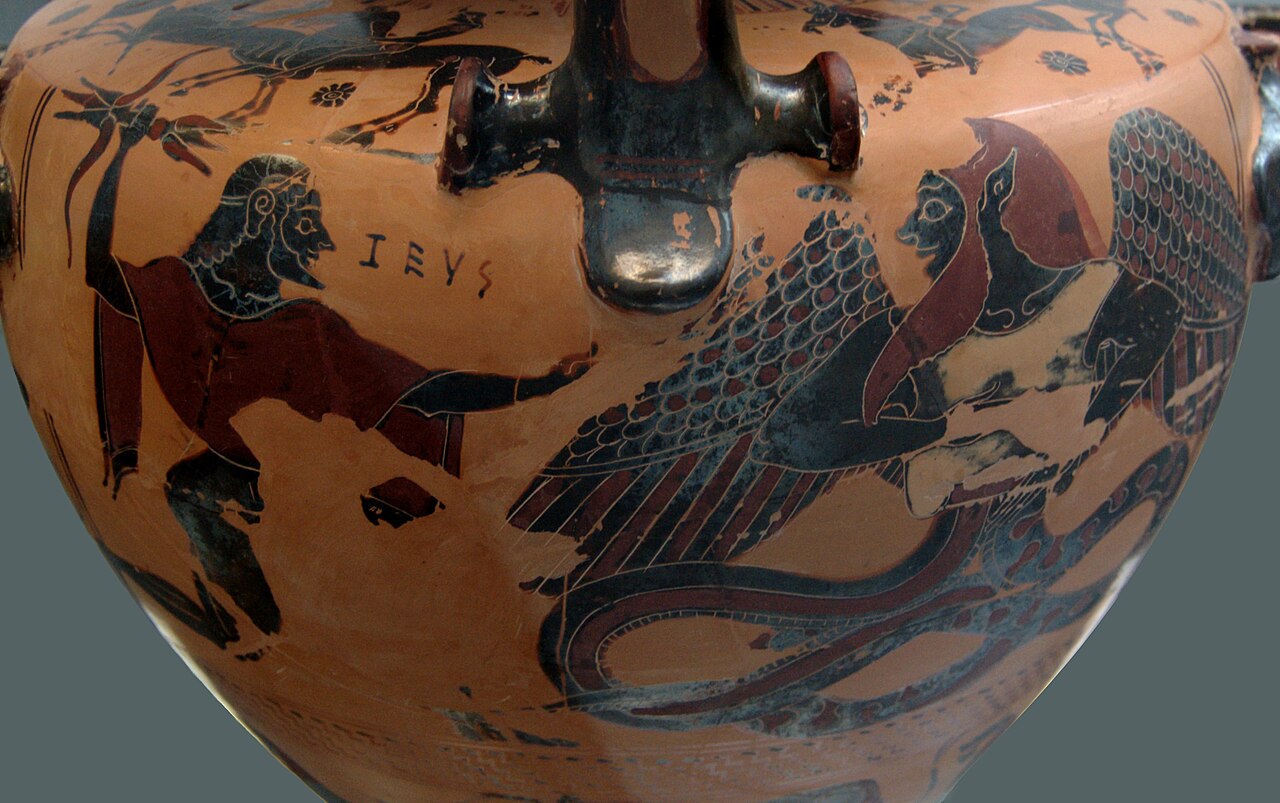
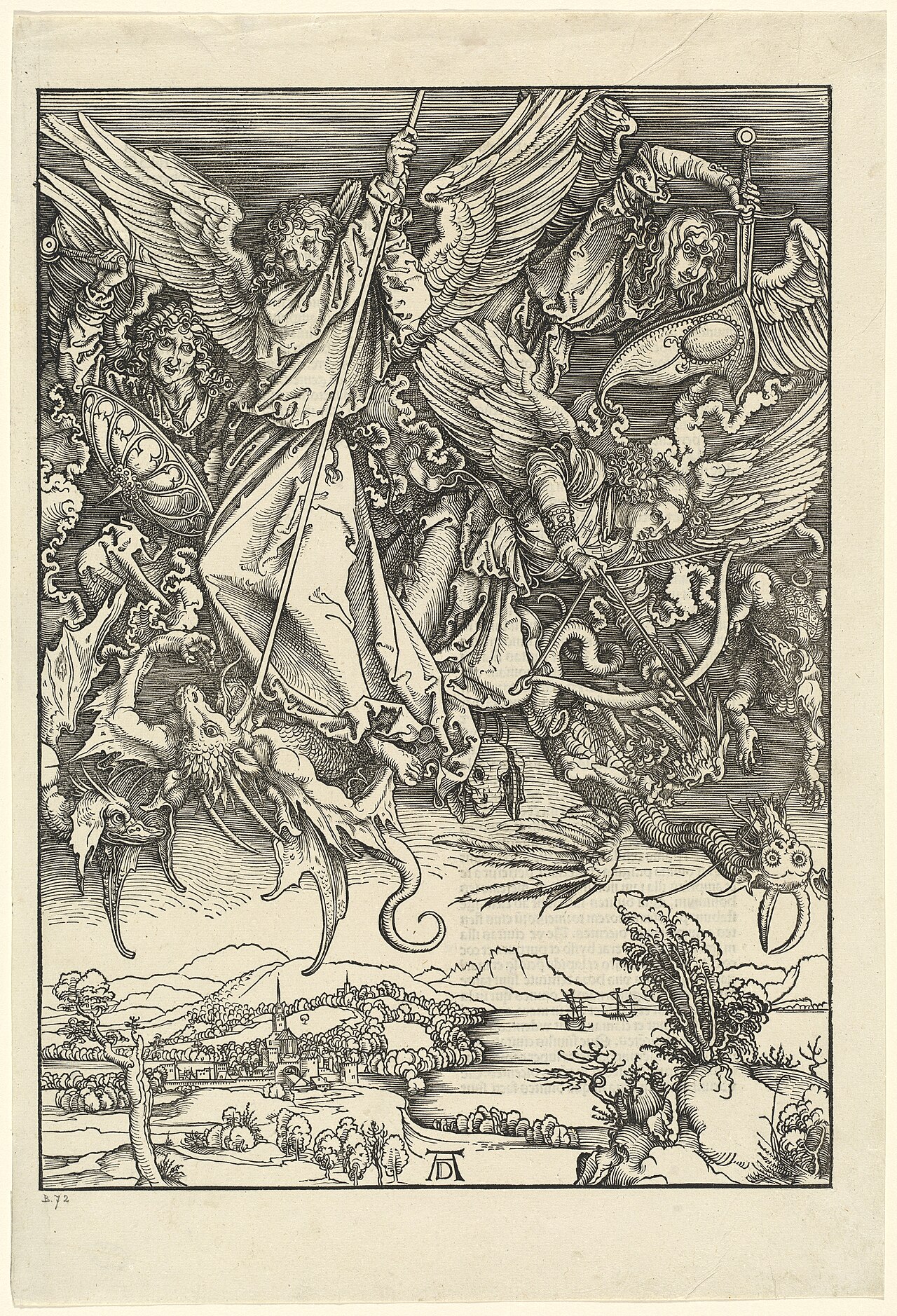
The same composition, two thousand years apart, with every proper name changed. A black-figure vase of about 540 BC showing Zeus with the thunderbolt raised against Typhon, and Albrecht Dürer’s Saint Michael Fighting the Dragon, 1498, illustrating Revelation 12. Weapon up and already descending, serpent below and twisting away. Nobody had to be taught this picture.
Israel kept the dragon, just not in Genesis
If the combat myth were simply a foreign story that Hebrew scripture refused, it would not be in Hebrew scripture. It is there constantly.
For God is my King of old, working salvation in the midst of the earth. Thou didst divide the sea by thy strength: thou brakest the heads of the dragons in the waters. Thou brakest the heads of leviathan in pieces, and gavest him to be meat to the people inhabiting the wilderness. (Psalm 74:12-14)
Read the order. God is named King first. Then the sea is divided, then the heads of the dragons are broken, plural heads on a plural enemy, then the carcass is handed out as food. And the psalm does not stop, because the next three verses are creation: the fountain cleft, the rivers dried, the light and the sun prepared, the borders of the earth set, summer and winter made. Kingship, sea, many-headed serpent, then sun and borders and seasons. That is the Babylonian sequence in a Hebrew psalm, in the same order, with the same parts. Nobody had to reconstruct it.
The same machinery is everywhere once you look. Psalm 89 breaks Rahab in pieces as one that is slain. Job says he divideth the sea with his power and then that his hand hath formed the crooked serpent. Exodus 15 defeats the sea, asks who is like unto thee, O LORD, among the gods, and ends with the LORD shall reign for ever and ever. Psalm 29 completes the four beats in a single line: The LORD sitteth upon the flood; yea, the LORD sitteth King for ever.
Psalm 89 then does something startling with that inheritance. Having broken Rahab, God says of the Davidic king: I will set his hand also in the sea, and his right hand in the rivers. Sea and Rivers, yam and neharot, יָם and נְהָרוֹת, which is Yam and Nahar, the Ugaritic title pair, now placed under the hand of a man in Jerusalem. That is the combat myth being transferred to a human throne, caught in the act. And the psalm’s second half is a complaint that it did not hold, that the crown has been profaned and cast to the ground.
Then Job 41 runs the entire mechanism backwards. It takes Leviathan and spends a chapter establishing that he cannot be beaten. Canst thou draw out leviathan with an hook. Lay thine hand upon him, remember the battle, do no more. Upon earth there is not his like, who is made without fear. And at the end it gives the animal the title that everywhere else belongs to the one who kills him.
He beholdeth all high things: he is a king over all the children of pride. (Job 41:34)
In Ugarit the dragon-slayer becomes king. In Job the dragon is the king and nobody slays him.
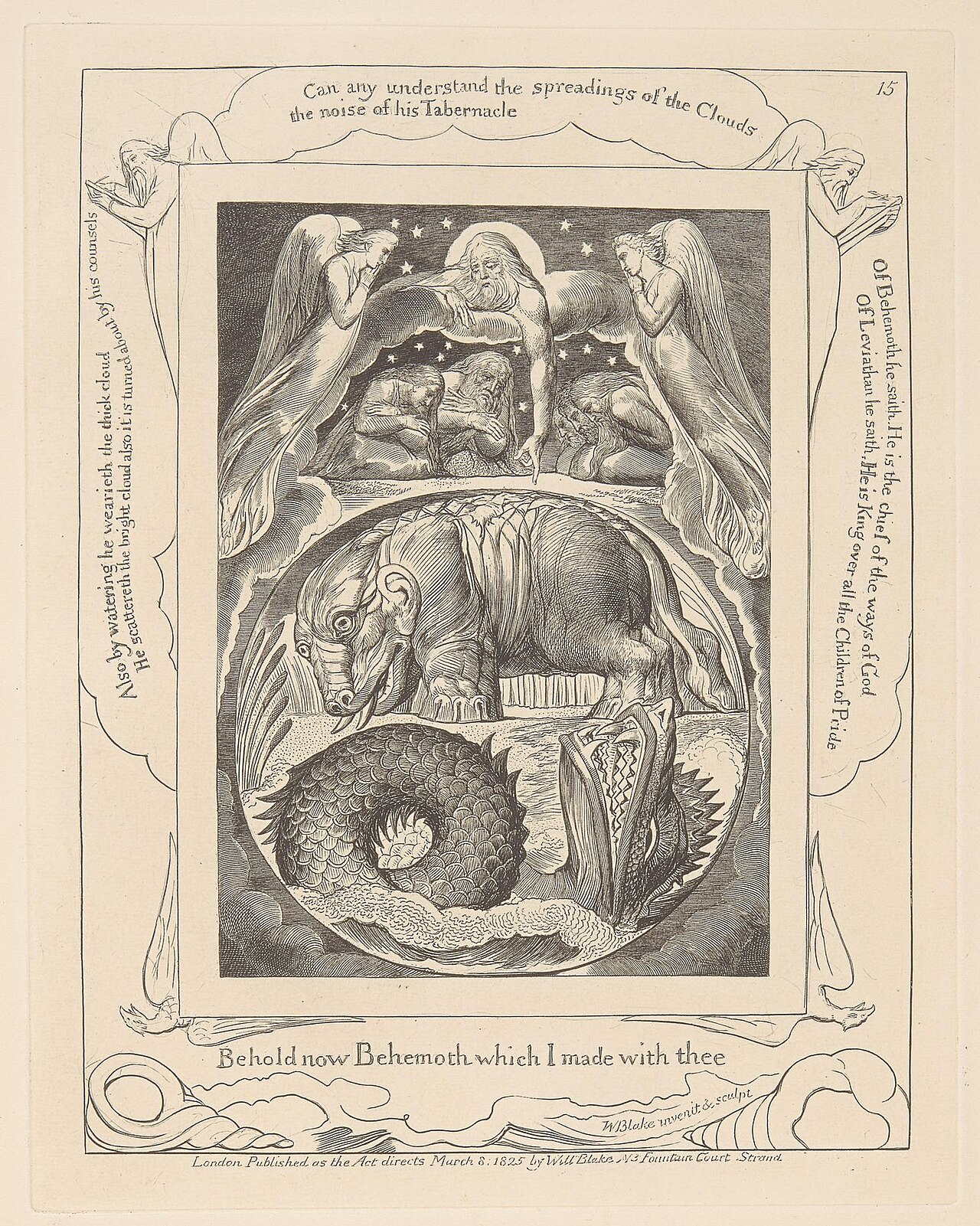
And the Psalms finish the demotion in the other direction. There go the ships: there is that leviathan, whom thou hast made to play therein. Seven heads in Psalm 74, unkillable in Job, and here he is splashing about in a hymn about how pleasant the world is, put in the sea so he can enjoy himself.
Rahab is also the name for Egypt
There is a reason the monster keeps changing size, and Isaiah shows the mechanism working inside one sentence.
Art thou not it that hath cut Rahab, and wounded the dragon? Art thou not it which hath dried the sea, the waters of the great deep; that hath made the depths of the sea a way for the ransomed to pass over? (Isaiah 51:9-10)
The first question is about a monster. The second is about the exodus. There is no transition between them because for Isaiah there is nothing to transition between. Cutting Rahab and drying the sea so the people could walk across are one act described twice. The cosmic enemy and the political enemy have been folded together so completely that the prophet changes subject without noticing.
Once seen, it is everywhere. Rahab is a sea monster in Job and Psalm 89, and Rahab is a name for Egypt in Psalm 87. Ezekiel drops the metaphor and addresses the head of state as the animal directly.
Behold, I am against thee, Pharaoh king of Egypt, the great dragon that lieth in the midst of his rivers, which hath said, My river is mine own, and I have made it for myself. (Ezekiel 29:3)
This site has argued that giants is what you call a people you intend to kill. Dragon works the same way, and here the evidence is easier, because the text performs the substitution in front of us. A prophet who wants Egypt destroyed reaches for the oldest story available and casts Pharaoh as the serpent, and every listener already knows what happens to the serpent. The combat myth is not decoration on the political claim. It is the claim.
Bruised, but not destroyed
Now put Genesis 3:15 back on the table and check it against the parts list.
A serpent, yes. Hostility between the serpent and a champion, yes. A wound to the head, which is where every version of this aims, yes. Then the absences. There is no fight, only a condition announced. There is no weapon, in a genre whose weapons have names, and what the champion is given instead is a heel. There is no world made, because Genesis 1 built one six days earlier by speaking, which is itself a refusal of the only creation method the neighbourhood knew. There is no coronation. And nobody dies. The verse says head and heel, bruise and bruise, using the same verb for both blows, and it does not tell you either wound was fatal.
That last point is where the article stops being about an absence and starts being about a category. Bruised and not destroyed is not a failure to finish the story. It is a recognised ending, and once you start counting it is common. Zeus does not kill Typhoeus, he puts him under the earth where he goes on making weather. The Hydra’s one immortal head is not killed either, it is buried under a rock at Lerna. The book of Enoch has Azazel bound hand and foot and thrown into a hole in the desert until the day of judgement. Isaiah keeps the sword and puts the kill in the future tense, in that day. Revelation chains its dragon in a pit for a thousand years before anything final happens to him. The serpent of Genesis 3 belongs in that company, not among the corpses.
And there is a pattern in the Hebrew Bible that makes the point harder. No dragon is ever killed in a narrative book. Not one. Every dragon-killing in the canon is either a hymn remembering the mythic past or a prophet promising the eschatological future. Psalm 74 and Psalm 89 and Isaiah 51 look backwards. Isaiah 27:1 looks forwards and is the only explicit, unambiguous slaying in the whole collection.
In that day the LORD with his sore and great and strong sword shall punish leviathan the piercing serpent, even leviathan that crooked serpent; and he shall slay the dragon that is in the sea. (Isaiah 27:1)
That is the verse from the table above, the one that speaks Ugaritic. The Canaanite formula and the only promised kill arrive in the same breath and are exiled to the same tense. Whatever else is going on, the tradition will not let the dragon die on any page that claims to be describing something that happened.
Genesis 3:15 stops being an oddity at that point. It is the most visible instance of a rule that holds across the whole library.
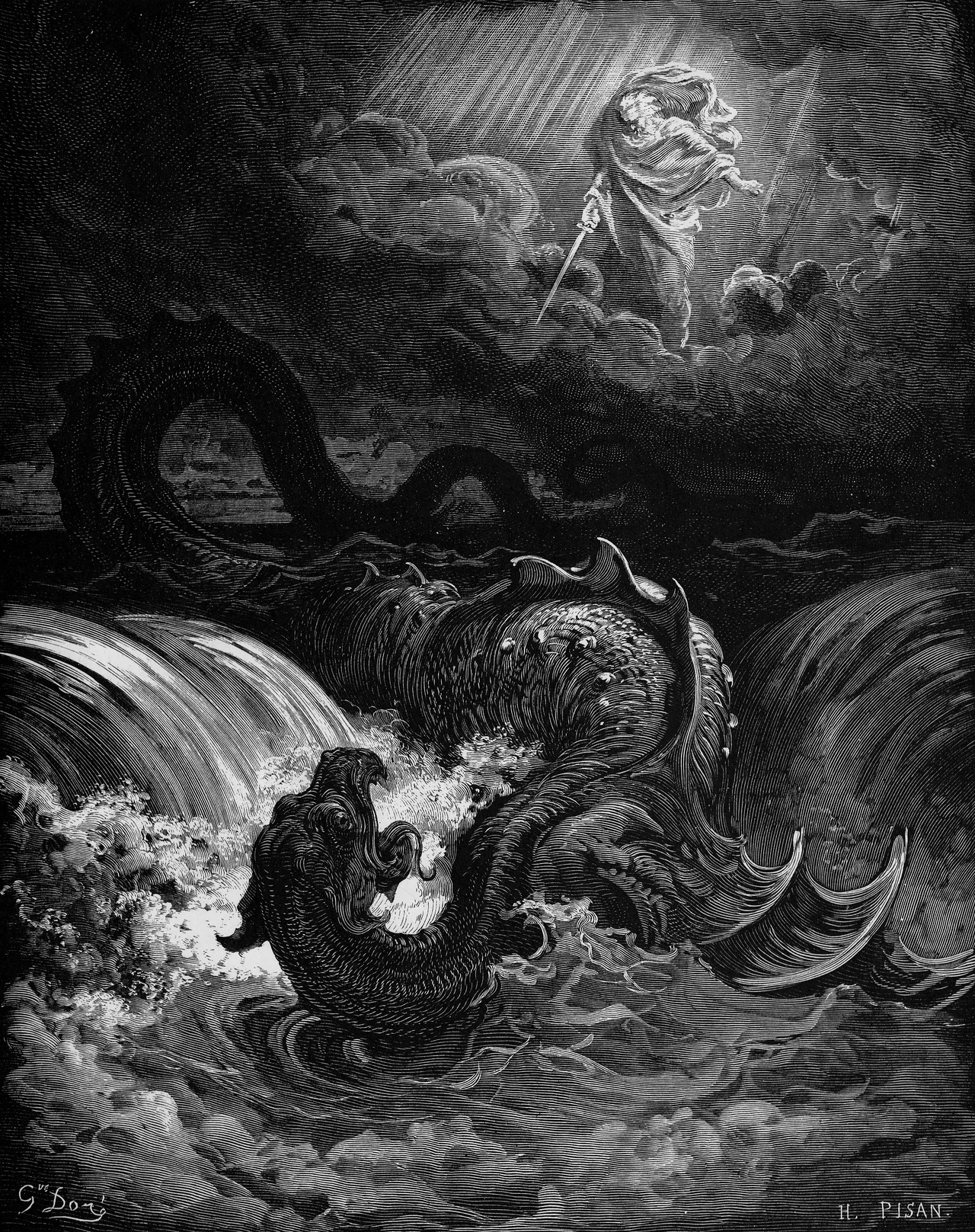
The dragon that is still alive at the end of the book
The two halves of this material stay apart for the whole Hebrew Bible. The talking animal in the garden is one thing and the many-headed monster in the sea is another, and no Hebrew writer joins them. Then at the end of the Christian canon somebody welds them together in a single clause.
And the great dragon was cast out, that old serpent, called the Devil, and Satan, which deceiveth the whole world. (Revelation 12:9)
The dragon there has seven heads, which is Lotan’s number and Psalm 74’s number, and seven crowns on them. Then that old serpent sends the reader back to a garden. In one sentence the sea monster and the beast of the field become the same character, and the crowns are on his head rather than on anybody who beat him.
Revelation is also the only book that finishes the job, and the manner of it is worth noticing. The dragon is seized, chained, shut in a pit, let out, and finally thrown into a lake of fire. No sword, no club, no thunderbolt, no arrow. He is picked up and disposed of by a power that was never at risk, and a sentence is carried out rather than a duel won. Even at the end, where the kill finally lands, the tradition declines to write it as a fight between equals. The sea itself is not defeated either. It is simply gone, in a subordinate clause: and there was no more sea.
Paul, meanwhile, had read Genesis 3:15 and understood that it was unfinished business. And the God of peace shall bruise Satan under your feet shortly. That is the verb from the garden and the foot from the garden, still in the future tense, several thousand years downstream. He is not citing a fulfilled prophecy. He is passing on a debt.
And here is the divergence that makes the Christian version strange rather than merely late. In every other telling the champion wins by striking. In this one the decisive moment is the heel. The claim is not that the serpent was outfought but that the wound to the champion was the mechanism, that he wins by being bitten, and that the bite is what he came for. Hebrews puts it with no dragon vocabulary at all, saying that through death he might destroy him that had the power of death. Marduk needed a net and four winds. This version needs its champion to lose the exchange in order to win the war, which is not a variation on the combat myth. It is an inversion of it.
A promise cannot crown anybody
Every nation in the neighbourhood had a founding kill, and the kill did political work. A Babylonian king could point at a poem recited aloud in his own capital every New Year, in which the god who rules had to be granted supreme power in advance and tested before he would fight, and could say that the arrangement on the tablet is the arrangement in this room. Ugarit had Baal proclaimed king with the body of Prince Sea on the ground and a palace going up. Delphi could name the god who took the shrine, when its writers admitted he took it. In each case somebody living sat in a chair that a dead serpent had paid for.
Israel had the same story, in the same vocabulary, down to a word its poets kept for no other purpose. What Israel would not do was let the kill happen anywhere that counted. It put the victory in hymns about the beginning of the world and in oracles about the end of it, and in the one place where the whole tradition was founded, it wrote a promise instead of a report.
A victory crowns somebody. A promise cannot, because there is nobody yet to crown. So the chair stays empty, and everything afterwards is shaped like the empty chair. That is what a messianic expectation is. It is the hole where the other nations kept their founding kill, and it stayed open so long that people were still waiting to fill it a thousand years later, which is not how this story works anywhere else.
Everybody else’s dragon is dead. Tiamat is the sky. Vritra lies in the water like a felled tree. Python is the rot that gave a town its name. Israel’s is still moving at the end of the book.