Genesis 6:4 ends with a phrase that belongs to Homer more than to Moses. The children born to the sons of God by the daughters of men, it says, became mighty men which were of old, men of renown. That is heroic vocabulary. It is the language a poet uses of Achilles or of Gilgamesh, and it is sitting in the fourth verse of a chapter whose whole purpose is to explain why God drowned the world.
The verse concedes something the rest of the Hebrew Bible works hard to deny. There was a category of being between gods and men, the ancient world knew it perfectly well, and Israel’s own scripture admits the category existed and that its members were famous. Then it drowns them. The place to start is with the material Genesis already shares with everybody else.
The Paleolithic Adam and Eve Story contains the essential elements that mythologies around the ancient world share such as the acts of creation, a primordial garden, a talking snake, the fruitful trees, an act of betrayal or overthrow of God’s reign by people and the final curse to punish and warn them.
Gods worshipped before Abram was called
The Sumerian, Egyptian, Greek, Hindu, Mayan and other conceptions of Gods were most alive in the imaginations of the ancient worlds priests, poets and philosophers from before the time of the Flood until the appearance of Abraham.
Those imaginations were not vague. They were staffed. Every one of those traditions kept a register of beings who were neither fully divine nor simply human, born from a god on one side and a mortal on the other, and the register was ordinary. A Greek could tell you which families in the next city descended from Zeus. A Babylonian scribe could give you the fraction. The demigod did not have to be argued for. It was a standing category of the ancient world, as unremarkable as a king or a priest, and every literate people kept a list.
The most important ancient mythological figures like Gilgamesh, Zeus, Krishna, and Horus lived and were worshipped before the Lord called upon Abram.
The type-scene: the god who fathers a son on a mortal woman. This is the single most widely distributed claim in ancient religion. Uruk says it of Gilgamesh, Thebes says it of Heracles, Mathura says it of Krishna, and Egypt says it of every reigning king. What the four traditions share is the mechanism, a divine father and an earthly mother producing a son whose status is disputed and has to be demonstrated. Where they part company is in the accounting. Mesopotamia gives a fraction, Greece gives a hybrid who dies, India gives a whole god who has crossed down into a body, and Egypt gives a living man on a throne. Genesis 6 knows the mechanism and gives the offspring no accounting at all, only a reputation and a flood.
The arithmetic of Gilgamesh
Gilgamesh is the oldest of them in writing, and the epic states his composition as a measurement. Two thirds of him is god and one third of him is human. His mother is the goddess Ninsun and his father is Lugalbanda, a king of Uruk who was himself entered among the gods after his death. The fractions do not divide. Two thirds cannot come out of one divine parent by any arithmetic a modern reader would accept. The scribes were not being careless. They were treating divinity as a substance that can be present in quantity, more of it in some men than in others, and Gilgamesh has more of it than anybody.
That assumption is the one Genesis 6 is written against. It is also the assumption Genesis 6 borrows, because a verse about the sons of God fathering children on the daughters of men only makes sense to a reader who already believes divinity can be transmitted by descent and diluted by it.
The epic also says what the substance is for. Gilgamesh proposes the march on the Cedar Forest, Enkidu tells him the guardian is terrible and the journey is death, and Gilgamesh answers that if he falls he will at least have established his name, and men will say that Gilgamesh fell fighting Humbaba. He is not going for timber. He is going to be spoken about afterwards. Hold that answer, because Genesis has a word for exactly the thing he wants, and Genesis does not admire it.
The oldest trace of them in Genesis
The earliest reference to the existence and worship of these polytheistic animalistic belief systems is in Genesis 3:22
And the LORD God said, Behold, the man is become as one of us, to know good and evil: and now, lest he put forth his hand, and take also of the tree of life, and eat, and live for ever:
The Authorised Version keeps the plural because the Hebrew has it. God says one of us about a man who has just acquired the knowledge of good and evil, and a sentence like that is spoken to somebody.
Who God was speaking to when he said one of us
Who is the Lord God speaking to immediately after he announces the curses on Adam, Eve and the serpent?
The term “one of us” denotes the spiritual residence of God opposed to man’s earthly home. So God is speaking to spiritual beings, orders of Angels obeying his divine will and performing his commands, like the Cherubims and the flaming sword. His next words are cut off when the Angel ejects Adam and Eve.
God is speaking to the angels or fallen angels, spiritual beings who would influence the descendants Adam and Eve into shaping their spiritual beliefs.
These angels would gradually reveal their forms to the founders of civilizations long before the Lord God finally reconnected to humanity through Abraham.

Genesis 6 and the taking of the daughters of men
Genesis does not leave that as an insinuation. Three chapters later it says it outright, and it says it in four verses.
And it came to pass, when men began to multiply on the face of the earth, and daughters were born unto them, That the sons of God saw the daughters of men that they were fair; and they took them wives of all which they chose. And the LORD said, My spirit shall not always strive with man, for that he also is flesh: yet his days shall be an hundred and twenty years. There were giants in the earth in those days; and also after that, when the sons of God came in unto the daughters of men, and they bare children to them, the same became mighty men which were of old, men of renown.
The narrator never stops to explain who the sons of God are. He does not introduce them, define them or place them. That silence is evidence. You do not define a term your audience already uses, and the audience for Genesis 6 evidently used it.
Notice what starts the sequence. Men began to multiply on the face of the earth. The flood chapter opens with a population count. The Babylonian flood story in Atrahasis opens the same way, with humanity multiplying until the noise of it reaches Enlil, who tries plague, then famine, then water. After that flood the gods install barren women and infant death to hold the numbers down for good. Genesis 6:3 caps the human span at a hundred and twenty years in the same breath as its flood. Two traditions, the same order of events, and in both of them the trouble begins with there being too many people.
Then they took them wives of all which they chose. The verb is the ordinary Hebrew verb for taking a wife, and the qualifier is what does the damage. In the Hebrew Bible a marriage is arranged between households, with a negotiation, a price and a father who can refuse. Nothing here is arranged. The sons of God see, they select and they take, and the phrase all which they chose removes every party except the one doing the choosing. Whatever these beings were, the text’s first complaint about them is not that they were foreign. It is that nobody could say no to them.
And there is a clause in verse four that most readers pass over. The giants were in the earth in those days, and also after that. Before the flood has even been announced, Genesis has conceded that the flood did not finish them. That loophole is going to matter a great deal by the time Israel reaches the edge of Canaan.
Nephilim and the argument about the verb naphal
The Authorised Version says giants because the Greek translators said gigantes, γίγαντες, and Jerome followed them into Latin. The Hebrew word is nephilim, נְפִלִים, and it occurs twice in the whole Hebrew Bible. Once here, and once in the reconnaissance report at Numbers 13. Two occurrences carrying the entire weight of the tradition.
The popular derivation takes it from naphal, נָפַל, the verb to fall, and produces the fallen ones. That reading has been repeated so often that it now looks like a translation rather than a guess, and it fits the angelic interpretation so conveniently that the fit itself should make a careful reader slow down. The grammatical objection is real. The form is the pattern that normally carries an active or adjectival sense, and fallen ones, a thing done to them rather than by them, wants a different shape. If the form is genuinely active, the word does not mean those who fell. It means those who make others fall. The fellers.
The strongest rival comes from Aramaic, where naphila, נפילא, simply means a giant, and is also used of the constellation Orion, the hunter lying across the winter sky. On that account the word arrived in Hebrew already meaning what the Greek translators thought it meant, and the fall has nothing to do with it.
The etymology is not load bearing for what follows. Whatever the word meant when it was coined, we can watch what it does in the texts that survive, and what it does is travel with an army.
Men of renown is heroic vocabulary
The Hebrew behind men of renown is anshe hashem, אַנְשֵׁי הַשֵּׁם, men of the name. Shem, שֵׁם, is the word for a name and for the reputation attached to it, the part of a man that keeps working after he is dead. Gilgamesh wanted one badly enough to walk into the Cedar Forest for it. The Greeks called it kleos, κλέος, the report that is spoken of you, and the Iliad is an economy running entirely on it, with Achilles told plainly that he can have a long life at home or a name that never rots, and not both.
So Genesis reaches for the exact term the neighbouring literatures use for their heroes, applies it to the offspring of the sons of God, and then floods the earth. That is the hinge of the whole passage. Every demigod catalogue in the ancient world is a catalogue of men of the name, and Genesis 6:4 is the verse where the Hebrew scriptures acknowledge that such catalogues describe something real.
Watch what Genesis does with the word afterwards. Five chapters on, the builders on the plain of Shinar say let us make us a name, lest we be scattered abroad upon the face of the whole earth, and the tower comes down and the languages come apart. One chapter after that, God says to Abram that he will make thy name great. Genesis has a settled doctrine about names. Taking one is the offence of the generation that gets drowned and of the city that gets scattered. Receiving one is what happens to the man the story is actually about. The men of renown are on the wrong side of that distinction, and the book has been arguing it since the fruit.
The type-scene: the name that outlives the man. The Greek version is a nation rather than a reputation. Ion, the son Apollo fathered on a mortal woman and the ancestor the Ionians are named after, gets the reward Genesis refuses to hand out. A people carries his name forward and his divine paternity is the charter for their existence. The shared element is the logic that descent from a god is a title deed. The divergence is total in the direction of the claim. Greek genealogy runs upward from the living aristocrat to the god who fathered his line, and the myth exists to justify the family that tells it. Genesis 6 names no offspring at all. Not one Nephil is given a name in the text that calls them men of the name, and no Israelite family is permitted to descend from them.
The Greek plan to end the age of heroes
Hesiod counts the ages of the world and puts a fourth race between the bronze men and the present misery. He calls them the godly race of hero men, the demigods, and he says they were destroyed at Thebes fighting over the flocks of Oedipus and at Troy fighting over Helen. He is describing the same population Genesis 6 describes, from the inside, with approval.
The Hesiodic school also produced an entire poem that does nothing but list them. The Catalogue of Women runs through the mortal women who bore children to gods, each section opening with the formula or like her, and the whole structure of Greek noble genealogy hangs off it. Genesis 6:1 and 6:2 are that poem compressed into two sentences and stripped of every name in it.
Here is the part that is rarely put next to Genesis. The Catalogue ends with Zeus deciding to destroy the demigods and to separate the gods from men so that the mixing stops. The Cypria opens the Trojan cycle by saying that the earth was burdened with the multitude of men and that Zeus planned the great war to lighten her. Greek tradition has the same three movements as Genesis 6 in the same order. Humanity multiplies, gods and women produce a generation of famous offspring, and the divine world then takes a deliberate decision to wipe that generation out. Genesis uses water. Greece uses a ten year war.
The type-scene: the gods end the age they began. Both traditions have the divine world create the hybrid generation and then destroy it, and in both the trigger is stated as overpopulation before it is stated as wickedness. The difference is the feeling. Hesiod grieves for the heroes and settles the survivors on the islands of the blessed at the ends of the earth, where they live untouched with Cronus as their king. Genesis gives its men of renown no islands, no cult, no tombs and no descendants. Greece kept its demigods as ancestors and built its aristocracy on them. Genesis refuses to let anyone in Israel claim descent from them at all. The same event is remembered as a loss by one people and as a cleaning by the other.
The Greek material also keeps a record of what it cost to be one of these sons. Phaethon demands that Helios prove his paternity, gets the proof, and is killed by it. The demand that a claimed son demonstrate his father is a fixed part of the pattern, and it is why so many of these stories end with a body.
Krishna, Horus and the two ways a god fathers a son
There are two distinct things going on under the single English phrase son of a god, and keeping them apart does more work than any amount of parallel hunting.
The first is mixture. Two sources combine and the result is a third thing that is neither. Gilgamesh at two thirds and one third is mixture stated as a sum. The Greek hero is mixture stated as inheritance, which is why he is stronger than other men and still dies like them. Genesis 6 is mixture, because the sons of God come in unto the daughters of men and children are born from the union.
The second is descent. Krishna is the eighth child of Devaki and Vasudeva, and the Indian tradition does not call him half of anything. The word is avatara, a crossing down, the god himself coming into a body without becoming a portion of one. That is a different claim from the Greek claim, and the difference is not decorative. A hybrid inherits power. A descent brings the whole of what it was before.
The type-scene: the newborn a king tries to kill. Kamsa is warned that the eighth child of Devaki will be his death, so he imprisons the parents and destroys the infants as they come, and the child is carried out by night and exchanged for a cowherd’s daughter in Gokula. Pharaoh gives the same order at the Nile and Moses goes into the reeds. Herod gives it at Bethlehem and the family goes into Egypt. The shared structure is exact. A reigning king hears that a child has been born with a claim above his own, he answers with a massacre of infants, and the child survives by being moved and raised by substitute parents. The divergence is in what the threatened king is defending. Kamsa is defending his life against a prophecy that names him. Herod is defending a throne. And the Indian and Hebrew stories part on the nature of the child, because Krishna is the god in person and the gospel infant is presented as a son with a human mother and a genealogy the text insists on printing. Indian tradition is full of kings whose legitimacy has to be proved by a test the gods arrange in disguise, which is the same anxiety arriving from the other direction.
Egypt is the one that runs a state on the claim. Horus is the son of Osiris and Isis, conceived after his father’s death, and the living Pharaoh is Horus while the dead one is Osiris. Egypt also put the mechanics on a wall. In the birth reliefs at Deir el Bahri and at Luxor the god Amun takes the form of the queen’s husband, goes to her, and fathers the child who will reign. The god comes in unto a woman and the offspring rules the country. That is Genesis 6:4 carved in limestone at state expense, with the difference that Egypt is bragging.
Set the two accounts side by side and something useful falls out. Egypt and Genesis describe the same event and disagree only about who benefits from telling it. In Egypt the offspring of the divine visit is the rightful king, and the story is published by the palace. In Genesis the offspring is a problem, and the story is published by somebody who wants him under water. The suspicious reading of this material does not have to be imported from outside. It arrives through the comparative door.
The three readings and which one survives the Hebrew
Three interpretations of sons of God have been in circulation for two thousand years. They are usually presented as a menu. They are better treated as an argument with a winner.
The angelic reading says the sons of God are heavenly beings who left their station. It is the oldest by a wide margin and it is not a fringe position recovered by moderns. It is in 1 Enoch, in Jubilees, in the Aramaic scrolls from Qumran, in Philo and in Josephus, who writes that many angels of God accompanied with women and begat sons that proved unjust, and then adds that the Greeks call these offspring giants. Justin Martyr, Irenaeus, Tertullian and Athenagoras all hold it. Some Greek manuscripts of Genesis 6:2 simply read angels of God. In the New Testament, Jude says the angels which kept not their first estate, but left their own habitation, he hath reserved in everlasting chains under darkness unto the judgment of the great day, and 2 Peter says that God spared not the angels that sinned, but cast them down to hell, and delivered them into chains of darkness, to be reserved unto judgment. Jude also quotes 1 Enoch by name and attributes it to Enoch, the seventh from Adam. Whatever a modern reader makes of that, it settles what the writers of those letters thought had happened.
The Hebrew backs them. Bene ha elohim, בְּנֵי הָאֱלֹהִים, is not a vague expression. It appears in Job when there was a day when the sons of God came to present themselves before the LORD, and Satan came also among them. It appears when the morning stars sang together, and all the sons of God shouted for joy, which is before any human being exists. It appears in the Psalms as the heavenly assembly. In Deuteronomy 32:8 the Qumran Hebrew and the old Greek both have the Most High dividing the nations according to the number of the sons of God, where the traditional text reads children of Israel. And Psalm 82 has God standing in the congregation of the mighty, judging among the gods, telling them ye are gods, and all of you are children of the most High, and then sentencing them to die like men. Everywhere else the phrase turns up, it means members of a heavenly court. There is no reason it should suddenly mean something else in Genesis 6 except that Genesis 6 is embarrassing.
The Sethite reading says the sons of God are the godly line of Seth and the daughters of men are the women of the line of Cain, and that the sin is intermarriage. Julius Africanus floats it in the third century, Augustine adopts it in the City of God, and from there it becomes the standard Western answer. This is the consensus I am departing from, and it is worth naming precisely, because it is still the default in conservative pulpits and in the footnotes of most study Bibles. It has two faults it cannot repair. The first is that the word for men in verse one plainly means humanity in general, since it is humanity that is multiplying on the face of the earth, and the same word cannot quietly narrow to mean Cainites one sentence later. The second is heavier. Two human lineages do not produce a category of offspring so distinct that the narrator has to reach for a separate noun and then call them the mighty men of old. The Sethite reading was constructed to spare the reader a difficulty, not to explain a text.
The dynastic reading says the sons of God are kings and rulers who claimed divine fathers. The Aramaic Targums already go this way, rendering the phrase as sons of the great ones or the nobles, and Symmachus translates it as the sons of the powerful. Everything in the Egyptian birth reliefs supports it, and it makes the sharpest sense of took them wives of all which they chose, which is a description of a harem being assembled rather than of a romance.
My position is that the angelic reading wins on the Hebrew, and that the dynastic reading is not its competitor. It is the same story told from the palace. A king who claims a god for a father is a son of God in the only sense that has consequences on the ground, and Egypt carved that claim into temple walls where anybody could see it. Genesis 6 and the Luxor reliefs are two reports of one institution. One of them was commissioned by the institution.

The Watchers on Mount Hermon
The fullest ancient account of what Genesis 6 compresses is the Book of the Watchers, the opening section of 1 Enoch, written in Aramaic and older than the book of Daniel. It reads less like a myth about weather than like the minutes of a conspiracy.
Two hundred of them come down in the days of Jared onto the summit of Mount Hermon. Their leader is Shemihazah, and his first act is not lust but risk management. He tells the others he is afraid he will be left to carry the penalty of this great sin alone, so he makes them all swear a mutual oath and bind themselves by a curse, and Enoch says the mountain got its name from that swearing. Every man involved is tied to every other before anything is done. That is how conspirators behave.
Then the teaching begins, and the list of subjects is the most revealing thing in the book. Azazel taught men to make swords, knives, shields and breastplates, and showed them the metals of the earth and the art of working them. In the same passage he taught bracelets and ornaments, the use of antimony, the beautifying of the eyelids and the colouring tinctures. Weapons and cosmetics in a single sentence. A reader can call that a strange pairing, or a reader can notice what the two have in common. Both are technologies for getting what you want out of another person without their agreement, one by force at a distance and one by manufactured desire. Shemihazah taught enchantments and the cutting of roots. Armaros taught the undoing of enchantments, Baraqijal astrology, Kokabel the constellations, Sariel the course of the moon, Araqiel the signs of the earth. Knowing the future is on the inventory of stolen goods, filed alongside the swords.
Genesis tells the same story four chapters earlier without any angels in it. In the line of Cain, Tubalcain is an instructer of every artificer in brass and iron, his sister is Naamah whose name means pleasant, and their father Lamech is the man who boasts to his two wives that he has killed a young man for wounding him and that Cain may be avenged sevenfold but Lamech seventy and sevenfold. Metalwork, ornament and a boast about killing, in three verses, in one family. Enoch did not invent the association. He staffed it with angels.
The offspring in Enoch are not merely large. The women bear giants of impossible height who consume everything the farmers can produce, and when the crops are gone they begin on the men, and then on the birds and beasts and creeping things and fish, and then they drink blood and turn on one another. The earth itself lays an accusation against them before heaven. Whatever else this is, it is a famine described as a monster. A population producing a surplus it does not get to eat, being eaten by what it feeds, is a picture a peasant would recognise in any century of the ancient world.
The type-scene: the heavenly teacher punished for teaching. Raphael is told to bind Azazel hand and foot, to make an opening in the desert of Dudael and cast him into it, to cover him with darkness and cover his face so that he may not see light until the day of judgement. Michael is told to bind Shemihazah and his associates for seventy generations in the valleys of the earth. Prometheus steals fire and craft for men and is fixed to a rock in the Caucasus. The scene is shared down to the restraint and the exposure. The verdict is opposite. Greek tradition treats Prometheus as a benefactor and his punishment as the tyranny of a jealous sky, and Aeschylus puts the audience on the prisoner’s side. Enoch treats the teaching itself as the crime and the binding as justice. The same act of giving mortals what the gods had, and two civilisations reading it in contrary directions. That disagreement is worth more than any list of similarities.
One more detail from Enoch changes the shape of everything downstream. When the giants die, their spirits do not go where human spirits go. They stay here. Enoch says evil spirits proceeded from their bodies and shall be called evil spirits upon the earth, afflicting and oppressing mankind. The demons of the Second Temple period are dead Nephilim. On that account the flood destroyed the bodies and released the problem, which is precisely the kind of result you get from a cover up rather than a solution.
Gilgamesh among the Nephilim at Qumran
The comparison this article is making is not a modern intrusion on an ancient text. It was made by the people closest to the text, in the same language as the text, and they made it in the same direction.
Among the Aramaic fragments from the caves at Qumran is a composition scholars call the Book of Giants. It tells the Watcher story from the children’s point of view. Ohyah and Hahyah, sons of Shemihazah, have dreams they cannot read, they understand that something is coming for them, and they send a messenger to Enoch asking for an interpretation. In those fragments the name Gilgamesh appears in Aramaic letters, and so does a form of the name Humbaba, the guardian of the Cedar Forest.
Jewish scribes before the turn of the era had already filed the hero of the Uruk epic under Nephilim. Josephus does the same thing in Greek when he explains that the offspring of the angels and the women are the beings the Greeks call giants. Two thirds god and one third man, on their reckoning, is a way of saying son of God and daughter of men in a Babylonian accent.
So the ancient readers took the heroic catalogues of the nations and the sons of God of Genesis 6 to be the same phenomenon under two sets of names. The dispute between them was never about whether the material was comparable. It was about whether the men in it were admirable.
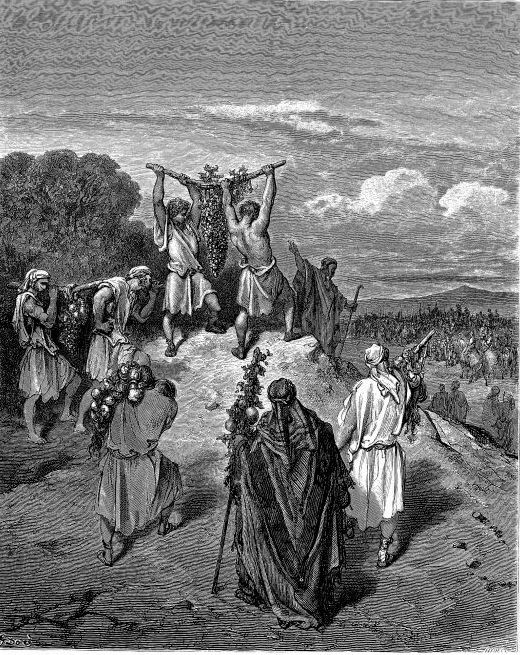
Giants is what you call a people you intend to kill
The second and final appearance of the word nephilim in the Hebrew Bible is not in a myth. It is in a military reconnaissance report, and everything that follows it is a war.
Deuteronomy keeps a gazetteer of giants. The Emims dwelt therein in times past, a people great, and many, and tall, as the Anakims, which also were accounted giants, as the Anakims, but the Moabites call them Emims. Further on, that also was accounted a land of giants, giants dwelt therein in old time, and the Ammonites call them Zamzummims, a people great, and many, and tall, as the Anakims, but the LORD destroyed them before them, and they succeeded them, and dwelt in their stead. Rephaim, Anakim, Emim, Zamzummim. Four names for the same alleged race, each one supplied by a different neighbouring people, which is exactly how ethnic labels behave when the referent is simply whoever was living there first.
Read what those verses are for. The giants are named, and in the same sentence they are dispossessed and somebody else is living in their houses. Deuteronomy applies the formula to Moab and to Ammon as well as to Israel, which tells you it is a formula. It is a standard clause for explaining how the current occupants of a country came to own it, and the clause includes its own justification.
The word Rephaim, רְפָאִים, is worse than it looks. In the Ugaritic texts the rpum are the shades of dead ancestors, and Hebrew uses the same consonants for the dead in Sheol, the ones Isaiah says are stirred up to meet the king of Babylon when he comes down. So the label being pinned on living populations in Transjordan is the word for corpses. A people are being called the dead while they are still farming.
Then there is Og. For only Og king of Bashan remained of the remnant of giants, behold, his bedstead was a bedstead of iron, is it not in Rabbath of the children of Ammon, nine cubits was the length thereof, and four cubits the breadth of it, after the cubit of a man. The proof offered for the existence of giants is a piece of furniture, on display in a foreign capital, produced after the owner is dead and his people are gone. The verse even anticipates the reader’s doubt with is it not, the phrasing of a man pointing at an exhibit. And in the same chapter, having established the size of the bed, the text says we utterly destroyed them, as we did unto Sihon king of Heshbon, utterly destroying the men, women, and children, of every city. Deuteronomy 20 gives the standing order in general terms, that of these cities thou shalt save alive nothing that breatheth.
Put the bed and the order next to each other and the function of the word giants becomes plain. No one writes down that they killed every woman and child in a city without a reason that will survive being read aloud by their grandchildren. They were not really men is that reason, and it is the oldest one on record. The label does the work that makes the sentence sayable, and in these chapters the label always arrives first.
Here is the consensus I am departing from. Mainstream scholarship treats the giant notices as folklore, an explanation invented after the fact for the dolmens and standing stones of Transjordan, and it treats the extermination commands as late ideology that never described any real campaign. That position is comfortable in a way I do not trust, because it concludes that the giants were not real and the massacres were not real and so it never has to ask what the two have to do with one another. My reading does not depend on the campaigns having happened as written. The text preserves the technique in working order whether or not it was ever used at that scale, and the technique is legible on the page. The chapters that command the killing also supply the dehumanising word, and they supply it in the sentence before.
The label also travels, which is the tell. Joshua reports that he cut off the Anakims from the mountains, from Hebron, from Debir, from Anab, and destroyed them utterly with their cities, and that there was none of the Anakims left in the land of the children of Israel, only in Gaza, in Gath, and in Ashdod, there remained. The survivors are placed with precision in three Philistine cities, meaning in the territory of whoever was the enemy at the time the account was written down. Goliath is later produced from Gath. Giants are always found where the current war is.
There is a popular alternative that reads the giant nations as a surviving population of another human species, and the term pre-Adamite usually gets attached to it. That term has a documented career in nineteenth century polygenist racial theory, where it was used to argue that some living peoples descended from a separate and lesser creation. The underlying textual question is a real one and Genesis 4 raises it without help from anybody, since Cain fears other people and finds a wife. That question has its own article here, with the history stated rather than avoided.
The strongest evidence against the giants is in the passage that reports them. At Kadesh the spies come back and say the land is one that eateth up the inhabitants thereof, and that all the people that we saw in it are men of a great stature, and there we saw the giants, the sons of Anak, which come of the giants, and we were in our own sight as grasshoppers, and so we were in their sight. The narrator has already classified this statement before the giants are mentioned. He calls it an evil report, a slander brought up against the land. Numbers 14 then says the men that did bring up the evil report upon the land died by the plague before the LORD.
So the only occurrence of the word nephilim outside Genesis 6 sits inside a statement that the Bible itself classifies as false witness, spoken by men who are killed for speaking it. And the spies give away the mechanism in their own sentence. We were in our own sight as grasshoppers, and so we were in their sight. They report the size as a thing that happened in their eyes, and then project it into the eyes of the other side without having asked. The verse contains its own analysis. What follows in Deuteronomy and Joshua is that same discredited report repeated as established fact, with an order to kill attached to it.
The type-scene: the monster who is also a neighbour. Hercules clears Greece of its monsters and Theseus clears the road to Athens, and the geography of those killings runs along the roads between real settlements. Humbaba guards the cedars that Uruk needs for building, and Gilgamesh kills him and takes the timber, which is the shape of a logging expedition against the people who live in the forest. Genesis 6 and Deuteronomy 2 sit inside this family. What all of them share is the removal of a population framed as the killing of a creature. Where Hebrew scripture differs from the Greek is that it preserves the paperwork. Greece tells you Heracles was glorious. Deuteronomy tells you the giants’ name in four languages, the dimensions of a bed, the cities taken, and the instruction about the women and children, and it is Numbers that files the original report as a lie.
Admitting the category and then drowning it
Every neighbouring tradition kept its demigods and was proud of them. Uruk kept Gilgamesh and pointed at the wall he built. Greece organised its aristocracy around descent from gods and kept an entire poem listing the mothers. Egypt carved the divine conception of the reigning king onto the walls of a temple. These were the founding ancestors of the civilised world, and the men who ruled that world traced their authority through them.
Genesis gives the whole institution four verses. It concedes that the sons of God fathered children on human women, it concedes that the offspring were the mighty men of old and hands them the finest phrase in the chapter, and it then floods the earth.
The question is why admit it at all. A tradition building a clean monotheism could have said nothing. No one would have missed the verse, and centuries of commentators would have been spared. Critical scholarship generally answers that 6:1 to 6:4 is a stray fragment of older polytheistic myth that a later editor retained clumsily, and that its awkwardness is the awkwardness of a seam. I read it the other way. The brevity is control rather than accident. A story everybody already knew could not be deleted, so it was kept, emptied of every name, reduced to four verses and bolted onto a punishment. The passage is not a leftover. It is a ruling. It takes the founding heroes of every surrounding nation and reclassifies them as the reason for the flood.
And it does not even claim the ruling worked. There were giants in the earth in those days, and also after that. The loophole is written into the verse that announces them, and Numbers 13 walks straight through it with a report about the sons of Anak.
Both readings of this material meet at that point. If the Nephilim were the heroic ancestors of the neighbouring peoples, then the flood is the erasure of everybody else’s founders told as a weather event, and the men of renown are famous in a book that will not print their names. If they were kings who claimed divine fathers and took whatever they chose, then Genesis 6 is the earliest surviving attack on the divine right of kings, and it is devastating. It grants the claim and then rules that the claim is what brought the water.
The seed of the Word among the nations
Justin Martyr held both of these readings at once in the second century, which is the precedent for the method used here. In his Second Apology he explains the gods of the poets as the offspring of the fallen angels and the women, so the pantheon is a crime scene. In his First Apology he writes that the seed of the Word was sown among the whole human race, and that men who lived with reason before Christ, Socrates among them, lived with Christ. The same writer says the nations were given something true and that what they made of it was a catalogue of crimes. C. S. Lewis and Tolkien reached the same double position by a different road, with the myths of the nations as good dreams and one of them turning out to have happened.
The type-scene: the son who is given a name rather than taking one. Genesis 6 and the gospels work with the same frame, and there is nothing to gain by pretending otherwise. A divine father, a human mother, a son whose standing is disputed and whose identity rests on a paternity that cannot be checked by ordinary means. The divergences are where the argument actually is. The sons of God saw that the daughters of men were fair and took them wives of all which they chose, and the annunciation is a proposal that is answered by a woman who speaks for herself. Gilgamesh is given a fraction, and the gospel claim is not a fraction of anything, which places it nearer to the Indian avatara than to the Greek hybrid, a descent rather than a mixture. And the offspring in Genesis 6 became men of renown, anshe hashem, men who had made themselves a name. The Authorised Version says of Jesus that he made himself of no reputation, and that the name above every name was given to him afterwards. Both passages are spending the same coin, in opposite directions.