A son told to prove his father, an oath that cannot be unsworn, and the day the world burned
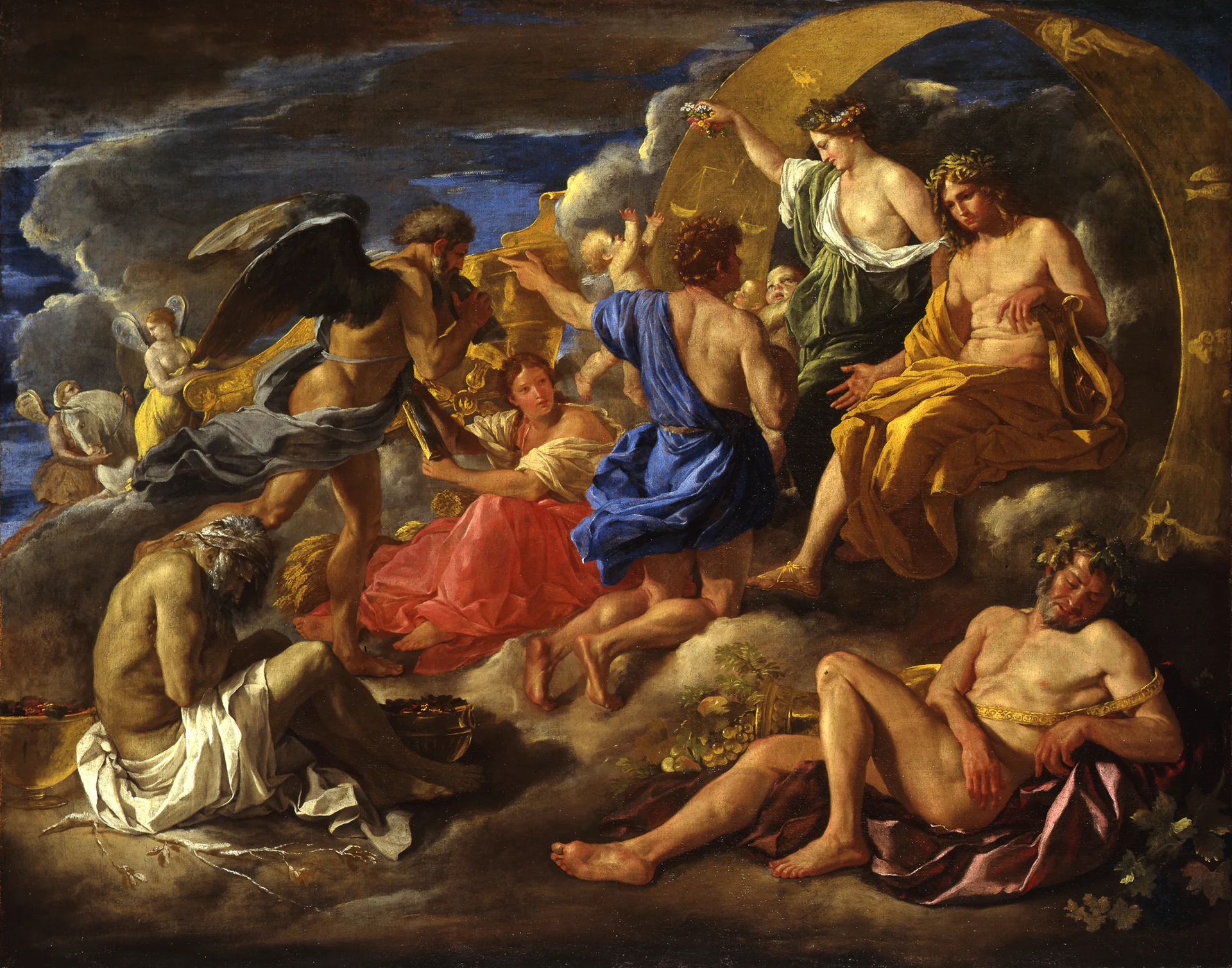
Opening illustration: Nicolas Poussin, Helios and Phaethon with Saturn and the Four Seasons, about 1629–1630. Gemäldegalerie, Berlin. Public domain.
Ovid begins the story with an insult between two boys.
Phaëton, sprung from the Sun, was equal to him in spirit and in years; whom formerly, as he uttered great boasts, and yielded not at all to him, and proud of his father, Phœbus, the grandson of Inachus could not endure; and said, “Thou, like a madman, believest thy mother in all things, and art puffed up with the conceit of an imaginary father.”
— Ovid, Metamorphoses 1.750–754, translated by Henry T. Riley, 1851.1
Prove It
The grandson of Inachus is Epaphus, whom Jupiter fathered on Io, and Egypt already kept temples for him beside his father’s. Phaethon had only his mother’s word. His name in Greek is Phaethōn, Φαέθων, “shining,” and it is older than he is. Homer knows no boy called Phaethon. He uses the word of the sun itself: ēelios phaethōn, ἠέλιος φαέθων, “the radiant sun.” The father’s other name in Ovid is Phoebus, from phoibos, φοῖβος, “pure, bright, radiant.” The boy is called by his father’s adjective, and he lives among “his own Æthiopians” in the house of his mother’s husband, Merops.2
Epaphus’s words in Latin are es tumidus genitoris imagine falsi, “you are swollen with the picture of a false father.” He does not deny that gods father sons on women, since he is one himself. He denies it of this boy. The suspicious reading of the story is spoken inside the story, by its first speaker.
The Gospels put the same demand to Jesus twice. In the wilderness the tempter says, “If thou be the Son of God, command that these stones be made bread,” ei huios ei tou theou, Εἰ υἱὸς εἶ τοῦ θεοῦ. At the cross the passers-by say, “If thou be the Son of God, come down from the cross.” Each time a claimed son is told to prove it on the spot. Phaethon takes the dare. Jesus refuses it both times, and the Gospels count the refusal in his favour.3
Phaethon goes red and says nothing. At home he tells his mother that he is ashamed “both that these reproaches can be uttered against us, and that they cannot be refuted,” and he begs her for “some token of his real father.” He swears by his own head and by the head of Merops. Clymene answers with an oath of her own.
Son, I swear to thee, by this beam, bright with shining rays, which both hears and sees us, that thou, that thou, I say, wast begotten by this Sun, which thou beholdest; by this Sun, which governs the world. If I utter an untruth, let him deny himself to be seen by me, and let this light prove the last for my eyes. Nor will it be any prolonged trouble for thee to visit thy father’s dwelling; the abode where he arises is contiguous to our regions. If only thy inclination disposes thee, go forth, and thou shalt inquire of himself.
— Metamorphoses 1.768–775, Riley.1
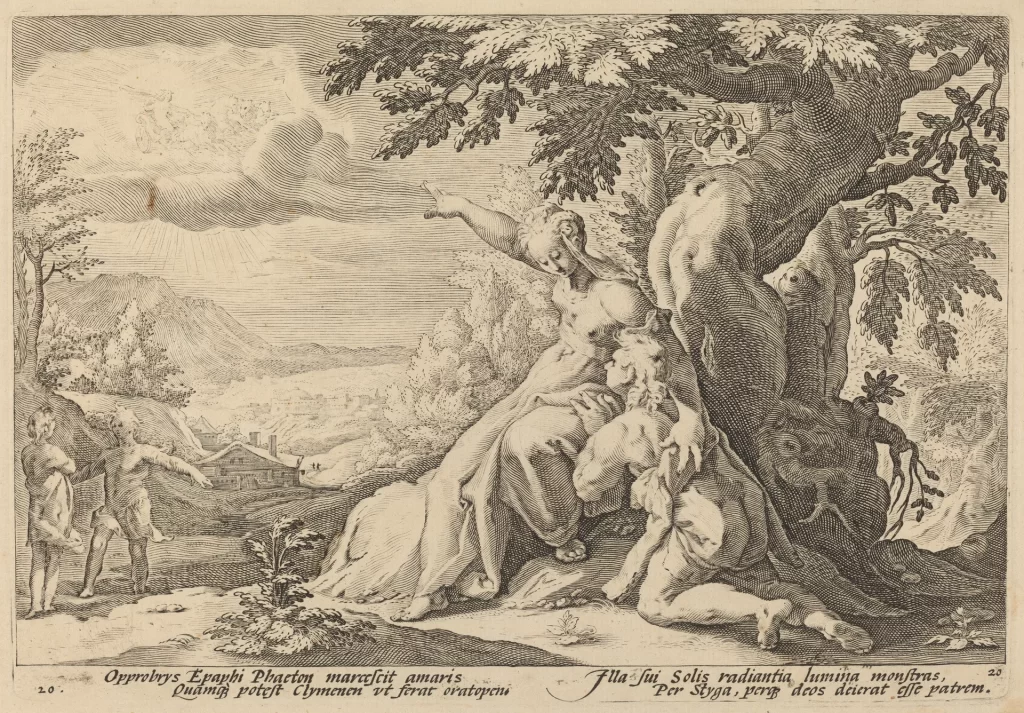
Ovid will not say why she swears. “It is a matter of doubt,” he writes, whether she was moved by the boy’s pleading “or by resentment at the charge made against her.” Her witness is the father himself, who cannot be questioned from the ground. She sends the boy to ask him.
The House of the Sun
He walks east, past the Indians, to the place where the sun comes up. The palace shines with gold and ivory, and on its silver doors Vulcan has carved the sea, the earth and the sky, with six signs of the zodiac on each door.
Soon as the son of Clymene had arrived thither by an ascending path, and entered the house of his parent, thus doubted of; he immediately turned his steps to the presence of his father, and stood at a distance, for he could not bear the refulgence nearer. Arrayed in a purple garment, Phœbus was seated on a throne sparkling with brilliant emeralds.
— Metamorphoses 2.19–24, Riley.1
Around the throne stand the Days, the Months, the Years, the Ages and the Hours, and the four Seasons: Spring in flowers, Summer naked with ears of corn, Autumn stained with grapes, Winter with white hair.
A son has come to his father’s house. Luke has the boy Jesus found in the Temple, asking his mother, “wist ye not that I must be about my Father’s business?” The Gospels later bring him into his Father’s city with crowds shouting on the road. Phaethon gets through the doors and has to stop. Ovid’s words are consistitque procul; neque enim propiora ferebat lumina, “he stood far off, for he could not bear the light nearer.” The First Letter to Timothy says of God that he dwells “in the light which no man can approach unto.” Jesus sits among the teachers in his Father’s house. Phaethon cannot cross the room in his.4
The father speaks first and calls him “a son not to be denied by his parent.” The boy asks all the same.
O thou universal Light of the unbounded World, Phœbus, my father, if thou grantest me the use of that name; and if Clymene is not concealing an error under a false pretext, give me, my parent, some token, by which I may be believed to be really thy progeny; and remove this uncertainty from my mind.
— Metamorphoses 2.35–39, Riley.1
Epaphus’s doubt has become his own. Nec falsa Clymene culpam sub imagine celat, he says, “if Clymene is not hiding a fault under a false picture,” and the two words falsa and imagine are the ones Epaphus threw at him. A boy who is told that a god is his father suspects first that the god is a cover for something else. Ion says the same to his mother at Delphi, as Ion — The Patriarchal Blessing and the Father of a Nation tells.
The Sun takes the rays off his head so that the boy can come near. He embraces him and says that Clymene told the truth. Then he tells him to “ask any gift thou mayst please.”
The Oath
“Let the lake, by which the Gods are wont to swear, and which is unseen, even by my eyes, be as a witness of my promise.” Hardly had he well finished, when he asks for his father’s chariot, and for the command and guidance of the wing-footed horses for one day. His father repented that he had so sworn, and shaking his splendid head three or four times, he said, “By thine have my words been made rash. I wish I were allowed not to grant what I have promised! I confess, my son, that this alone I would deny thee. Still, I may dissuade thee: thy desire is not attended with safety. Thou desirest, Phaëton, a gift too great, and one which is suited neither to thy strength, nor to such youthful years. Thy lot is that of a mortal; that which thou desirest, belongs not to mortals.”
— Metamorphoses 2.45–56, Riley.1
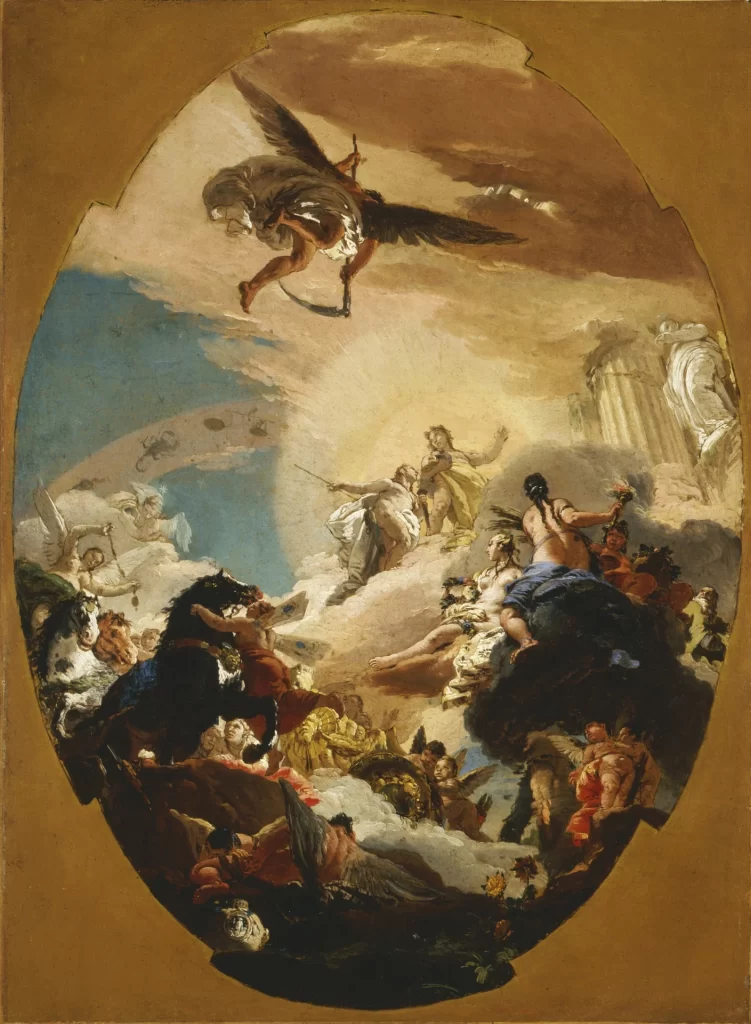
The lake is the Styx, and an oath by it is the one a god cannot break. Paenituit iurasse patrem, Ovid says, “the father repented that he had sworn.” Mark says it of Herod, who swore to a dancing girl, “Whatsoever thou shalt ask of me, I will give it thee, unto the half of my kingdom,” and was asked for a head. “The king was exceeding sorry; yet for his oath’s sake” he “would not reject her.” Jephthah vowed to the LORD whatever first came out of his door, and his daughter came out: “I have opened my mouth unto the LORD, and I cannot go back.” In each story a powerful man binds himself before he hears the price, and somebody else pays it.5
The Sun cannot refuse, so he argues. The road is steep at dawn, and at noon so high that he is afraid to look down. The sky turns against him the whole way. The track runs past the Bull’s horns, the Lion’s mouth and the Scorpion’s claws, and the horses breathe fire. Jupiter himself could not drive them. Sors tua mortalis, non est mortale quod optas: “thy lot is that of a mortal; that which thou desirest, belongs not to mortals.” Genesis draws the same line in the garden, where the serpent promises “ye shall be as gods,” as Eden and Göbekli Tepe tells. Adam reached for the knowledge that belonged to God, and Phaethon for the reins that only his father could hold.6
Then the father gives the proof that the boy came for.
Thou askest, forsooth, a sure proof that thou mayst believe thyself sprung from my blood? I give thee a sure proof in thus being alarmed for thee; and by my paternal apprehensions, I am shown to be thy father. Lo, behold my countenance! I wish, too, that thou couldst direct thy eyes into my breast, and discover my fatherly concern within!
— Metamorphoses 2.90–94, Riley.1
Do pignora certa timendo: “I give sure pledges by fearing.” The proof of the father is that he is afraid. The boy wanted a proof that other people could see. “Thou art asking, Phaëton, a punishment instead of a gift,” the Sun says, poenam pro munere, and then gives up: “by the Stygian waves I have sworn it.”
The Middle Road
The chariot is Vulcan’s work, with an axle and pole of gold, golden rims and silver spokes. A chariot was the car of kings and of victory processions, and the man who stood in one was seen to rule. The boy who asks to drive it for a day is asking to be seen where a king is seen. The sun had a chariot in Jerusalem too. King Josiah, the Second Book of Kings says, “took away the horses that the kings of Judah had given to the sun, at the entering in of the house of the LORD,” and “burned the chariots of the sun with fire,” markevot ha-shemesh, מַרְכְּבוֹת הַשֶּׁמֶשׁ. Until that reform the kings of Judah kept the sun’s horses and chariots at the door of the temple.7
Dawn opens her doors. The stars leave, “the troops whereof Lucifer gathers,” and the Hours yoke the horses.
Then the father touched the face of his son with a hallowed drug, and made it able to endure the burning flames, and placed the rays upon his locks, and fetching from his troubled heart sighs presaging his sorrow, he said: “If thou canst here at least, my boy, obey the advice of thy father, be sparing of the whip, and use the bridle with nerve. Of their own accord they are wont to hasten on; the difficulty is to check them in their full career.”
— Metamorphoses 2.122–128, Riley.1
The father anoints the son’s face and sets his own rays on the boy’s head. When Moses came down from Sinai “the skin of his face shone,” and Israel was afraid to come near him. On the mountain Jesus “was transfigured before them: and his face did shine as the sun,” elampsen to prosōpon autou hōs ho hēlios, ἔλαμψεν τὸ πρόσωπον αὐτοῦ ὡς ὁ ἥλιος. In all three the light on the face shows where the man has been. Only Phaethon’s is put on with an ointment, as protection against a fire that he is about to let loose.8
The rule of the road is half a line: medio tutissimus ibis, “you will go safest in the middle.” Too high and he will burn the houses of heaven, too low and he will burn the earth. Six books later Daedalus gives the same rule to Icarus, another father to another son who will not keep it. “Make use of my advice, and not my chariot,” the Sun says at the last moment. The boy is already standing in it.9
The Ride
Ovid names the horses for fire. Eous is heōos, ἑῷος, “of the dawn.” Aethon comes from aithō, αἴθω, “to burn,” Phlegon is phlegōn, φλέγων, “blazing,” and Pyrois is “the fiery one.” Their driver, Ovid says, nec nomina novit equorum, “does not know the horses’ names.” They feel at once that the chariot is too light. It bounces like a ship without ballast, and they leave the track.10
But when, from the height of the skies, the unhappy Phaëton looked down upon the earth, lying far, very far beneath, he grew pale, and his knees shook with a sudden terror; and in a light so great, darkness overspread his eyes. And now he could wish that he had never touched the horses of his father; and now he is sorry that he knew his descent, and that he prevailed in his request; now desiring to be called the son of Merops.
— Metamorphoses 2.178–184, Riley.1
The proof he asked for is under his feet, and he would give it back. Iam Meropis dici cupiens: “now wanting to be called the son of Merops.”
Nietzsche has an aphorism that fits him, headed “Injuring with one’s best Qualities.” It begins: “Our strong points sometimes drive us so far forward that we cannot any longer endure our weaknesses, and we perish by them: we also perhaps see this result beforehand, but nevertheless do not want it to be otherwise.” Phaethon was told the result beforehand by the one person who knew it. What was best in him, his father’s blood and the nerve to claim it, carried him to a height where the rest of him was a boy with shaking knees. The aphorism goes on to the cost for others. It is with their best abilities, Nietzsche says, “that they destroy much that is weak, uncertain, evolving.”11

Among the constellations he sees the Scorpion, “wet with the sweat of black venom,” and he drops the reins.
The World on Fire
The horses run where they like, up among the fixed stars and then down close over the earth. The clouds smoke. The grass goes white, trees burn in full leaf, and the standing corn feeds the fire. “But I am complaining of trifling ills,” Ovid says, parva queror.
Great cities perish, together with their fortifications, and the flames turn whole nations, with their populations, into ashes; woods, together with mountains, are on fire.
— Metamorphoses 2.214–216, Riley.1

Athos burns, and Etna, Parnassus, Olympus, the Alps and the Apennines. The rivers boil from the Ganges to the Tagus, and the Nile runs to the end of the earth and hides its head. The nations are burned in a line and a half, and the poem does not come back to them. It keeps two marks of the fire.
They believe that it was then that the nations of the Æthiopians contracted their black hue, the blood being attracted into the surface of the body. Then was Libya made dry by the heat, the moisture being carried off.
— Metamorphoses 2.235–238, Riley.1
The Greek name already said so. Aithiops, Αἰθίοψ, is “burnt-face,” from the same aithō that named the horse and from ops, ὄψ, “face.” The story supplies an event for the name. It turns the skin of the boy’s own countrymen, and the desert beside them, into damage left by his ride.12
“They believe,” says Ovid, credunt, and keeps his distance. Plato kept more. In the Timaeus an Egyptian priest tells Solon the Athenian that the Greeks have a story of Phaethon, who could not drive his father’s horses, burnt up the earth and was killed by a thunderbolt.
Now this has the form of a myth, but really signifies a declination of the bodies moving in the heavens around the earth, and a great conflagration of things upon the earth, which recurs after long intervals.
— Plato, Timaeus 22c–d, translated by Benjamin Jowett, 1871.13
For the priest the boy and the chariot are the form in which a real fire was remembered.
The Earth herself lifts her scorched face out of the ground and asks Jupiter to end it. She has borne the plough and fed cattle, men and gods, she says, and this is her pay.
If the sea, if the earth perishes, if the palace of heaven, we are thrown into the confused state of ancient chaos. Save it from the flames, if aught still survives, and provide for the preservation of the universe.
— Metamorphoses 2.298–300, Riley.1
In chaos antiquum confundimur. Ovid’s poem began from chaos, and it has already destroyed the world once, by water, one book earlier. There Jupiter put his thunderbolts down and chose a flood, because he remembered a decree of fate: adfore tempus, quo mare, quo tellus correptaque regia caeli ardeat, “that a time would come when sea and land and the palace of heaven would catch fire and burn.” The Second Letter of Peter has the same two ends in the same order: “the world that then was, being overflowed with water, perished: But the heavens and the earth, which are now, by the same word are kept in store, reserved unto fire.” In Ovid the fire comes early, by a boy’s hand, and is put out. In Peter it is still to come. Noah — Prophet and Builder tells of the water.14
The Thunderbolt
But the omnipotent father, having called the Gods above to witness, and him, too, who had given the chariot to Phaëton, that unless he gives assistance, all things will perish in direful ruin, mounts aloft to the highest eminence, from which he is wont to spread the clouds over the spacious earth; from which he moves his thunders, and hurls the brandished lightnings.
He thundered aloud, and darted the poised lightning from his right ear against the charioteer, and at the same moment deprived him both of his life and his seat, and by his ruthless fires restrained the flames.
But Phaëton, the flames consuming his yellow hair, is hurled headlong, and is borne in a long tract through the air; as sometimes a star from the serene sky may appear to fall, although it really has not fallen. Him the great Eridanus receives, in a part of the world far distant from his country, and bathes his foaming face.
— Metamorphoses 2.304–308, 311–313, 319–324, Riley.1

Jupiter calls witnesses before he throws, and the boy’s father is one of them. He kills a boy whose offence was to ask, on an oath that was the father’s. Ovid lets the Sun say so afterwards: “he who did not successfully guide them, did not deserve death.”
The boy falls like a star, and Ovid has already named the star. At dawn the last to leave the sky was Lucifer, “light-bearer,” the morning star. Jerome put the same word into Isaiah’s taunt against the king of Babylon, quomodo cecidisti de caelo, Lucifer, and the King James kept it: “How art thou fallen from heaven, O Lucifer, son of the morning!” Jesus says, “I beheld Satan as lightning fall from heaven.” Isaiah’s king had said in his heart, “I will exalt my throne above the stars of God.” Phaethon wanted nobody’s throne. He wanted one day in his father’s place, so that another boy would have to believe him.15
The nymphs of the west bury him beside the river and cut two lines on the stone.
Here is Phaëton buried, the driver of his father’s chariot, which if he did not manage, still he miscarried in a great attempt.
— Metamorphoses 2.327–328, Riley.1
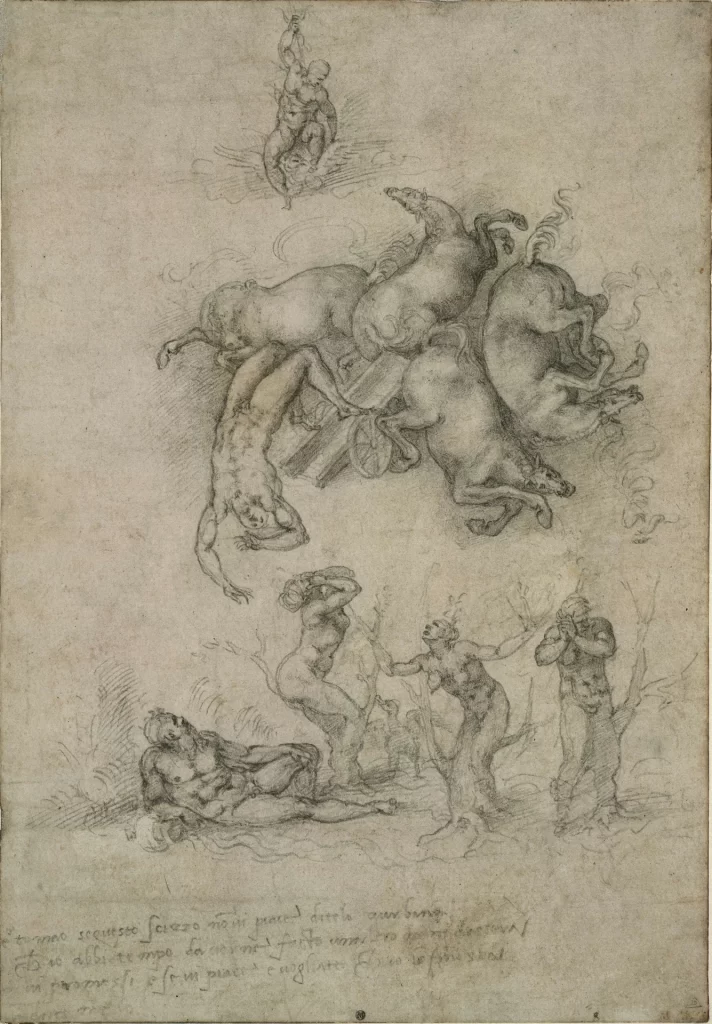
Magnis tamen excidit ausis: “yet he fell from a great daring.” The stone gives him the title Epaphus refused, currus auriga paterni, “driver of his father’s chariot,” and it does not mention the cities.
A Day without the Sun
But his wretched father had hidden his face, overcast with bitter sorrow, and, if only we can believe it, they say that one day passed without the sun. The flames afforded light; and so far, there was some advantage in that disaster.
— Metamorphoses 2.329–332, Riley.1
Luke says that at the crucifixion “there was a darkness over all the earth until the ninth hour. And the sun was darkened,” tou hēliou eklipontos, τοῦ ἡλίου ἐκλιπόντος, “the sun failing.” In both stories the sun goes out when the son dies. In Ovid the sun is the father, and he hides his face over a death he argued against. In Luke the dying son says, “Father, into thy hands I commend my spirit,” and the Gospels hold that the Father willed it.16

Scripture also uses the sun as a name. A psalm says that “the LORD God is a sun and shield,” shemesh u-magen, שֶׁמֶשׁ וּמָגֵן, and Malachi promises “the Sun of righteousness.” In John Jesus takes the title for himself: “I am the light of the world.” Phaethon borrowed his father’s light for a morning and burned the earth with it. In John the son says that he is the light, and the day that goes dark is the day he dies.16
Clymene walks the whole earth until she finds the grave “on a foreign bank.” She lies down on it and warms the name on the marble with her breast. His sisters, the daughters of the Sun, mourn there for four months, until roots hold their feet and bark climbs over them. Their mother tears at the branches, and the branches bleed.
The bark came over the last words. Thence tears flow forth; and amber distilling from the new-formed branches, hardens in the sun; which the clear river receives and sends to be worn by the Latian matrons.
— Metamorphoses 2.363–366, Riley.1
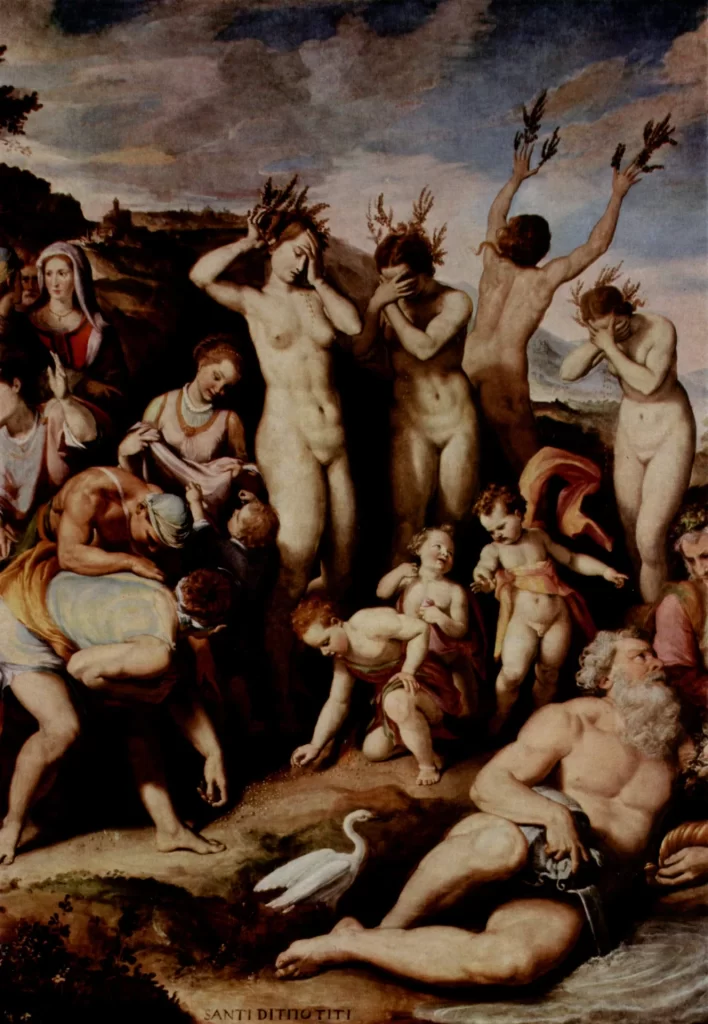
The Sun refuses to drive. “Let Jupiter himself drive it,” he says, so that he “may for a time lay aside the lightnings that bereave fathers.” The gods beg him not to leave the world in the dark. Jupiter excuses the thunderbolt and, Ovid says, precibusque minas regaliter addit, “adds threats to his prayers, as a king does.” The Sun gathers the horses and flogs them, “and charges his death upon them.” No one in heaven answers for the boy or for the nations. The father who swore the oath beats the animals, and the king who threw the bolt threatens the father.17
Tears for Sale
The poem’s last word on the sisters is a trade. Nuribus mittit gestanda Latinis: the river sends the amber “to be worn by the brides of Latium.” Amber in Greek is ēlektron, ἤλεκτρον, and Homer calls the sun ēlektōr, ἠλέκτωρ, “the beaming sun.” Pliny gives the link himself: the tears were named electrum “from the circumstance that the Sun was usually called” elector. The stone had the sun’s name before it had the story of the sun’s daughters.18

Pliny did not believe the story. He calls it one of “the frivolities and falsehoods of the Greeks.” Amber, he says, came from the coast of Germany, six hundred miles beyond the Danube, and the Veneti at the head of the Adriatic made it known, which is how the river Po came into the tale. In his own day “the female peasantry in the countries that lie beyond that river” wore “necklaces of amber,” and at Rome “a very diminutive human effigy, made of amber, has been known to sell at a higher price than living men even, in stout and vigorous health.”18
A century later the satirist Lucian said that he had gone to look. He was on the Eridanus on other business, and he asked the boatmen when they would come to the poplars that weep amber.
‘What liar took you in like that, sir?’ they said; ‘we never saw a coachman spilt; and where are the poplars? why, do you suppose, if it was true, we would row or tow up stream for sixpences? we should only have to collect poplar-tears to be rich men.’
— Lucian, Swans and Amber, translated by H. W. and F. G. Fowler, 1905.19
“The natives,” Lucian says, “had not so much as heard of Phaethon.” The boy had asked for one day on which the whole world would see whose son he was. On the river where he is buried the men at the oars did not know his name, and the farm women on the far bank wore his sisters’ tears for a sore throat.
Sources and Translation Notes
1. Ovid, Metamorphoses 1.747–779 and 2.1–400, translated by Henry T. Riley, The Metamorphoses of Ovid (London, 1851), Project Gutenberg. Riley spells the name Phaëton. Latin from The Latin Library, Book 1 and Book 2. The block quotations in the earlier version of this article were from Brookes More’s translation of 1922. ↩
2. Liddell–Scott–Jones, φαέθω, “radiant, epith. of the sun,” and as a proper name the “son of Helios, famous for his unlucky driving of the sun-chariot”; φοῖβος, “pure, bright, radiant.” Homer, Iliad 11.735: εὖτε γὰρ ἠέλιος φαέθων ὑπερέσχεθε γαίης. Merops: Metamorphoses 1.763 and 2.184, with Riley’s note that he “was king of Ethiopia.” ↩
3. Matthew 4:3 and 27:40, King James Version. Greek from the SBL Greek New Testament, Bible Gateway. ↩
4. Luke 2:49 and 1 Timothy 6:16, King James Version. The entry into Jerusalem: Mark 11:1–11. Latin of Metamorphoses 2.22–23. ↩
5. Latin of Metamorphoses 2.49. Mark 6:22–26 and Judges 11:30–35, King James Version. Greek of Mark 6:26 from the SBL Greek New Testament: καὶ περίλυπος γενόμενος ὁ βασιλεὺς διὰ τοὺς ὅρκους. ↩
6. Latin of Metamorphoses 2.56. Genesis 3:5, King James Version. ↩
7. 2 Kings 23:11, King James Version; Hebrew from Mechon Mamre: וְאֶת־מַרְכְּבוֹת הַשֶּׁמֶשׁ שָׂרַף בָּאֵשׁ. ↩
8. Exodus 34:29–30 and Matthew 17:2, King James Version; Greek from the SBL Greek New Testament, Bible Gateway. ↩
9. Latin of Metamorphoses 2.137. Daedalus and Icarus: Metamorphoses 8.203–206. ↩
10. Latin of Metamorphoses 2.153–154 and 2.192. Liddell–Scott–Jones: ἑῷος and φλέγω. ↩
11. Friedrich Nietzsche, The Joyful Wisdom (Die fröhliche Wissenschaft, 1882), aphorism 28, translated by Thomas Common (Edinburgh, 1910), Project Gutenberg. ↩
12. Liddell–Scott–Jones, Αἰθίοψ, from αἴθω and ὄψ, “properly, Burnt-face.” Latin of Metamorphoses 2.235–236: Sanguine tum credunt in corpora summa vocato Aethiopum populos nigrum traxisse colorem. ↩
13. Plato, Timaeus 22c–d, translated by Benjamin Jowett (Oxford, 1871), Project Gutenberg. ↩
14. Latin of Metamorphoses 2.299 and 1.253–261. 2 Peter 3:6–7, King James Version. ↩
15. Metamorphoses 2.114–115: diffugiunt stellae, quarum agmina cogit Lucifer. Isaiah 14:12–13 and Luke 10:18, King James Version. Latin Vulgate, Isaiah 14:12, Bible Gateway. ↩
16. Luke 23:44–46, Psalm 84:11, Malachi 4:2 and John 8:12, King James Version. Greek from the SBL Greek New Testament, Bible Gateway. Hebrew of Psalm 84 from Mechon Mamre, where the verse is numbered 12. ↩
17. Metamorphoses 2.381–400, Riley; Latin of 2.397. ↩
18. Latin of Metamorphoses 2.366. Liddell–Scott–Jones: ἤλεκτρον, “amber,” and ἠλέκτωρ, “the beaming sun,” at Iliad 6.513 and 19.398. Pliny, Natural History 37.11–12 (sections 31, 42–45 and 49), translated by John Bostock and H. T. Riley (London, 1857), Perseus Digital Library. ↩
19. Lucian, Swans and Amber, translated by H. W. Fowler and F. G. Fowler, The Works of Lucian of Samosata, volume 3 (Oxford, 1905), Project Gutenberg. ↩