Apollo’s son is raised in his father’s temple, handed to another man as that man’s own, and made the ancestor of the Ionians on condition that nobody says who his father is
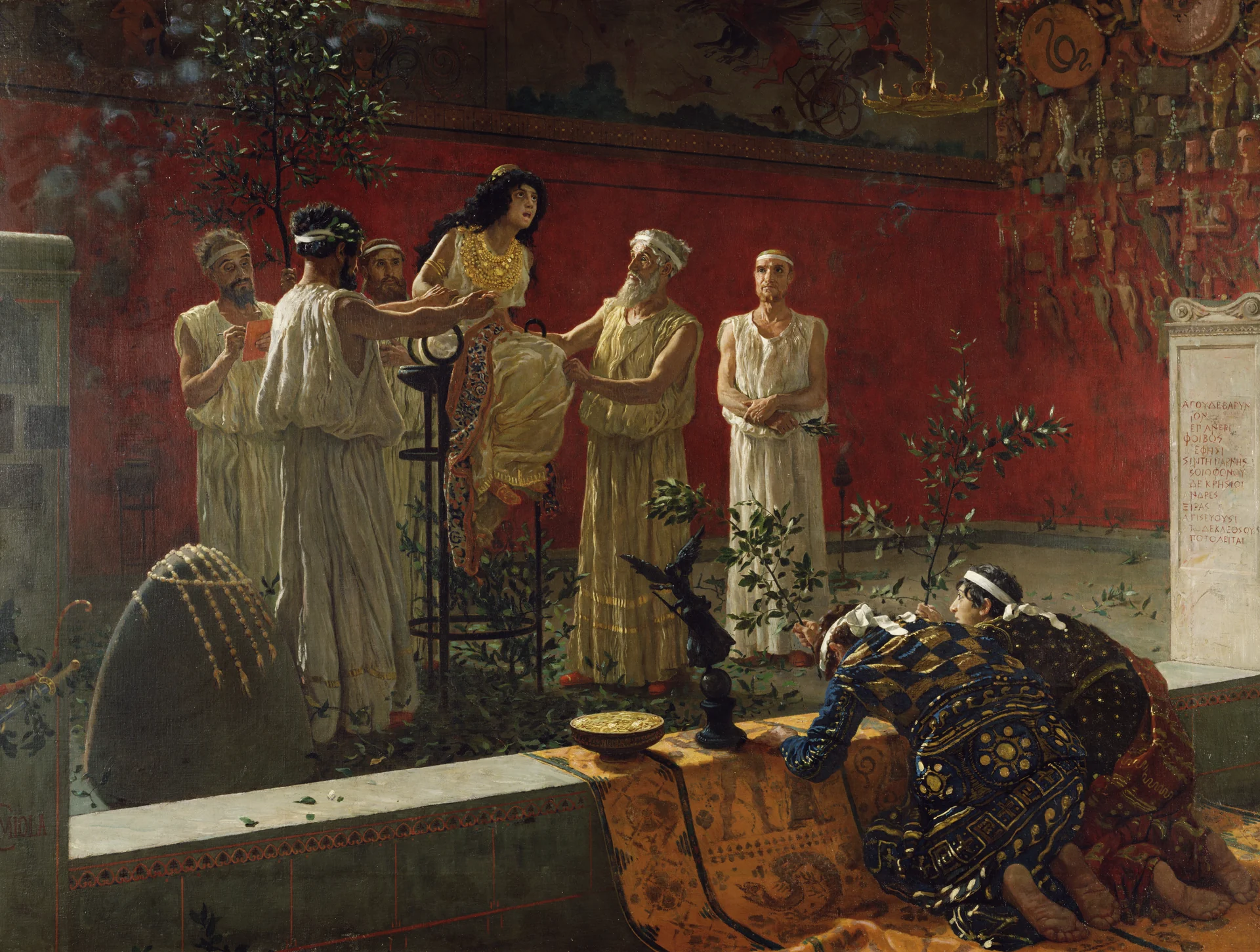
Opening illustration: Camillo Miola, The Oracle, 1880. The priestess of Apollo on her tripod at Delphi, with the navel-stone of the world at the left. J. Paul Getty Museum, Los Angeles, 72.PA.32. Public domain.
Euripides opens the play with a god explaining what his brother did.
Lo! I am come to this land of Delphi where sits Phœbus on the centre of the world and giveth oracles to men, ever chanting lays prophetic of things that are to be. Now there is a city in Hellas of no small note, called after Pallas, goddess of the golden lance; there did Phœbus force his love on Creusa, daughter of Erechtheus, beneath the rock of Pallas, northward of Athens’ steep realm, called Macræ by the kings of Attica. And she without her father’s knowledge—for such was the god’s good pleasure,—bore the burden in her womb unto the end, and when her time came, she brought forth a child in the house and carried him away to the self-same cave wherein the god declared his love to her, and she cradled him in the hollow of a rounded ark and cast him forth to die.
— Euripides, Ion 5–18, translated by E. P. Coleridge, 1891.1
The Cave under the Acropolis
The speaker is Hermes, alone in front of Apollo’s temple. Coleridge does not soften the verb, and neither does the Greek: Phoibos ezeuxen gamois bia Kreousan, Φοῖβος ἔζευξεν γάμοις βίᾳ Κρέουσαν, “Phoebus yoked Creusa in marriage by force.” Creusa is the daughter of the king of Athens, and the place is a cave in the north face of the Acropolis. Nearly six centuries later the traveller Pausanias was still shown it: “a sanctuary of Apollo in a cave. It is here that Apollo is believed to have met Creusa, daughter of Erechtheus.”2
A god takes a mortal woman, and a son comes of it. The Hebrew Bible has the same act at Genesis 6, where “the sons of God saw the daughters of men that they were fair; and they took them wives of all which they chose,” as the Nephilim article tells. It stands behind half the divine parentages in Greek myth. What is unusual here is the point of view. Euripides gives the woman a voice and lets her accuse the god later in the play, and Apollo never comes on stage to answer her. Luke’s annunciation differs at exactly that point. There the messenger explains himself, the woman is allowed her question, “How shall this be,” and nothing happens until she has agreed.2
Another Father for His Son
Hermes carried the baby to Delphi at his brother’s request and left the basket on the temple steps. The priestess took the child in. He grew up playing round the altar, and the Delphians made him steward of the god’s treasure.

His mother was married to Xuthus, a soldier who had fought for Athens and was “no native, but an Achæan.” After years without a child the couple have come to Delphi to ask for one, and Hermes says what Apollo means to do.
For when Xuthus enters this shrine, the god will give him his own son and declare that Xuthus is the sire, that so the boy may come to his mother’s home and be acknowledged by Creusa, while the marriage of Loxias remains a secret and the child obtains his rights; and he shall cause him to be called Ion, founder of a realm in Asia, through all the breadth of Hellas.
— Ion 69–75, Coleridge.1
Matthew tells the same arrangement from the husband’s side. Joseph finds his betrothed with child, and an angel tells him in a dream, “fear not to take unto thee Mary thy wife: for that which is conceived in her is of the Holy Ghost.” He takes her, and he names the boy, as Xuthus will name Ion. The difference is what the husband is told. Joseph is given the truth and keeps the child. Xuthus is given the child and a false account of him.3
The Boy in His Father’s House
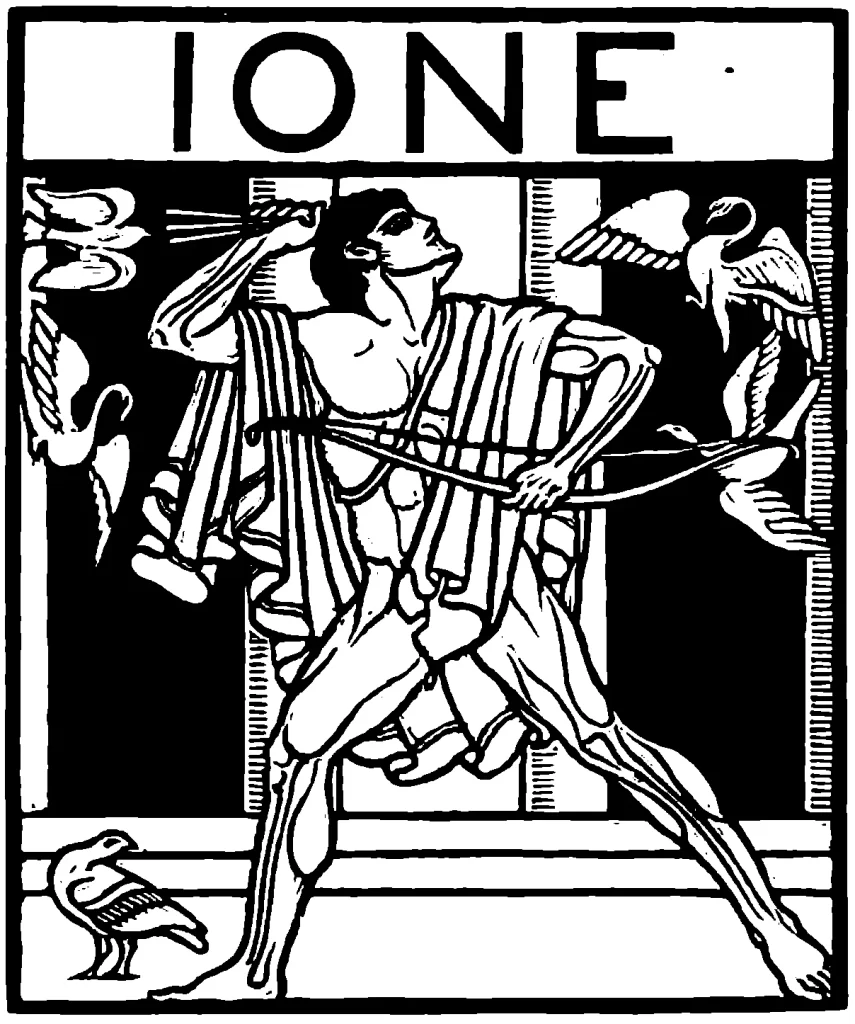
The boy comes out at sunrise with a broom of laurel and a bow, to sweep the temple steps and keep the birds off the offerings.
Phœbus is to me as the father that begot me, for as such I praise the god that gives me food. ’Tis Phœbus, who dwelleth in the temple, whom I call by that helpful name of father.
— Ion 136–140, Coleridge.1
In Greek he says Phoibos moi genetōr patēr, Φοῖβός μοι γενέτωρ πατήρ, “Phoebus is my father who begot me.” He means it as a figure of speech, and the audience has just been told that it is a fact. Then the birds come down from Parnassus, an eagle, a swan, a third that wants to nest under the eaves. He threatens each with the bow and does not shoot: “I am loth to slay ye, ye messengers to mortal man of messages from heaven.”4
Luke has one story of Jesus as a boy, and it is set in a temple. His parents lose him in Jerusalem and find him after three days among the teachers. His mother says, “thy father and I have sought thee sorrowing,” and he answers, “wist ye not that I must be about my Father’s business?” The Greek is en tois tou patros mou, ἐν τοῖς τοῦ πατρός μου, “in my Father’s house.” Both boys are at home in a temple and call its god father. Jesus says it knowing what he means, and corrects his mother’s “thy father” as he says it. Ion says it as a courtesy and is right by accident.4
A Friend of Mine
Creusa reaches the temple before her husband. She and the boy take to each other at once, and she tells him her own story as another woman’s. A friend of hers, she says, was forced by Apollo, bore a child and put it out to die, and wants to ask the god in secret whether it lived. Ion tells her that the god will not answer a question that shames him. When she has gone he speaks to the temple.
Yet must I warn Phœbus of what is happening to him; he ravishes a maid and proves unfaithful to her, and after secretly begetting a son leaves him to die. O! Phœbus, do not so, but as thou art supreme, follow in virtue’s track; for whosoever of mortal men transgresses, him the gods punish. How, then, can it be just that you should enact your laws for men, and yourselves incur the charge of breaking them? Now I will put this case, though it will never happen. Wert thou, wert Poseidon, and Zeus, the lord of heaven, to make atonement to mankind for every act of lawless love, ye would empty your temples in paying the fines for your misdeeds.
— Ion 436–447, Coleridge.1
The son of the god is passing sentence on his own begetting and does not know it. Read with suspicion, the speech is the play’s verdict on its plot, given to the one character who has no reason to lie.
The First Youth He Meets
Xuthus comes out of the shrine and throws his arms round the boy, who reaches for his bow. The oracle has told Xuthus that the first person he met on leaving was his son. Ion asks one sharp question: was he born Xuthus’s son, or is he dōron, δῶρον, “a gift”? A gift, Xuthus says, and his own child too. He supposes he fathered the boy on some girl at a festival of Bacchus when he was young. Then he names him: “Thy name shall be Ion, in accordance with what happened, for that thou wert the first to cross my path as I came forth from Apollo’s sanctuary.” The name Iōn, Ἴων, is heard as “going,” and Xuthus was exionti, ἐξιόντι, “coming out,” when they met. Hermes had used the name already in the prologue, and boasted of being the first of the gods to say it.5

Ion is glad of a father and afraid of the city he is being taken to. “Athens, I am told,—that glorious city of a native race,—owns no aliens; in which case I shall force my entrance there under a twofold disadvantage, as an alien’s son and base-born as I am.” “Of a native race” is autochthonas, αὐτόχθονας, “sprung from the soil itself.” The Athenians claimed to have been born from their own ground, and Xuthus is an immigrant. He decides to bring the boy home as a guest, and tells the women of the chorus that if they say a word to his wife they will die.5
A Cup of Poison
The chorus tells her anyway. An old servant of her father’s house explains what she has been handed: “some slave-girl’s child, whose mother is unknown, himself of no account,” brought in to be lord of the house of Erechtheus. He advises her to kill. Creusa, who has kept her secret since she was a girl, speaks it aloud to the god’s own temple.
Yes, I saw thee come, the glint of gold upon thy locks, as I was gathering in my folded robe the saffron blooms that blazed like flowers of gold; and by my lily wrist didst thou catch me and ledst me to the cavern’s bed, what time I cried aloud upon my mother’s name,—thou a god to mate with me in shameless wise to pleasure lady Cypris! Then to my sorrow I bore thee a son, whom, though anguish thrilled my mother’s breast, I cast upon that bed of thine, where thou didst join in woful wedlock this unhappy maid. Ah! woe is me! that poor babe I bare thee is now no more; winged fowls have torn and devoured him, but thou art gaily carolling unto thy lyre some song of joy.
— Ion 887–906, Coleridge.1
She believes her child dead, and the god who took her is giving her husband an heir. She agrees to poison the boy at the feast Xuthus is holding for him, and the old man drops it in his cup. Someone speaks an unlucky word, Ion has the wine poured on the ground as an offering, and the temple doves come down to drink. “One that settled on the spot where the son new-found had poured his wine, no sooner had tasted thereof, than convulsions seized her feathered form.” The birds he would not shoot that morning have saved his life. The Delphians vote to stone Creusa, she runs to the altar, and Ion comes after her.6
The Cradle
The priestess who raised him comes out with the basket he was found in. Creusa knows it, and before he lifts the lid she tells him what is inside: a piece of her own girlhood weaving with the Gorgon in the middle, a pair of golden snakes, which are the mark of her family, and a wreath of olive. Mother and son hold each other.

Then he takes her aside.
Bethink thee, mother, carefully; didst thou make the fatal slip, that maidens will, as touching secret amours, and then upon the god wouldst foist the blame, in thy anxiety to escape the shame of my birth asserting that Phœbus is my sire, albeit the god was not the parent.
— Ion 1523–1527, Coleridge.1
This is the suspicious reading of every divine birth, and here the son of the god says it himself. The Gospel of John records the same insinuation thrown at Jesus in the temple at Jerusalem. “Where is thy Father?” his opponents ask, and then, “We be not born of fornication; we have one Father, even God.” Creusa swears by Athena that it was Apollo. Ion asks why, then, the god gave him to another man, and turns to go in and put the question to the oracle.7
He is stopped by Athena, who appears above the temple.
’Tis I, Pallas, after whom your land is named, that am here, by Apollo sent in headlong haste; for he thought not fit to appear before you twain, lest his coming might provoke reproaches for the past.
Now therefore hold thy peace as to this thy child’s real parentage, that Xuthus may delight in his fond fancy, and thou, lady, continue to enjoy thy blessing.
— Ion 1555–1558 and 1601–1603, Coleridge.1
The god of truth does not come. “Reproaches” is mempsis, μέμψις, “blame,” and he sends his sister to avoid it. “Hold thy peace” is siōpa, σιώπα, “be silent.” Xuthus’s “fond fancy” is his dokēsis, δόκησις, his “belief.” Athena also says why the boy was given away: hōs nomizē, ὡς νομίζῃ, “that you may be reckoned” a member of a noble house. Luke uses the same verb when he begins the genealogy of Jesus, “being (as was supposed) the son of Joseph,” hōs enomizeto, ὡς ἐνομίζετο. Each son of a god has a supposed father in his pedigree, and each inheritance runs through that man, Athens through Xuthus and the line of David through Joseph. Luke puts the supposition in a bracket for the reader. Athena orders it kept from the husband.8
The Blessing Taken by Deception
Ion is unlike most Greek heroes. He kills no monster and goes on no quest. Everything that happens to him is about whose son he is and what he will inherit.
The nearer story is in Genesis. Rebekah dresses her younger son in his brother’s clothes and sends him in to his blind father with the words “Upon me be thy curse, my son,” as the Rebekah article tells. Isaac blesses the wrong son, and when Esau arrives he can only say, “Thy brother came with subtilty, and hath taken away thy blessing.” In both houses a mother and a son deceive the father to secure the inheritance, and in both the deception is the peaceable course. Cain killed his brother over God’s favour, as the Cain and Abel article tells. Jacob gets the blessing by a trick, and nobody dies. Ion, an adopted stranger in a house that has just tried to poison him, keeps the peace by letting Xuthus believe. Each becomes the father of a nation, Israel from Jacob and the Ionians from Ion.9
In both stories the god stays out of the room. The God of Genesis never says whether Rebekah did right. Apollo sends his brother to open the play and his sister to close it.
Ancestral Apollo
Athena’s speech is a charter. Ion’s four sons will give their names to the four old tribes of Athens. Their descendants will settle the islands and both shores of the Aegean, “thereby strengthening my country,” and “in honour of Ion’s name shall they be called Ionians.” Then she promises Creusa and Xuthus two sons of their own: Dorus, the ancestor of the Dorians, and Achaeus. The play was staged in Athens about 413 BCE, when the city ruled an empire of Ionian towns and was at war with Dorian Sparta. In it the Ionians descend from a god through an Athenian princess, and the Dorians from her immigrant husband.10
The older account had no god in it. Herodotus, a generation earlier, knows the ancestor as “Ion the son of Xuthos.” By Plato’s time the new father was common knowledge. Socrates tells a sophist that Athenians have “an ancestral Apollo there is, who is the father of Ion.” And Aristotle records what was asked of every man chosen to govern the city.10
When they are examined, they are asked, first, ‘Who is your father, and of what deme? who is your father’s father? who is your mother? who is your mother’s father, and of what deme?’ Then the candidate is asked whether he possesses an ancestral Apollo and a household Zeus, and where their sanctuaries are.
— Aristotle, Constitution of the Athenians 55.3, translated by F. G. Kenyon, 1891.10
The secret that Athena told a mother and son to keep from one man became a question put to every magistrate of Athens. The Gospels bring the same question into the open. Jesus stands before the council at Passover, and at first, Mark says, ho de esiōpa, ὁ δὲ ἐσιώπα, “he held his peace,” which is Athena’s verb. Then the high priest asks, “Art thou the Christ, the Son of the Blessed? And Jesus said, I am.” Ion keeps silent about his father and is given a throne. Jesus names his before the court, “and they all condemned him to be guilty of death.”11
Sources and Translation Notes
1. Euripides, Ion, translated by Edward P. Coleridge, The Plays of Euripides (London, 1891), Wikisource. Line numbers are those of the Greek text, from the Perseus Digital Library. The play was first staged at Athens about 413 BCE. ↩
2. Greek of Ion 10–11: οὗ παῖδ’ Ἐρεχθέως Φοῖβος ἔζευξεν γάμοις βίᾳ Κρέουσαν. Pausanias, Description of Greece 1.28.4, translated by W. H. S. Jones (Loeb Classical Library, 1918), Theoi. Genesis 6:2 and Luke 1:26–38, King James Version. ↩
3. Matthew 1:18–25, King James Version. ↩
4. Greek of Ion 136–140: Φοῖβός μοι γενέτωρ πατήρ· τὸν βόσκοντα γὰρ εὐλογῶ. The birds are at 154–183. Luke 2:41–51, King James Version; Greek of 2:49 from the SBL Greek New Testament, Bible Gateway: οὐκ ᾔδειτε ὅτι ἐν τοῖς τοῦ πατρός μου δεῖ εἶναί με; ↩
5. Greek of Ion 537, σὸν γεγῶτ’, ἢ δῶρον ἄλλως; of 661–663, Ἴωνα δ’ ὀνομάζω σε τῇ τύχῃ πρέπον, ὁθούνεκ’ ἀδύτων ἐξιόντι μοι θεοῦ ἴχνος συνῆψας πρῶτος; of 80–81, Ἴων’ ἐγώ νιν πρῶτος ὀνομάζω θεῶν; of 589–590, εἶναί φασι τὰς αὐτόχθονας κλεινὰς Ἀθήνας οὐκ ἐπείσακτον γένος. The festival of Bacchus is at 545–555, and the threat to the chorus at 666–667. ↩
6. Ion 836–838 (the old servant) and 1196–1208 (the doves), Coleridge. ↩
7. Ion 1320–1444 for the basket and its tokens. John 8:19 and 8:41, King James Version. ↩
8. Greek of Ion 1557–1558, ὃς ἐς μὲν ὄψιν σφῷν μολεῖν οὐκ ἠξίου, μὴ τῶν πάροιθε μέμψις ἐς μέσον μόλῃ; of 1561–1562, δίδωσι δ’ οἷς ἔδωκεν, οὐ φύσασί σε, ἀλλ’ ὡς νομίζῃ ’ς οἶκον εὐγενέστατον; of 1601–1602, νῦν οὖν σιώπα, παῖς ὅδ’ ὡς πέφυκε σός, ἵν’ ἡ δόκησις Ξοῦθον ἡδέως ἔχῃ. Liddell–Scott–Jones, δόκησις. Luke 3:23, King James Version; Greek from the SBL Greek New Testament, Bible Gateway: ὢν υἱός, ὡς ἐνομίζετο, Ἰωσήφ. ↩
9. Genesis 27:13 and 27:35, King James Version. ↩
10. Ion 1575–1594, Coleridge. Herodotus, Histories 8.44 and 7.94, translated by G. C. Macaulay (London, 1890), Project Gutenberg. Plato, Euthydemus 302c–d, translated by Benjamin Jowett, Project Gutenberg. Aristotle, Constitution of the Athenians 55.3, translated by F. G. Kenyon (London, 1891), Project Gutenberg; at 3.2 Aristotle has Ion called in to command the Athenian army. ↩
11. Mark 14:60–64, King James Version; Greek from the SBL Greek New Testament, Bible Gateway: ὁ δὲ ἐσιώπα καὶ οὐκ ἀπεκρίνατο οὐδέν. ↩