The prophetic powers of a Trojan princess and a Galilean teacher, and the two cities that did not listen
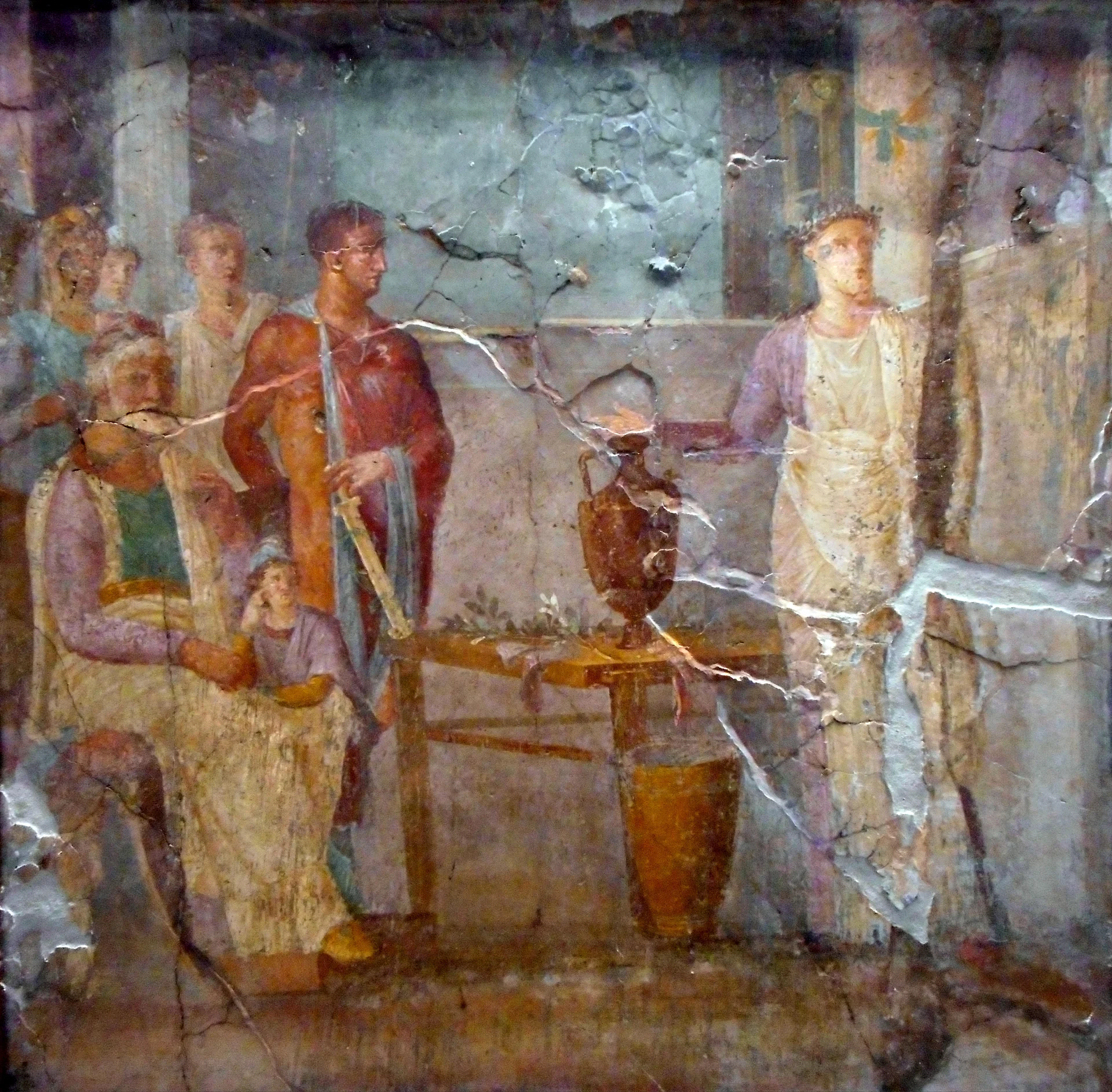
Opening illustration: Cassandra’s Prophecy, wall painting from the House of the Five Skeletons, Pompeii, first century BCE or CE. Cassandra, in the laurel wreath, prophesies before Priam, with the child Paris at his knee. Museo Archeologico Nazionale, Naples, inv. 8999. Public domain.
Homer lets Cassandra speak once, and the whole city comes.
No one neither man nor woman saw them, till Cassandra, fair as golden Venus standing on Pergamus, caught sight of her dear father in his chariot, and his servant that was the city’s herald with him. Then she saw him that was lying upon the bier, drawn by the mules, and with a loud cry she went about the city saying, “Come hither Trojans, men and women, and look on Hector; if ever you rejoiced to see him coming from battle when he was alive, look now on him that was the glory of our city and all our people.” At this there was not man nor woman left in the city, so great a sorrow had possessed them.
— Homer, Iliad 24.697–708, translated by Samuel Butler, 1898.1
The Fairest of Priam’s Daughters
In the Iliad Cassandra is Priamoio thygatrōn eidos aristēn, Πριάμοιο θυγατρῶν εἶδος ἀρίστην, “the fairest of Priam’s daughters,” and a suitor dies fighting for her hand. Homer says nothing about prophecy. When she cries out from the citadel she is reporting what her eyes see, and Troy believes her at once. The city that will not listen to her warnings comes running when the news is a corpse.1
The later tellers gave her the sight and took away her hearers. In their versions she serves Apollo as a priestess, and from the god she receives the power to see what is coming. What she sees is the destruction of Troy, years before anyone else in the city has a reason to be afraid.
The Gift Apollo Could Not Take Back
Aeschylus puts the story of the gift into twelve lines between Cassandra and the old men of Argos.
CASSANDRA. That is my power—a boon Apollo gave.
— Aeschylus, Agamemnon 1202–1213, translated by E. D. A. Morshead, 1881.2
CHORUS. God though he were, yearning for mortal maid?
CASSANDRA. Ay! what seemed shame of old is shame no more.
CHORUS. Such finer sense suits not with slavery.
CASSANDRA. He strove to win me, panting for my love.
CHORUS. Came ye by compact unto bridal joys?
CASSANDRA. Nay—for I plighted troth, then foiled the god.
CHORUS. Wert thou already dowered with prescience?
CASSANDRA. Yea—prophetess to Troy of all her doom.
CHORUS. How left thee then Apollo’s wrath unscathed?
CASSANDRA. I, false to him, seemed prophet false to all.
CHORUS. Not so—to us at least thy words seem sooth.
Apollo wanted her. He offered prophecy, she agreed, and once the gift was hers she refused him. “I, false to him, seemed prophet false to all” is in Greek epeithon ouden’ ouden, ἔπειθον οὐδέν’ οὐδέν, “I persuaded no one of anything.” Apollodorus puts it the same way: Apollo “deprived her prophecy of power to persuade.” She is never wrong. She is only unbelievable, and a god arranged it.3
A late Roman commentator on Virgil explains why the god did not simply take the sight back. Apollo spat in her mouth, and quia eripere deo semel tributum munus non conveniebat, “because it did not befit a god to snatch away a gift once given,” he left her the truth and removed the belief. The rule is not peculiar to Troy. Helios swears by the Styx before he hears what his son will ask, as the Phaethon article tells, and Herod promises Salome anything she names in front of his guests and pays with the head of John the Baptist. The powerful party binds himself, and someone weaker is destroyed by it.3
Underneath the curse is a god who wants a mortal woman. The Trojan version is milder than most. Apollo does not take her by force and fathers no child on her. He pays in advance, is refused, and makes the payment worthless. Luke’s annunciation has a god’s messenger come to a mortal woman too. Nothing is bargained for there, and the scene ends on her consent: “be it unto me according to thy word.” Cassandra consents, takes the gift and then refuses, and she bears no son of a god. What the refusal costs her is being believed.3
Set beside Jesus, the curse marks a first difference between the two prophets. Cassandra carries a god’s message and claims nothing about herself. The Gospels have Jesus carry the message and stand inside it as its subject. His hearers are asked to believe a prediction about the city and also something about the man who makes it.
Helen Arrives
She knew that her brother Paris would bring the city down by sailing to Sparta and coming home with Helen. Ovid has Paris himself report what she shouted as his ships were leaving:
“Whither thy headlong course? Thou wilt bring conflagration back with thee! How great the flames thou seekest over these waters, thou dost not know!” A truthful prophetess was she; I have found the fires of which she spoke, and flames of fierce love rage in my helpless breast!
— Ovid, Heroides 16.121–126, translated by Grant Showerman, 1914.4
In Latin her words are referes incendia tecum, “you will bring fire back with you,” and his are vera fuit vates, “she was a true prophet.” He hears every word and takes the fire for love. The curse works through ordinary motives. Nobody in Troy hears a voice from heaven telling them to ignore the princess. They find a reason of their own, and there is always one to hand.4
When the ship comes home, the late Greek poet Colluthus gives her one gesture: “Cassandra on the acropolis, when she beheld the new-comer, tore her hair amain and flung away her golden veil. But Troy unbarred the bolts of her high-built gates and received on his return her citizen that was the source of her woe.”4
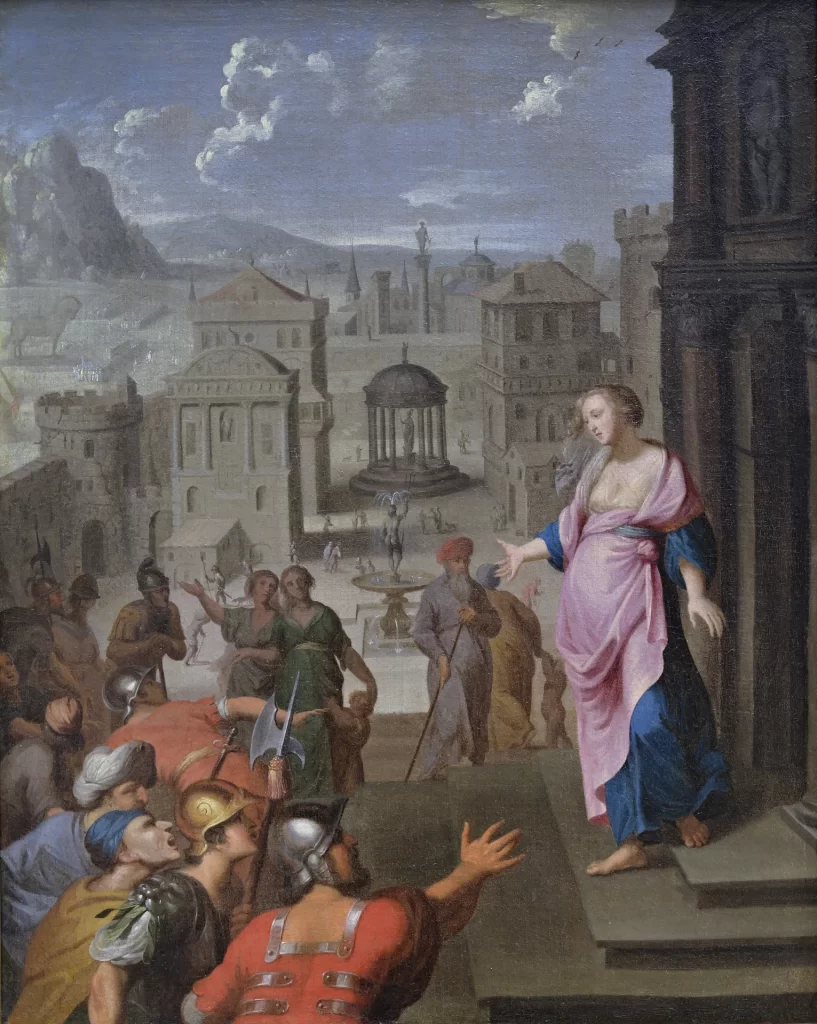
Jesus meets the same refusal in his own town and is given the same kind of reason. “Is not this the carpenter, the son of Mary?” the people of Nazareth ask, and Mark says “he could there do no mighty work.” His own people had already come to take him home, “for they said, He is beside himself.” His answer is a proverb: “A prophet is not without honour, but in his own country.” “Without honour” is atimos, ἄτιμος. Troy calls its prophet mad. Nazareth calls its prophet mad, and ordinary as well.5
At the Door of the House of Atreus
Troy fell as she said it would. On the night the wooden horse was dragged in, Virgil’s Aeneas remembers, she spoke once more: tunc etiam fatis aperit Cassandra futuris ora, dei iussu non umquam credita Teucris, “then too Cassandra opened her lips to the coming doom, lips that by a god’s command the Trojans never believed.”6

In the sack the Locrian Ajax found her “clinging to the wooden image of Athena” and raped her there. “Therefore they say that the image looks to heaven,” Apollodorus adds. She was counted with the spoil and given to Agamemnon.6

The Agamemnon of Aeschylus opens with the king coming home to Argos and Cassandra in the chariot behind him. By then everything she has said has been proved right, and being right has bought her nothing. Left with the old men of the chorus at the palace door, she cries out to the god.
Apollo, Apollo!
— Agamemnon 1080–1082, Morshead.2
God of all ways, but only Death’s to me,
Once and again, O thou, Destroyer named,
Thou hast destroyed me, thou, my love of old!
The Greek is a pun on his name. She calls him apollōn emos, ἀπόλλων ἐμός, “my destroyer,” and says apōlesas, ἀπώλεσας, “you have destroyed me.” The verb is apollymi, ἀπόλλυμι, and she hears it inside Apollo.7
Then she reads the house in front of her like a page of writing: the children once butchered in it, the net, the wife with the blade. She turns to her father and the animals he killed to keep his city safe.
Woe for my city, woe for Ilion’s fall!
— Agamemnon 1167–1172, Morshead.2
Father, how oft with sanguine stain
Streamed on thine altar-stone the blood of cattle, slain
That heaven might guard our wall!
But all was shed in vain.
Low lie the shattered towers whereas they fell,
And I—ah burning heart!—shall soon lie low as well.
Priam killed cattle on that altar for years and the walls came down. A little later she says that a slaughter-house will see her “hewn down, a reeking sacrifice.” The royal house pays for the city in animals until it pays in its own members. The Indian king who weighs his own flesh against a dove makes the same payment willingly, as the King Shibi article tells.
The chorus is not hostile. The old men pity her. They tell her, “to us at least thy words seem sooth,” and that “a child might read aright thy fateful strain.” Then they do nothing. Minutes later the king is screaming inside the house and they are still on the step debating whether to go in. Apollo never needed to make them deaf.
Mark puts the same problem at the centre of his Gospel. Jesus explains his parables in words from Isaiah: “That seeing they may see, and not perceive; and hearing they may hear, and not understand.” Mark’s wording is harder than it is usually read. The parables are told “that” the outsiders may not understand, “lest at any time they should be converted.” Read plainly, the unbelief is arranged in Mark as it is in Aeschylus. The motive given is different. Apollo’s is wounded pride. Isaiah’s words are a judgment on a people who had already stopped listening.8
The Trojan version does one more thing. A city warned by a prophetess whose warnings were bound to fail is a city that could never have saved itself. The Achaeans who sacked it become the instruments of a decree and stop being men who chose to burn a town and sell its women. The curse tidies the ledger for the winners, and the play was performed in a Greek theatre before a Greek audience.
The Wreath She Stamped into the Ground
At the end of the scene Cassandra takes the insignia of her office off her body and destroys them.
Ye wands, ye wreaths that cling around my neck,
— Agamemnon 1264–1270, Morshead.2
Ye showed me prophetess yet scorned of all—
I stamp you into death, or e’er I die—
Down, to destruction! Thus I stand revenged—
Go, crown some other with a prophet’s woe.
Look! it is he, it is Apollo’s self
Rending from me the prophet-robe he gave.
She wore them, she says, while her own people called her “witch and cheat.” The Greek words are harder: agyrtria, ἀγύρτρια, a begging fortune-teller, and limothnēs, λιμοθνής, “starveling.” Then one line holds the whole story: kai nyn ho mantis mantin ekpraxas eme, καὶ νῦν ὁ μάντις μάντιν ἐκπράξας ἐμέ, “and now the prophet has undone me, his prophet.” The god who gave her the sight strips the robe off her at the end of it.9
Jesus is handled the other way round. He strips off no sign of office. He is dressed in one as a joke. The soldiers “clothed him with purple, and platted a crown of thorns, and put it about his head,” and kneel to him. Cassandra destroys her regalia to be free of the god who gave it. Jesus is given regalia by men who think the claim behind it is ridiculous. Both wear the contempt of everyone watching, and only one of them chose the clothes.9
Then she walks in.
Portal of Hades, thus I bid thee hail!
Grant me one boon—a swift and mortal stroke,
That all unwrung by pain, with ebbing blood
Shed forth in quiet death, I close mine eyes.CHORUS. Maid of mysterious woes, mysterious lore,
Long was thy prophecy: but if aright
Thou readest all thy fate, how, thus unscared,
Dost thou approach the altar of thy doom,
As fronts the knife some victim, heaven-controlled?CASSANDRA. Friends, there is no avoidance in delay.
— Agamemnon 1291–1299, Morshead.2
The Gospels stage the same refusal to postpone in the garden. Jesus asks once whether the cup can pass, “nevertheless not what I will, but what thou wilt,” and waits for the men who are coming for him. Neither runs. What they ask for on the way in is different. Cassandra has just said ou mēn atimoi g’ ek theōn tethnēxomen, οὐ μὴν ἄτιμοί γ’ ἐκ θεῶν τεθνήξομεν, “we shall not die without honour from the gods.” An avenger will come, a son who will kill his own mother for it. Her word is the atimos of the proverb at Nazareth, and she expects her honour to be paid in blood. Jesus asks that the men killing him be forgiven, “for they know not what they do,” and tells the disciple with the sword, “Put up again thy sword into his place.”10
Not One Stone upon Another
Jesus of Nazareth also foresaw a city ruined by a war it could not win.
And as he went out of the temple, one of his disciples saith unto him, Master, see what manner of stones and what buildings are here! And Jesus answering said unto him, Seest thou these great buildings? there shall not be left one stone upon another, that shall not be thrown down.
— Mark 13:1–2, King James Version.11
The Greek is lithos epi lithon, λίθος ἐπὶ λίθον, “stone upon stone.” Luke gives the prophecy again from the road down the Mount of Olives, and there the prophet is in tears.
And when he was come near, he beheld the city, and wept over it, Saying, If thou hadst known, even thou, at least in this thy day, the things which belong unto thy peace! but now they are hid from thine eyes. For the days shall come upon thee, that thine enemies shall cast a trench about thee, and compass thee round, and keep thee in on every side, And shall lay thee even with the ground, and thy children within thee; and they shall not leave in thee one stone upon another; because thou knewest not the time of thy visitation.
— Luke 19:41–44, King James Version.11

What the city did not know were “the things which belong unto thy peace.” Its people wanted to be free of Roman taxes and of Roman interference in their religion, and many were waiting for a king like David who would drive the occupier out. The Gospels have Jesus refuse that part twice. In the wilderness the devil shows him “all the kingdoms of the world, and the glory of them,” and he turns the offer down. When a crowd in Galilee means to “take him by force, to make him a king,” he goes up a mountain alone. He told them that the war they wanted would finish them.11
The war came in the year 66, and in 70 the legions of Titus took the city. Josephus, a Jewish commander who had gone over to the Romans, watched it end.
Caesar gave orders that they should now demolish the entire city and temple, but should leave as many of the towers standing as were of the greatest eminency.
But for all the rest of the wall, it was so thoroughly laid even with the ground by those that dug it up to the foundation, that there was left nothing to make those that came thither believe it had ever been inhabited.
— Josephus, The Jewish War 7.1–3, translated by William Whiston, 1737.12

Troy’s fall was centuries old when Aeschylus wrote, and nobody in his theatre took the play for news. Mark was written close to the year the temple fell, and Luke after it. Luke’s version, with its trench and its encirclement, reads like a description of the siege, and the shape of the prophecy may owe something to the outcome.
Woe, Woe to Jerusalem
Jerusalem had another prophet of its fall. Josephus, who never mentions the prediction in the Gospels, tells his story. He was a farmer, and his name was Jesus.
There was one Jesus, the son of Ananus, a plebeian and a husbandman, who, four years before the war began, and at a time when the city was in very great peace and prosperity, came to that feast whereon it is our custom for everyone to make tabernacles to God in the temple, began on a sudden to cry aloud, “A voice from the east, a voice from the west, a voice from the four winds, a voice against Jerusalem and the holy house, a voice against the bridegrooms and the brides, and a voice against this whole people!”
— Josephus, The Jewish War 6.300–301, Whiston.12
The leading citizens had him flogged. He said nothing for himself and went on crying. They took him to the Roman governor, “where he was whipped till his bones were laid bare; yet he did not make any supplication for himself, nor shed any tears,” and at every stroke he answered, “Woe, woe to Jerusalem!” The governor Albinus “took him to be a madman, and dismissed him.” He kept up the cry for seven years and five months, until the siege he had announced was under way. Then, on the wall, “just as he added at the last, “Woe, woe to myself also!” there came a stone out of one of the engines, and smote him, and killed him immediately.”12
This Jesus is Jerusalem’s Cassandra. He has one message, he is beaten for it and called mad, and he dies as it comes true. Like the Jesus of the Gospels he is handed by his own leaders to the Roman governor, is scourged, and gives no answer. Mark says of the other, “Jesus yet answered nothing; so that Pilate marvelled.” Josephus’s prophet claims nothing about himself, and nobody worshipped him afterwards.12
Weep for Yourselves
On the road to the place of execution Luke has Jesus stop and speak to the women who are following him.
But Jesus turning unto them said, Daughters of Jerusalem, weep not for me, but weep for yourselves, and for your children. For, behold, the days are coming, in the which they shall say, Blessed are the barren, and the wombs that never bare, and the paps which never gave suck. Then shall they begin to say to the mountains, Fall on us; and to the hills, Cover us. For if they do these things in a green tree, what shall be done in the dry?
— Luke 23:28–31, King James Version.13
Cassandra speaks her last lines from the same position, on foot, under guard, a few steps from where she will be killed, before people who can do nothing for her. Her last thought is not for herself either. Of all human fortune she says, “One wet sponge-sweep wipes all our trace away,” and that she pities this more than her own death. The Greek scene is the bleaker in one respect. Cassandra speaks to men who have already admitted she is right. Jesus speaks to women who weep for him and have not understood the warning.13
What the Victors Kept
The Greeks did not leave her at that door. For what Ajax had done at Athena’s image, an oracle told his people “to send two maidens as suppliants for a thousand years.” The girls lived in the temple at Troy and swept it: “their hair was cropped, and they wore single garments and no shoes.” In Laconia the traveller Pausanias found “a sanctuary and image of Alexandra,” and the people of Amyclae told him that Alexandra was “Cassandra, the daughter of Priam.” Beside it they showed him the tomb of Agamemnon. The country of the kings who sacked Troy gave its prophetess a shrine and another name.14

Rome carried the furniture of the temple through its streets and carved the seven-branched lampstand on the Arch of Titus. Two and a half centuries later Eusebius, a bishop in the empire whose army had done it, copied Josephus’s account of the siege into his history of the church and gave the reason for the city’s end: “the judgment of God at length overtook those who had committed such outrages against Christ and his apostles.” In that sentence the army of Titus does not appear. A prophet nobody heeded turns a sack into a sentence already passed. The Greeks had that from Cassandra’s curse, and Eusebius has it from the tears on the Mount of Olives. The arch still stands, and the temple was not rebuilt.14
Sources and Translation Notes
1. Homer, Iliad 24.697–708 and 13.361–369, translated by Samuel Butler (London, 1898), Project Gutenberg. Greek from the Perseus Digital Library: ἀλλ’ ἄρα Κασσάνδρη ἰκέλη χρυσῇ Ἀφροδίτῃ (24.699). Butler gives the gods their Latin names. ↩
2. Aeschylus, Agamemnon, translated by E. D. A. Morshead, The House of Atreus (London, 1881), Project Gutenberg. Line numbers are those of the Greek text, from the Perseus Digital Library. ↩
3. Greek of Agamemnon 1208 and 1212: ξυναινέσασα Λοξίαν ἐψευσάμην; ἔπειθον οὐδέν’ οὐδέν, ὡς τάδ’ ἤμπλακον. Apollodorus, Library 3.12.5, translated by J. G. Frazer (1921), Theoi. Servius on Aeneid 2.247, Perseus Digital Library. Mark 6:22–28 and Luke 1:38, King James Version. ↩
4. Ovid, Heroides 16.121–126, translated by Grant Showerman (Loeb Classical Library, 1914), Theoi; Latin from The Latin Library. Colluthus, The Rape of Helen, closing lines, translated by A. W. Mair (Loeb Classical Library, 1928), Theoi. ↩
5. Mark 6:1–6 and 3:21, King James Version. Greek of Mark 6:4 from the SBL Greek New Testament, Bible Gateway: Οὐκ ἔστιν προφήτης ἄτιμος εἰ μὴ ἐν τῇ πατρίδι αὐτοῦ. ↩
6. Virgil, Aeneid 2.246–247, Latin from The Latin Library. Apollodorus, Epitome 5.22–23, Frazer, Theoi. ↩
7. Greek of Agamemnon 1081–1082: ἀπόλλων ἐμός. ἀπώλεσας γὰρ οὐ μόλις τὸ δεύτερον. Liddell–Scott–Jones, ἀπόλλυμι, “destroy utterly.” ↩
8. Mark 4:11–12, King James Version, quoting Isaiah 6:9–10. ↩
9. Greek of Agamemnon 1273–1275: καλουμένη δὲ φοιτὰς ὡς ἀγύρτρια πτωχὸς τάλαινα λιμοθνὴς ἠνεσχόμην. Mark 15:16–20, King James Version. ↩
10. Greek of Agamemnon 1279–1280: οὐ μὴν ἄτιμοί γ’ ἐκ θεῶν τεθνήξομεν. ἥξει γὰρ ἡμῶν ἄλλος αὖ τιμάορος. Mark 14:36, Luke 23:34 and Matthew 26:52, King James Version. ↩
11. Mark 13:1–2, Luke 19:41–44, Matthew 4:8–10 and John 6:15, King James Version. Greek from the SBL Greek New Testament, Mark 13:2, οὐ μὴ ἀφεθῇ ὧδε λίθος ἐπὶ λίθον, and Luke 19:44, τὸν καιρὸν τῆς ἐπισκοπῆς σου. ↩
12. Josephus, The Jewish War 7.1–3 and 6.300–309, translated by William Whiston (London, 1737), Lexundria: book 7 and book 6. Mark 15:1–5 and 15:15, King James Version. ↩
13. Luke 23:27–31, King James Version. Agamemnon 1327–1330, Morshead. ↩
14. Apollodorus, Epitome 6.20–22, Frazer. Pausanias, Description of Greece 3.19.6 and 3.26.5, translated by W. H. S. Jones and H. A. Ormerod (Loeb Classical Library, 1926), Theoi. Eusebius, Church History 3.5.3, translated by A. C. McGiffert (1890), New Advent. ↩