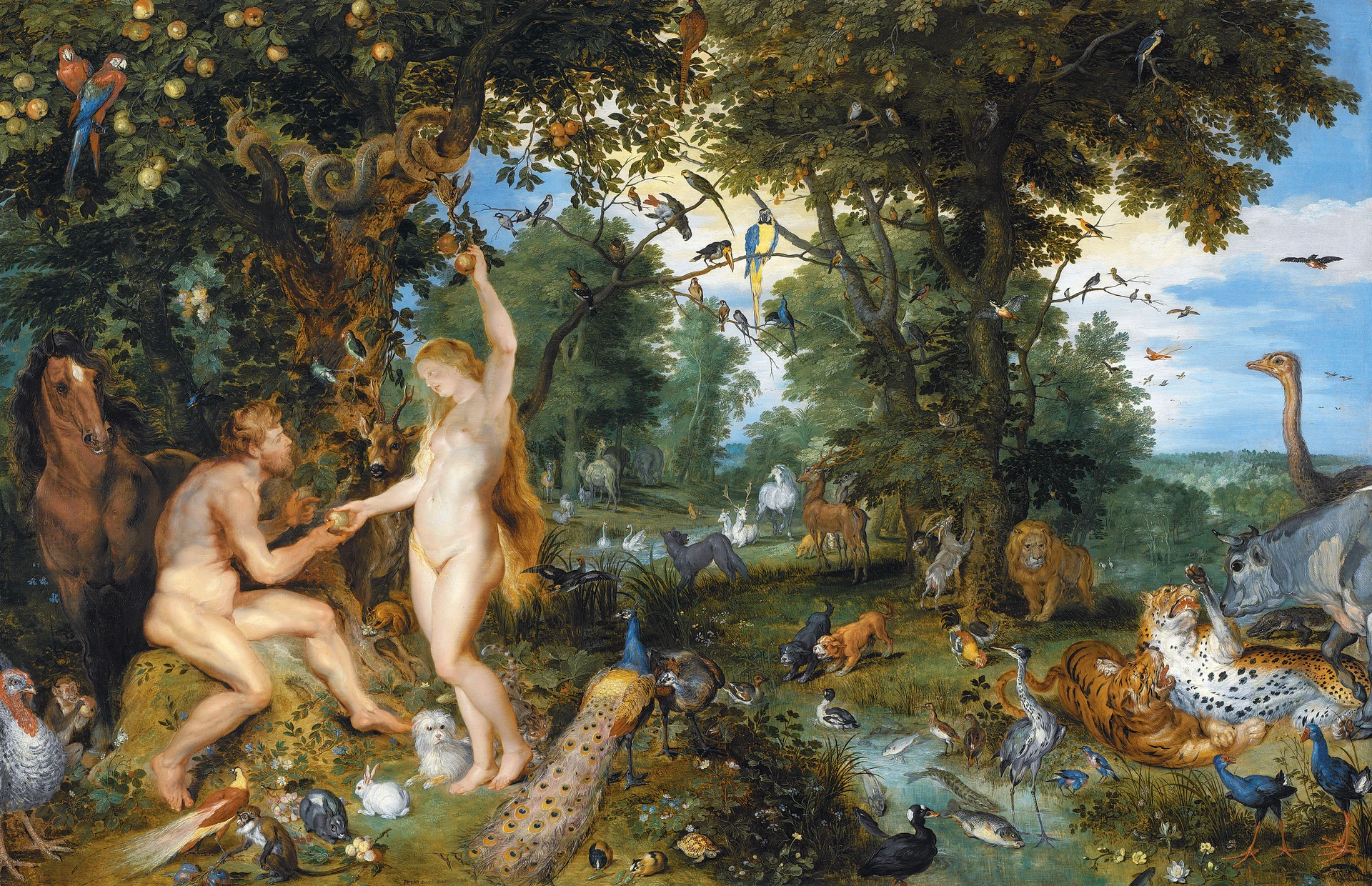
The serpent says three things in Genesis 3 and all three come true. Nobody questions it, the man and the woman are not cursed, the tree of life was never forbidden, and the first thing opened eyes see is their own nakedness
Opening illustration: Jan Brueghel the Elder and Peter Paul Rubens, The Garden of Eden with the Fall of Man, about 1615. Rubens painted Adam and Eve and Brueghel the garden and its animals. Eve reaches up into the tree; the beasts around them are still at peace. Mauritshuis, The Hague. Wikimedia Commons, public domain.
The serpent makes three statements in Genesis 3 and all three turn out to be correct. It says they will not die that day, and they do not die that day. It says their eyes will be opened, and two verses later the text says their eyes were opened, in those words. It says they will become as gods knowing good and evil, and before the chapter closes God says the man has become as one of us, to know good and evil. The only sentence in the episode that does not come true on its own stated terms is the warning God gave in the chapter before.
Jewish and Christian interpreters have answered that observation in a dozen ways, some of them very good. None of the answers makes it disappear, because the text supplies both halves of it.
This is the chapter the rest of the early Genesis stories reach back toward. The Nephilim come later. Cain comes later. The flood comes later. All of it is aftermath, and this is the scene it is the aftermath of.
Two Trees and One Prohibition
And out of the ground made the LORD God to grow every tree that is pleasant to the sight, and good for food; the tree of life also in the midst of the garden, and the tree of knowledge of good and evil.
— Genesis 2:9, King James Version.1
Two trees are named and only one is ever forbidden.
Of every tree of the garden thou mayest freely eat: but of the tree of the knowledge of good and evil, thou shalt not eat of it: for in the day that thou eatest thereof thou shalt surely die.
— Genesis 2:16–17, King James Version.
Read that as an inventory. Every tree is permitted, one is excepted, and the tree of life is not the exception. It falls inside the permission, so the man is free to eat from it on the day he is placed in the garden and every day after. The text never says he did and never says he did not. It leaves a tree of life standing in an orchard he has been told to help himself to, then says nothing more about it until the last three verses of the next chapter, where it suddenly matters more than anything else in the story.
Notice the diet as well. These are trees the man did not plant and does not water. He has a job there, to dress it and to keep it, but the food is already on the branches. The man in Eden eats fruit off trees. The sentence at the end of chapter three changes what he eats and how he gets it, and that change is the punishment.
Chapter two closes on the line the next scene destroys: they were both naked, the man and his wife, and were not ashamed. The next sentence introduces the serpent, and the narrator joins the two with a pun. The humans are ʿarummim, עֲרוּמִּים, naked. The serpent is ʿarum, עָרוּם, shrewd, “more subtil than any beast of the field.”
The Question That Misquotes God
Now the serpent was more subtil than any beast of the field which the LORD God had made. And he said unto the woman, Yea, hath God said, Ye shall not eat of every tree of the garden?
— Genesis 3:1, King James Version.2
The serpent opens with a misquotation slanted to make God look worse. God said that of every tree thou mayest freely eat, with one exception. The serpent asks whether God said they may not eat of every tree, taking a permission that carried an exception and handing it back as a blanket prohibition. It does this as a question, so it is not yet on record as having asserted anything.
And the woman said unto the serpent, We may eat of the fruit of the trees of the garden: but of the fruit of the tree which is in the midst of the garden, God hath said, Ye shall not eat of it, neither shall ye touch it, lest ye die.
— Genesis 3:2–3, King James Version.
She corrects him, and alters it twice. She adds a rule. God said do not eat of it. She says do not eat of it, neither shall ye touch it. Nobody in the text has told her not to touch the tree. Whether she built that fence herself or was handed it by the man who took the command directly, Genesis does not say. Either way the prohibition in her mouth is bigger than the one issued, and the first thing that happens to an inflated rule is that somebody tests the inflated part and finds nothing behind it. She also calls it the tree which is in the midst of the garden, which is where Genesis 2:9 put the tree of life. Asked directly which tree is off limits, she gives the address of the one that was never forbidden.
The conversation also changes the name of God. Everywhere else in Genesis 2 and 3 the narrator calls him YHWH Elohim, יְהוָה אֱלֹהִים, “the LORD God,” twenty times in all. In this exchange, and only here, he is plain Elohim, אֱלֹהִים, “God”: in the serpent’s question, in the woman’s answer, and in the serpent’s reply. The personal name drops out of the one conversation about God held behind his back. The two speakers talk about a deity. Neither of them uses his name.3
Ye Shall Not Surely Die
And the serpent said unto the woman, Ye shall not surely die: for God doth know that in the day ye eat thereof, then your eyes shall be opened, and ye shall be as gods, knowing good and evil.
— Genesis 3:4–5, King James Version.4
There are two claims there and only one is a denial. The first contradicts the penalty. God said mot tamut, מוֹת תָּמוּת, “dying thou shalt die.” The serpent says lo-mot temutun, לֹא־מוֹת תְּמֻתוּן, the same words with “not” in front. On the day in question nobody dies. Genesis 5:5 eventually reports that Adam lived nine hundred and thirty years. The usual defence is that the Hebrew means dying became certain rather than immediate, which is how most translations soften it.
The second claim is the dangerous one, because it does not dispute what the fruit does. It agrees with God about the tree’s effect and disagrees about the motive for fencing it off. God doth know, says the serpent. The fruit works, it opens eyes, it confers the knowledge of good and evil, and the prohibition is therefore not protection but an interest being defended. That is an accusation of motive and the chapter never answers it. God questions the man. God questions the woman. Nothing in Genesis 3 is addressed to the charge, and when God finally speaks about it in verse twenty-two he says something closer to a confirmation than a denial.
The type-scene: wisdom given, deathlessness withheld. This plot was told in Mesopotamia long before Genesis was written down, and the closest version is Adapa. Adapa is not the first man. He is the wise man of Eridu, who bakes the bread and catches the fish for the god Ea’s table, and one copy of the story opens by saying that Ea gave him wisdom and did not give him eternal life. He breaks the wing of the south wind and is summoned before Anu, the god of heaven, to answer for it. Ea coaches him first and tells him that the bread and water he will be offered in heaven are the bread and water of death, so he must refuse them. Anu, won over, offers him the bread and water of life instead. Adapa obeys his own god, refuses, and is sent back to earth a mortal. The machinery is close: a man near to a god, a food that would have given him life, an instruction from a god that keeps him from taking it, and mortality as the result. What differs is who speaks. The Mesopotamian poem splits the parts between two gods, Ea who warns and Anu who offers, and it never says why Ea gave the warning. George Barton read it as a deliberate lie. Jack Sasson hears a pun, since the scribe’s spelling can mean food of death or food for humans, which would make the warning ambiguous rather than false. Genesis gives the warning and the garden to one God, and his reason comes out only later, in the verse that closes the garden. The snake is already in the tradition too. When Gilgamesh obtains the plant that restores youth he sets it down to bathe, and a serpent smells it, takes it, and sheds its skin as it goes.
The Serpent Coiled Round the Tree
Before the woman reaches for the fruit, look at the picture the scene is built from, because Genesis did not invent it. A tree bearing fruit the gods have reserved, with a serpent wound round its trunk, is one of the standard images of the ancient world, and it normally means one thing.
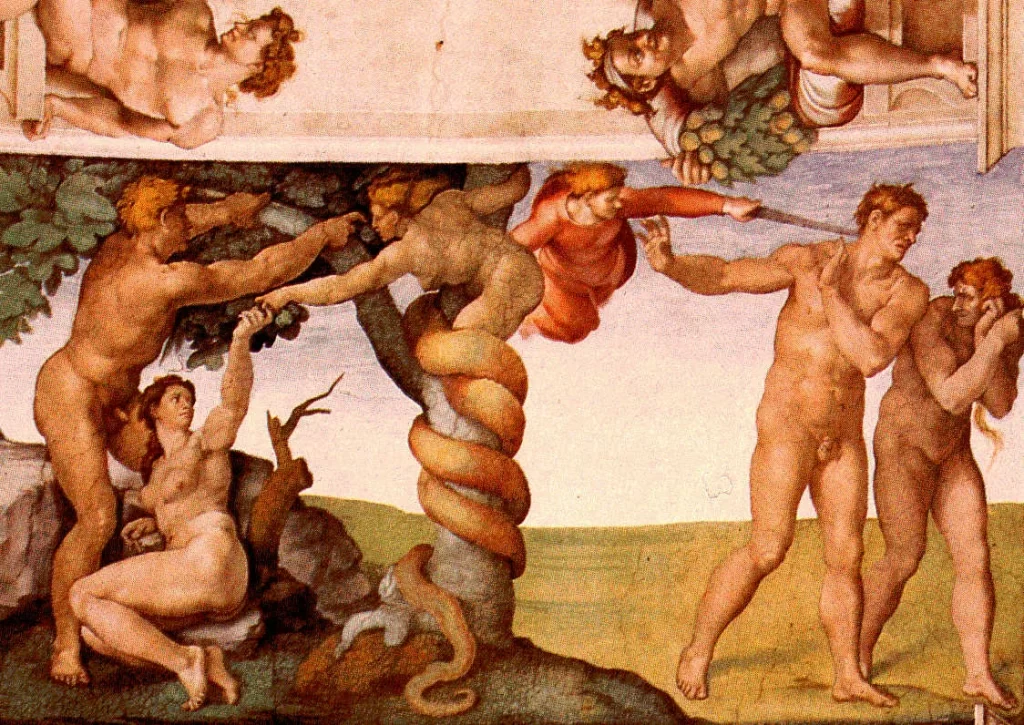
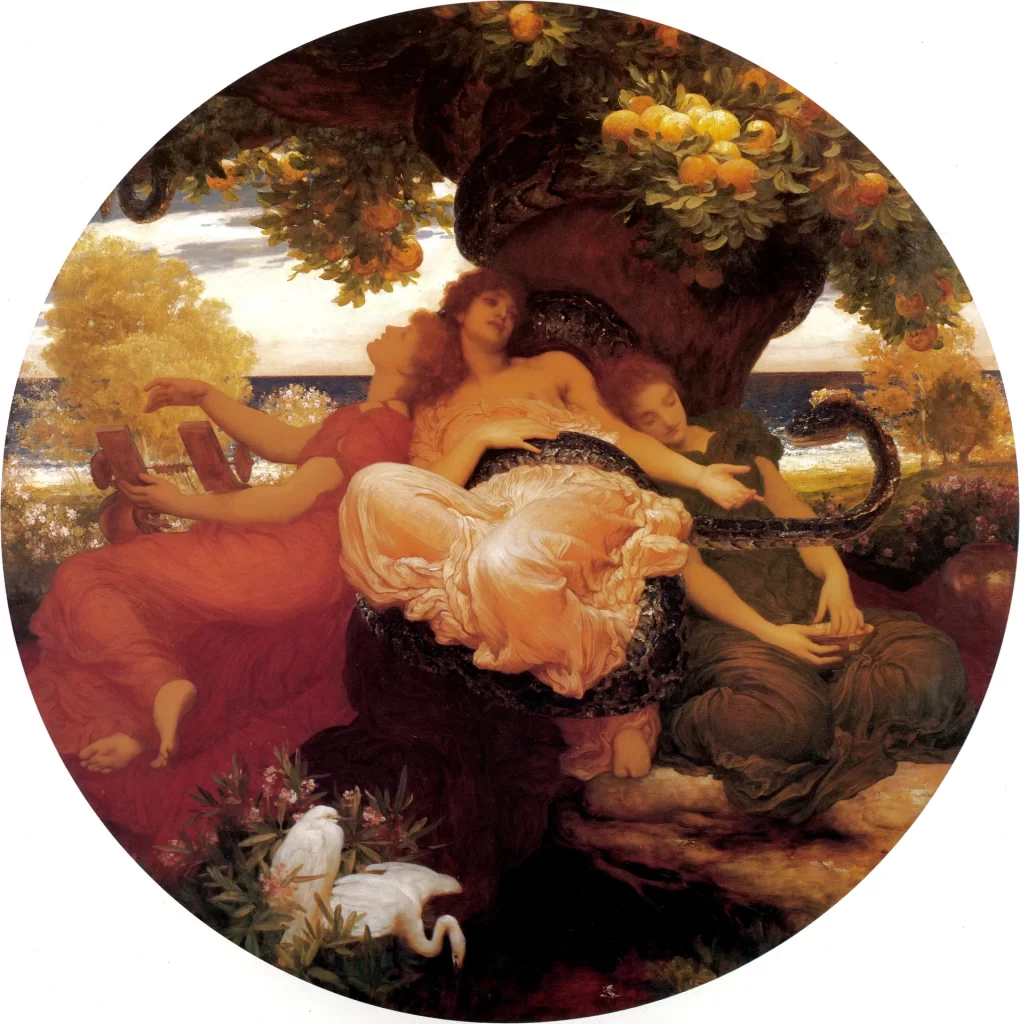
The same picture, doing opposite jobs. Michelangelo, The Temptation and Fall, Sistine Chapel ceiling, about 1510, public domain, and Frederic Leighton, The Garden of the Hesperides, 1892, Lady Lever Art Gallery, public domain. Both show a serpent wound round the trunk of a fruit tree mortals are not supposed to eat from. The serpent of the Hesperides is there to stop anybody taking the apples. The serpent in Eden is handing one over.
The type-scene: the serpent set to guard the fruit. At the western edge of the world the Hesperides keep a tree of golden apples, and a serpent that never sleeps is coiled round it; later writers call him Ladon, and Heracles has to get past him. In Colchis the golden fleece hangs on an oak with a sleepless serpent round it, and Jason has to get past that one, with Medea’s help. The furniture is not vague. A tree, restricted fruit, and a snake wrapped round the wood, and in every case but one the snake’s job is obvious. He is the lock, and he exists so the valuable thing stays with the gods who own it. Genesis inherits the image and reverses the one element that matters. Its serpent stands at the same tree doing the opposite job, arguing the fruit into human hands instead of keeping human hands off it. That reversal is Genesis being original rather than derivative, and it is also what makes the serpent culpable, because a guard who opens the gate has betrayed a post.5
It Was Never an Apple
And when the woman saw that the tree was good for food, and that it was pleasant to the eyes, and a tree to be desired to make one wise, she took of the fruit thereof, and did eat, and gave also unto her husband with her; and he did eat.
— Genesis 3:6, King James Version.6
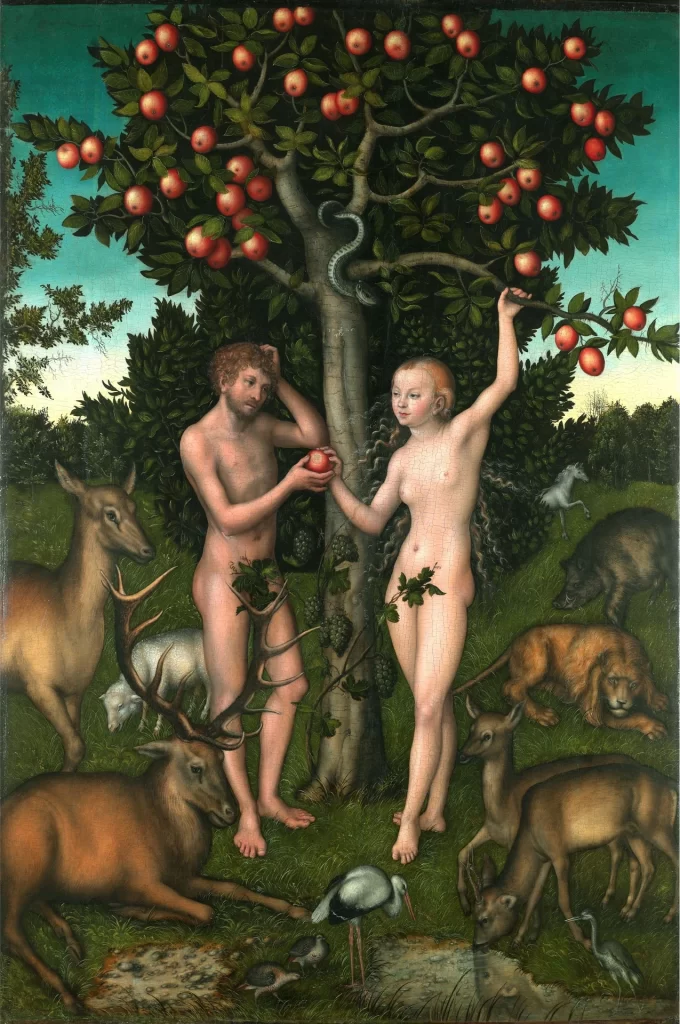
The Hebrew says fruit, peri, פְּרִי, and nothing else, and so does every other verse in the chapter. The early guesses were various and none was an apple. The rabbis of the Talmud and of Genesis Rabbah argued for wheat, grapes, the citron and the fig. Rashi chose the fig, because the leaves they sew together come off a fig tree, so that “by the thing through which they were spoiled they were mended.”
The usual explanation for the apple is a Latin pun: malum is “evil” and mālum is “apple.” The Vulgate does not make it. Its fruit is fructus, “she took of its fruit,” tulit de fructu illius. The only mali in the passage is in the tree’s name, lignum scientiae boni et mali, “the tree of the knowledge of good and of evil.” The pun was available to anyone who wanted it, and later Latin writers used it, but it is not in the text. The apple arrives in pictures. In French pomme, from the Latin poma, fruits, narrowed over the Middle Ages from fruit in general to one fruit in particular, and by the later Middle Ages painters across northern Europe agreed on it. The apple in Eden is a French word getting smaller, followed by four hundred years of painters agreeing with each other.
What the Tree Gives
Three reasons are given for eating and only the third involves knowledge. The fruit is food, it is beautiful, and it will make her wise. The first two are reasons anyone would eat anything in that garden, since every tree there was already pleasant to the sight and good for food. What singles this tree out is the third reason, and the third reason is the one the serpent supplied. Then the man eats and the text gives him nothing. No question, no hesitation, not one word of speech. She hands it to him and he eats it. For a chapter usually summarised as the woman deceived and the man led astray, Genesis is precise about the difference. She is worked on at length by something the narrator has called subtil, and she is the only person in the story who reasons about anything. He is handed fruit.
And the eyes of them both were opened, and they knew that they were naked; and they sewed fig leaves together, and made themselves aprons.
— Genesis 3:7, King James Version.7
They were naked in 2:25 and it did not register. They are naked in 3:7 and it is unbearable. Nothing about their bodies has changed. What has changed is that somebody is now keeping score from the inside.
The Hebrew Bible uses the phrase “good and evil” elsewhere in ways that are easier to read. The tree is the tree of ha-daʿat tov va-raʿ, הַדַּעַת טוֹב וָרָע, the knowing of good and bad. A woman of Tekoah flatters David by telling him he is as an angel of God, to discern good and bad. Barzillai turns down a place at court because he is eighty years old and can no longer discern between good and evil, and then explains what he means: he cannot taste his food or hear singers any more. Deuteronomy calls the children who will be let into the land the ones who in that day had no knowledge between good and evil. In none of those places does the phrase mean the difference between righteousness and sin. It means competence, the working judgement of an adult or an elder or a king. That changes what kind of tree this is. It is not a tree that turns innocent people into sinners. It is a tree that turns children into adults, and what it gives is the capacity to judge.
Nobody Asks the Serpent Anything
And they heard the voice of the LORD God walking in the garden in the cool of the day: and Adam and his wife hid themselves from the presence of the LORD God amongst the trees of the garden.
— Genesis 3:8, King James Version.8
They hide among the trees, which are the things they were given. The walking happens in the cool of the day as a matter of routine, which tells you these are parties who know each other. Then comes the question that treats the knowledge itself as evidence: who told thee that thou wast naked. Shame is the receipt.
And the man said, The woman whom thou gavest to be with me, she gave me of the tree, and I did eat.
— Genesis 3:12, King James Version.
That is a two-part answer and most retellings keep only the first part. He blames the woman, and before he blames the woman he blames whoever supplied her. The woman whom thou gavest. Asked a direct question about his own conduct, he answers by naming the party who made the introduction.
She passes it down one further link, saying the serpent beguiled her, and there the chain stops, because the serpent is never asked anything at all. Both humans get a question and a chance to answer it. The serpent gets a sentence with no hearing, and the narrative records no motive for it before or after. It is not told what it wanted. It is not accused of lying, which would be awkward, since everything it said was accurate. It is not called Satan, or an adversary, or a fallen angel. Genesis 3:1 calls it a beast of the field and Genesis 3:14 curses it above all cattle, a comparison that only works if the thing cursed is an animal.
The identification with Satan is real and it matters enormously, but it happens later and elsewhere. The Wisdom of Solomon, written in Greek perhaps a century before the gospels, says that through envy of the devil came death into the world, and Revelation makes it permanent by naming the dragon as that old serpent, called the Devil, and Satan. A reader who comes to Genesis 3 holding Revelation finds Satan in the garden without difficulty. A reader who comes to it cold finds a talking animal that was right.
Three Sentences, and Who Is Not Cursed
And the LORD God said unto the serpent, Because thou hast done this, thou art cursed above all cattle, and above every beast of the field; upon thy belly shalt thou go, and dust shalt thou eat all the days of thy life.
— Genesis 3:14, King James Version.9
The verse that follows is the most heavily worked line in the chapter and it has its own article on this site, because the enmity between two lines of seed runs into every serpent-slaying story in the ancient world. What belongs here is the sentence above it. The serpent goes onto its belly and is given dust to eat, which explains why snakes move as they do. It is a sentence passed on a species.
Unto the woman he said, I will greatly multiply thy sorrow and thy conception; in sorrow thou shalt bring forth children; and thy desire shall be to thy husband, and he shall rule over thee.
— Genesis 3:16, King James Version.
And unto Adam he said, Because thou hast hearkened unto the voice of thy wife, and hast eaten of the tree, of which I commanded thee, saying, Thou shalt not eat of it: cursed is the ground for thy sake; in sorrow shalt thou eat of it all the days of thy life; thorns also and thistles shall it bring forth to thee; and thou shalt eat the herb of the field; in the sweat of thy face shalt thou eat bread, till thou return unto the ground; for out of it wast thou taken: for dust thou art, and unto dust shalt thou return.
— Genesis 3:17–19, King James Version.
Now count the curses. The serpent is cursed and the ground is cursed. The man is not cursed and the woman is not cursed. Whatever those two are receiving, the chapter avoids that word for both of them, and a chapter this economical does not spend that kind of care by accident.
Every item in the two sentences describes ordinary life in the ancient Near East. Childbirth did kill women. The soil was thin and full of thistles. Grain farming ate the whole year. Women were under the authority of husbands. People died. The chapter takes the conditions its readers were already living inside and supplies a reason why they are deserved. Form critics call that an etiology, and the label is accurate and a little too comfortable, because it names the form without asking what the form does. A story explaining a hardship as a punishment earned by the first people tells you that you have no standing to complain about it.
The sharpest case is the clause about the husband, because later writers pick it up where we can watch. Ben Sira writes that from a woman came the beginning of sin, and that because of her we all die. The writer of First Timothy forbids women to teach and takes his reason straight from this chapter: Adam was not deceived, but the woman being deceived was in the transgression. That is Genesis 3 cited as legal precedent, inside the canon, in an argument about who is allowed to speak.
The verse also has a twin in the next chapter that almost nobody reads beside it. God warns Cain that sin lieth at the door, and then says, and unto thee shall be his desire, and thou shalt rule over him. To the woman: ve-el-ishekh teshuqatekh ve-hu yimshol-bakh, וְאֶל־אִישֵׁךְ תְּשׁוּקָתֵךְ וְהוּא יִמְשָׁל־בָּךְ. To Cain: ve-elekha teshuqato ve-attah timshol-bo, וְאֵלֶיךָ תְּשׁוּקָתוֹ וְאַתָּה תִּמְשָׁל־בּוֹ. Desire, teshuqah, and rule, mashal, the same two words, in a sentence plainly about mastering something that is trying to master you. Read Genesis 3:16 against Genesis 4:7 and it stops sounding like a description of marriage.
Then there is the food. The man ate fruit off trees that grew by themselves, and his sentence turns him into a farmer: cursed ground, thorns, sweat, bread. The next chapter opens with his two sons, one a keeper of sheep and the other a tiller of the ground, and the tiller kills the keeper. This site has argued that the garden is the world before agriculture and that the first murder is a quarrel between two ways of getting fed. Genesis 3 is where the switch is thrown, and the skeletons on either side of that change are not a matter of interpretation. Early farmers were often shorter than the foragers before them, their teeth were worse, and their bones record hunger and disease in ways forager bones generally do not. Genesis says the change was a punishment. The excavated remains say it made people worse off.
The Reason He Actually Gives
Adam then calls his wife’s name Eve, Ḥavvah, חַוָּה, because she was the mother of all living, em kol-ḥai, אֵם כָּל־חָי, which names her for life in the verse immediately after she is sentenced to pain in childbirth. This is also where another famous name gets attached, so it is worth clearing away. Lilith is not in Genesis. The story that makes her Adam’s first wife, refusing to lie beneath him and leaving the garden, comes from the Alphabet of Ben Sira, a Hebrew text of the eighth to tenth century. The one lilit, לִילִית, in the Hebrew Bible is at Isaiah 34:14, among the creatures haunting a ruin, and the King James renders it screech owl.
Unto Adam also and to his wife did the LORD God make coats of skins, and clothed them.
— Genesis 3:21, King James Version.10
Something has to die for that. The fig leaves were their own work and did not survive a chapter. The kotnot ʿor, כָּתְנוֹת עוֹר, coats of skin, are God’s work, and skins mean the first death in the Bible happens here, off the page, to an animal nobody names, so that two people can be covered. Read it as a small mercy at the end of a hard scene and it is exactly that. Read it as the opening entry in a system and it is also that, and the system runs for the next thousand years on the same principle. Something dies and the shame gets covered over.
And the LORD God said, Behold, the man is become as one of us, to know good and evil: and now, lest he put forth his hand, and take also of the tree of life, and eat, and live for ever:
— Genesis 3:22, King James Version.
That verse is the hinge of the chapter and it does three difficult things at once. It confirms the serpent, since “the man is become as one of us, to know good and evil” is verse five with the tense changed and God speaking it. It gives the reason for the expulsion, and the reason is not sin. It is lest he put forth his hand, and take also of the tree of life, and eat, and live for ever. The concern is access. They are removed from the garden to keep them from a tree that was never on the forbidden list, because now they can judge like gods and the only thing still separating them from gods is that they die.
And the sentence does not finish. Hebrew narrative breaks off like this occasionally, and the colon at the end of verse twenty-two in the King James is an honest colon. Whatever the consequence would have been, the text declines to say it out loud.
So he drove out the man; and he placed at the east of the garden of Eden Cherubims, and a flaming sword which turned every way, to keep the way of the tree of life.
— Genesis 3:24, King James Version.
He is sent out to till the ground, so the exile and the job description are one sentence. Then a guard is posted, ha-keruvim, הַכְּרֻבִים, and lahat ha-ḥerev ha-mithappekhet, לַהַט הַחֶרֶב הַמִּתְהַפֶּכֶת, the flame of the turning sword, and that detail tells you what sort of place Eden was. Nobody posts armed guards on a wilderness. Guards go on property. Ezekiel, addressing the king of Tyre, puts him in Eden the garden of God as a matter of course, walking among the stones of fire with a cherub beside him. Persian kings and nobles kept walled parks stocked with trees and game, and the Persian word for one passed into Greek as paradeisos, παράδεισος, and into English as paradise; the Greek translators of Genesis used it for the garden itself. Two people are expelled from a royal park and the gate is put under guard behind them. That is not in the first place a theological image. It is what happens to people who have lost access to a king.
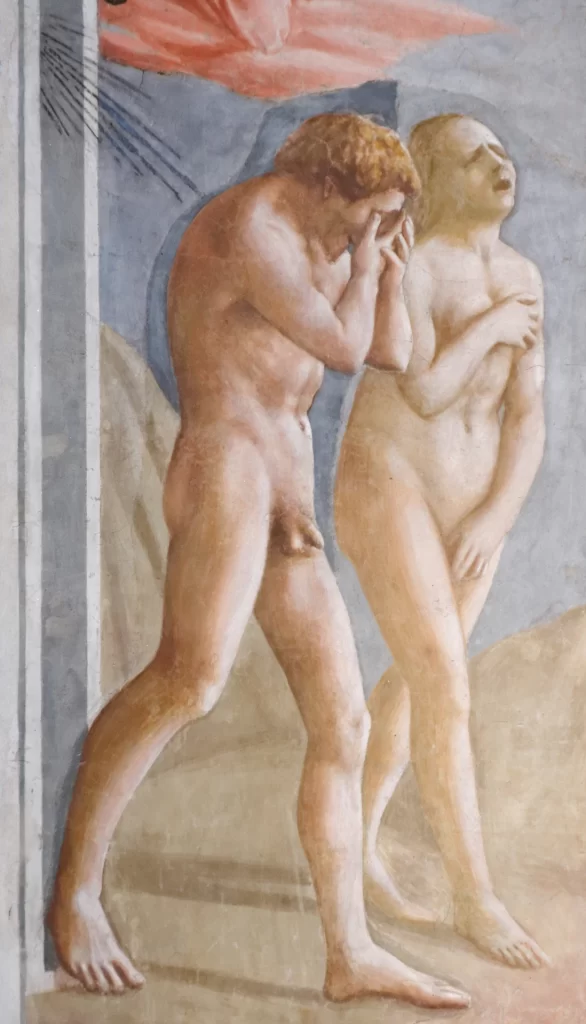
The Serpent as Liberator
Orthodoxy settled this chapter a long time ago and the settlement is tidy. The serpent is the devil, the fruit is disobedience, the pair are sinners, and the expulsion is a sentence justly passed on people who forfeited a kingdom. Everything in the chapter gets read backwards from the ending, and the ending is a locked gate.
There were readers in antiquity who took the same verses and came out the other side. They were not ignoring the text or importing a foreign story into it. They read the sentences in the order they appear and refused to supply the motive the chapter withholds.
The Testimony of Truth, found at Nag Hammadi, works straight through Genesis 3 and asks the question the chapter invites: what sort is this God? First he refuses Adam the tree of knowledge, then he comes through the garden calling Adam, where art thou, as though he did not know. The verdict that text reaches is that he has shown himself a malicious grudger. There is nothing strained about the reasoning. It is verse twenty-two read without a thumb on the scale.11
Push that one step further and the whole cast changes places. In the Hypostasis of the Archons the serpent is the Instructor, the one being in the garden who tells the two of them the truth about what has been done to them. The creator is a jealous ruler who wants his workforce ignorant. And Eve is not the one who ruined it. She is the one who wakes Adam up: she says “Arise, Adam,” and he answers that it is she who has given him life, and that she will be called mother of the living.
Set that beside Genesis 3:20, where Adam gives Eve exactly that name. In Genesis she is named mother of all living immediately after being sentenced, and the name reads like a consolation handed to a woman who has just lost. In the Gnostic version she earns the title by the act itself, because the act was a rescue. Irenaeus called groups who read this way Ophites, from ophis, ὄφις, the Greek for snake, and he meant it as an insult.
The two readings are not two moods. They disagree about what happened. One says a kingdom was forfeited by people who were told not to and did. The other says a prison was opened, that the eyes were the point, and that the two who walked out were the first people in the world to see anything clearly. The chapter as written will support either, because it will not say what the serpent wanted, and it will not deny what the serpent said.
The Second Adam and the Second Tree
The archetype reading is not something later Christians imposed on a chapter that was resisting them. Paul builds his whole account of salvation on this chapter, and he builds it as a mirror: “For as in Adam all die, even so in Christ shall all be made alive.” Hōsper gar en tō Adam pantes apothnēskousin, ὥσπερ γὰρ ἐν τῷ Ἀδὰμ πάντες ἀποθνῄσκουσιν. The mechanism only works if there was a first one, and the symmetry is the argument. What one man’s disobedience did, one man’s obedience undoes.12
Read that way, the furniture of Genesis 3 keeps turning up in the gospels with the labels still on it. The ground is cursed to bring forth thorns, and soldiers plait a crown of thorns for the man Paul calls the last Adam. The curse falls on a tree, and the apostles in Acts and in First Peter call the cross a tree, the word Deuteronomy uses for the one that is hanged and cursed. A tree brought death to the first pair, the tradition answers with a tree, and the last chapter of Revelation puts the tree of life back in the middle of the city with its leaves for the healing of the nations, which is the guarded thing at the end of Genesis 3 finally handed over.
The gardens line up as well. A man is tested in a garden, takes what he is offered, and hides. Another man goes with his disciples over the brook Cedron, “where was a garden,” and is arrested there without hiding. He is buried in a garden, and the first person to see him afterwards takes him for the gardener, ho kēpouros, ὁ κηπουρός.
And Their Eyes Were Opened
Which leaves the promise the serpent actually made. Not knowledge in the abstract, and not power. Eyes. “Your eyes shall be opened,” it said, and verse seven delivers it: “and the eyes of them both were opened, and they knew.” What they knew was that they were standing there with no clothes on. Sight arrived and the first thing it brought was shame, which is the cruellest sentence in the chapter and the only one nobody passes on them. They do that to themselves.13
The Greek translation of Genesis words verse seven kai diēnoichthēsan hoi ophthalmoi tōn dyo, kai egnōsan, καὶ διηνοίχθησαν οἱ ὀφθαλμοὶ τῶν δύο, καὶ ἔγνωσαν, “and the eyes of the two were opened, and they knew.” Luke, who read his scriptures in that Greek, uses the same verb at the end of his gospel. Two disciples walk seven miles to Emmaus with a stranger who explains the scriptures to them, and at the table, when he breaks the bread, autōn de diēnoichthēsan hoi ophthalmoi kai epegnōsan auton, αὐτῶν δὲ διηνοίχθησαν οἱ ὀφθαλμοὶ καὶ ἐπέγνωσαν αὐτόν, “and their eyes were opened, and they knew him.” The first pair open their eyes and know what they are. These two open their eyes and know who he is.
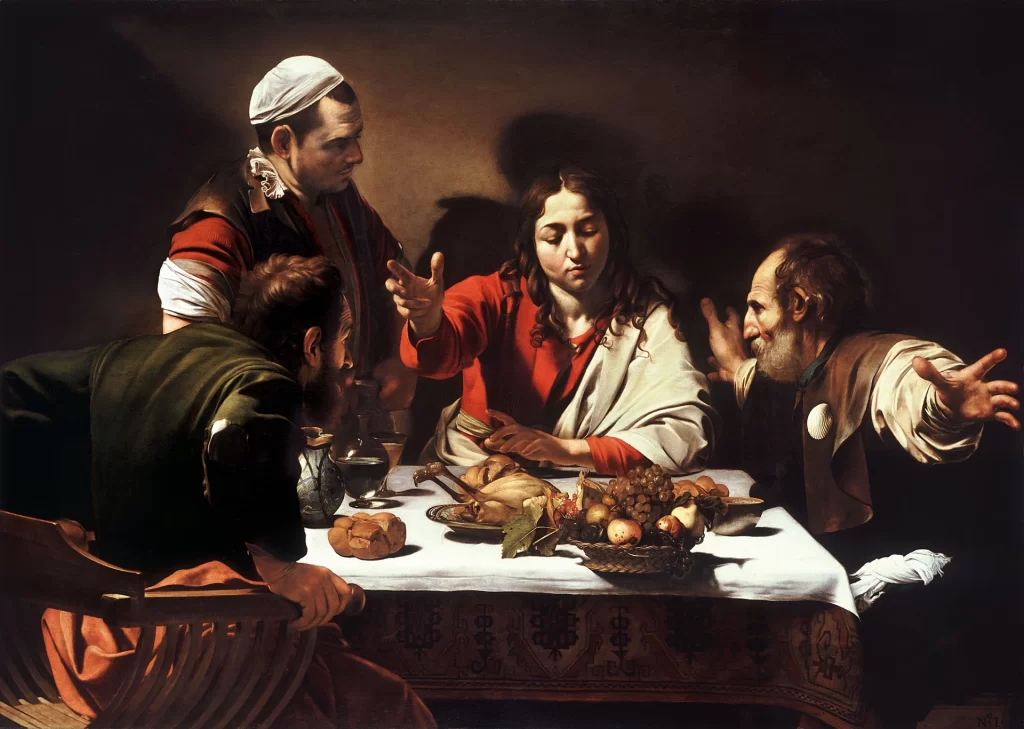
The gospels keep giving the serpent’s promise back. A man born blind is given his sight and can say only, “whereas I was blind, now I see.” Paul says he was sent to the nations “to open their eyes, and to turn them from darkness to light.” Each time it is eyes, and each time the person whose eyes are opened stays to look.
In Eden, when their eyes were opened, the two of them hid from God among the trees. At Emmaus, when their eyes were opened, Luke’s sentence goes on: “and he vanished out of their sight.” It was toward evening and the day was far spent. “And they rose up the same hour, and returned to Jerusalem.”
Sources and Translation Notes
Biblical passages are quoted from the King James Version. Hebrew is from the Masoretic text as given by Sefaria, Greek of the New Testament from the SBL Greek New Testament, Latin from the Clementine Vulgate. The transliterations are simplified.
1. Genesis 2:9, 2:15–17 and 2:25; Claus Westermann, Genesis 1–11: A Commentary (Minneapolis, 1984), on the ʿarummim and ʿarum wordplay. ↩
2. Genesis 3:1–3. ↩
3. The count of YHWH Elohim (twenty, in Genesis 2:4–3:24) and of plain Elohim (only 3:1, 3:3 and 3:5) was made from the Hebrew text. ↩
4. Genesis 2:17, 3:4–5 and 5:5. Adapa in Stephanie Dalley, Myths from Mesopotamia (Oxford, 1989), pp. 182–188. Ea’s warning as a lie: George A. Barton, Archaeology and the Bible (second edition, Philadelphia, 1917), p. 260, his commentary rather than a line of the tablet. The pun on mūtu, death, and mutu, a human being, is Jack M. Sasson’s proposal in “Another Wrinkle on Old Adapa” (2008), pp. 4–5. Gilgamesh XI, the plant and the snake, in Andrew George, The Epic of Gilgamesh (London, 1999), Tablet XI, lines 285–307. ↩
5. Hesiod, Theogony 215–216 for the Hesperides and 333–335 for the serpent that guards the golden apples; Apollodorus, Library 2.5.11, for Heracles and the serpent; Apollonius of Rhodes, Argonautica 4.1396 for the name Ladon and 4.123–166 for the serpent of the fleece. The paired paintings are Michelangelo’s Temptation and Fall on the Sistine ceiling and Frederic Leighton’s Garden of the Hesperides. ↩
6. Genesis 3:6. Genesis Rabbah 15:7 and Babylonian Talmud Berakhot 40a for wheat, grapes, the citron and the fig; Rashi on Genesis 3:7. Vulgate, Genesis 2:17, 3:3 and 3:6. On pomme and the apple in medieval images, Michel Pastoureau, Une histoire symbolique du Moyen Âge occidental (Paris, 2004), and Alain Rey, ed., Dictionnaire historique de la langue française (Paris, 1992), s.v. pomme. ↩
7. Genesis 2:9 and 3:7; 2 Samuel 14:17, 2 Samuel 19:35, Deuteronomy 1:39. ↩
8. Genesis 3:8–14. Wisdom of Solomon 2:24; Revelation 12:9 and 20:2. ↩
9. Genesis 3:14–19 and 4:7. Sirach (Ecclesiasticus) 25:24; 1 Timothy 2:12–14. On health before and after farming, Mark Nathan Cohen, Health and the Rise of Civilization (New Haven, 1989), and Clark Spencer Larsen, Bioarchaeology (Cambridge, 1997). ↩
10. Genesis 3:20–24. The Alphabet of Ben Sira in David Stern and Mark Jay Mirsky, eds., Rabbinic Fantasies (Philadelphia, 1990); Isaiah 34:14. Ezekiel 28:13–14. Xenophon, Anabasis 1.2.7 and Oeconomicus 4.13 for the Persian parks; the Septuagint’s paradeisos at Genesis 2:8. ↩
11. The Testimony of Truth (Nag Hammadi Codex IX, 3) and The Hypostasis of the Archons (Codex II, 4), in James M. Robinson, ed., The Nag Hammadi Library in English (San Francisco, 1988); Irenaeus, Against Heresies 1.30. ↩
12. 1 Corinthians 15:22 and 15:45; Romans 5:12–19. Matthew 27:29; Deuteronomy 21:22–23; Acts 5:30; 1 Peter 2:24; Revelation 22:2. John 18:1, 19:41 and 20:15; Greek from the SBL Greek New Testament. ↩
13. Genesis 3:5 and 3:7, with the Septuagint of 3:7. Luke 24:13–33; John 9:25; Acts 26:18. ↩