Genesis makes light on the first day and the sun on the fourth. Paul read that first light as the light that shines in the heart, and the chapter around it turns the gods of Israel’s neighbours into water, lamps and creatures, and gives the image of God to everyone
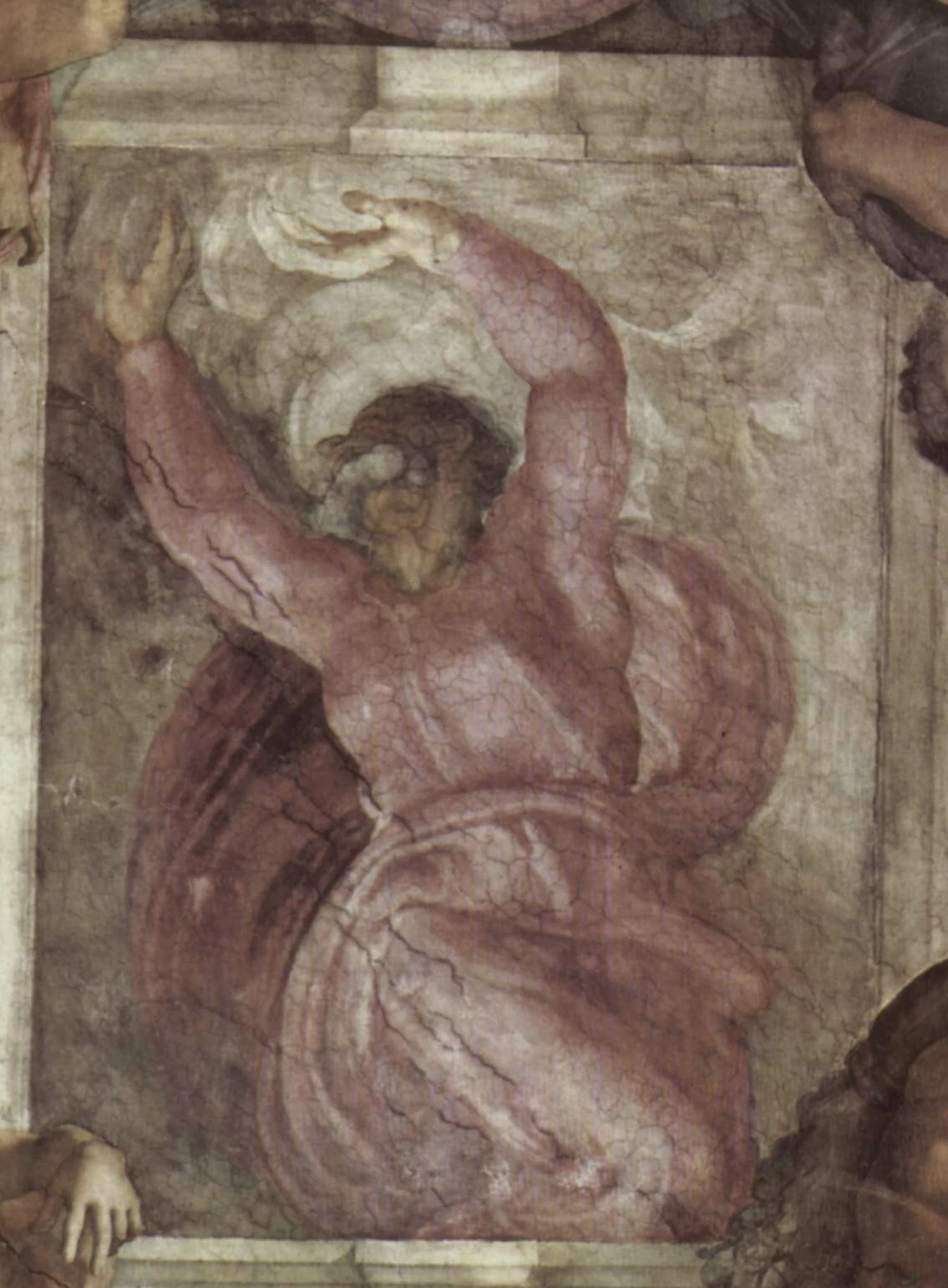
Opening illustration: Michelangelo, The Separation of Light from Darkness, the scene of the first day on the ceiling of the Sistine Chapel, painted about 1511 above the altar. God turns upward with both arms raised into the light and the dark. There is no sun in it: the text does not make one until the fourth day. Detail of a photograph of the ceiling’s first bay (The Yorck Project), Wikimedia Commons, public domain.
The first chapter of the Bible makes light on the first day and the sun on the fourth. For three evenings and three mornings there is light and darkness, and nothing in the sky to make either. Nobody who wrote this down needed to be told where daylight comes from. Genesis puts the light first anyway, and three days before the lamps.
Between its first word and the seventh day, Genesis 1:1 to 2:3, the chapter also takes the gods of Israel’s neighbours apart one at a time: the deep, the sun and moon, the sea dragons, and the king who alone was the image of a god.
The Deep and the Wind
In the beginning God created the heaven and the earth. And the earth was without form, and void; and darkness was upon the face of the deep. And the Spirit of God moved upon the face of the waters.
— Genesis 1:1–2, King James Version.1
The first word is bereshit, בְּרֵאשִׁית. The old translations, Greek and Latin, made it a complete statement: “In the beginning God created.” Rashi, in eleventh-century France, pointed out that reshit is in the construct form, “the beginning of,” and read the opening as a time clause: when God began to create heaven and earth, and the earth was formless and void, God said, “Let there be light.” On his reading the first thing the chapter narrates is the light, and the earth, the dark and the water are already there when it starts.
The earth is tohu va-vohu, תֹהוּ וָבֹהוּ, a rhyming pair. Tohu is used elsewhere of trackless desert, bohu of emptiness. Over it is ḥoshekh ʿal-penei tehom, חֹשֶׁךְ עַל־פְּנֵי תְהוֹם, “darkness upon the face of the deep.” Tehom is the same Semitic word as Tiamat, the salt-water mother of the Babylonian Enūma Eliš. In that poem Apsu and Tiamat begin the world by mingling their waters, and the young god Marduk later kills Tiamat, splits her body, and makes the sky from half of it. Genesis writes tehom without the article, as Hebrew nearly always does with this word, so some readers have heard a name in it; if it is one, Genesis does nothing with it. The deep in Genesis is water. It is not fought and it is not split.
Then ve-ruaḥ Elohim meraḥefet ʿal-penei ha-mayim, וְרוּחַ אֱלֹהִים מְרַחֶפֶת עַל־פְּנֵי הַמָּיִם. Ruaḥ is wind, breath and spirit at once. The verb raḥaf in this form occurs once more in the Torah, in the Song of Moses, where God is like an eagle that “stirreth up her nest, fluttereth over her young.” The thing over the water is a bird over a nest.
Egypt had its own creator who worked by speaking. The Memphite inscription on the Shabaka Stone has Ptah create the gods and all things through what his heart thought and his tongue commanded. Genesis gives its God no heart and no tongue. It gives him a voice. “And God said” comes nine times in the chapter, and once more “God said unto them.” The Mishnah says the world was created by ten sayings.
Let There Be Light
And God said, Let there be light: and there was light. And God saw the light, that it was good: and God divided the light from the darkness. And God called the light Day, and the darkness he called Night. And the evening and the morning were the first day.
— Genesis 1:3–5, King James Version.2
In Hebrew the command and its fulfilment are four words: yehi ʾor va-yehi ʾor, יְהִי אוֹר וַיְהִי־אוֹר. Then God divides, va-yavdel, וַיַּבְדֵּל, the verb badal that will do the work of the next two days as well. The darkness is not abolished. It is separated off and given a name, Night.
Genesis does not say where the darkness came from. It is simply there in verse 2. A prophet later in the book of Isaiah has God say it outright: “I form the light, and create darkness: I make peace, and create evil: I the LORD do all these things.” Yotser ʾor u-voreʾ ḥoshekh, יוֹצֵר אוֹר וּבוֹרֵא חֹשֶׁךְ, with the verb bara, the one Genesis keeps for God’s own creating. Isaiah claims for God the one thing Genesis 1 leaves unclaimed.
What is this light, with no sun to give it? Augustine asked in his commentary The Literal Meaning of Genesis, written between about 401 and 415. He could not make the first three days solar days, since there was no sun to measure them, and one of the answers he gave was that the light of the first day was a spiritual light: the creation of minds able to know, turned toward the Word that made them.
Paul read the verse the same way, and he said so. Writing to Corinth, he quotes the first day of creation and applies it to an event inside a person: “For God, who commanded the light to shine out of darkness, hath shined in our hearts, to give the light of the knowledge of the glory of God in the face of Jesus Christ.” The Greek begins ho theos ho eipōn, Ek skotous phōs lampsei, ὁ θεὸς ὁ εἰπών· Ἐκ σκότους φῶς λάμψει, “the God who said, Out of darkness light shall shine,” and continues hos elampsen en tais kardiais hēmōn, ὃς ἔλαμψεν ἐν ταῖς καρδίαις ἡμῶν, “who shone in our hearts.” For Paul the light of Genesis 1:3 is what happens in a person who begins to see. He wrote it within about twenty-five years of the crucifixion.
John’s gospel opens with the same two words as Genesis, “In the beginning,” and comes to the light within four verses: “In him was life; and the life was the light of men. And the light shineth in darkness; and the darkness comprehended it not.” Kai to phōs en tē skotia phainei, kai hē skotia auto ou katelaben, καὶ τὸ φῶς ἐν τῇ σκοτίᾳ φαίνει, καὶ ἡ σκοτία αὐτὸ οὐ κατέλαβεν. Katelaben can mean “grasped” or “overcame,” and both fit. In Genesis the darkness is divided off from the light. In John it fails to take hold of it.
Read with Paul, the first day is the arrival of light in the mind: awareness, moral sight, the knowledge that one is a creature before God. People may have lived a very long time before that light came. Genesis puts it first in the order of the days, ahead of every made thing that will be lit by it. The rest of the Bible keeps the same picture. The first thing the fruit does in the garden is open eyes.
The Vault and the Dry Land
And God said, Let there be a firmament in the midst of the waters, and let it divide the waters from the waters. And God made the firmament, and divided the waters which were under the firmament from the waters which were above the firmament: and it was so. And God called the firmament Heaven. And the evening and the morning were the second day.
— Genesis 1:6–8, King James Version.3
“Firmament” is raqiaʿ, רָקִיעַ, from the verb raqaʿ, to beat out flat. The craftsmen of the tabernacle “did beat the gold into thin plates,” va-yeraqqeʿu et-paḥei ha-zahav, וַיְרַקְּעוּ אֶת־פַּחֵי הַזָּהָב. In Job, Elihu asks, “Hast thou with him spread out the sky, which is strong, and as a molten looking glass?” The verb there is tarqiaʿ, the same root, and a looking glass then was polished bronze. The sky of Genesis is a beaten sheet holding back water above it.
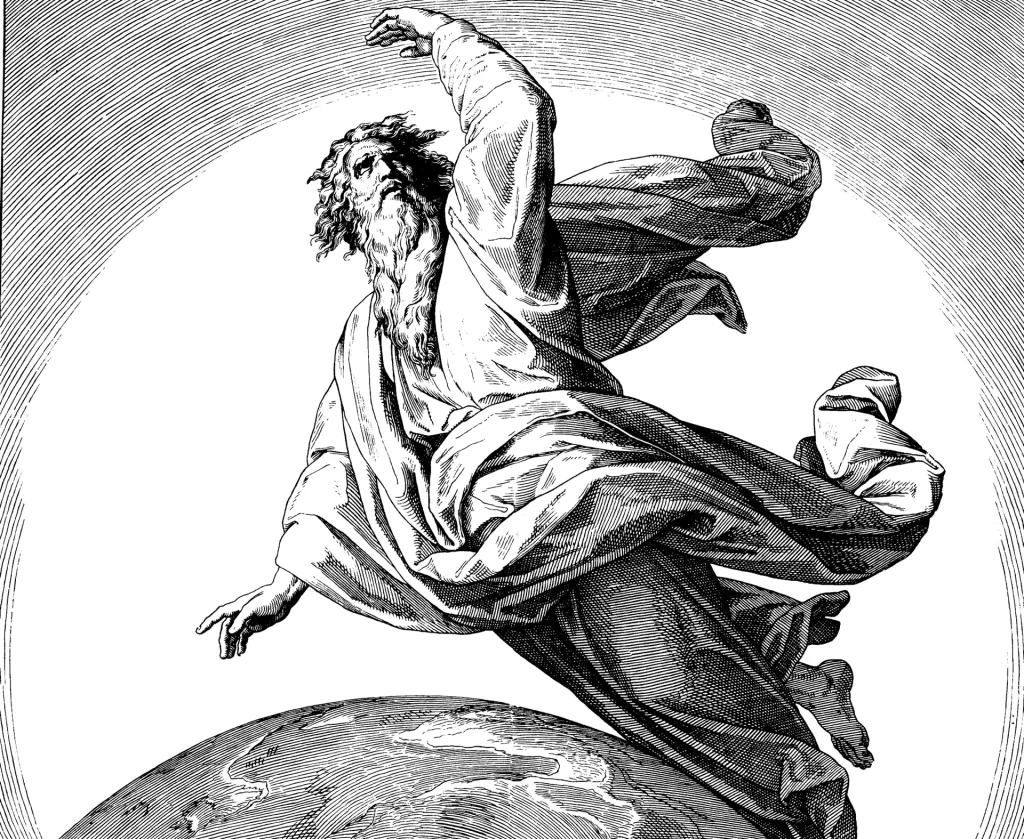
Marduk made his sky the same way, by dividing the waters, but with Tiamat’s body. He split her, raised half of her as the sky, set a bar and a guard on it, and told them not to let her waters out. Genesis keeps the waters above and the waters below and removes the corpse. Nothing is killed to make the vault.
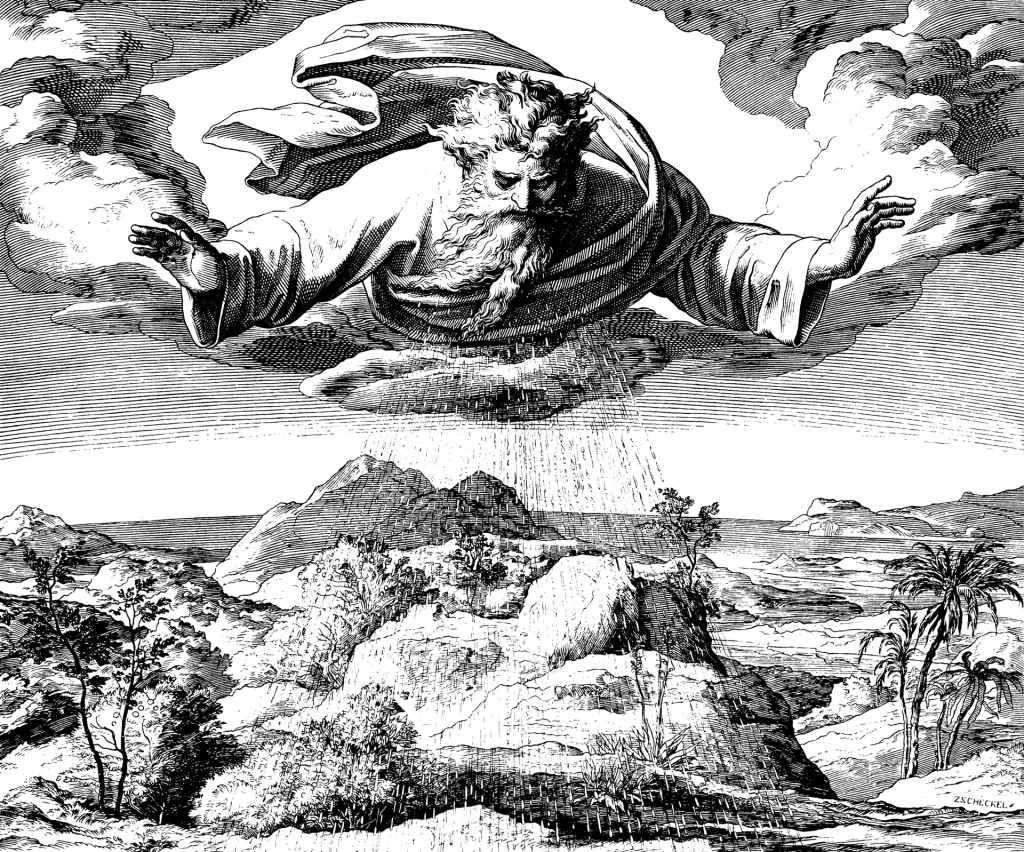
On the third day the lower waters are gathered into one place and the dry ground appears, ha-yabbashah, הַיַּבָּשָׁה. The earth then brings out grass, plants yielding seed, and trees bearing fruit, each “after his kind.” The six days are built in two sets of three. The first three make spaces by dividing: light from dark, waters above from waters below, sea from land. The next three fill the same spaces in the same order: lights for the day and night, birds and fish for the sky and sea, animals and people for the land. The earth was tohu, without form, and the first three days form it. It was bohu, empty, and the next three fill it.
Lamps, Not Gods
And God said, Let there be lights in the firmament of the heaven to divide the day from the night; and let them be for signs, and for seasons, and for days, and years: and let them be for lights in the firmament of the heaven to give light upon the earth: and it was so. And God made two great lights; the greater light to rule the day, and the lesser light to rule the night: he made the stars also.
— Genesis 1:14–16, King James Version.4
In the lands around Israel the sun and moon were gods. Babylon’s sun was Shamash, the judge who sees everything, and its moon was Sin, who kept the months. Ugarit, on the coast north of Israel, worshipped the sun goddess Shapash and the moon god Yarikh. The Hebrew words for sun and moon, shemesh, שֶׁמֶשׁ, and yareaḥ, יָרֵחַ, are those same names.
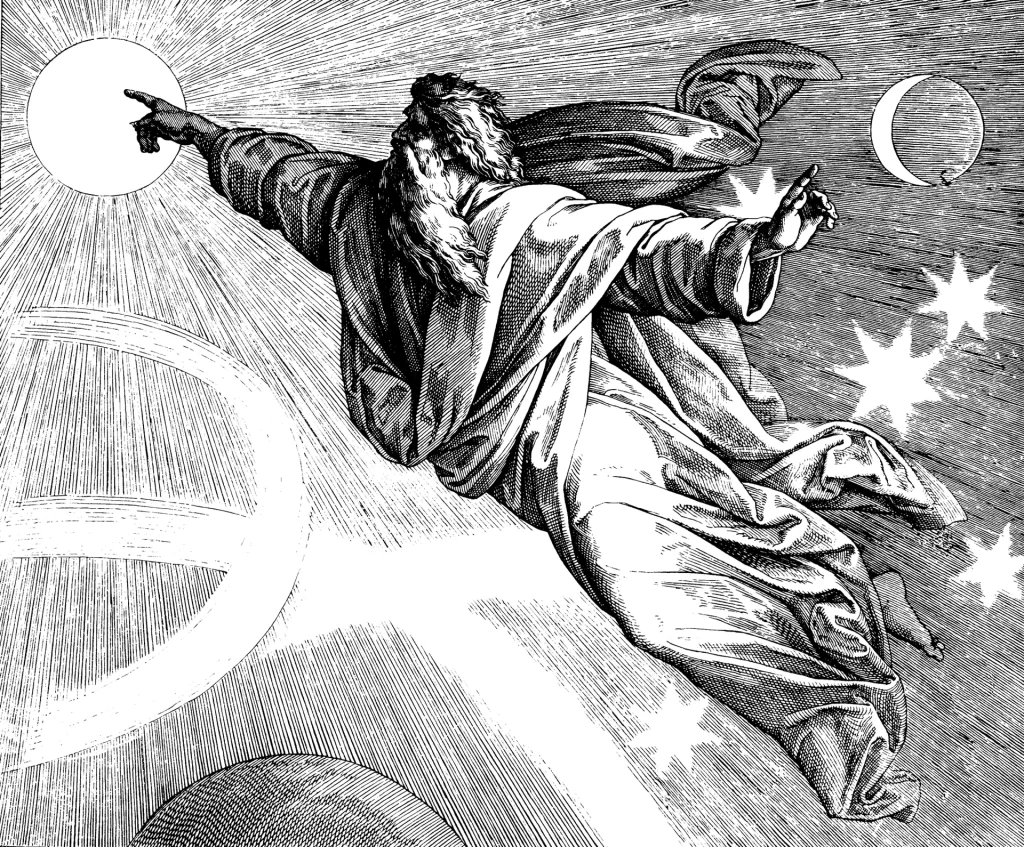
Genesis 1 does not use them. The sun is ha-maʾor ha-gadol, הַמָּאוֹר הַגָּדֹל, “the greater light,” and the moon ha-maʾor ha-qaton, הַמָּאוֹר הַקָּטֹן, “the lesser light.” A maʾor is a light-giver, and the word is used again in the Torah for the lampstand of the tabernacle and the oil “for the light.” The chapter names day, night, heaven, earth and seas. It leaves the sun and the moon without a name.
Their job is to mark time: “for signs, and for seasons, and for days, and years.” “Seasons” is moʿadim, מוֹעֲדִים, appointed times. Leviticus uses it for the festivals, “the feasts of the LORD, which ye shall proclaim to be holy convocations.” Jeremiah uses it for the stork that “knoweth her appointed times.” A psalm puts it simply: “He appointed the moon for seasons,” ʿasah yareaḥ le-moʿadim, עָשָׂה יָרֵחַ לְמוֹעֲדִים. In Genesis the lights keep the calendar. They do not rule fates.
The stars get two Hebrew words: ve-ʾet ha-kokhavim, וְאֵת הַכּוֹכָבִים, “and the stars.” The King James supplies “he made” and “also.” The Babylonian astronomers who watched the stars for omens about kings kept records for centuries. Genesis gives them one clause. Isaiah later sends Israel outside to look: “Lift up your eyes on high, and behold who hath created these things, that bringeth out their host by number: he calleth them all by names.” Mi-vara ʾelleh, מִי־בָרָא אֵלֶּה, “who created these?” The stars have names in Isaiah, and God is the one who gives them.
A sky with no gods in it cannot be read for the will of the gods. The priests and diviners of the great courts read it for kings. Genesis takes that office away from them by making the lights into furniture.
The Great Sea Creatures
And God created great whales, and every living creature that moveth, which the waters brought forth abundantly, after their kind, and every winged fowl after his kind: and God saw that it was good.
— Genesis 1:21, King James Version.5
The verb here is bara, for the first time since the first verse, and its first object after heaven and earth is ha-tanninim ha-gedolim, הַתַּנִּינִם הַגְּדֹלִים, “the great sea monsters.” The King James says “whales.” A tannin is a dragon of the sea. At Ugarit the goddess Anat boasts that she muzzled Tannin and crushed the twisting serpent with seven heads. In the Bible itself the old fight survives in poetry: “Thou didst divide the sea by thy strength: thou brakest the heads of the dragons in the waters. Thou brakest the heads of leviathan in pieces.” Shibbarta raʾshei tanninim ʿal-ha-mayim, שִׁבַּרְתָּ רָאשֵׁי תַנִּינִים עַל־הַמָּיִם.
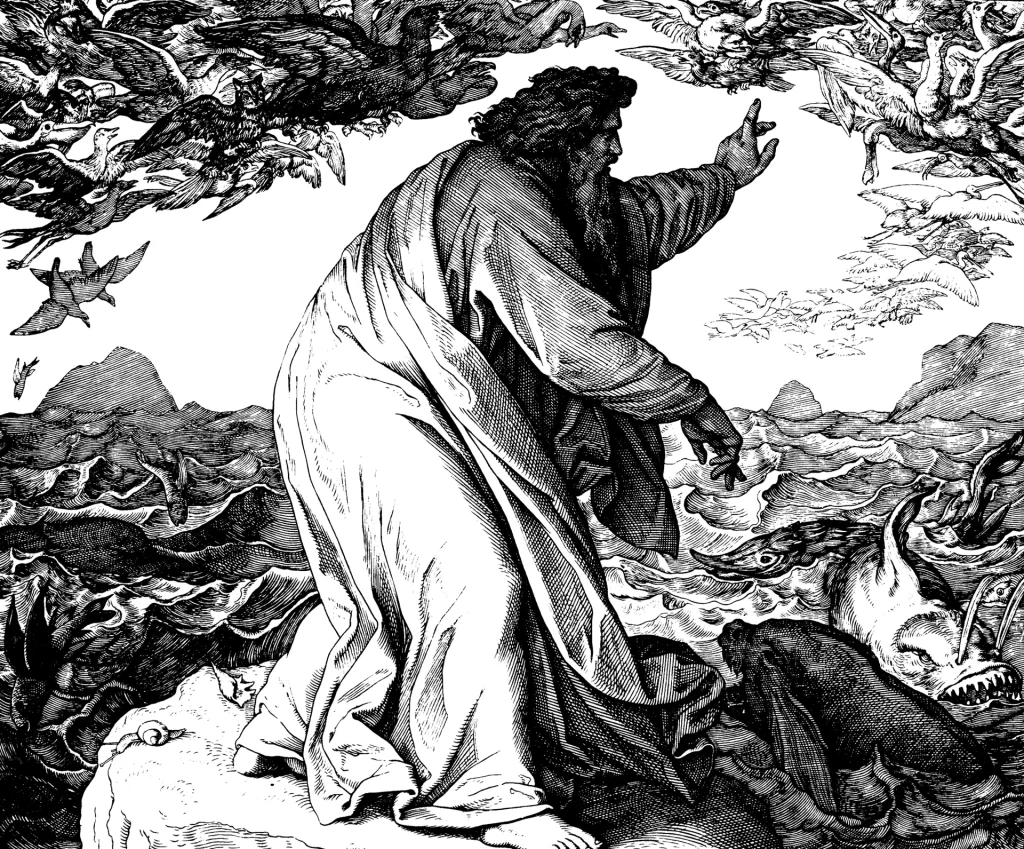
Genesis 1 has no fight. The dragons are made on the fifth day with the fish and the birds, and they are called good. Another psalm puts the leviathan in the sea among the ships, the creature “whom thou hast made to play therein.”
The animals of the sea, the air and the land are each called nefesh ḥayyah, נֶפֶשׁ חַיָּה, a living creature, at verses 20, 21, 24 and 30. The next chapter will use the same two words of the man God forms from dust. Genesis 1 does not separate humans from animals by what they are made of. It separates them by what they are told.
In Our Image
And God said, Let us make man in our image, after our likeness: and let them have dominion over the fish of the sea, and over the fowl of the air, and over the cattle, and over all the earth, and over every creeping thing that creepeth upon the earth. So God created man in his own image, in the image of God created he him; male and female created he them.
— Genesis 1:26–27, King James Version.6
“Let us make,” naʿaseh ʾadam be-tsalmenu ki-dmutenu, נַעֲשֶׂה אָדָם בְּצַלְמֵנוּ כִּדְמוּתֵנוּ. Justin Martyr, about 155, argued against a Jewish teacher that God was speaking to another divine person, his Son. Philo of Alexandria, a century earlier, thought God was speaking to subordinate powers, so that whatever was bad in human beings could be credited to them. Rashi said God consulted his heavenly court to teach humility: the greater should take counsel with the lesser. The verse holds all three readings, and the Hebrew does not decide between them.
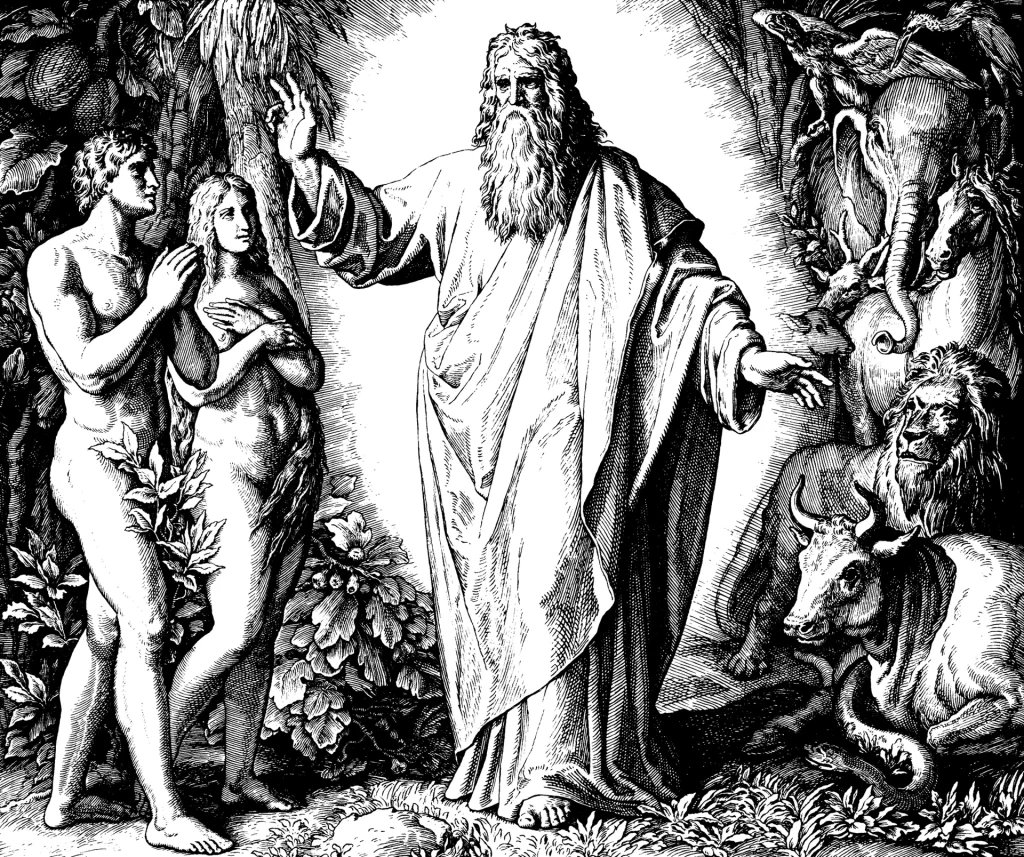
Tselem, צֶלֶם, is the word for a statue or an image, the kind set up for a god. In Egypt and Mesopotamia “the image of the god” was a royal title. Tutankhamun’s name, Tut-ʿankh-Amun, means “living image of Amun.” Assyrian court letters call the king the ṣalmu, the image, of the god Bel. One man stood for the god on earth, and everyone else served him. The Babylonian Atrahasis epic says the gods made humans in the first place to carry the gods’ labour.
Genesis gives the title to ʾadam, humankind, and then adds, “male and female created he them.” The image of God is no longer the king’s. It belongs to every man and woman in the chapter. They are given a royal task: u-redu, וּרְדוּ, “have dominion,” and ve-khivshuha, וְכִבְשֻׁהָ, “subdue it,” both verbs of kings. And they are given a diet of plants, with every green herb for the animals: no animal is food for anyone in Genesis 1.
They are given a blessing, a task and a diet. They are not given a prohibition, and there is no penalty for anything in the whole chapter. Nobody in Genesis 1 can do wrong, because nobody has been told not to.
Paul uses the image word of Christ two verses before he quotes the first day. The light of the gospel, he says, is “the glorious gospel of Christ, who is the image of God,” hos estin eikōn tou theou, ὅς ἐστιν εἰκὼν τοῦ θεοῦ. Genesis took the image away from the king and gave it to everyone. Paul gives it to a man executed by the empire whose emperors were called sons of gods.
The Name of God in Genesis 1
From 1:1 to 2:3 God is Elohim, אֱלֹהִים, and only Elohim: thirty-five times, five sevens, and the personal name YHWH, יהוה, not once. The name changes at 2:4, where the next story calls him YHWH Elohim, “the LORD God.” Rashi, on the first verse, gives the rabbinic explanation. God first thought to create the world by the measure of strict justice, middat ha-din, the measure the rabbis attach to Elohim. He saw that the world could not stand on justice alone, so he joined to it the measure of mercy, middat ha-raḥamim, which belongs to the name YHWH. That is why the second story uses both names. In the chapter where nobody has yet been told anything, justice is enough.7
The Seventh Day
Thus the heavens and the earth were finished, and all the host of them. And on the seventh day God ended his work which he had made; and he rested on the seventh day from all his work which he had made. And God blessed the seventh day, and sanctified it: because that in it he had rested from all his work which God created and made.
— Genesis 2:1–3, King James Version.8
“Rested” is shavat, שָׁבַת, to stop, to cease. God does not recover from tiredness. He stops because the work is done. The Greek translation of the third century BC, and the Samaritan Torah with it, say God finished his work “on the sixth day,” which avoids having God work on the seventh. The Hebrew says the seventh.
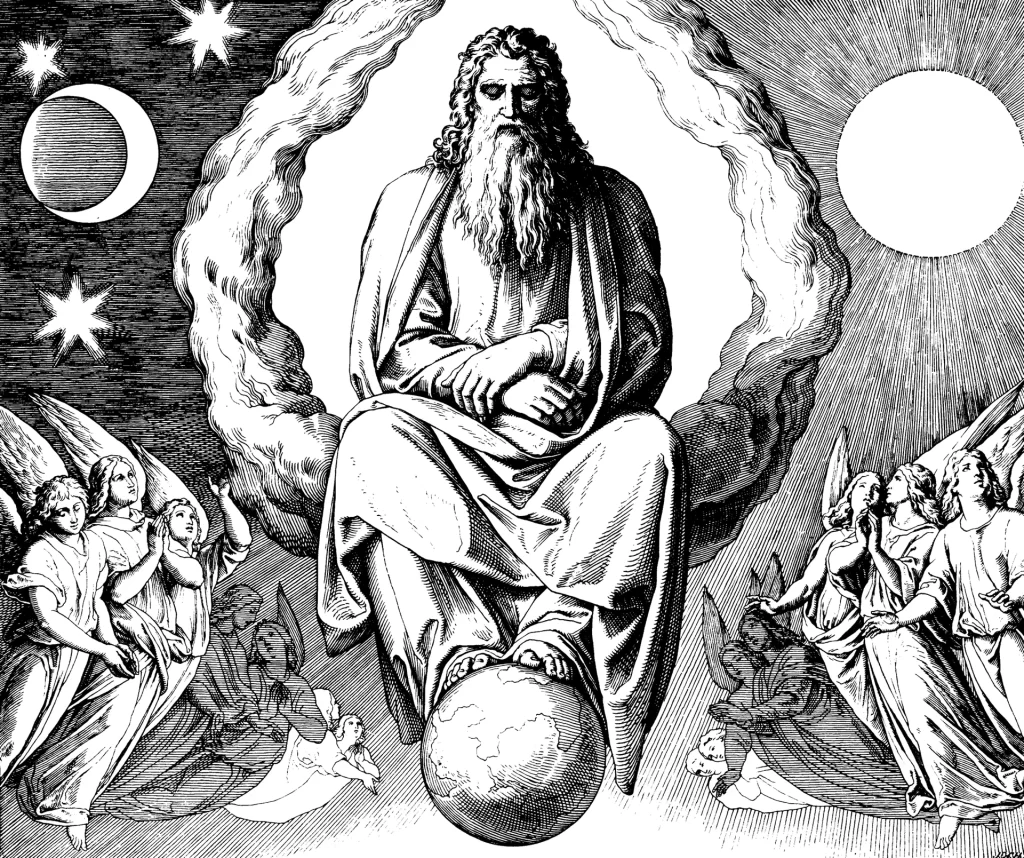
Va-yeqaddesh ʾoto, וַיְקַדֵּשׁ אֹתוֹ, “and he made it holy.” It is the first time the root q-d-sh, holy, appears in the Bible, and the first thing to be holy is a day. Abraham Joshua Heschel built a book on that observation in 1951: a religion of time, whose “Sabbaths are our great cathedrals.” No stone, no mountain, no altar and no priesthood is holy before the seventh day.
In Babylon the gods built Esagila for Marduk after his victory, and the poem ends with them feasting in his house. A god at rest is a god enthroned in his temple. Genesis gives its God a rest without a building. The heavens and the earth are what he finished, and the day is what he made holy.
When Jesus was accused of healing a man on the Sabbath, his answer turned this verse around: “My Father worketh hitherto, and I work.” Ho patēr mou heōs arti ergazetai kagō ergazomai, Ὁ πατήρ μου ἕως ἄρτι ἐργάζεται κἀγὼ ἐργάζομαι. Genesis says God ceased from all his work. Jesus says the Father has not stopped working, and claims the same right for himself. John adds that this is why they sought to kill him: he called God his own Father.
The First Command
The last clause of Genesis 2:3 has no end. God rested from all his work ʾasher-baraʾ Elohim laʿasot, אֲשֶׁר־בָּרָא אֱלֹהִים לַעֲשׂוֹת: “which God created to make,” or “had created, in making it.” The verse finishes with an infinitive and the next verse begins another story.
In that story the LORD God plants a garden and puts a man in it, and he speaks to him the first command in the Bible: “Of every tree of the garden thou mayest freely eat: but of the tree of the knowledge of good and evil, thou shalt not eat of it: for in the day that thou eatest thereof thou shalt surely die.” Genesis 1 made people in the image of God and gave them light before it gave them a sun. Genesis 2 gives one of them something to obey, and with it the first thing he can be guilty of. In Genesis 3 a serpent tells the woman that on the day they eat, “your eyes shall be opened.”
Sources and Translation Notes
Biblical passages are quoted from the King James Version. Hebrew is from the Masoretic text as given by Sefaria and Greek from the SBL Greek New Testament. The transliterations are simplified.
1. Genesis 1:1–2. Rashi on Genesis 1:1, in M. Rosenbaum and A. M. Silbermann, Pentateuch with Rashi’s Commentary (London, 1929). Jeremiah 4:23 and Isaiah 34:11 for tohu and bohu together. On tehom and Tiamat, Alexander Heidel, The Babylonian Genesis (2nd ed., Chicago, 1951); Enūma Eliš I.1–5 for the mingling of the waters. Deuteronomy 32:11. Mishnah Avot 5:1 for the ten sayings. The Shabaka Stone, British Museum EA 498, in Miriam Lichtheim, Ancient Egyptian Literature, vol. 1 (Berkeley, 1973), pp. 51–57. ↩
2. Genesis 1:3–5. Isaiah 45:7. Augustine, De Genesi ad litteram 1.9.17 and 4.26.43, in John Hammond Taylor’s translation, The Literal Meaning of Genesis (New York, 1982). 2 Corinthians 4:6 and John 1:1–5, King James Version; Greek from the SBL Greek New Testament. The eyes opened are Genesis 3:5 and 3:7. ↩
3. Genesis 1:6–13. Exodus 39:3 and Numbers 16:38 for raqaʿ; Job 37:18. Enūma Eliš IV.137–140 for Tiamat’s body as the sky. ↩
4. Genesis 1:14–19. For maʾor as the tabernacle light, Exodus 25:6 and Numbers 4:9. Leviticus 23:2, Jeremiah 8:7 and Psalm 104:19 for moʿadim. Isaiah 40:26. ↩
5. Genesis 1:20–25. Psalm 74:13–14 and Psalm 104:26. Anat’s boast is in the Baal cycle from Ugarit, KTU 1.3 iii 38–42. ↩
6. Genesis 1:26–31. Justin Martyr, Dialogue with Trypho 62; Philo, On the Creation of the World 72–75; Rashi on Genesis 1:26. On tselem and royal image language in Egypt and Assyria, J. Richard Middleton, The Liberating Image: The Imago Dei in Genesis 1 (Grand Rapids, 2005). Atrahasis I.189–197 in W. G. Lambert and A. R. Millard, Atra-ḫasīs: The Babylonian Story of the Flood (Oxford, 1969). 2 Corinthians 4:4. ↩
7. The count of Elohim in Genesis 1:1–2:3 and of YHWH Elohim in 2:4–3:24 was made from the Hebrew text. Rashi on Genesis 1:1, after Genesis Rabbah 12:15. ↩
8. Genesis 2:1–3. The Septuagint and the Samaritan Pentateuch read “sixth day” at 2:2. Abraham Joshua Heschel, The Sabbath: Its Meaning for Modern Man (New York, 1951), pp. 8–10. Enūma Eliš VI for Esagila and the banquet. John 5:16–18, King James Version; Greek from the SBL Greek New Testament. Genesis 2:16–17 for the first command and Genesis 3:5 for the serpent. ↩