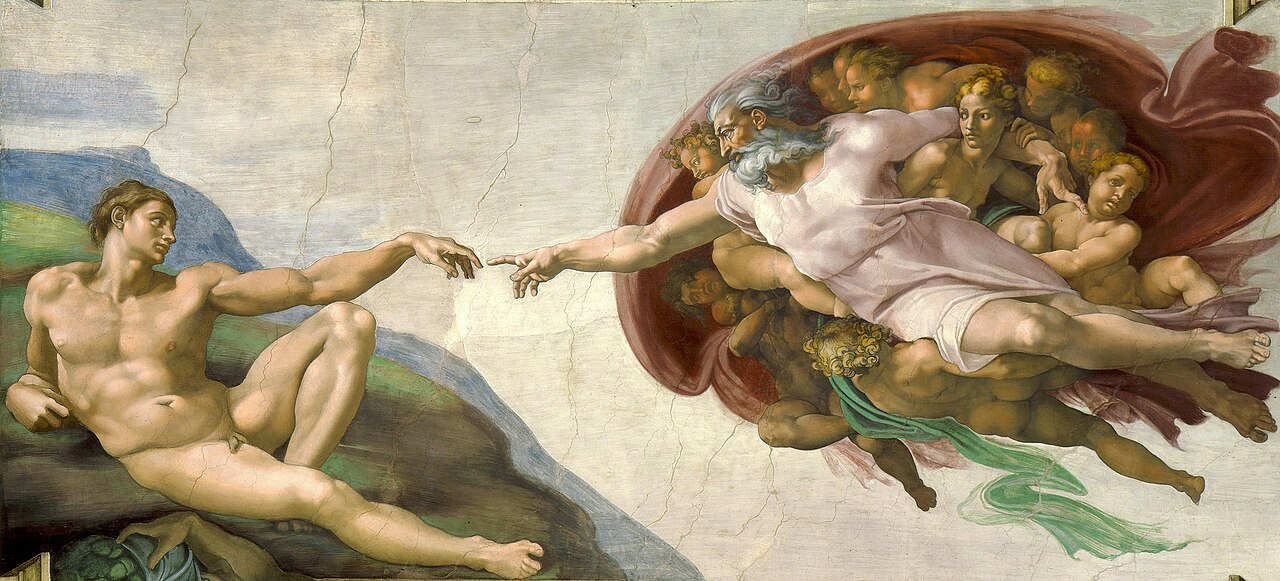
By the fourth chapter of Genesis the named human family is Adam, Eve, Cain and Abel, and Cain has just killed his brother. He then fears people whom the story has not introduced.
Behold, thou hast driven me out this day from the face of the earth; and from thy face shall I be hid; and I shall be a fugitive and a vagabond in the earth; and it shall come to pass, that every one that findeth me shall slay me. (Genesis 4:14)
Every one that findeth me. The chapter has not named the people Cain fears. They could be relatives left outside its immediate account, or people beyond Adam’s family. God does not dismiss the danger. He takes a precaution against it.
And the LORD said unto him, Therefore whosoever slayeth Cain, vengeance shall be taken on him sevenfold. And the LORD set a mark upon Cain, lest any finding him should kill him. (Genesis 4:15)
A mark is a signal, and a signal needs somebody able to read it. Then Cain leaves, and within two verses he has both a wife and a city.
And Cain knew his wife; and she conceived, and bare Enoch: and he builded a city, and called the name of the city, after the name of his son, Enoch. (Genesis 4:17)
A wife, possible attackers and a city imply a wider social world than the chapter’s named household. Readers have answered in different ways: Cain married a sister or another relative; the narrative is symbolic and its population cannot be counted literally; or other people existed outside Adam’s family.
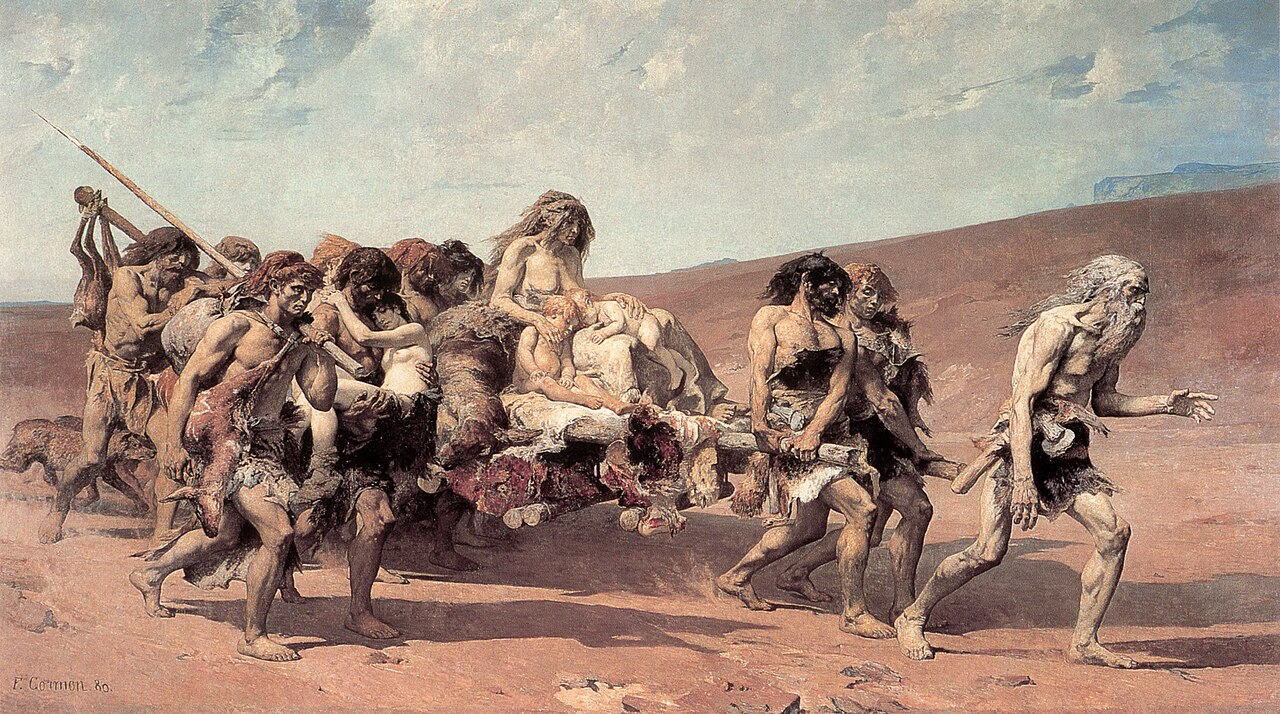
Two accounts, and why it matters which
The sister answer is possible, and Genesis 5:4 explicitly says that Adam fathered sons and daughters. Their names and the date of Cain’s marriage are not supplied. The chapter’s silence therefore cannot prove an outside population, and the mark could protect Cain from relatives as well as strangers. A symbolic reading also changes the questions we ask without abolishing the need to explain the characters, actions and consequences.
The third answer is the one the book keeps making room for, and it starts before Cain, because Genesis tells the making of humanity twice and the two tellings do not agree.
In the first, God makes light, sky, land and plants, then the lights, then fish and birds, then land animals, and last of all people. The passage introduces humanity collectively, male and female, after everything else is finished. That language can encompass a founding pair or a larger population; it does not by itself choose between them.
So God created man in his own image, in the image of God created he him; male and female created he them. (Genesis 1:27)
In the second the order runs backwards. There is no rain and nobody to work the ground. One man is formed from dust before there is a garden for him. The garden is planted afterwards, for him. The animals come after that and are brought to him to be named. The woman comes last, because the man has been looked at and judged incomplete.
In chapter one the animals precede people by a day. In chapter two they are made after the man, expressly to cure his loneliness, and fail to cure it. Both cannot be a straight chronology of one week.
Two accounts do not yet give us two populations. Their differences might belong to distinct traditions compiled into one book. Reading Genesis 2 as a sequel to Genesis 1 is another proposal. On the reading explored here, chapter two follows one man within a world already in existence; that is an interpretation requiring an argument, rather than a population count supplied by either chapter.
Adam is not a name for most of the story
Adam, אָדָם, is an ordinary Hebrew noun meaning humankind, and through most of these chapters it carries the definite article: ha-adam, הָאָדָם, the man, or the human. Where the article is present, the expression functions as the human rather than simply as a personal name. It can nevertheless refer to an individual; the grammatical form alone does not decide how many humans exist.
The noun is also a pun on the material. He is ha-adam taken from ha-adamah, הָאֲדָמָה, the ground. English has no clean equivalent, and the usual attempts, earthling from earth or human from humus, are approximations of a joke that runs through every verse about dust.
Then Genesis 5 declines to settle whether Adam is a person or a population.
Male and female created he them; and blessed them, and called their name Adam, in the day when they were created. (Genesis 5:2)
Their name. The Hebrew carries a plural suffix, shemam, their-name. God names a male and a female together, and the name he gives them is Adam. Two verses earlier the chapter calls itself the book of the generations of Adam, and two verses later it reports how old Adam was when he fathered Seth. Inside four verses the word is a couple, a book title, and a man.
That verse cuts both ways and should be quoted by anyone arguing either side. It refuses the reading in which Adam is only ever one individual, and it equally refuses the reading in which he is only ever a species.
One bad argument in this direction is worth refusing while we are here. Genesis 1:28 says replenish the earth, and generations of writers have taken replenish to mean refill, implying an earlier population cleared away. The Hebrew is mil’u, the plain verb fill, and God says exactly the same thing to Noah at Genesis 9:1. The word carried no sense of repetition in 1611 English either. That argument should be dropped by the people who like its conclusion.
The people made out of maize
Genesis is not the only scripture that makes humanity more than once.
The Popol Vuh, the K’iche’ Maya book of origins, has the gods attempt humanity in stages and fail twice. The first people are shaped from mud and cannot hold together. The second are carved from wood: they multiply and speak, but they have no minds and no memory of their makers, so they are destroyed in a flood, and as they die their own possessions turn on them. Their grinding stones complain that they were worked day and night with a sound of screeching, and say they will now grind the flesh of the people who used them. Their dogs bite them for never being fed. The survivors become the monkeys in the forest.
Only the third attempt works, and the material matters. The successful humanity is made from maize, a crop that does not exist without farmers to keep it. The failed one lived in the woods and ended as animals.
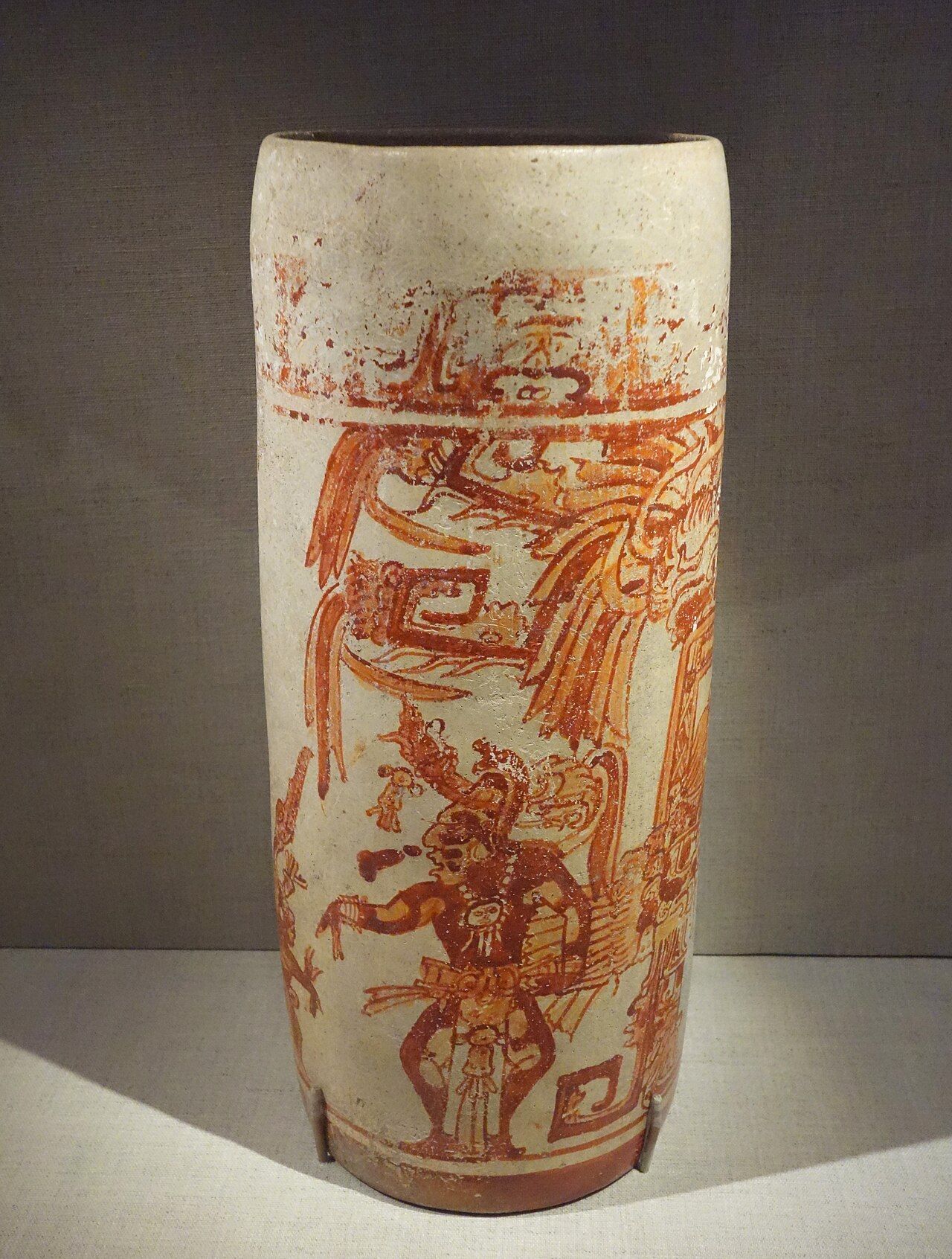
The type-scene: humanity made in more than one attempt. Set beside Genesis, the shared element is a sequence of human beginnings. Hesiod offers another sequence of generations, but the heroic generation is better than its predecessor, and the iron generation is his own. These stories differ in what becomes of earlier humanity. Their resemblance enlarges the range of imaginable readings; it does not establish a shared chronology or decide which reading of Genesis is correct. Genesis never calls the humanity of chapter one a failure, never describes it as a lower kind, and never narrates its destruction between the two creation accounts. On the reading explored here, attention to one family need not condemn everyone else.
One caution about the Popol Vuh, since the parallel is close enough to be suspicious. It survives only in a manuscript written in Latin script after the Spanish conquest, and Lewis Spence, working on it in 1908, marked some of this material as showing possible Christian influence. The resemblance may be inheritance rather than independent witness, and nobody can currently settle it.
Where this reading came from, including the bad part
The observation that Genesis 1 and 2 do not match is ancient. The conclusion that other people were living outside the garden is not, and pretending otherwise would be dishonest.
Genesis Rabbah worried at Cain’s wife and answered with twin sisters born alongside the brothers. Augustine reached the same answer independently in the City of God. Philo of Alexandria, in the first century, did read Genesis 1 and Genesis 2 as two different men, a heavenly one and an earthly one, but his two men are two kinds of being rather than two populations, and he never suggests anybody was living beyond the garden wall. In antiquity the only figure who argued for people outside Eden was Julian the Apostate, and he was arguing against Christianity rather than within it.
The hinge is Isaac La Peyrère, whose Prae-Adamitae appeared in 1655. His argument turned on a verb. Romans 5:13 says that sin is not imputed where there is no law, and the Greek ellogeitai is an accounting term, to put to someone’s account. La Peyrère read Paul as saying that people had existed whose sins were not booked against them because the law had not yet been given, and concluded there had been humanity before Adam. He supported it with Cain’s wife, with Chinese and Chaldean chronologies longer than the biblical one, and with the inhabitants of the Americas and Greenland, who were difficult to fit into a genealogy from Noah.
Then the part that matters for anyone using this material now. La Peyrère’s own scheme made the Jews the descendants of Adam and the Gentiles the pre-Adamites, which made Europeans the pre-Adamite race. His book was burned in Paris, he was arrested in Brussels, and he recanted in 1658, converting to Catholicism and formally submitting the book to the Pope.
Within two centuries his argument had been turned inside out and pressed into the service of American slavery: Samuel Morton in 1839, Nott and Gliddon in 1854, the anonymous Ariel pamphlet of 1867, Alexander Winchell in 1878, Charles Carroll in 1900. Every one of them used a pre-Adamite argument to sort living human populations by ancestry.
There is a clean structural test that separates those versions from a chronological one, and it can be stated without any moralising. Can the proposal be used to sort the people in the room? Every racist version places contemporaneous populations on different lines of descent and requires the lines to stay separate. A claim about an event in the past makes no assertion about who alive today descends from whom. If a reading can be used to rank the living, it is the polygenist version, whichever way round it assigns the virtue. Turning the valuation upside down and making the other line the good one does not fix it, because the machine is the sorting and not the verdict.
Samuel Cartwright is the best illustration of why word evidence is not decoration. Defending slavery, he argued that the serpent of Eden was a human gardener rather than a snake, on the ground that nachash, נָחָשׁ, the Hebrew for serpent, carried a sense of becoming black. It does not. He had collided it with nechosheth, נְחֹשֶׁת, the word for bronze or copper, which shares consonants and means the colour of polished metal. An entire doctrine rested on a confusion between two Hebrew words, and a reader who knew the Hebrew could have taken it apart in a sentence.
Whose son was Cain?
Cain’s wife and Cain’s father are different questions. A pre-Adamite reading supplies other people from whom a wife could come. A serpent-seed reading gives Cain another father, the serpent or the power acting through it. Neither claim establishes the other.
And I will put enmity between thee and the woman, and between thy seed and her seed; it shall bruise thy head, and thou shalt bruise his heel. (Genesis 3:15)
The curse sets the serpent’s offspring against the woman’s offspring. It names no child of their union and says nothing here about Cain’s conception. The next chapter begins with a different sequence:
And Adam knew Eve his wife; and she conceived, and bare Cain, and said, I have gotten a man from the LORD. (Genesis 4:1)
Adam knows Eve, she conceives, and Cain is born. A reading that assigns another father must explain that sequence. The later stories are interesting precisely because they make that interpretive move.[1]
In Pirqei de-Rabbi Eliezer 21, the garden and its sowing become an account of sexual conception. Gerald Friedlander’s translation gives the decisive clause:
(Sammael) riding on the serpent came to her, and she conceived (Pirqei de-Rabbi Eliezer 21, trans. Friedlander, p. 150)
Sammael’s name is supplied in parentheses by the translator; the wording varies between witnesses. The story then assigns Abel’s conception to Adam and reads Adam’s knowing as his recognition that Eve had already conceived. Cain’s difference from his brother has acquired a supernatural origin. This is one particular retelling, not a teaching shared by every Jewish interpreter.[2]
The Targum Pseudo-Jonathan makes a related alteration. In Etheridge’s translation of Genesis 4:1, Eve is the wife “who had desired the Angel,” and she calls Cain “a man, the Angel of the Lord.” At Genesis 5:3 the Targum explicitly contrasts Cain with Seth, the son in Adam’s likeness. Cain’s absence from that genealogy becomes part of its explanation. The selective genealogy in Genesis itself does not establish a different biological father.[3]
The Gnostic Secret Book of John tells another version: the chief ruler fathers both Cain and Abel upon Eve, and Adam subsequently fathers Seth. It therefore cannot be reduced to the scheme in which Cain alone has a supernatural father while Abel is Adam’s son. The common concern is the origin of a divided humanity; the accounts disagree about where that division runs.[4]
First John is another text drawn into the argument. Its description of Cain must be read with the explanation that immediately follows:
Not as Cain, who was of that wicked one, and slew his brother. And wherefore slew he him? Because his own works were evil, and his brother’s righteous. (1 John 3:12)
The writer identifies Cain’s evil works and his brother’s righteous ones. Earlier in the same passage, whoever commits sin is described as being of the devil, and the children of God are distinguished by righteousness and love of their brother (1 John 3:8–10). John 8:39–44 likewise tests an appeal to Abrahamic fatherhood against the speakers’ deeds. These passages make conduct central; they do not supply a biological pedigree for Cain’s descendants.[1]
The religious question is substantial: how does evil enter a human family, and what binds a person to it? One answer locates the struggle in actions and allegiance. Another gives the first murderer a father from outside the human household. The suspicious reading begins when that explanation becomes inherited guilt, so that a person’s ancestry decides their moral character before they act. A proposal about people outside Eden needs no such claim. Changing Cain’s father does not tell us where his wife came from, and supplying her with another population does not make Cain the serpent’s son.
Genealogical descent is not the same as inherited DNA. Douglas L. T. Rohde, Steve Olson and Joseph T. Chang’s 2004 models in Nature suggest that all living humans could share genealogical ancestors within the last few thousand years, depending on assumptions about migration and population connections. Such models can illustrate how someone living among other people could become a universal ancestor under suitable conditions. They do not establish that Adam existed or identify him among our ancestors. Universal ancestry is not exclusive ancestry. The theological affirmation of shared humanity is a different kind of claim:
And hath made of one blood all nations of men for to dwell on all the face of the earth. (Acts 17:26)
Made of the same stuff
Everything above leaves one question, and the vocabulary of Genesis bears on it.
If there were people outside the garden, were they a different kind of creature? Genesis 2:7 describes the man as a living being, nephesh chayyah, נֶפֶשׁ חַיָּה, an expression also used of animals: of the sea creatures at 1:20, the land animals at 1:24, and everything that creeps at 1:30, where the King James renders the same two words as living creature instead. The phrase does not, by itself, name a uniquely human substance bestowed on Adam and withheld from everyone else.
That limits one argument for hierarchy. It does not settle every question about human nature, nor identify the people who might have lived outside the garden. On the reading explored here, the distinction concerns calling and relationship rather than a claim that other people lacked souls.
If the difference were a substance, a reader could ask who has it and sort people by the answer. The shared expression nephesh chayyah supplies no basis for that division.
What is different is not the material but the dealing. One line is formed by hand, breathed into directly, placed in a garden, and given a command with a penalty attached. That is the first prohibition in the Bible, and a creature cannot be guilty of breaking a rule it was never given. Whatever happened to Adam’s line happened in that relationship, not in their bones.
Narrowing, not sorting
The shape of Genesis is a funnel. A species is made and given the earth. The focus then closes to a line, to a garden, to one man who is spoken to and can answer back. It keeps closing for the rest of the book, from all nations to one family to one tribe, and the New Testament runs the movement in reverse, from one man back out to everybody.
Narrowing is not sorting, and Genesis shuts the door on sorting repeatedly. Eve is the mother of all living at 3:20. Genesis 5:1-2 heads Adam’s own genealogy with the creation formula from chapter one, tying the two accounts together rather than prising them apart. The people outside the garden are never called a lower kind, never given a different substance, and never destroyed. They are simply not who the story is following.
And there is one more thing they are never denied, which is the whole case in a single verse. Whoever the people of chapter one are, here is what the chapter says about them before Adam has been mentioned at all.
So God created man in his own image, in the image of God created he him; male and female created he them. (Genesis 1:27)
The image is given to the humanity of Genesis 1. Anyone arguing that the people outside Eden were something less than human must account for the verse that made humanity in God’s image. After the flood, when God addresses the shedding of human blood, the reason given is that same image.
Whoso sheddeth man’s blood, by man shall his blood be shed: for in the image of God made he man. (Genesis 9:6)
The divine image belongs to humanity, not to a privileged pedigree. Here it grounds the seriousness of shedding human blood, even as the verse expresses that seriousness through a demand for the killer’s death.
Then the sword, which is worth looking at because most readers remember it wrongly.
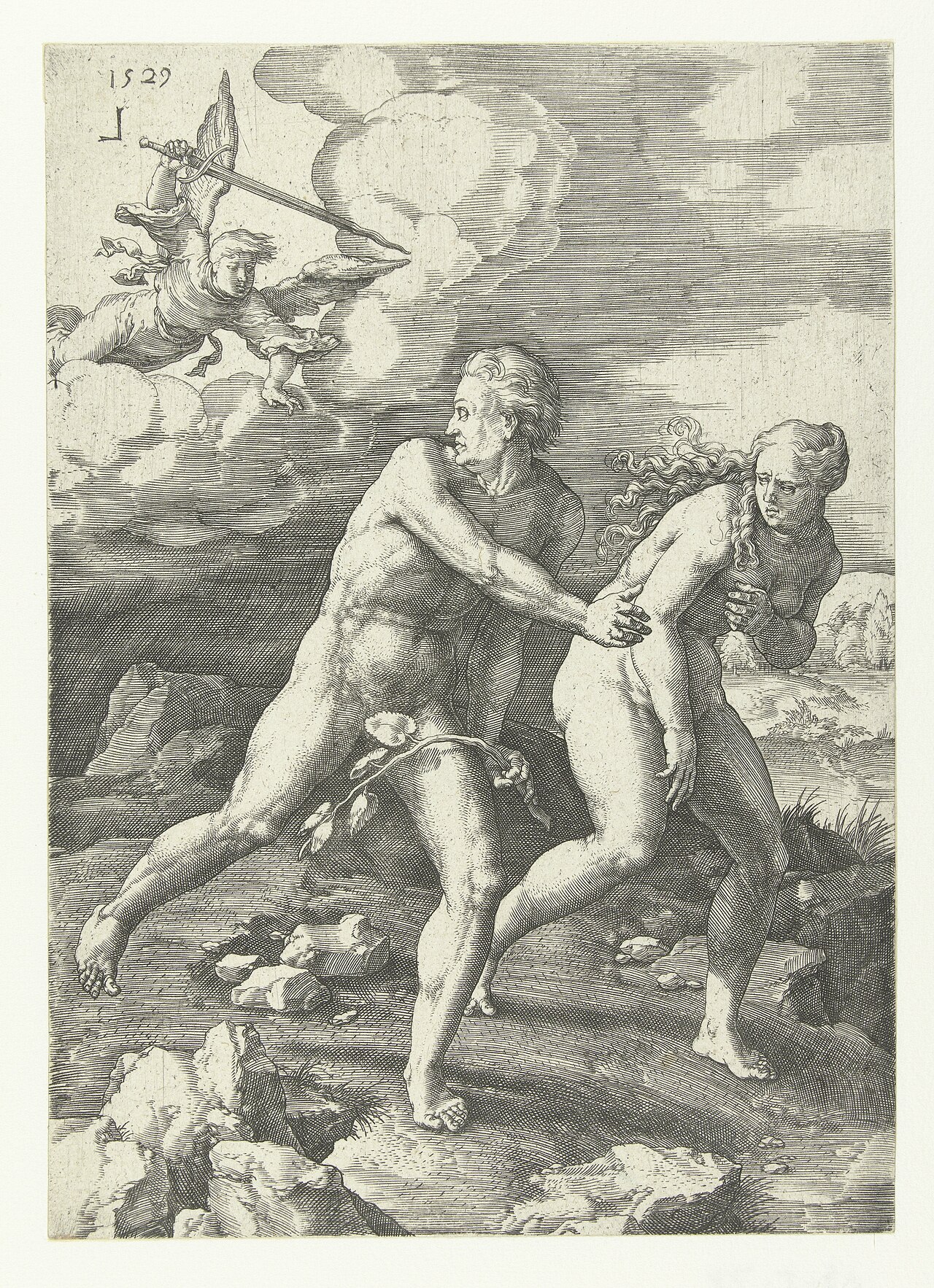
So he drove out the man; and he placed at the east of the garden of Eden Cherubims, and a flaming sword which turned every way, to keep the way of the tree of life. (Genesis 3:24)
Read what it is guarding. Not a border between peoples. Not a wall around a chosen family. The sword has one stated job, which is to keep the way of the tree of life, and the only thing it stands between is human beings and immortality. Genesis puts exactly one barrier in the world, and it does not run between one kind of person and another.
The guard is set at the east of the garden. Cain later goes east to the land of Nod, where the narrative names his wife and the city he builds. It does not say when or where he met her. On the reading explored here, the movement carries Adam’s family into a wider human world; the location of Cain’s marriage remains unstated.
The sword guards the tree of life; Genesis gives it no purpose of preserving a pedigree. Whether Cain’s wife belongs to Adam’s wider family or to a population outside it remains the reader’s question. Cain has already killed his brother before he leaves. The man who builds the city carries the violence of the garden family into the world beyond it.
That is the ordinary condition of almost everybody in almost every book. It is worth saying plainly because the alternative has a history, and every version of this reading that turned vicious did so at precisely this point, by converting a story that follows one line into a claim about what the other lines are.
The text gives no warrant for the conversion. It gives the image to everybody, sets its one sword between people and a tree, and then drives the man it has been following out through the gate to live with everybody else.
Sources and notes
This essay draws on questions opened by John H. Walton’s The Lost World of Genesis One and The Lost World of Adam and Eve, particularly his distinction between material origins and divine assignment, and his allowance for reading Genesis 2 as a sequel. That is an attribution of influence rather than a claim that Walton endorses every argument or comparison made here.
- John H. Walton, The Lost World of Adam and Eve: Genesis 2–3 and the Human Origins Debate (IVP Academic, 2015). Proposition 7 on reading Genesis 2 as a possible sequel, proposition 12 on priestly assignment, proposition 20 on universal descent not being essential to the interpretation.
- John H. Walton, The Lost World of Genesis One: Ancient Cosmology and the Origins Debate (IVP Academic, 2009), and his own summary of the functional reading in “Material or Function in Genesis 1?” (BioLogos, 3 April 2015).
- Konrad Schmid, “Genesis’ Two Creation Accounts Compiled and Interpreted as One”, for the distinct-traditions explanation of the differences between the accounts.
- Douglas L. T. Rohde, Steve Olson and Joseph T. Chang, “Modelling the recent common ancestry of all living humans”, Nature 431 (2004): 562–566, doi:10.1038/nature02842.
- Genesis Rabbah 22:2, for the tradition of sisters born alongside Cain and Abel.
- Augustine, City of God XV.16, which defends marriage between siblings in the earliest generations.
- Philo, On the Creation §134, for the contrast between the intelligible and the embodied human.
- Hesiod, Works and Days, approximately lines 109–201, for the sequence of human generations.
- Popol Vuh, translated and annotated by Allen J. Christenson, available here, for the mud, wooden-effigy and maize creation episodes.
- Serpent-seed discussion: Genesis 3:15 and 4:1; 1 John 3:7–12; John 8:39–44. Biblical quotations use the King James Version. Genesis 5:4 also supplies the sons and daughters relevant to Cain’s unnamed relatives.
- Pirqei de-Rabbi Eliezer 21, trans. Gerald Friedlander, Pirḳê de Rabbi Eliezer (London, 1916), pp. 150–151. The short quotation retains the translator’s parenthesized name; it does not silently add Cain’s name to that clause.
- Targum Pseudo-Jonathan, Genesis 4:1–2 and 5:1–3, trans. J. W. Etheridge (1862). Its expanded wording is distinguished here from the wording of Genesis.
- Apocryphon of John (Secret Book of John), trans. Frederik Wisse, the Cain, Abel and Seth episode after the expulsion (Nag Hammadi Codex II, pp. 24–25). Paraphrased, not quoted.
- Rachel Adelman, “Cain, Son of the Fallen Angel Samael” (2021), especially the textual discussion and notes 9–12 on the differing witnesses to Pirqei de-Rabbi Eliezer and the Targum. Its scholarship is used alongside the primary texts, rather than as a replacement for them.