Before he could lead others, he had to be carried, sheltered, and taught
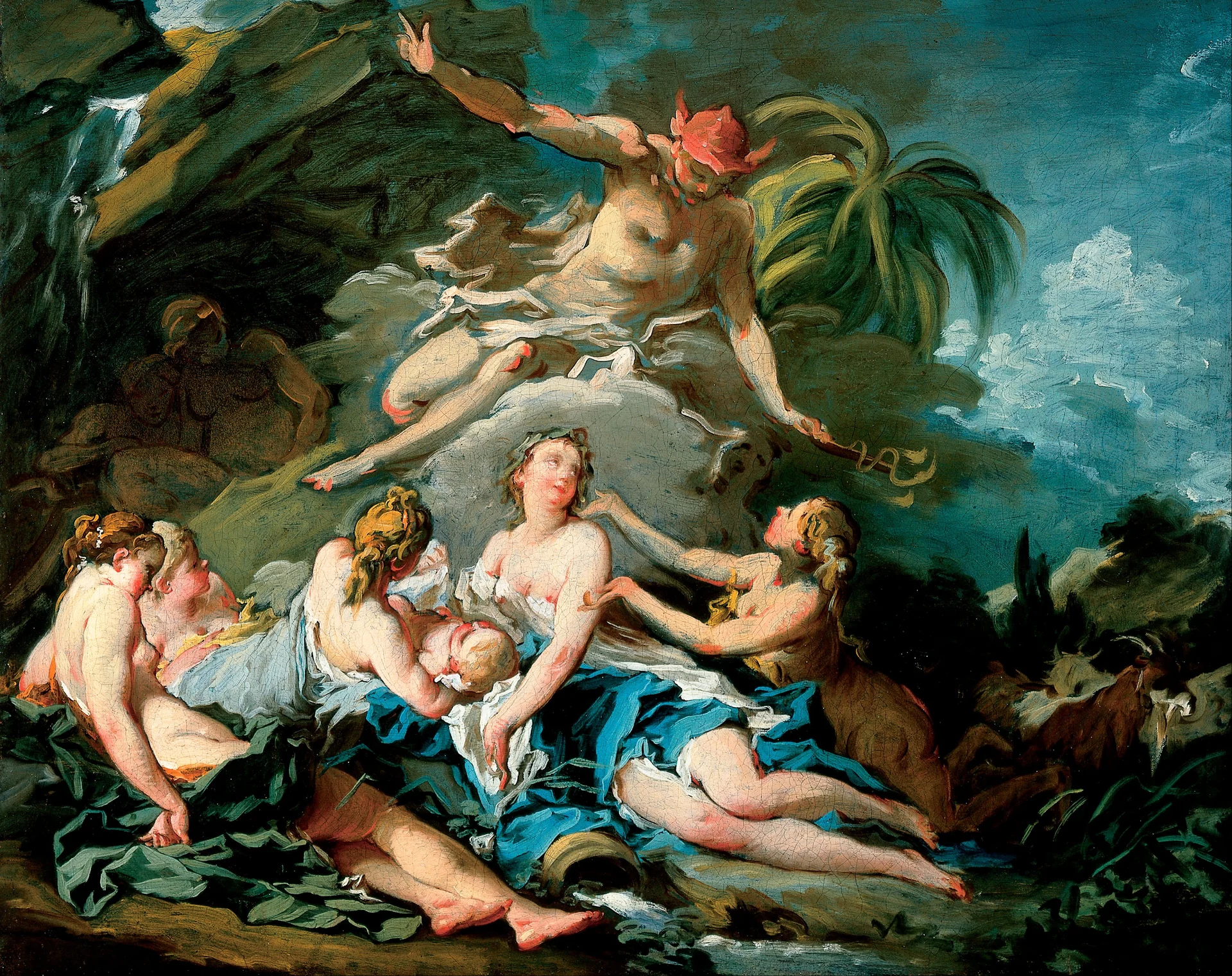
Opening illustration: François Boucher, Mercury Entrusting the Infant Bacchus to the Nymphs of Nysa, 1734. Mercury, in his winged cap, has brought the baby down to the nymphs, who take him into their arms. Oil on canvas, 59.7 × 73.7 cm. Cincinnati Art Museum, accession 1989.24. Public domain, via Wikimedia Commons.
Hermes carries Dionysus away from another ruined household.
Semele, his mother, is dead. Ino, the aunt who sheltered him, has been driven into the sea, and her husband has killed one of their sons. Zeus hides the child in the shape of a young goat, and Hermes takes him to the nymphs of Nysa. The son of the ruler of heaven still needs someone to keep him safe.1
The god of the house of Cadmus first survives by being taken for an animal. His cousins are killed by the same mistake: Athamas has already taken Learchus for a lion cub, and in Thebes Agave will take Pentheus for a lion.
Luke gives the son of God a childhood too. After the presentation in the temple his parents take him home to Nazareth, “and the child grew, and waxed strong in spirit, filled with wisdom: and the grace of God was upon him.” Both stories stop to let a divine child grow. The difference is who does the raising. Jesus grows up in his mother’s house with the man who will raise him. Dionysus has lost his mother and his foster-mother, and Hermes hands him to strangers, the women the hymn will name and who will later follow him as their leader.2
At Nysa the story stops over something less spectacular than survival: the work of bringing him up.
The Women Who Raised Their Leader
I begin to sing of ivy-crowned Dionysus, the loud-crying god, splendid son of Zeus and glorious Semele. The rich-haired Nymphs received him in their bosoms from the lord his father and fostered and nurtured him carefully in the dells of Nysa, where by the will of his father he grew up in a sweet-smelling cave, being reckoned among the immortals.
But when the goddesses had brought him up, a god oft hymned, then began he to wander continually through the woody coombes, thickly wreathed with ivy and laurel. And the Nymphs followed in his train with him for their leader; and the boundless forest was filled with their outcry. And so hail to you, Dionysus, god of abundant clusters! Grant that we may come again rejoicing to this season, and from that season onwards for many a year.
— Homeric Hymn 26, to Dionysus, translated by Hugh G. Evelyn-White.3
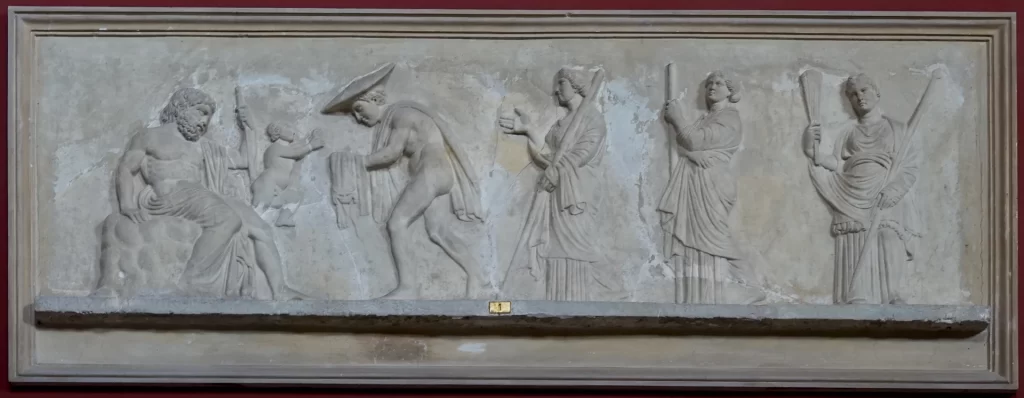
The people who first carried him become the company he leads. His authority grows inside a relationship of care, not out of the defeat of an enemy. The hymn does not jump from divine parentage to a grown god demanding recognition. Between the birth and the leadership stand others who feed him, shelter him and walk with him.
The hymn’s first line calls him eribromon, ἐρίβρομον, “loud-roaring.” Diodorus also records the title Bromios, Βρόμιος, “the Roarer,” which he derives from bromos, βρόμος, the thunder that came at his birth. His own name Diodorus explains through his father and his nurses: Dionysos, Διόνυσος, from Dios, Διός, “of Zeus,” and Nysa, Νῦσα, the place where he was raised. Nysa is a second birthplace beside Thebes. Thebes is where Semele’s pregnancy ended; Nysa is where her child was allowed to keep growing.4
The forest fills with voices. For now, wandering is something the young Dionysus does with those who know him.
The Gift of the Vine
Looking across his later career, Diodorus remembers the child of Nysa as a teacher of farming:
After he had received his rearing by the nymphs in Nysa, they say, he made the discovery of wine and taught mankind how to cultivate the vine. And as he visited the inhabited world almost in its entirety, he brought much land under cultivation and in return for this received most high honours at the hands of all men. He also discovered the drink made out of barley and called by some zythos, the bouquet of which is not much inferior to that of wine. The preparation of this drink he taught to those peoples whose country was unsuited to the cultivation of the vine.
— Diodorus Siculus, Library of History 4.2.5, translated by C. H. Oldfather.5
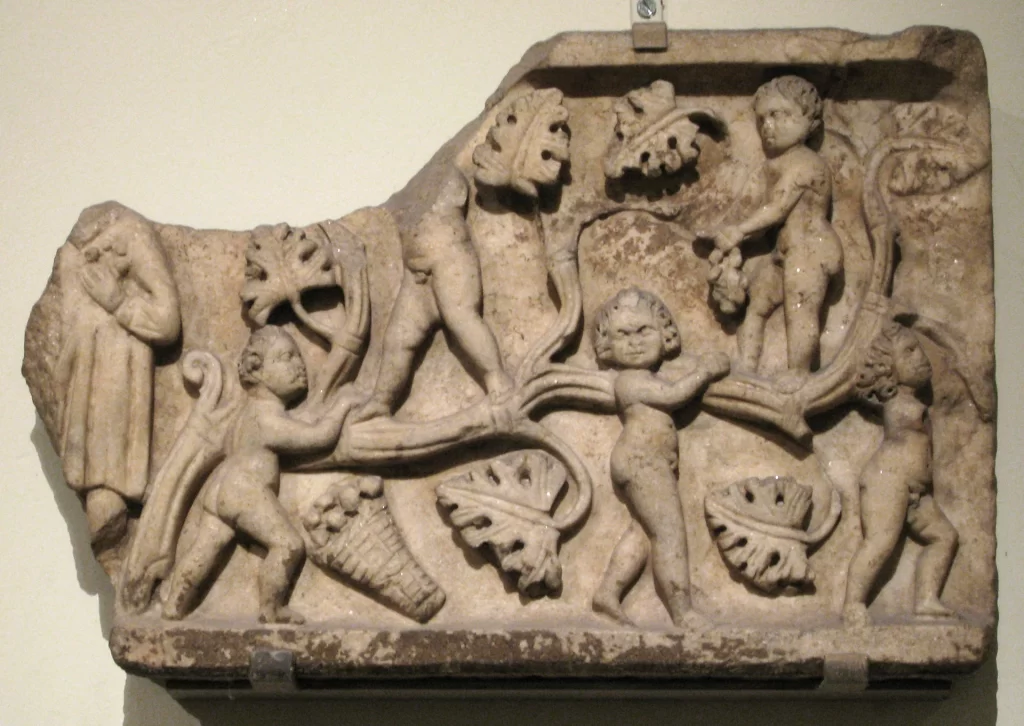
The gift includes a practice. People have to learn to grow what gives them their pleasure, and where the vine will not grow, zythos, ζῦθος, barley beer, takes its place. Diodorus’s benefactor fits his teaching to the land instead of making every country bear the same fruit. This is a reason to welcome Dionysus before there is any reason to fear him. His honour answers something people received.
Diodorus tells the same story twice. In his first book the traveller is Osiris, who gathers an army to visit all the inhabited earth, “teaching the race of men how to cultivate the vine and sow wheat and barley,” and who leaves the same fallback behind him: “if any country did not admit of the growing of vine he introduced the drink prepared from barley, which is little inferior to wine in aroma and strength.” The match was old by then. Four centuries earlier Herodotus had written, “Osiris in the tongue of Hellas is Dionysos.” What Book 1 adds is a motive. Osiris sets out because “he supposed that if he made men give up their savagery and adopt a gentle manner of life he would receive immortal honours because of the magnitude of his benefactions.” The gift is also a bid for godhood, and Diodorus says it worked.6
The Gospel of John gives the vine a different owner. “I am the true vine,” Jesus says, egō eimi hē ampelos hē alēthinē, Ἐγώ εἰμι ἡ ἄμπελος ἡ ἀληθινή, “and my Father is the husbandman.” Dionysus is the god who found the vine and taught it. In the Bacchae the prophet Teiresias goes further and says the god himself is in the cup: houtos theoisi spendetai theos gegōs, οὗτος θεοῖσι σπένδεται θεὸς γεγώς, “he, being a god, is poured out as a libation to the gods.” At the Last Supper Jesus takes the cup and says, “this is my blood of the new testament, which is shed for many,” and adds, “I will not drink henceforth of this fruit of the vine, until that day when I drink it new with you in my Father’s kingdom.” In both, the god is the drink. The difference is the occasion. Dionysus’s gift is a harvest, taught everywhere and adapted to every soil. Jesus’s is a single cup at a last meal, and he will not drink it again until he drinks it new in his Father’s kingdom.7
Yet the discoverer of the vine is not always master of his own life. In another strand of the tradition, it goes where neither the hymn’s happy company nor Diodorus’s celebration would lead anyone to expect.
The Wanderer Who Lost His Way
At the opening of Euripides’ satyr play Cyclops, Silenus, Dionysus’s old companion, recalls the hardships of serving him:
O Bromius, unnumbered are the toils I bear because of thee, no less now than when I was young and hale; first, when thou wert driven mad by Hera and didst leave the mountain nymphs, thy nurses …
— Euripides, Cyclops 1–4, translated by E. P. Coleridge.8
The familiar company has been left behind. Wandering now follows an injury rather than the pleasure of moving through the woods. Apollodorus gives the route in one compact passage:
Dionysus discovered the vine, and being driven mad by Hera he roamed about Egypt and Syria. At first he was received by Proteus, king of Egypt, but afterwards he arrived at Cybela in Phrygia. And there, after he had been purified by Rhea and learned the rites of initiation, he received from her the costume and hastened through Thrace against the Indians.
— Apollodorus, Library 3.5.1, translated by James George Frazer.1
Egypt offers hospitality through Proteus. Phrygia offers more: purification and teaching. The itinerary carries Dionysus between people who take him in, not only through places he will make acknowledge him. Hera’s attack also changes what divinity seems to guarantee. He has survived the loss of his mother and the wreck of his foster household, and surviving them has not made him safe. The mind can become a place no change of clothing or shape lets him leave. He reaches Rhea as someone who has something to receive.
The Mother’s Instruction
Rhea is the mother of Zeus and Hera, and so Dionysus’s grandmother on his father’s side. She once hid the infant Zeus from Kronos and gave him to nurses. Keeping a threatened divine child alive is already part of her story.9
Apollodorus records three things she does: she purifies him, she teaches him the rites, and she gives him the costume. His journey goes on only after those three gifts. A god can hold power without knowing how to live in the role that power opens. The future initiator has first to become an initiate.
The Mother’s ritual world is not quiet or remote from the wild. A short Homeric hymn gives its sound:
I prithee, clear-voiced Muse, daughter of mighty Zeus, sing of the mother of all gods and men. She is well-pleased with the sound of rattles and of timbrels, with the voice of flutes and the outcry of wolves and bright-eyed lions, with echoing hills and wooded coombes. And so hail to you in my song and to all goddesses as well!
— Homeric Hymn 14, to the Mother of the Gods, translated by Hugh G. Evelyn-White.10
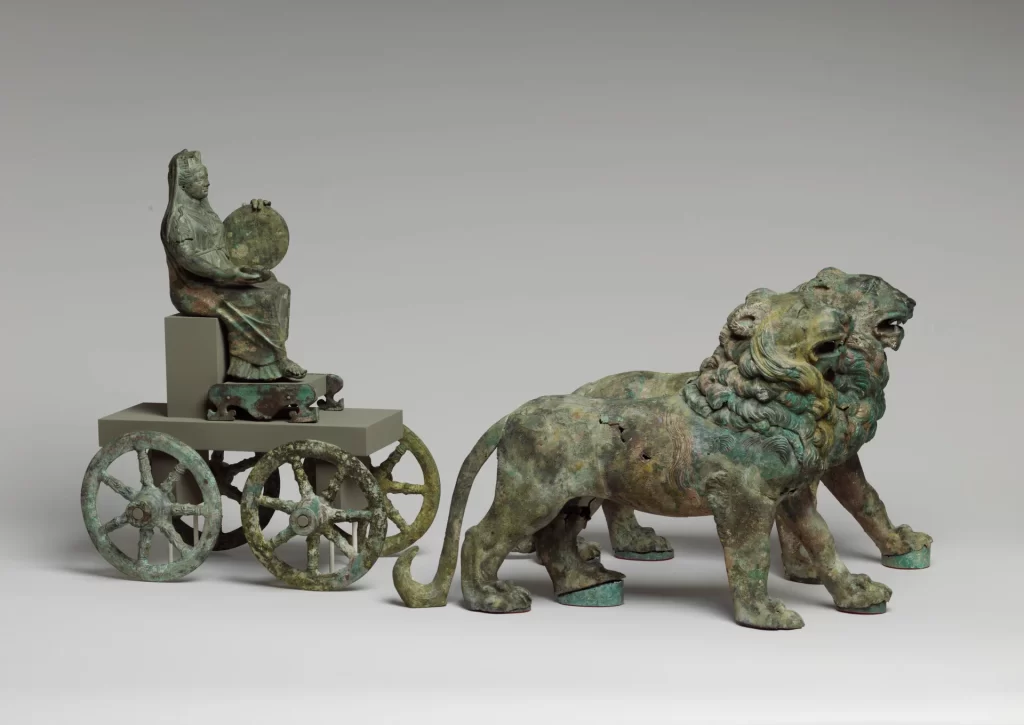
In the Bacchae, Dionysus himself claims part of that noise. He tells his women to take up “the drums native to the Phrygians’ city,” tympana, Rheas te mētros ema th’ heurēmata, τύμπανα, Ῥέας τε μητρὸς ἐμά θ᾽ εὑρήματα, “the inventions of Mother Rhea and of me.” The tympanon, τύμπανον, is the frame drum, from typtō, τύπτω, “to strike,” and it gave Latin tympanum and English “tympanum” and “timpani.” What he learned at Cybela he carries away as his own. His chorus joins the two worships in a single sentence:11
O happy he! who to his joy is initiated in heavenly mysteries and leads a holy life, joining heart and soul in Bacchic revelry upon the hills, purified from every sin; observing the rites of Cybele, the mighty mother, and brandishing the thyrsus, with ivy-wreathed head, he worships Dionysus.
— Euripides, Bacchae 72–82, translated by E. P. Coleridge.12
The Phrygian Mother called Cybele and Apollodorus’s Rhea belong to the same ritual landscape. The chorus sets purification beside movement, noise and shared celebration. Sacred order here does not mean the absence of powerful feeling. That lets Rhea’s instruction be read as more than the end of a disturbance. The experience that overwhelmed one wanderer gets a place in practices others can share. A cry becomes part of a song, and movement gets a rhythm.
The costume gives that change an outward sign. Earlier a disguise hid the endangered child. Now he receives the clothing of the rites he has learned. Appearance no longer serves only to conceal; it can mark belonging. The wanderer leaves Phrygia wearing what Rhea gave him.
When the Gift Wounds Its Guests
The vine raises the same problem among the people who receive it. Diodorus explains the light plant stalk carried by Dionysus’s followers:
The narthex is also associated with Dionysus for the following reason. When wine was first discovered, the mixing of water with it had not as yet been devised and the wine was drunk unmixed; but when friends gathered together and enjoyed good cheer, the revellers, filling themselves to abundance with the unmixed wine, became like madmen and used their wooden staves to strike one another.
Consequently, since some of them were wounded and some died of wounds inflicted in vital spots, Dionysus was offended at such happenings, and though he did not decide that they should refrain from drinking the unmixed wine in abundance, because the drink gave such pleasure, he ordered them hereafter to carry a narthex and not a wooden staff.
— Diodorus Siculus, Library of History 4.4.6–7, translated by C. H. Oldfather.5
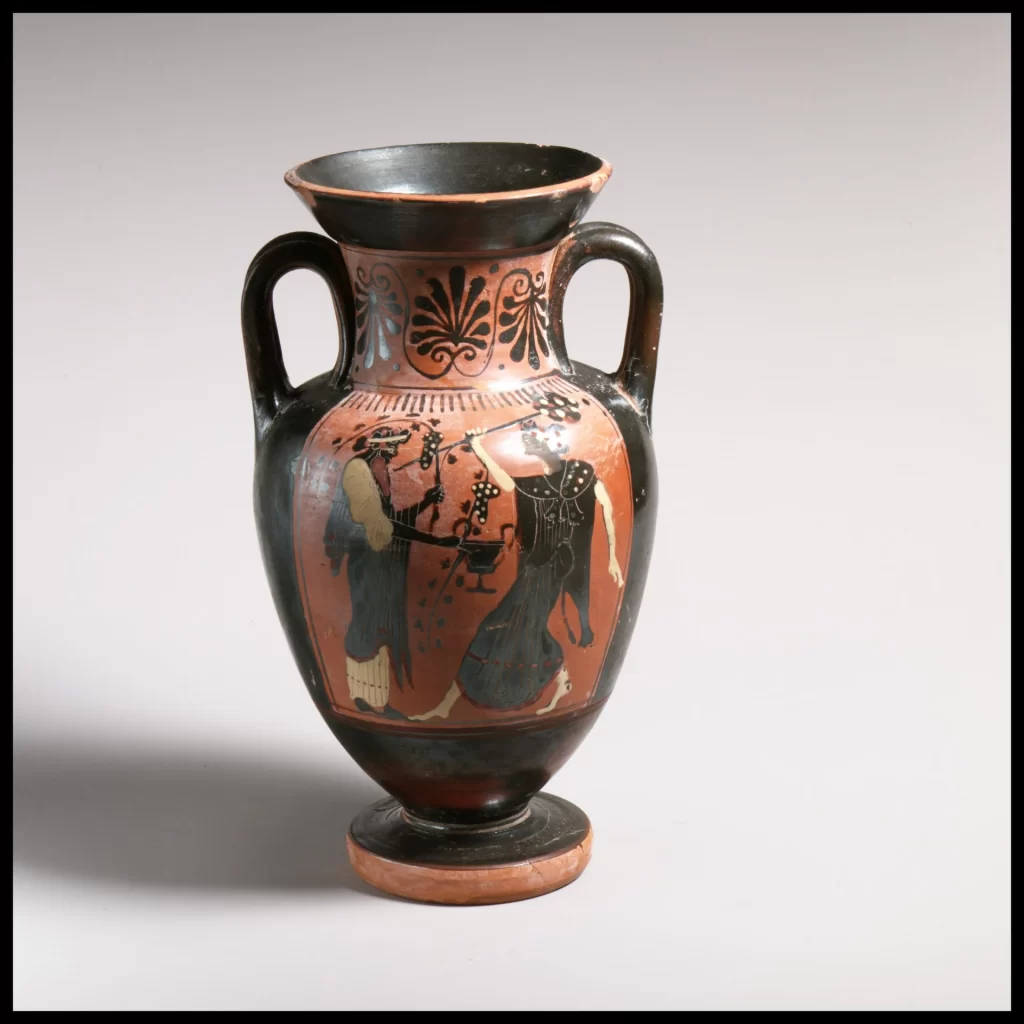
The narthēx, νάρθηξ, is the giant fennel, a tall plant with a light, hollow stem, and its stalk is the shaft of the thyrsos, θύρσος, the ritual wand. In Diodorus’s story the change of staff is meant to make a quarrel less deadly. The instrument of celebration is a response to the injuries celebration caused.
There is something constructive in the choice. Dionysus does not declare the pleasure worthless because it has turned dangerous. He changes a practice around it. But the compromise leaves a question behind. Diodorus says plainly that he declined to restrict the heavy drinking because of the pleasure it gave. He changes what the revellers carry, not whether they become the kind of company that strikes its friends. The gift has been made less deadly, which is not the same as wiser. A benefactor sees the harm, and his attachment to the pleasure limits the cure.
A Wound Passed On, or Something Learned?
Plato makes the dispute explicit. In Book 2 of the Laws, an Athenian visitor is discussing drinking, music and the education of citizens, and he reports a far darker account of Dionysus’s gift:
There is a tradition or story, which has somehow crept about the world, that Dionysus was robbed of his wits by his stepmother Here, and that out of revenge he inspires Bacchic furies and dancing madnesses in others; for which reason he gave men wine.
— Plato, Laws 2.672b, translated by Benjamin Jowett.13
On this reading, the one who suffered makes others go through what was done to him, and the gift becomes an injury passed on. The Athenian does not adopt it. His next words are “Such traditions concerning the Gods I leave to those who think that they may be safely uttered.” Then he turns to the restless movement of young creatures and describes rhythm and harmony as powers that give movement a form, and he ends against the revenge story:
The other story implied that wine was given man out of revenge, and in order to make him mad; but our present doctrine, on the contrary, is, that wine was given him as a balm, and in order to implant modesty in the soul, and health and strength in the body.
— Plato, Laws 2.672d, translated by Benjamin Jowett.13
Read with suspicion, this is a lawgiver managing a myth. The revenge story is not refuted. It is set aside as unsafe to say, and replaced with a doctrine the city can use. The Athenian’s whole plan in these books is to bring drinking under public control: drinking parties presided over by a sober leader, where the state can watch how its citizens behave when the wine loosens them. The god’s gift is taken into the curriculum.
The two readings ask what suffering teaches. In one, injury repeats itself. In the other, a practice turns an overwhelming experience into something bearable. Rhea’s welcome belongs to the second. She takes in the afflicted wanderer and gives him a way on, and his condition is not treated as an offence for which he must be broken further. But being helped does not make anyone incapable of harm. The darker reading stays open because an injury does not settle what someone will do with power afterward. Dionysus’s history can explain why madness belongs so closely to his world. It cannot by itself justify every time he sends someone else into it.
The Stalk and the Porch
The narthex outlived the revels. It was already an old carrier: Hesiod says Prometheus stole fire from the gods and brought it to men hidden en koïlōi narthēki, ἐν κοΐλῳ νάρθηκι, “in a hollow fennel stalk.” In Diodorus, Dionysus puts the same stalk in his worshippers’ hands so that they stop killing one another.14
Later Greek gave the word to a building. The narthex of a church is the porch at its west end, the end farthest from the altar, where those not yet admitted to the body of the church stood: penitents waiting to be restored, and those still being taught the faith. The porch took the plant’s name, it is said, because it looked like a hollow stem, not because of any rite; but one word now named both the wand of Dionysus’s initiates and the place where the church kept the uninitiated.15
Dionysus himself had to be purified and taught at Cybela before he could set out among peoples who did not know him. The church kept its learners at the door, in a room that bears the name of his wand.
Sources and Translation Notes
1. Apollodorus, Library 3.4.3 and 3.5.1, translated by James George Frazer (1921), Theoi Classical Texts. In 3.4.3 Zeus turns Dionysus into a kid, a young goat, and Hermes takes him to the nymphs at Nysa in Asia. ↩
2. Luke 2:39–40, King James Version. ↩
3. Homeric Hymn 26, to Dionysus, translated by Hugh G. Evelyn-White (1914), Theoi Classical Texts; the whole hymn is quoted. ↩
4. Greek of Hymn 26.1, κισσοκόμην Διόνυσον ἐρίβρομον ἄρχομ᾽ ἀείδειν, from the Perseus Digital Library. Diodorus 4.2.4 for Zeus and Nysa (“he received the name he bears from Zeus and Nysa”) and 4.5.1 for Bromius “from the thunder (bromos) which attended his birth,” Oldfather translation. ↩
5. Diodorus Siculus, Library of History 4.2.5 and 4.4.6–7, translated by C. H. Oldfather (1935), LacusCurtius. ↩
6. Diodorus Siculus, Library of History 1.17.1–2 and 1.20.4, translated by C. H. Oldfather (1933), ToposText. Herodotus 2.144, translated by G. C. Macaulay (1890), Project Gutenberg. ↩
7. John 15:1 and Matthew 26:27–29, King James Version. Euripides, Bacchae 284, Greek from the Perseus Digital Library; translation new. Coleridge renders the line “God though he is, he serves all other gods for libations.” ↩
8. Euripides, Cyclops 1–4, translated by E. P. Coleridge, Internet Classics Archive. ↩
9. Apollodorus, Library 1.1.5–7, translated by James George Frazer (1921), Theoi Classical Texts. ↩
10. Homeric Hymn 14, to the Mother of the Gods, translated by Hugh G. Evelyn-White (1914), Theoi Classical Texts; the whole hymn is quoted. ↩
11. Euripides, Bacchae 58–59, Greek from the Perseus Digital Library; translation new. Coleridge renders τύμπανα as “cymbals.” ↩
12. Euripides, Bacchae 72–82, translated by E. P. Coleridge, Internet Classics Archive. ↩
13. Plato, Laws 2.672b–d, translated by Benjamin Jowett, Internet Classics Archive. The speaker is the Athenian Stranger. Jowett spells Hera “Here.” The supervised drinking parties are the subject of Laws 1.637–650 and 2.671–672. ↩
14. Hesiod, Theogony 565–567; the phrase ἐν κοΐλῳ νάρθηκι is at 567, and again at Works and Days 52. ↩
15. Douglas Harper, “narthex,” Online Etymology Dictionary: “porch at the west end of early churches, the end furthest from the sanctuary (used by penitents not admitted to the body of the church),” from Late Greek narthex, classical “giant fennel.” ↩