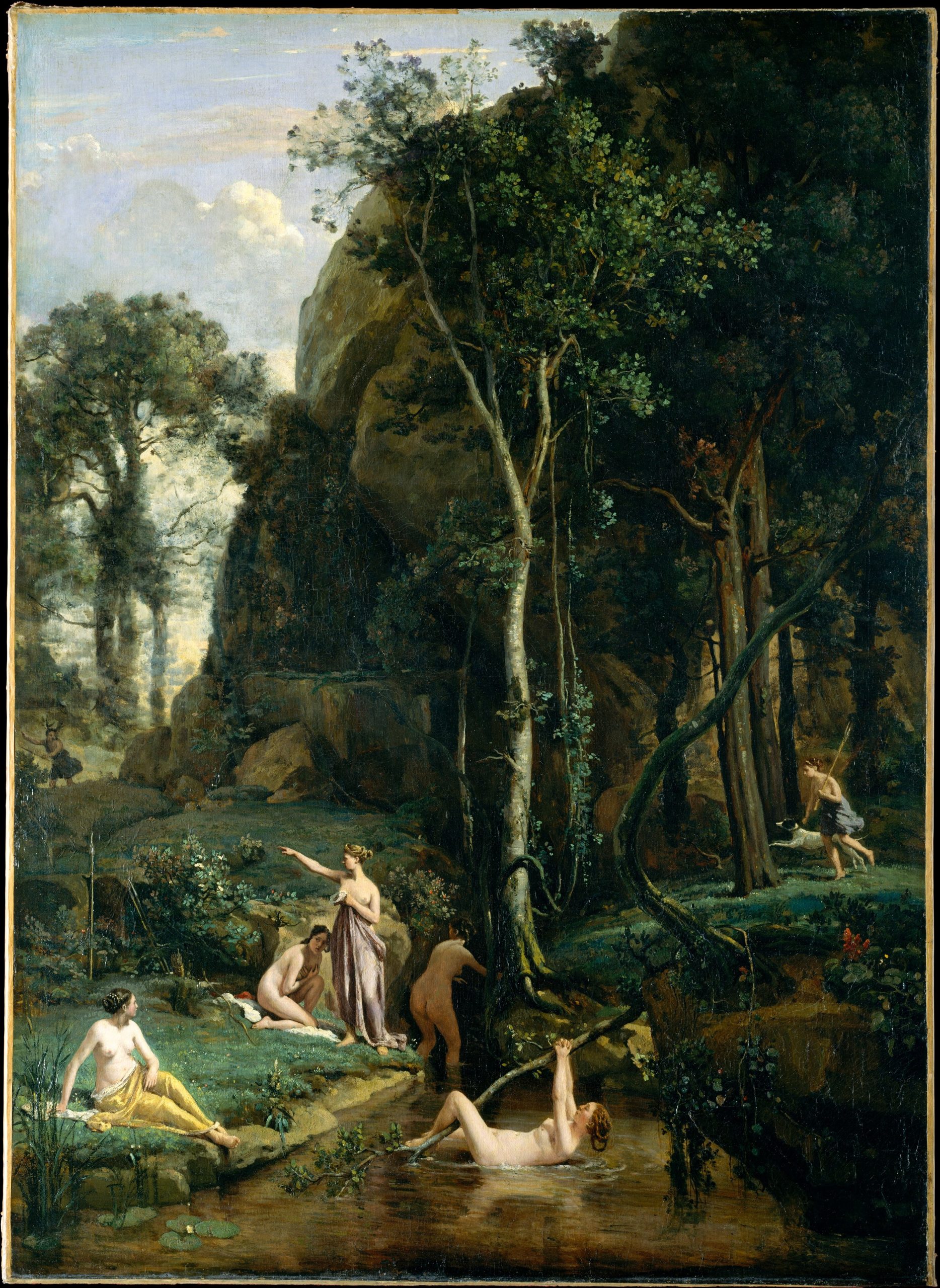
The hunt was over. The danger had not begun.
Opening illustration: Jean-Baptiste Camille Corot, Diana and Actaeon (Diana Surprised in Her Bath), 1836. The Metropolitan Museum of Art, Robert Lehman Collection, 1975 (1975.1.162). Public domain (CC0). Corot keeps the hunter small and the wood large: nothing in the place warns him what it holds.
At noon, Actaeon calls off the chase. The mountain is already stained with the blood of animals; the nets and spears have done enough work. His companions can return tomorrow. For now, they should rest.
He knows when to stop hunting. He does not know where to stop walking.
Ovid introduces the disaster with a judgment that its victim will never be allowed to deliver:
Thy grandson, Cadmus, was the first occasion of sorrow to thee, among so much prosperity, the horns, too, not his own, placed upon his forehead, and you, O dogs, glutted with the blood of your master. But, if you diligently inquire into his case, you will find the fault of an accident, and not criminality in him; for what criminality did mistake embrace?
Ovid, Metamorphoses 3.138–142, translated by Henry Thomas Riley.1
The Latin sets error against scelus: a mistake against a crime. Later, Actaeon enters the grove errans, wandering. His feet stray before anyone accuses his eyes. The language joins losing the way to the error that will destroy him.2
The story proceeds with his innocence already before us.
The principal text is Ovid’s Metamorphoses 3.138–255. Extended quotations use Henry Thomas Riley’s public-domain translation, first published in 1851. Narration calls the goddess Artemis; Riley calls her Diana. Other ancient versions and later interpretations are identified where they enter.
Noon at the hidden spring
Actaeon belongs to the house of Thebes: his mother, Autonoe, is Cadmus’s daughter. Pseudo-Apollodorus names Aristaeus as his father and Chiron as the teacher who trained him to hunt. He is experienced in the forest, but experience cannot tell him everything the forest contains.3
Ovid leads him toward Gargaphie:
There was a valley, thick set with pitch-trees and the sharp-pointed cypress; by name Gargaphie, sacred to the active Diana. In the extreme recess of this, there was a grotto in a grove, formed by no art; nature, by her ingenuity, had counterfeited art; for she had formed a natural arch, in the native pumice and the light sand-stones. A limpid fountain ran murmuring on the right hand with its little stream, having its spreading channels edged with a border of grass. Here, when wearied with hunting, the Goddess of the woods was wont to bathe her virgin limbs in clear water.
After she had entered there, she handed to one of the Nymphs, her armor-bearer, her javelin, her quiver, and her unstrung bow. Another Nymph put her arms under her mantle, when taken off: two removed the sandals from her feet. But Crocale, the daughter of Ismenus, more skilled than they, gathered her hair, which lay scattered over her neck, into a knot, although she herself was with her hair loose. Nephele, and Hyale, and Rhanis, fetch water, Psecas and Phyale do the same, and pour it from their large urns. And while the Titanian Goddess was there bathing in the wonted stream, behold! the grandson of Cadmus, having deferred the remainder of his sport till next day, came into the grove, wandering through the unknown wood, with uncertain steps; thus did his fate direct him.
Ovid, Metamorphoses 3.155–176, translated by Henry Thomas Riley.1
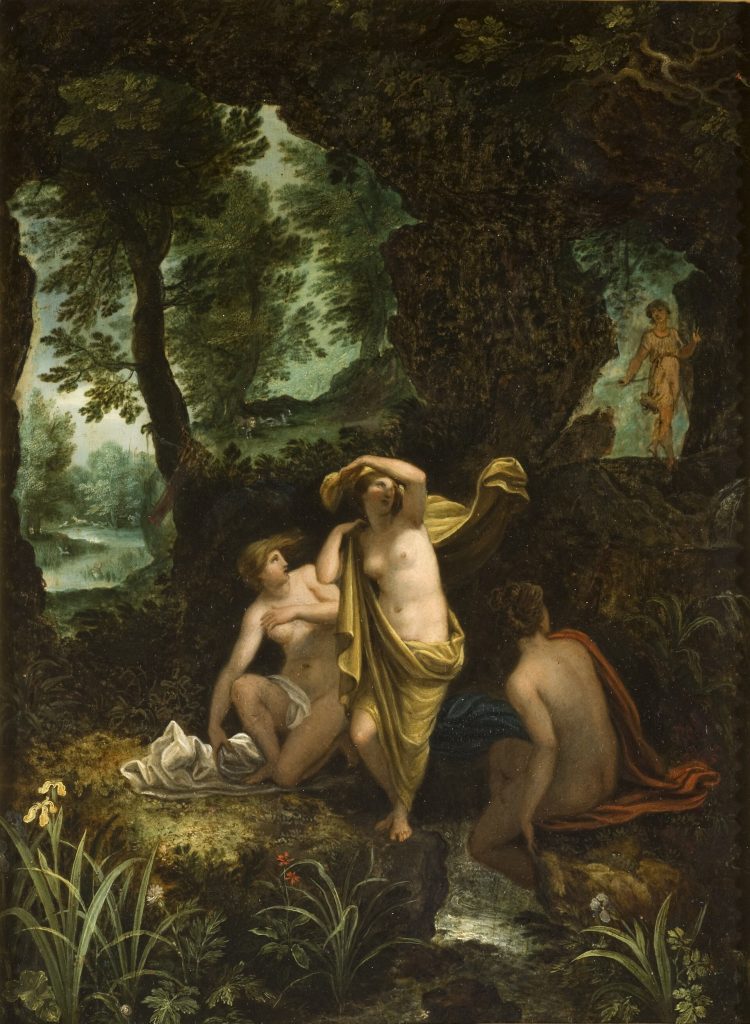
Both hunter and goddess have withdrawn from the hunt. He has put his work aside; she has put her weapons aside. The meeting occurs during an interval of rest.
The place itself appears welcoming: clear water, grass, shelter from the heat. Its beauty does not announce its danger. Nature has made something resembling a human work of art, but the traveler who enters it has not been invited.
The sight that cannot be told
The nymphs see him and try to cover the goddess:
Soon as he entered the grotto, dropping with its springs, the Nymphs, naked as they were, on seeing a man, smote their breasts, and filled all the woods with sudden shrieks, and gathering round Diana, covered her with their bodies. Yet the Goddess herself was higher than they, and was taller than them all by the neck. The color that is wont to be in clouds, tinted by the rays of the sun when opposite, or that of the ruddy morning, was on the features of Diana, when seen without her garments.
She, although surrounded with the crowd of her attendants, stood sideways, and turned her face back; and how did she wish that she had her arrows at hand; and so she took up water, which she did have at hand, and threw it over the face of the man, and sprinkling his hair with the avenging stream, she added these words, the presages of his future woe: “Now thou mayst tell, if tell thou canst, how that I was seen by thee without my garments.” Threatening no more, she places on his sprinkled head the horns of a lively stag; she adds length to his neck, and sharpens the tops of his ears; and she changes his hands into feet, and his arms into long legs, and covers his body with a spotted coat of hair; fear, too is added.
Ovid, Metamorphoses 3.177–197, translated by Henry Thomas Riley.1
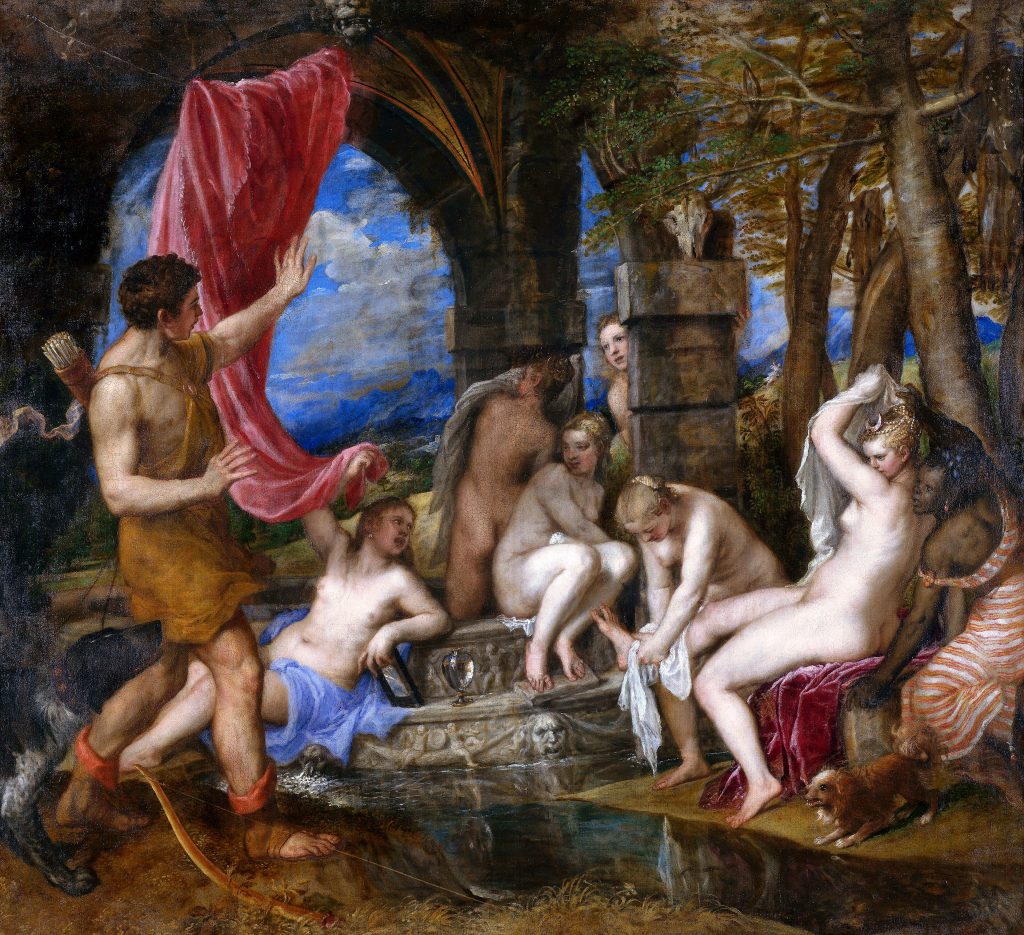
Artemis’s first response is intelligible without making Actaeon guilty. She has entered a secluded place, undressed, and suddenly finds a man before her. Her attendants panic. She turns away and wants the weapons she has relinquished.
His lack of intention does not make her exposure unreal.
But her words move beyond the intrusion to its possible afterlife: what he might tell. The sight could become a story, and the story could pass beyond her control. The transformation prevents that possibility before Actaeon has chosen what to do with his knowledge.
The water also changes its function. What washed the goddess becomes the means of altering the witness. She answers her exposure by taking away his recognizable human body. Her momentary vulnerability becomes his enduring helplessness.
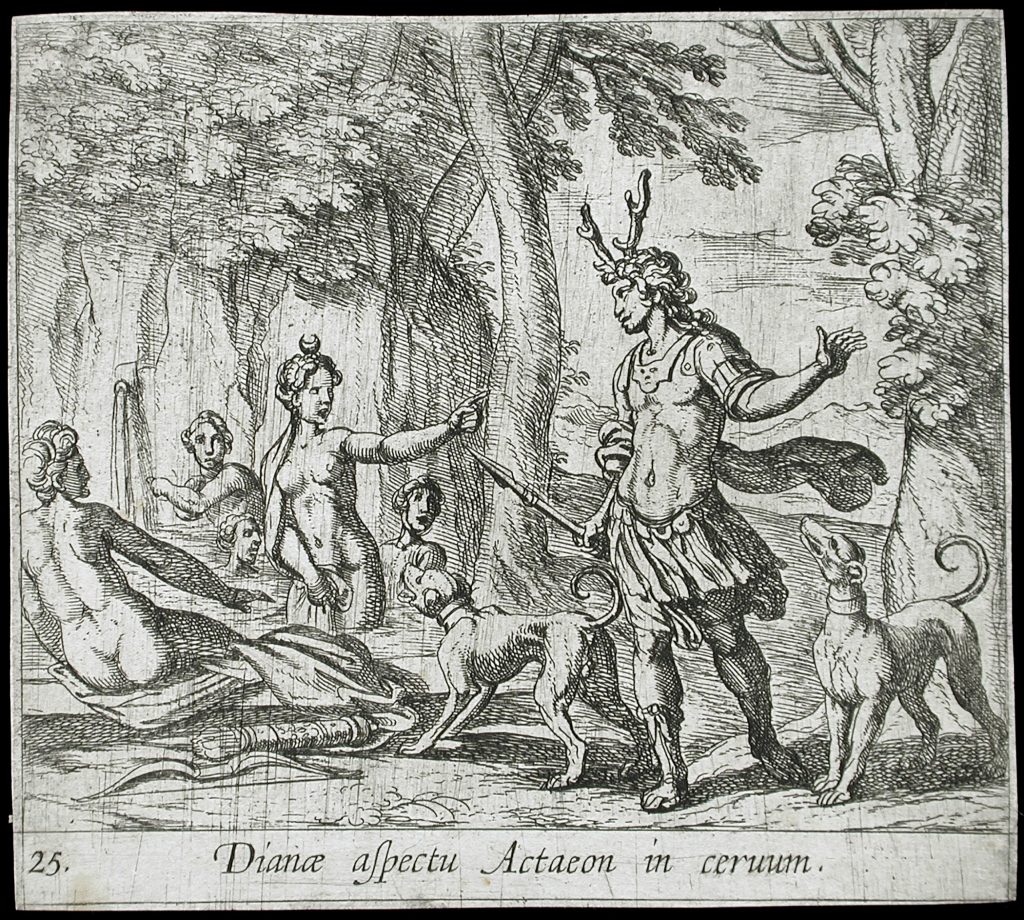
The hunt from the other side
The new body carries a fear that the old body did not know:
The Autonoëian hero took to flight, and wondered that he was so swift in his speed; but when he beheld his own horns in the wonted stream, he was about to say, “Ah, wretched me!” when no voice followed. He groaned; that was all his voice, and his tears trickled down a face not his own, but that of a stag. His former understanding alone remained.
Ovid, Metamorphoses 3.198–203, translated by Henry Thomas Riley.1
He hesitates between home and the forest. Then his dogs find him. Ovid names them individually, recalling their origins, their speed, and their talents. These are not strangers arriving from the wilderness. They belong to the world Actaeon has trained and commanded.2
Their excellence becomes his danger:
This pack, in eagerness for their prey, are borne over rocks and cliffs, and crags difficult of approach, where the path is steep, and where there is no road. He flies along the routes by which he has so often pursued; alas! he is now flying from his own servants. Fain would he have cried, “I am Actæon, recognize your own master.” Words are wanting to his wishes; the air resounds with their barking.
Melanchætes was the first to make a wound on his back, Theridamas the next; Oresitrophus fastened upon his shoulder. These had gone out later, but their course was shortened by a near cut through the hill. While they hold their master, the rest of the pack come up, and fasten their teeth in his body. Now room is wanting for more wounds.
He groans, and utters a noise, though not that of a man, still, such as a stag cannot make; and he fills the well-known mountains with dismal moans, and suppliant on his bended knees, and like one in entreaty, he turns round his silent looks as though they were his arms.
But his companions, in their ignorance, urge on the eager pack with their usual cries, and seek Actæon with their eyes; and cry out “Actæon” aloud, as though he were absent. At his name he turns his head, as they complain that he is not there, and in his indolence, is not enjoying a sight of the sport afforded them. He wished, indeed, he had been away, but there he was; and he wished to see, not to feel as well, the cruel feats of his own dogs.
They gather round him on all sides, and burying their jaws in his body, tear their master in pieces under the form of an imaginary stag. And the rage of the quiver-bearing Diana is said not to have been satiated, until his life was ended by many a wound.
Ovid, Metamorphoses 3.225–252, translated by Henry Thomas Riley.1
Actaeon is Cadmus’s grandson, the son of his daughter Autonoe, and in that house he is the first to be killed by those who should have known him. His grandfather’s city began on a field where armed brothers, struck by Cadmus’s stones, each took the other for the attacker.
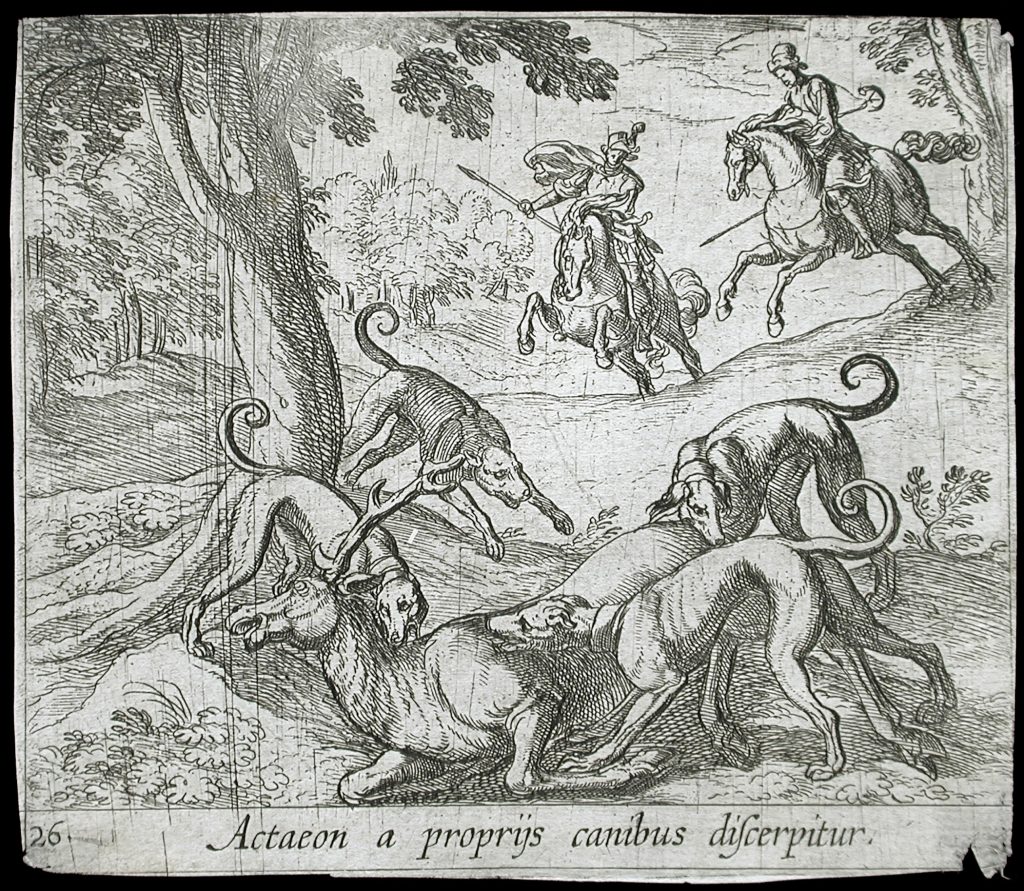
The dogs pursue what they perceive. His companions encourage the familiar spectacle. No one needs to hate Actaeon for the hunt to destroy him.
His human understanding makes the scene more than an animal’s death. He can recognize every relationship that has become useless to him. He remembers being the master of the creatures that now hold him down. His friends believe him absent while standing beside his suffering.
But the reversal also takes us beyond his individual identity. The landscape and the practice of hunting remain familiar; his position within them has changed. What once meant recreation now means terror. The spectator learns what the spectacle feels like.
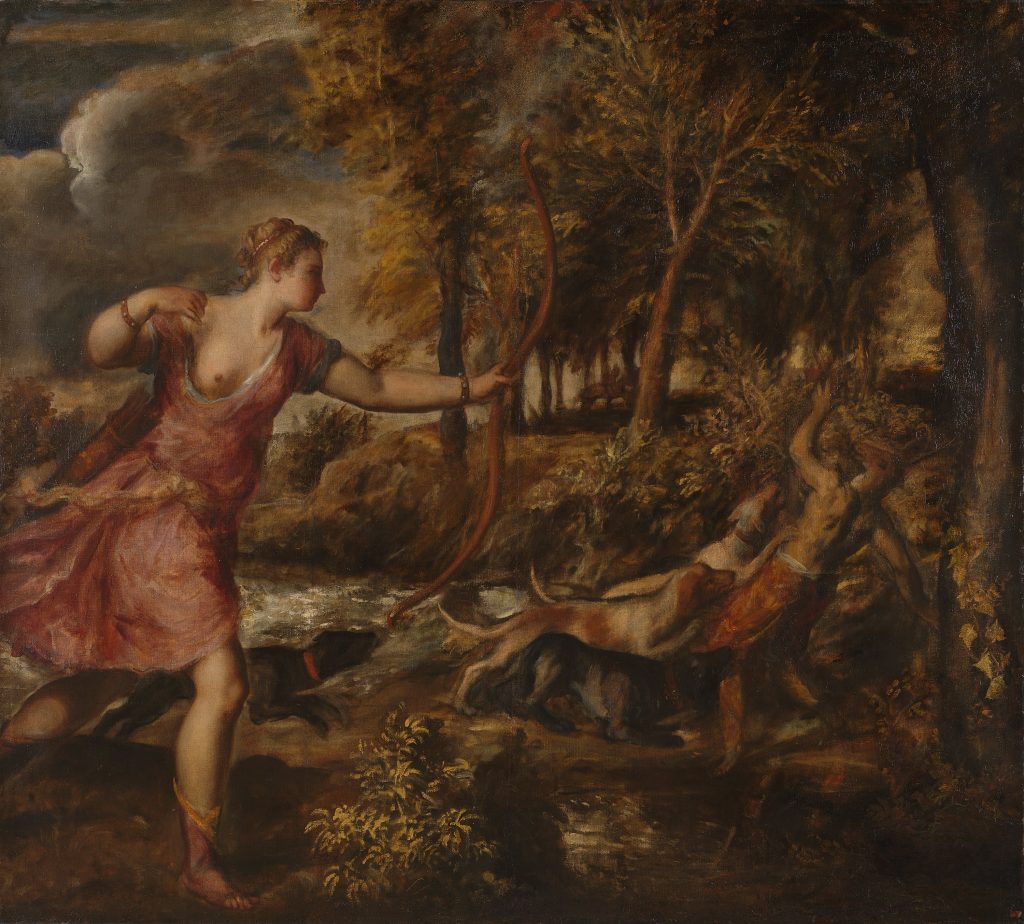
This is not necessarily a condemnation of hunting: Artemis herself hunts. It is an imaginative passage into the vulnerability that mastery ordinarily keeps at a distance. The hunter discovers that the forest contains a point of view from which his dogs have always been frightening.
When the act outweighs the intention
After the killing, Ovid leaves the audience divided:
They speak in various ways of this matter. To some, the Goddess seems more severe than is proper; others praise her, and call her deserving of her state of strict virginity: both sides find their reasons.
Ovid, Metamorphoses 3.253–255, translated by Henry Thomas Riley.1
The disagreement is already inside the ancient telling. We do not need to invent a modern prosecution against a uniformly approving audience.
One side judges the consequence against the absence of deliberate wrongdoing. The other understands Artemis’s severity as the defense of something that cannot be surrendered without changing who she is. Her virginity, privacy, and divine standing are not incidental possessions. They belong to the integrity of the goddess.
Under this second reading, the sacred prohibition concerns the act itself. To see what is forbidden is to cross the line, whether desire, malice, curiosity, or mere wandering brought the eyes there. Innocence of intention does not undo the encounter.
Ovid returns to precisely this difficulty in his exile poetry:
Why did I see anything? Why did I make my eyes guilty? Why did wrongdoing become known to me unwittingly? Unknowing, Actaeon saw Diana unclothed; none the less he became prey for his own dogs. Evidently, among the gods even misfortune must be paid for, and when a divinity has been offended, accident receives no pardon.
Ovid, Tristia 2.103–108; original prose translation from the Latin.4
Here is the disturbing possibility: the gods may punish an innocent person without considering innocence a defense.
Within that conception of sacred law, mercy risks appearing as a failure to uphold the prohibition. The question is not what the mortal meant, but what the divine order will tolerate having happened. Actaeon’s eyes have received the forbidden sight. His good intentions cannot make them receive it for the first time again.
The encounter can consequently be understood almost like contact with fire: danger does not wait for a guilty intention. But Ovid does not let that analogy remove the goddess’s agency. Artemis speaks, transforms, and remains angry until he dies. The scene contains both the inexorability of a taboo and the passion of an offended person.
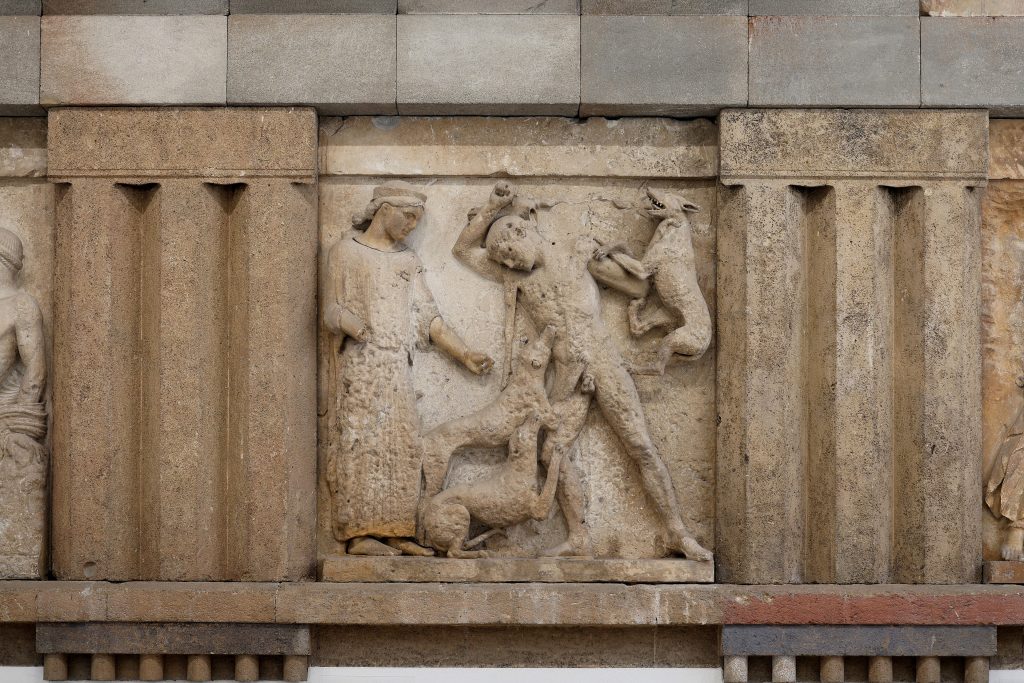
That tension prevents an easy verdict. A sacred rule can explain the punishment within the story’s world while the poem still asks whether that explanation makes the punishment just.
The guilt that makes the punishment easier to defend
The tradition does not give us one Actaeon with one offense. It gives us competing accounts of why the same terrible end occurred.
Diodorus reports versions in which Actaeon presumes upon his success as a hunter to seek union with Artemis, or boasts that he surpasses her in hunting. These accounts make his death answer an intentional challenge. Diodorus explicitly concludes that the goddess’s indignation was justified.5
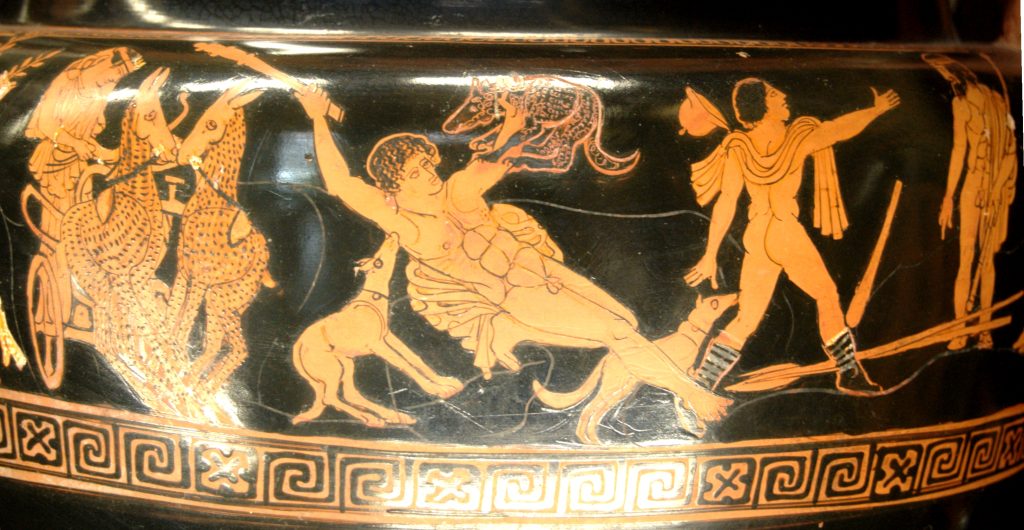
Pseudo-Apollodorus preserves a different explanation attributed to Acusilaus: Zeus becomes angry because Actaeon courts Semele. Here the fatal conflict concerns the desire of a divine rival, not an accidental encounter at the bath.3
Ovid, however, is not alone in preserving innocence. Callimachus also describes Actaeon seeing Artemis unwillingly. The opposition is therefore between branches of the tradition, not between one compassionate poet and every other ancient voice.6
Read suspiciously, the blame-bearing versions can perform a protective function. They defend divine authority by supplying the victim with the guilt that makes his punishment acceptable. A cover-up need not erase the killing. It can preserve the killing while changing the story through which the audience judges it.
Once the goddess is assumed to be just, the dead man must become the offender. The narrative finds him a boast, a forbidden desire, or a deliberate challenge. His destruction then confirms the order instead of exposing its severity.
The question becomes not only what Actaeon did, but what his storytellers need him to have done.
The sympathetic reading of those variants remains possible: they warn skilled people against confusing excellence with exemption from limits. Yet the accidental version exposes what that lesson cannot answer. A warning against arrogance offers little protection to someone whose fatal act precedes any arrogant choice.
Ovid does not rescue Actaeon by changing his fate. He rescues the possibility of judging him separately from it.
Tiresias: the life allowed after the loss
Callimachus places another young man beside a forbidden spring. Tiresias, thirsty while ranging with his dogs, accidentally sees Athena bathing with his mother, Chariclo. He loses his sight, and Chariclo protests.6
Athena answers that the consequence belongs to the law of Zeus:
“Whosoever shall behold any of the immortals, when the god himself chooses not, at a heavy price shall he behold.”
Callimachus, Hymn 5: The Bath of Pallas, within lines 97–105, translated by A. W. Mair.6
She does not restore the eyes. Instead, she grants Tiresias prophetic understanding, a guiding staff, and a long life. His loss becomes the beginning of another form of perception.
Callimachus makes the comparison with Actaeon himself: Athena foretells that he, too, will see a goddess unwillingly, but his own dogs will devour him. Chariclo’s grief will seem fortunate beside his mother’s.6
The difference is not that one young man intends harm while the other does not. Nor does Athena simply abolish the sacred rule. She preserves its consequence while making room for care afterward.
Tiresias must live differently. Actaeon is not permitted to live.
The comparison leaves open a question more searching than whether a prohibition exists: what can divine authority still give to the person who has already paid for crossing it?
Other forbidden sights
Ovid follows Actaeon’s death with Semele’s: she asks Zeus to approach her as he approaches Hera, and her mortal body cannot survive the revelation. Actaeon is destroyed after a sight he never sought; Semele is destroyed by the divine presence she requests.7
In Exodus, Moses asks to see God’s glory. He is told that no one can see the divine face and live. Yet God shelters him in a cleft of rock and permits a limited revelation. The dangerous encounter is managed so that the mortal can survive it.8
In the Japanese Kojiki, Izanami tells Izanagi not to look at her in the land of the dead. He looks anyway, sees her changed body, and recoils. She experiences the exposure as humiliation; pursuit and separation follow. Here, unlike Ovid’s Actaeon, the observer has received an explicit warning.9
The shared pattern is a sight that changes the relationship between the one who sees and the one who is seen. But its meanings differ: protected revelation, disobedient discovery, accidental exposure. Sometimes the veil preserves life; sometimes it preserves dignity; sometimes lifting it reveals a reality that the relationship cannot survive.
The resemblance does not make every veil sacred for the same reason. It makes the consequences of seeing worth examining.
Another Actaeon: devoured by what he loves
The hounds also invite a reading in which the consuming power grows out of the hunter’s own way of life.
Palaephatus offers an ancient rationalization: Actaeon’s devotion to hunting and the upkeep of his dogs consume his resources until the saying that his dogs “devoured” him becomes a story of literal death. This is his explanation of the tale, not another event in Ovid’s narrative.10
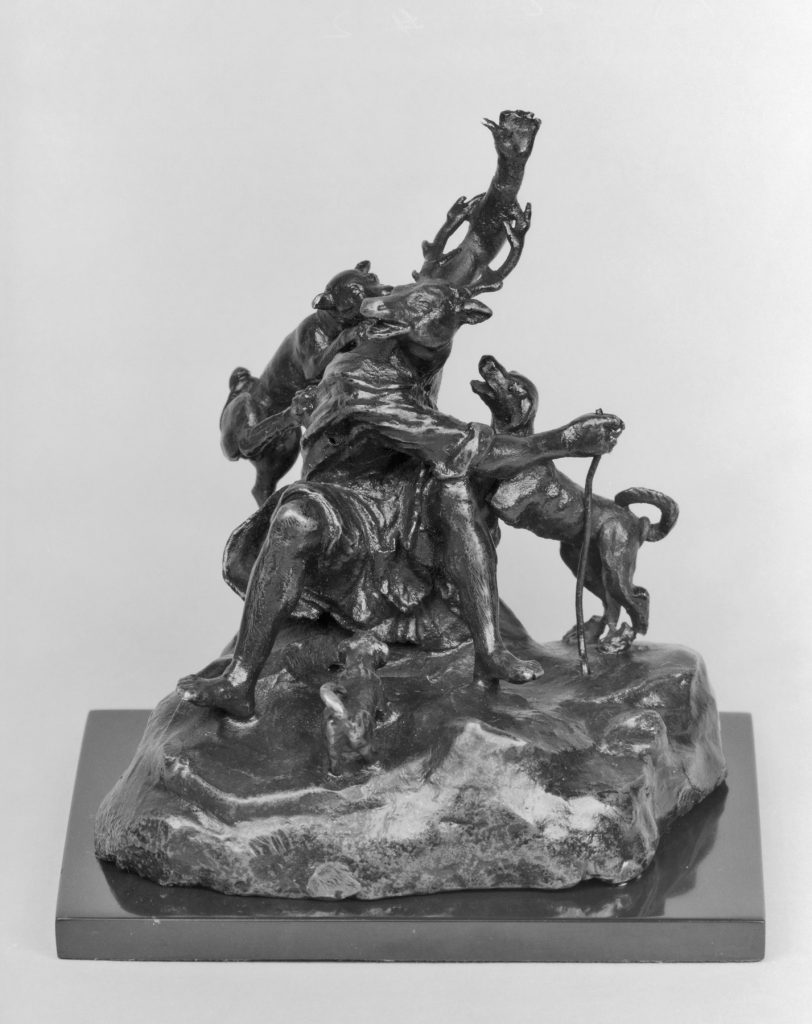
Under that reading, the supposed servants have become the masters. What Actaeon maintains for his pleasure consumes the life that maintains it. The image turns from divine punishment toward the danger of a passion that no longer knows its limits.
Centuries later, Giordano Bruno gives the reversal a strikingly different meaning. In The Heroic Enthusiasts, the hunt becomes an intellectual and spiritual pursuit. Actaeon seeks divine wisdom and beauty; his hounds become the thoughts with which he pursues them:
So Actæon with those thoughts—those dogs—which hunted outside themselves for goodness, wisdom, and beauty, thus came into the presence of the same, and ravished out of himself by so much splendour, he became the prey, saw himself converted into that for which he was seeking, and perceived, that of his dogs or thoughts, he himself came to be the longed-for prey; for having absorbed the divinity into himself it was not necessary to search outside himself for it.
Giordano Bruno, The Heroic Enthusiasts, Part I, Fourth Dialogue, translated by L. Williams, 1887, pp. 93–94.11
Bruno’s hunter does not simply acquire an object called truth and return unchanged. The discovery alters the one who discovers. He finds within himself what he had pursued as something outside him.
The hounds’ killing becomes the ending of an ordinary way of life and the beginning of an intellectual one. This is a philosophical transformation of the myth, not a claim that Ovid’s wounded man secretly survives. Bruno makes a spiritual passage out of what the ancient narrative presents as bodily destruction.11
Its force lies in the reversal of value. The loss of mastery need not signify only exclusion from the divine. It can signify participation in something the seeker cannot possess without being changed by it.
For the frightened hunter, becoming the prey is annihilation. For Bruno’s seeker, it is the discovery that the truth being hunted also lays claim to the hunter.
The gaze can expose what a person is forbidden to know. It can also dissolve the person who believed that knowing would leave him untouched.
The dogs that search for their master
There is one more ancient ending worth placing beside Ovid’s.
In Pseudo-Apollodorus, Artemis transforms Actaeon and drives his dogs mad. They kill him unwittingly. Afterward, their search begins:
Actaeon being gone, the dogs sought their master howling lamentably, and in the search they came to the cave of Chiron, who fashioned an image of Actaeon, which soothed their grief.
Pseudo-Apollodorus, Library 3.4.4, translated by James George Frazer.3
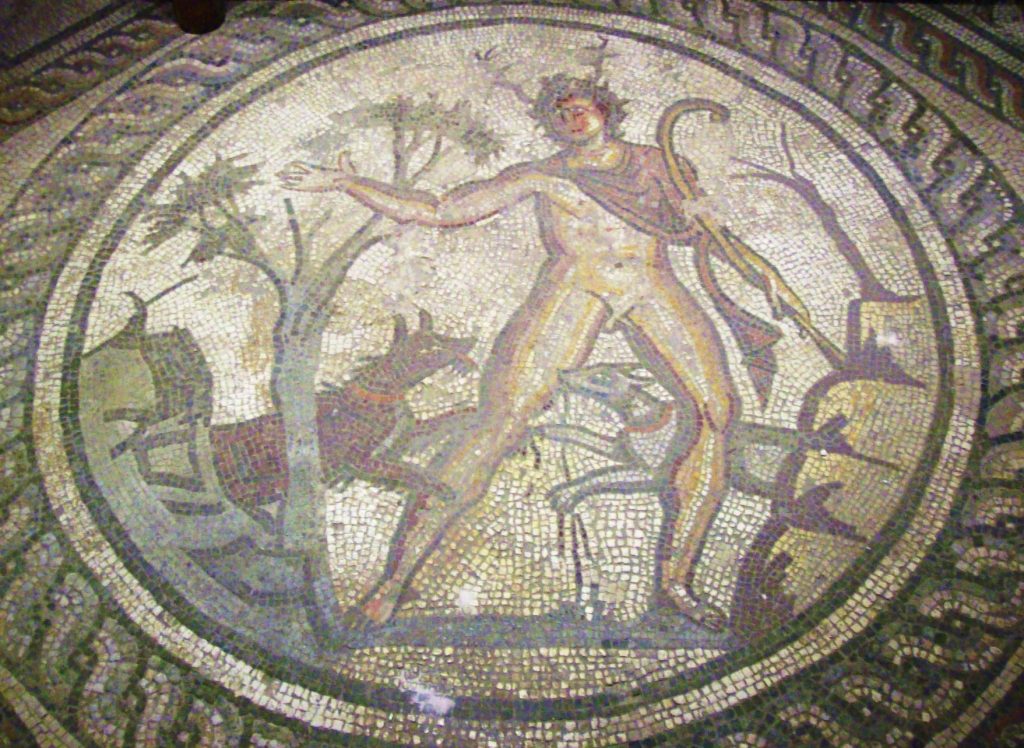
This ending does not restore the hunter, but it restores something to the dogs. Their failure was not the betrayal of a master they knowingly rejected. They grieve for the one they destroyed.
Chiron’s image can offer consolation because it returns the appearance through which their attachment can find an object. The living man was hidden inside a shape they could not recognize. The likeness, which contains no living man, gives them something recognizable again.
Art repairs the image of the relationship without repairing the death.
The dogs become quiet. Their master does not return.
What the poem allows us to see
Ovid’s opening appeal asks us to examine Actaeon’s case rather than infer his guilt from the fact that a goddess punished him. The killing happens; the judgment remains open. Even the audience within the poem divides over what it has heard.1
That distinction preserves both the sacred terror and the human difficulty. The goddess’s exposure matters. The hunter’s lack of intention matters. To understand the force of the prohibition is not yet to settle the worth of the person who crossed it.
The poem also gives us a sight that the hunters inside it never receive. We know whose consciousness survives beneath the hide. Where they see successful sport, we see a person struggling to make himself known.
Actaeon’s first sight is accidental. Our attention to his suffering need not be.
His companions call his name.
He turns his head.
They keep looking for him.
Sources and textual notes
1. Ovid, Metamorphoses 3.138–255. Henry Thomas Riley, trans., The Metamorphoses of Ovid (translation first published 1851; Project Gutenberg text based on later reprints). English text, Book III. Quoted passages are 3.138–142, 155–176, 177–197, 198–203, 225–252, and 253–255. Original wording is retained; page numbers, note markers, and marginal verse-range labels are omitted, with paragraphing and typography adjusted. Riley’s synopses and explanations are editorial commentary, not Ovid’s verses. The divided response at 3.253–255 appears under Riley’s next fable heading but concerns Actaeon’s death.
2. Ovid, Metamorphoses 3.138–255, Latin text. Especially error at 3.142; errans at 3.175; mens tantum pristina mansit at 3.203; the hounds at 3.206–224; the reciprocal paths at 3.228; the companions calling his name at 3.242–246; Artemis’s anger at 3.251–252. The article uses the attested verbal relationship between error and wandering instead of a speculative derivation of the proper name Actaeon. Riley’s “imaginary stag” at 3.250 renders falsi … sub imagine cervi: the outward stag conceals the master; it does not mean the dogs attack an insubstantial hallucination.
3. Pseudo-Apollodorus, Library 3.4.4, James George Frazer, trans. (1921), primary text at ToposText. Includes Actaeon’s parentage, Chiron’s teaching, the explanation attributed to Acusilaus, the bath explanation, Artemis’s maddening of the dogs, and the image that quiets their grief. The dogs’ madness and Chiron’s image belong to this account and are not inserted into Ovid’s narrative.
4. Ovid, Tristia 2.103–108, Latin text. Original prose translation prepared for this draft, not a quotation from Riley or a modern translator. Latin: Cur aliquid uidi? Cur noxia lumina feci? / Cur imprudenti cognita culpa mihi? / Inscius Actaeon uidit sine ueste Dianam: / praeda fuit canibus non minus ille suis. / Scilicet in superis etiam fortuna luenda est, / nec ueniam laeso numine casus habet. The rhetorical comparison does not establish the historical circumstances of the error associated with Ovid’s exile.
5. Diodorus Siculus, Library of History 4.81.3–5, primary-text extract, BYU’s Oxford Guide to Classical Mythology in the Arts resource. The competing explanations concern Actaeon’s presumption toward Artemis and a claim to superior hunting skill. Diodorus endorses the justification of her indignation. The article’s account of blame-bearing versions as potentially apologetic is a literary interpretation, not a proposed chronological proof that a historical incident was covered up. The English extract is paraphrased rather than reproduced at length.
6. Callimachus, Hymn 5: The Bath of Pallas, particularly 68–130; A. W. Mair, trans. (1921), primary text at ToposText. Tiresias sees unwillingly; Athena attributes the sanction to Zeus’s law and fate, offers compensating gifts, and explicitly invokes Actaeon as another unwilling witness who will suffer worse. This prevents the mistaken claim that every non-Ovidian tradition makes Actaeon deliberately guilty. The quoted sentence about beholding the gods falls within the speech at 97–105.
7. Ovid, Metamorphoses 3.256–315, especially 3.286–309 for Semele’s request and death. Latin text, Book III; Henry Thomas Riley’s public-domain translation. The comparison follows the sequence of Ovid’s narrative; it is a paraphrase, not a quotation.
8. Exodus 33.18–23, King James Version, text. Moses requests the vision; the face is forbidden while a protected, limited revelation is permitted. The comparison concerns the different handling of dangerous divine sight, not an assertion that the scenes carry an identical moral doctrine.
9. Kojiki, section IX, “The Land of Hades,” Basil Hall Chamberlain, trans. (1882), public-domain text. Izanami’s explicit warning, Izanagi’s prohibited look, her shame, and pursuit distinguish this episode from Ovid’s accidental encounter.
10. Palaephatus, On Unbelievable Things 6, primary work in English translation at ToposText. The economic explanation is the ancient rationalizer’s interpretation, not established history. The modern English rendering is paraphrased. The brief phrase about dogs devouring him names the underlying story rather than claiming a newly verified literal event.
11. Giordano Bruno, The Heroic Enthusiasts (Gli Eroici Furori), Part I, Fourth Dialogue, discussion of Actaeon; L. Williams, trans. (London, 1887), pp. 91–94. Public-domain English text. The long quotation appears across pp. 93–94. It is from the dialogue, not the translator’s introduction. Bruno identifies Actaeon with the intellect pursuing divine wisdom and beauty, the dogs with his pursuing thoughts, and the death with departure from an ordinary form of life into intellectual life. The article does not confuse this later philosophical interpretation with Ovid’s plot or endorse literal self-destruction.