Before sailors called upon her, she was the one in need of rescue
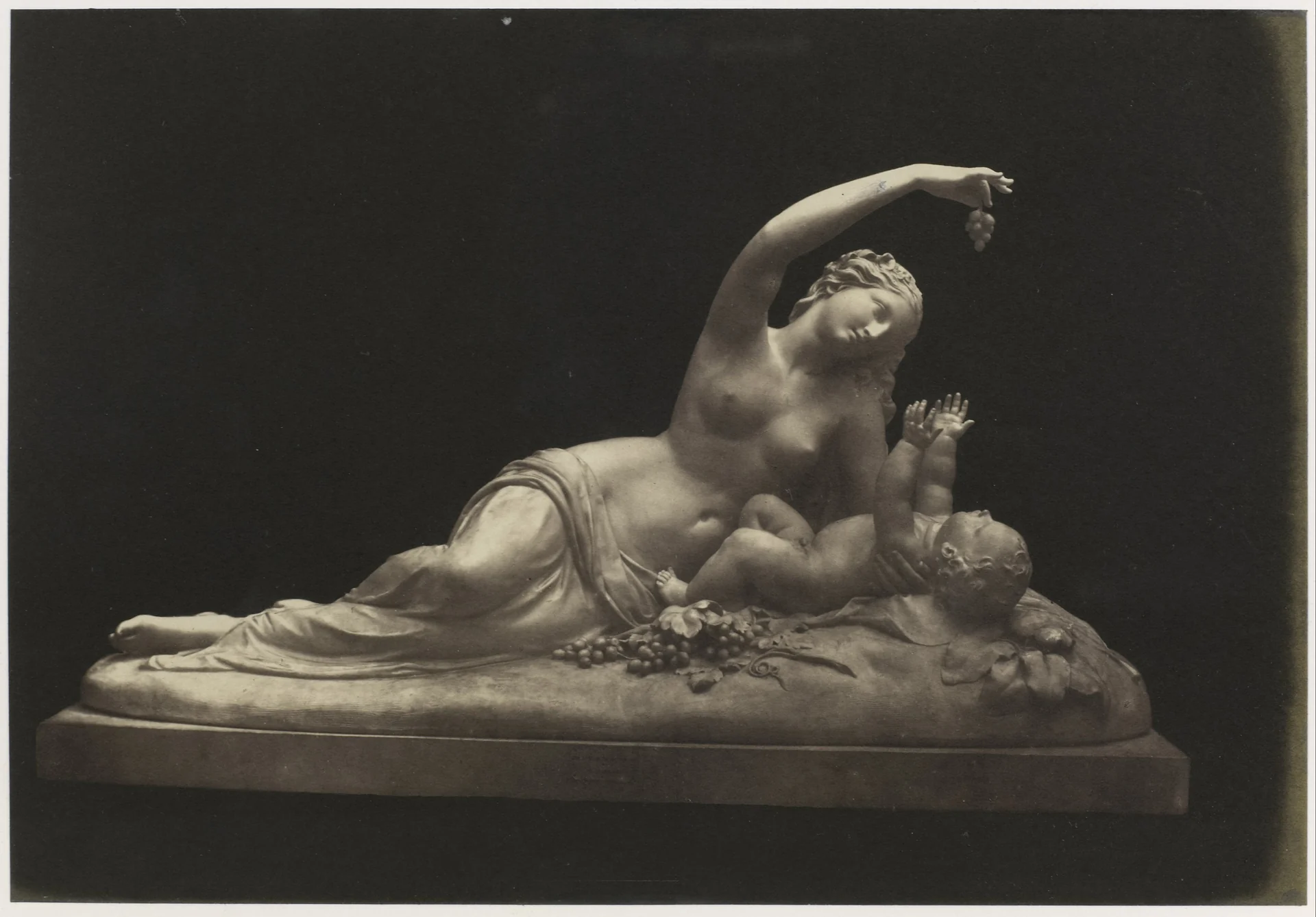
Opening illustration: John Henry Foley, Ino and Bacchus, the plaster model shown at the Great Exhibition in London, in a photograph of 1851 attributed to C. M. Ferrier and F. von Martens. Ino reclines and holds a bunch of grapes above the infant god. Rijksmuseum, RP-F-F25215-M. Public domain, via Wikimedia Commons.
Hermes brings Ino a child whose mother can no longer hold him.
Semele is dead. Zeus has carried their son Dionysus through a second gestation in his own body, but the infant still needs someone to rear him. The messenger brings him to Semele’s sister and her husband, Athamas.1
Ino is a daughter of Cadmus and Harmonia. Athamas rules in Boeotia. Their sons are Learchus and Melicertes; by an earlier marriage, to Nephele, Athamas also had Phrixus and Helle. The household into which Dionysus arrives has a history of its own.2
For now, the request is to make room for one more child, and to hide who he is.
The Child They Hid
But at the proper time Zeus undid the stitches and gave birth to Dionysus, and entrusted him to Hermes. And he conveyed him to Ino and Athamas, and persuaded them to rear him as a girl.
— Apollodorus, Library 3.4.3, translated by James George Frazer.1
The disguise protects a life that cannot yet protect itself. Before Dionysus unsettles the identities of those who oppose him, his own survival depends on appearing to be someone else.
For Ino, the child is not only the son of Zeus. He is her dead sister’s son. Taking him in continues a family bond the thunderbolt interrupted.
But the divine relationship follows him into the house. In Apollodorus, Hera answers by driving both foster parents mad. The people who shelter the child become the people through whom her anger reaches him.
Ovid places the attack later, when Dionysus’s power is already celebrated and Ino is proud of the child she once nursed. Hera sees a woman pleased with her marriage, her children and her divine foster-son, and that flourishing household becomes intolerable to her. She goes below the earth to enlist Tisiphone, one of the Furies.3
The Fury at the Door
Her name is Tisiphonē, Τισιφόνη, from tisis, τίσις, “retribution,” and phonos, φόνος, “murder.” She is the avenger of killing, and Hera sends her to cause one. Hera asks that Athamas be driven into crime and the house of Cadmus brought down. Tisiphone accepts, and when the goddess returns toward heaven, Iris purifies her with water.
She now reaches the threshold; the Æolian door-posts are said to have shaken, and paleness tints the maple door; the Sun, too, flies from the place. His wife is terrified at these prodigies; Athamas, too, is alarmed, and they are both preparing to leave the house. The baneful Erinnys stands in the way, and blocks up the passage; and extending her arms twisted round with folds of vipers, she shakes her locks; the snakes thus moved, emit a sound.
Some lying about her shoulders, some gliding around her temples, send forth hissings and vomit forth corruption, and dart forth their tongues. Then she tears away two snakes from the middle of her hair, which, with pestilential hand, she throws against them. But these creep along the breasts of Ino and Athamas, and inspire them with direful intent. Nor do they inflict any wounds upon their limbs; it is the mind that feels the direful stroke.
— Ovid, Metamorphoses 4.486–499, translated by Henry Thomas Riley.3
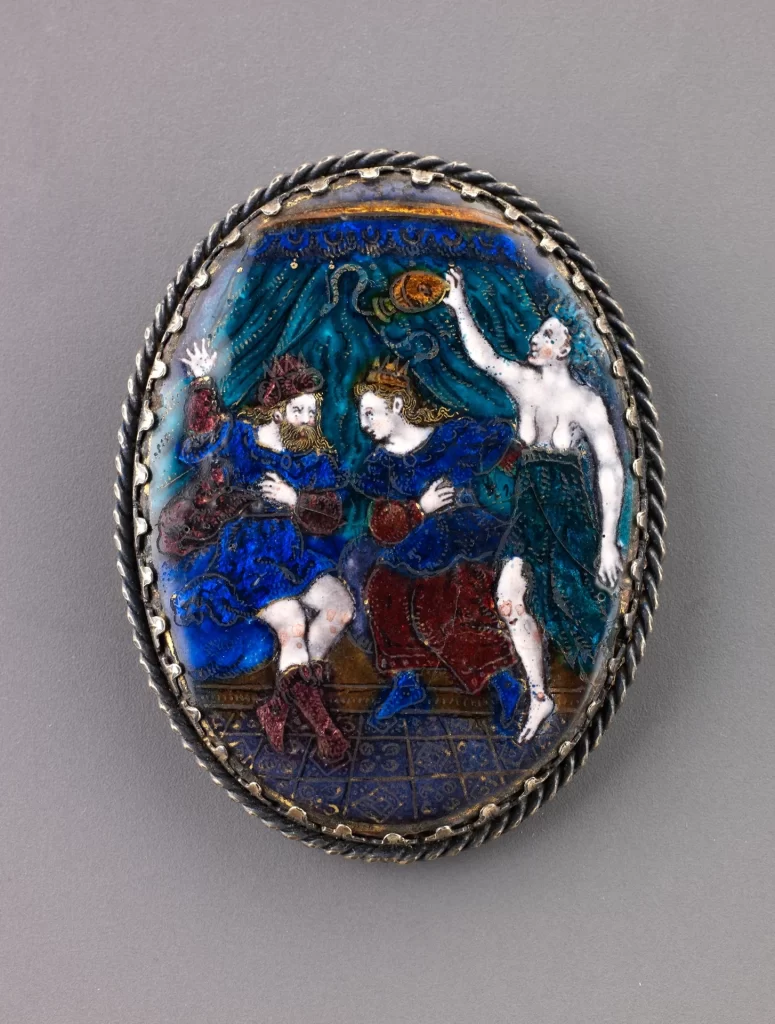
Erinnys is another name for a Fury. She blocks the way out before she makes the house unsafe. Ovid’s last line is mens est, quae diros sentiat ictus: the snakes leave no mark on the body, and “it is the mind that feels the dreadful blows.”
At first the parents share one perception: something terrible has come, and they should leave. The attack destroys that shared understanding. Their bodies can still act, but the world they act on is no longer the world in front of them. The violence does not need to break the family’s walls. It breaks the recognition by which the people inside them belong to one another.
The Father Who Sees a Beast
Immediately the son of Æolus, filled with rage, cries out, in the midst of his palace, “Ho! companions, spread your nets in this wood; for here a lioness was just now beheld by me with two young ones.” And, in his madness, he follows the footsteps of his wife, as though of a wild beast; and he snatches Learchus, smiling and stretching forth his little arms from the bosom of his mother, and three or four times he whirls him round in the air like a sling, and, frenzied, he dashes in pieces the bones of the infant against the hard stones.
Then, at last, the mother being roused (whether it was grief that caused it, or whether the power of the poison spread over her), yells aloud, and runs away distracted, with dishevelled hair; and carrying thee, Melicerta, a little child, in her bare arms, she cries aloud “Evoë, Bacche.” At the name of Bacchus, Juno smiles, and says, “May thy foster-child do thee this service.”
— Ovid, Metamorphoses 4.512–524, translated by Henry Thomas Riley.3
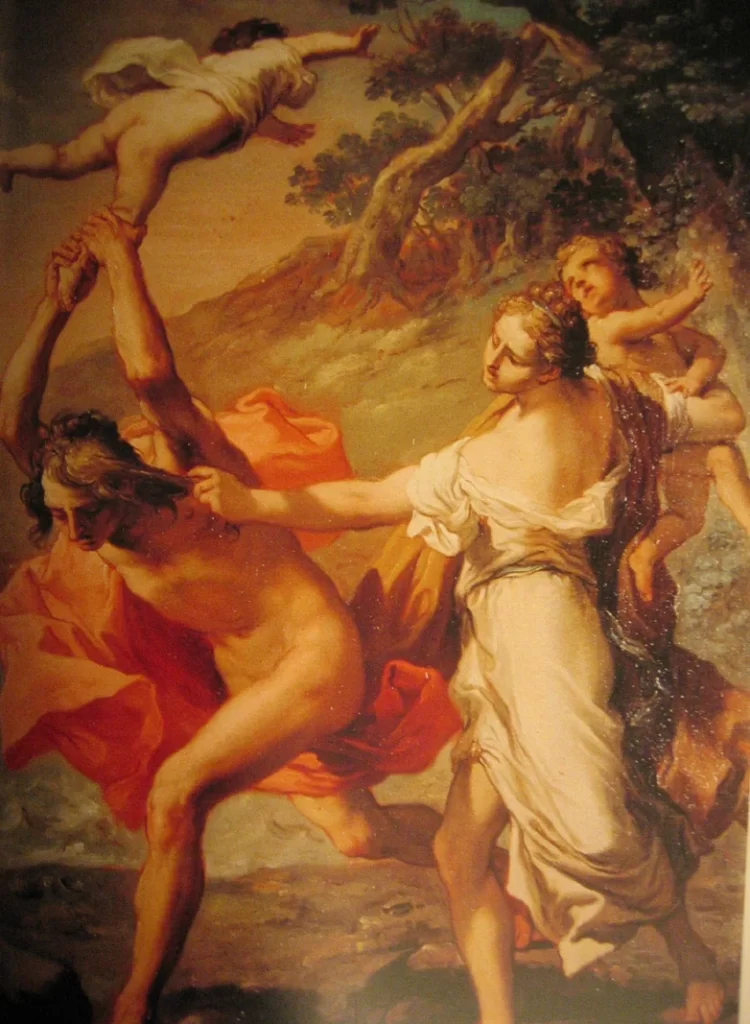
The child’s outstretched arms make the failure unbearable. Learchus still lives in a world where a father coming toward him means a welcome. Athamas has entered a hunt.
Actaeon’s story is reversed here. Actaeon’s body became an animal while his mind stayed human. Learchus stays a child, and the mind looking at him supplies the animal. In both, the familiar bond fails at the moment it is needed most.4
Athamas does to his son what Cadmus’s stones made the Sown Men do at the founding of Thebes. He looks at his own blood and sees a quarry.
Ino still has Melicertes in her arms. Ovid leaves grief and the Fury’s poison tangled together in her flight. Her cry names Bacchus, the Dionysus she fostered, and Hera turns that love into a taunt. The child Ino protected has become a name she can cry out, and the name does not stop the pursuit.
The Mother at the Cliff
There is a rock that hangs over the sea; the lowest part is worn hollow by the waves, and defends the waters covered thereby from the rain. The summit is rugged, and stretches out its brow over the open sea. This Ino climbs (madness gives her strength), and, restrained by no fear, she casts herself and her burden into the deep; the water, struck by her fall, is white with foam.
But Venus, pitying the misfortunes of her guiltless granddaughter, in soothing words thus addresses her uncle: “O Neptune, thou God of the waters, to whom fell a power next after the empire of heaven, great things indeed do I request; but do thou take compassion on my kindred, whom thou seest being tossed upon the boundless Ionian sea; and add them to thy Deities. I have surely some interest with the sea, if, indeed, I once was foam formed in the hollowed deep, and my Grecian name is derived from that.”
Neptune yields to her request; and takes away from them all that is mortal, and gives them a venerable majesty; and alters both their name and their shape, and calls Palæmon a Divinity, together with his mother Leucothoë.
— Ovid, Metamorphoses 4.525–542, translated by Henry Thomas Riley.3
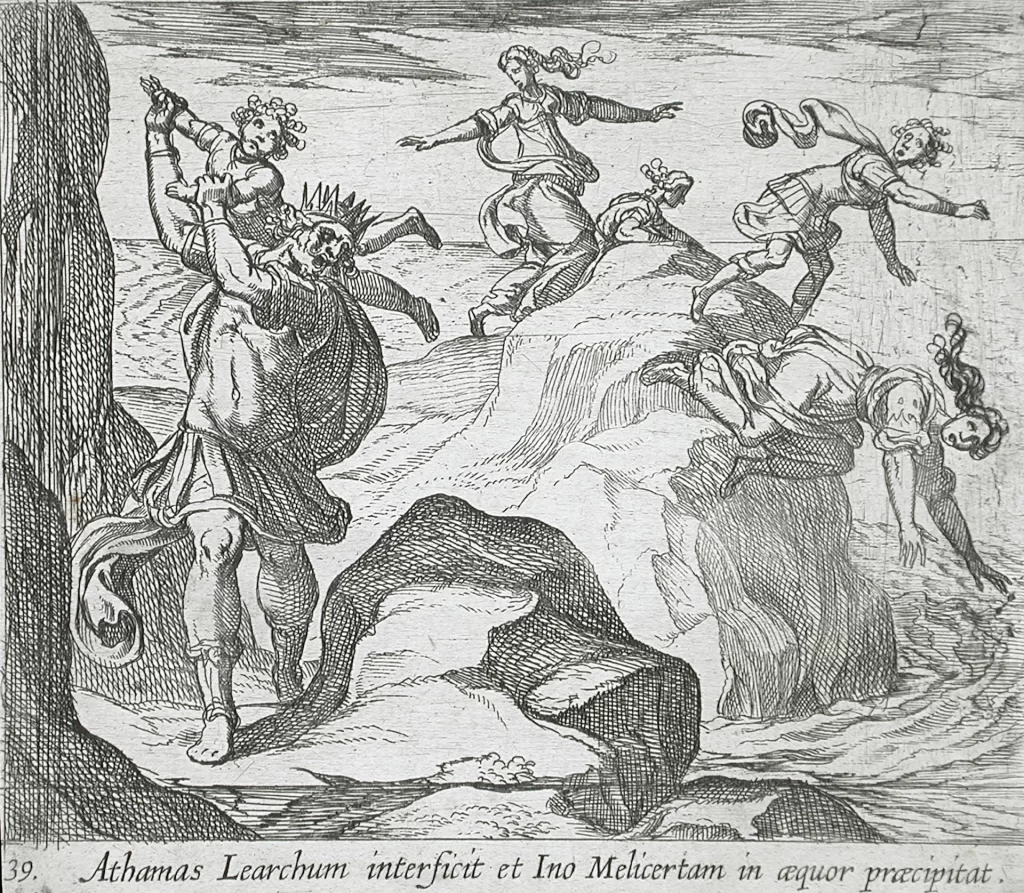
Venus is Aphrodite, Ino’s grandmother through Harmonia. A divine family quarrel brought the Fury into the house; another member of the divine family now comes forward to plead for the people being destroyed. Her claim on the sea is her name. Greek tradition derived Aphroditē, Ἀφροδίτη, from aphros, ἀφρός, “foam,” and the goddess born from foam pleads for a woman who has just struck the water and turned it white. Ovid’s phrase is percussa recanduit unda, “the struck wave grew white.”
Riley’s “take compassion on my kindred” is tu miserere meorum, “have mercy on my own.” Miserere is the word that opens the fifty-first Psalm in the Latin church, Miserere mei, Deus, “Have mercy on me, O God.” Ovid also calls Ino inmerita, undeserving of what she suffers. The plea is made by one god to another, on behalf of a woman who did nothing to earn this.
Aphrodite asks for a change in their condition, not a delay of their deaths, and Poseidon grants it. The sea becomes the place where the household’s ending opens into another existence. It is not a victory Ino planned. She reaches the water in grief and madness, and the saving act belongs to the compassion that meets her there. Nor is the family returned whole. Mother and younger son receive another life. Learchus does not.
Leucothea and Palaemon
Leukothea, Λευκοθέα, means “White Goddess,” from leukos, λευκός, “white, bright,” and thea, θεά, “goddess.” Ovid’s white foam gives the name a fitting image, but Homer already uses it centuries before Ovid tells the plunge.
Melicertes becomes Palaemon. Apollodorus ties the new names to the people they help:
And she herself is called Leucothea, and the boy is called Palaemon, such being the names they get from sailors; for they succour storm-tossed mariners. And the Isthmian games were instituted by Sisyphus in honor of Melicertes.
— Apollodorus, Library 3.4.3, translated by James George Frazer.1
Their remembered identity has changed from what happened to them to what they do for others. The dangerous sea becomes a place where their names can be called on with hope.
The boy’s two names point somewhere else as well. Melikertēs, Μελικέρτης, has no agreed Greek derivation. It sounds very like Melqart, 𐤌𐤋𐤒𐤓𐤕, the god of Tyre, whose name is usually understood as “king of the city”; compare Hebrew melekh, מֶלֶךְ, “king,” and qeret, קֶרֶת, “city.” Ino is the daughter of Cadmus, who came west from Phoenicia, and Ovid calls the women who attend her Sidoniae comites, her companions from Sidon. The Greeks called Melqart the Tyrian Heracles, and the boy’s second name, Palaimōn, Παλαίμων, “the wrestler,” was an epithet of Heracles. The scholar Lewis Farnell dismissed the likeness of Melicertes and Melqart as an accident of sound, since Melqart was a bearded god and Melicertes a child. The proposed connection would give a Phoenician princess’s son one name resembling the god of Tyre and another shared with that god’s Greek counterpart. No ancient source identifies Melicertes with Melqart, but the resemblance sits in a family whose founding story already starts in Phoenicia.5
Apollodorus’s road to the sea is harsher than Ovid’s. He sends the madness through both parents’ hands:
But Hera indignantly drove them mad, and Athamas hunted his elder son Learchus as a deer and killed him, and Ino threw Melicertes into a boiling cauldron, then carrying it with the dead child she sprang into the deep.
— Apollodorus, Library 3.4.3, translated by James George Frazer.1
Here the mother is not only fleeing violence. Under the imposed madness, she has done it. The child is already dead when she enters the sea, and their divine names follow a catastrophe in which neither parent stayed a safe guardian. Ovid’s Ino carries a living child away from his father. Apollodorus’s Ino carries a child she has killed. They reach the same sea by different roads.
In Apollodorus, Dionysus escapes again. Zeus turns him into a young goat, and Hermes carries him to the nymphs of Nysa. His future goes on beyond the household that sheltered him.
The Children Who Pay
The fostering story makes the unequal share of danger plain. Zeus’s child receives another disguise and another refuge. The foster parents’ children receive no escape from the attack on their home.
That does not make Dionysus responsible for needing protection. He is a child carried from one set of hands to another. It makes the treatment of the other children harder to justify. Hera’s grievance has a recognisable source: Zeus’s affair with Semele has produced a child whose survival carries that affair into the future. From her side, sheltering him may look like taking part in the insult. But protecting an infant is not the same act as betraying a spouse, and the protectors’ children took part in neither. The reprisal wipes out those distinctions. A whole household suffers because one member offered shelter.
Ovid sharpens the problem by having Hera learn from Dionysus. In his order of events she has already seen what madness did to Pentheus, and she decides to use the same weapon on Ino. The rival powers oppose each other without opposing the method, and the mortal house is where their contest becomes pain.3
Ino’s Sidonian attendants call the punishment unjust. Ovid does not leave that judgment to a later reader. Hera answers their reproaches by turning them to stone or into birds, and one of them stays fixed with her hand stretched toward the sea. Even mourning becomes dangerous when it names the punishment as wrong. The change meant to silence them preserves their gestures. A hand held out toward the water can be read as a monument to divine severity, or as the last shape of someone who would not call that severity just.6
The Other Children in the House
The earlier marriage, to Nephele, carries a story that unsettles any simple picture of Ino as a protector of children. Apollodorus says she plotted against Phrixus and Helle. Her plan first makes the country hungry, then offers that hunger a convenient cure:
But Ino plotted against the children of Nephele and persuaded the women to parch the wheat; and having got the wheat they did so without the knowledge of the men. But the earth, being sown with parched wheat, did not yield its annual crops; so Athamas sent to Delphi to inquire how he might be delivered from the dearth. Now Ino persuaded the messengers to say it was foretold that the infertility would cease if Phrixus were sacrificed to Zeus. When Athamas heard that, he was forced by the inhabitants of the land to bring Phrixus to the altar.
— Apollodorus, Library 1.9.1, translated by James George Frazer.2
Nephele snatches her children away on the golden-fleeced ram. What matters here is the method. Ino manufactures a famine, buys an oracle from the messengers, and turns a private hatred into a public necessity. The king does not decide to kill his son. The people force him, because the god has spoken, and the god never did.
The woman who gives one endangered child a home appears in another tradition endangering others. Her tenderness follows the lines of kinship rather than reaching everyone within reach.
Pausanias, describing the cliffs along the coast road west of Megara, records a version with no god in it at all:
As to the Molurian, it is said that from it Ino flung her self into the sea with Melicertes, the younger of her children. Learchus, the elder of them, had been killed by his father. One account is that Athamas did this in a fit of madness; another is that he vented on Ino and her children unbridled rage when he learned that the famine which befell the Orchomenians and the supposed death of Phrixus were not accidents from heaven, but that Ino, the step-mother, had intrigued for all these things.
— Pausanias, Description of Greece 1.44.7, translated by W. H. S. Jones.7
In the second account the gods appear only in the lies. The famine was made by hand, the oracle was bought, and the killing was a father’s revenge. Read that way, the Fury with her snakes is the story a family tells when a man has killed his son in rage, and Hera’s jealousy is how a household names a crime without naming the criminal. Neither account makes the killing of Ino’s children a remedy for the danger she brought on Nephele’s. A child is still someone other than the parent through whom revenge looks for its target.
Ino’s suffering does not erase the scheming stepmother, and the stepmother is not the whole of the woman who becomes Leucothea. Her clearest act as a goddess of the sea belongs to a different poem, beside a man who is not one of her children at all.
The Stranger on the Raft
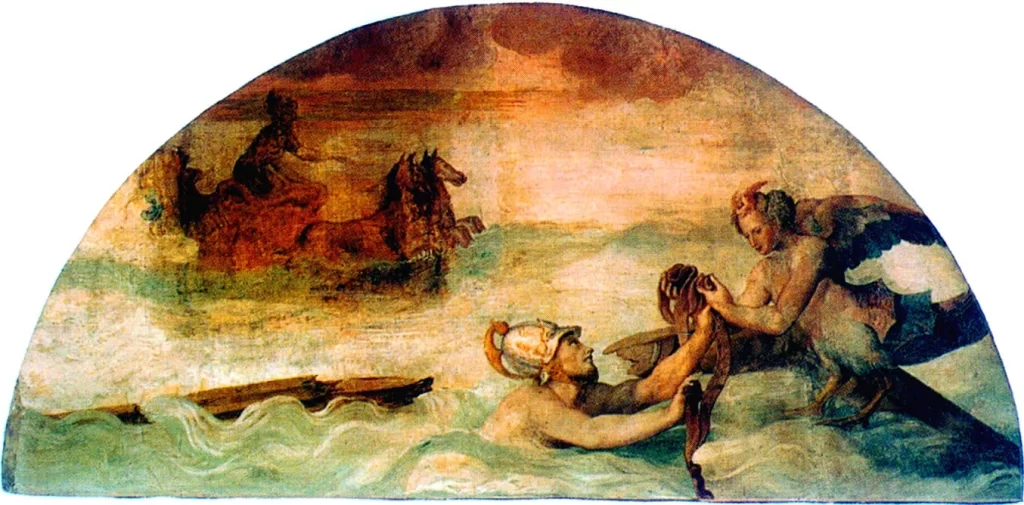
In the Odyssey, Odysseus has left Calypso’s island on a raft and is struggling toward the land of the Phaeacians when Poseidon raises a storm. The sea breaks his mast and throws him from the raft. He manages to climb back, but cannot make it safe. Then Ino sees him:
When he was in this plight, Ino daughter of Cadmus, also called Leucothea, saw him. She had formerly been a mere mortal, but had been since raised to the rank of a marine goddess. Seeing in what great distress Ulysses now was, she had compassion upon him, and, rising like a sea-gull from the waves, took her seat upon the raft.
“My poor good man,” said she, “why is Neptune so furiously angry with you? He is giving you a great deal of trouble, but for all his bluster he will not kill you. You seem to be a sensible person, do then as I bid you; strip, leave your raft to drive before the wind, and swim to the Phaeacian coast where better luck awaits you. And here, take my veil and put it round your chest; it is enchanted, and you can come to no harm so long as you wear it. As soon as you touch land take it off, throw it back as far as you can into the sea, and then go away again.” With these words she took off her veil and gave it him. Then she dived down again like a sea-gull and vanished beneath the dark blue waters.
— Homer, Odyssey 5.333–353, translated by Samuel Butler.8
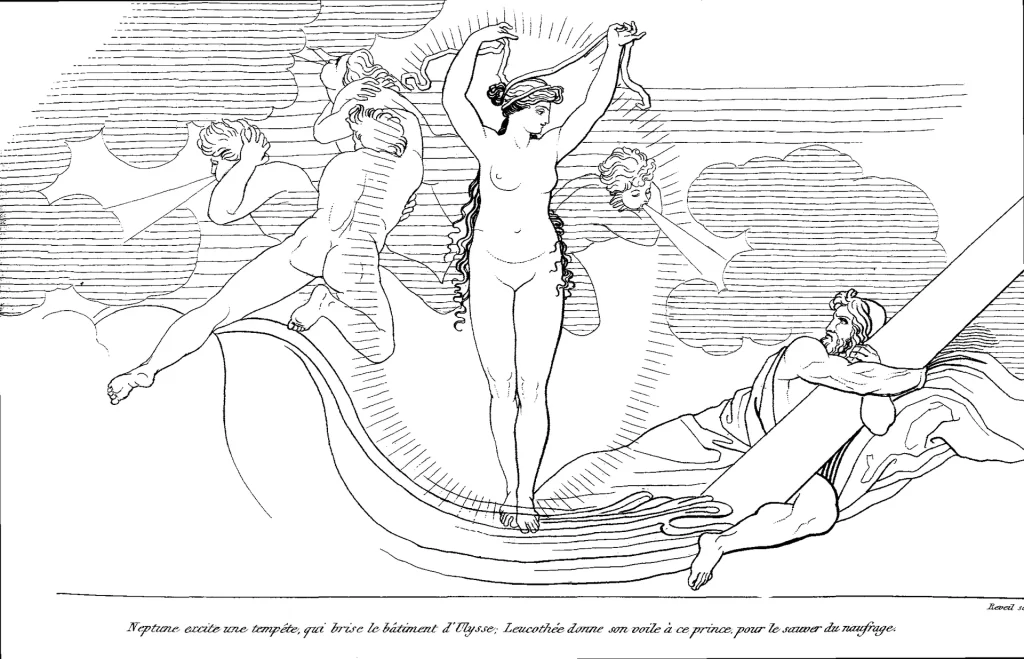
Homer is centuries earlier than Ovid or Apollodorus. He knows she was mortal and the daughter of Cadmus, hē prin men eēn brotos audēessa, ἣ πρὶν μὲν ἔην βροτὸς αὐδήεσσα, “who was once a mortal with a human voice,” and he tells nothing else of her past. Butler’s “she had compassion upon him” is one word in Greek, eleēsen, ἐλέησεν, “she had mercy.” It is the verb of the church’s prayer Kyrie eleēson, Κύριε ἐλέησον, “Lord, have mercy.”
The veil is a krēdemnon, κρήδεμνον, from kras, κράς, “head,” and deō, δέω, “to bind”: a woman’s head-binding, the veil that covers her in public. Homer uses the same word for the battlements that crown a city’s walls. Ino takes off her own covering and tells Odysseus to fasten it around his chest, where it will become his wall against the sea.9
Poseidon, who makes her a goddess in Ovid, is the power trying to drown the swimmer here. Her mercy does not wait for his agreement. She answers the suffering in front of her.
Help That Survives Doubt
Odysseus does not trust the advice:
But Ulysses did not know what to think. “Alas,” he said to himself in his dismay, “this is only some one or other of the gods who is luring me to ruin by advising me to quit my raft. At any rate I will not do so at present, for the land where she said I should be quit of all troubles seemed to be still a good way off. I know what I will do—I am sure it will be best—no matter what happens I will stick to the raft as long as her timbers hold together, but when the sea breaks her up I will swim for it; I do not see how I can do any better than this.”
— Homer, Odyssey 5.354–364, translated by Samuel Butler.8
His suspicion makes sense. A stranger has told him to abandon the one visible support keeping him above water, and in his experience knowing that a speaker is divine does not settle whether she means him well. Homer’s verb is mermērixe, μερμήριξε, “he was torn in mind.”
Matthew tells another rescue at sea. In Matthew, the disciples’ boat is “tossed with waves: for the wind was contrary,” and Jesus comes to them walking on the water. Peter asks to be told to come, and is told, and leaves the boat. Then he sees the wind, is afraid, begins to sink, and cries “Lord, save me.” Jesus catches him by the hand and says, “O thou of little faith, wherefore didst thou doubt?” The word for doubt is edistasas, ἐδίστασας, built on dis, δίς, “twice”: to stand two ways at once, which is exactly where Odysseus stands. The stories share a storm, divine help upon the water, a command to leave a vessel, and a man of two minds. Matthew’s boat stays intact; Odysseus’s raft breaks apart. The difference is also in how the doubt is met. Peter asks for the command, leaves at Jesus’s word, and is rebuked for wavering. Odysseus stays on the raft until the sea breaks it under him, and Ino’s help is still there when he finally needs it. No one rebukes him.10
Leucothea’s gift stays available. He delays, and another wave destroys the raft. Then he puts on the veil and begins to swim. Athena calms the winds and later helps him survive the rocks, and a river gives him an opening to reach the shore. The rescue is shared. Leucothea does not abolish every danger or perform every part of his return. She gives him the one protection without which the next effort would be hopeless, and it saves a man who doubted her. The man who survives is still the man who hesitated.8
What the Sea Gives Back
When Odysseus finally reaches shelter, he is too exhausted to stand:
His body was all swollen, and his mouth and nostrils ran down like a river with sea-water, so that he could neither breathe nor speak, and lay swooning from sheer exhaustion; presently, when he had got his breath and came to himself again, he took off the scarf that Ino had given him and threw it back into the salt stream of the river, whereon Ino received it into her hands from the wave that bore it towards her.
Then he left the river, laid himself down among the rushes, and kissed the bounteous earth.
— Homer, Odyssey 5.455–463, translated by Samuel Butler.8
The garment goes back to the one who lent it. The rescue has not made the rescued man hers, and he can go on toward a home that is not hers. In the household that sheltered Dionysus, kinship carried danger from one person to the next. Here, care crosses the line of kinship and gives a stranger another chance to live.
The Crown at the Isthmus
The sea gave her son back too. Pausanias says that a dolphin carried the body of Melicertes to the Isthmus of Corinth:
Farther on the pine still grew by the shore at the time of my visit, and there was an altar of Melicertes. At this place, they say, the boy was brought ashore by a dolphin; Sisyphus found him lying and gave him burial on the Isthmus, establishing the Isthmian games in his honor.
— Pausanias, Description of Greece 2.1.3, translated by W. H. S. Jones.11
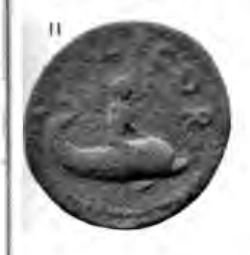
The Isthmian Games, one of the four great festivals of Greece, began as funeral games for a drowned child. In the sanctuary there stood a temple of Palaemon, with images of Poseidon, Leucothea and the boy, and what Pausanias calls his holy of holies, with an underground descent to it, “where they say that Palaemon is concealed.” Anyone who swore falsely there could not escape his oath. When Rome rebuilt Corinth, the city struck bronze coins showing the boy’s body lying across a dolphin under the pine.
The victors’ crown came from the story too. At a dinner in Corinth during the games, Plutarch and his friends argued over why the Isthmian crown was pine, and were told that the body of Melicertes was found fixed to a pine tree by the sea. One guest remembered that the crown had once been made of parsley, a plant they called unlucky, and said that “those that are dangerously sick we usually say have need of parsley.”12
Paul wrote to the church at Corinth, a few miles from that sanctuary, using the games its people knew: “Know ye not that they which run in a race run all, but one receiveth the prize? … Now they do it to obtain a corruptible crown; but we an incorruptible.” The word is phtharton, φθαρτόν, “perishable,” against aphtharton, ἄφθαρτον, “imperishable.” At Corinth, the perishable crown was pine or parsley, cut for games founded over a drowned child.13
Sources and Translation Notes
1. Apollodorus, Library 3.4.2–3, translated by James George Frazer (1921), Theoi Classical Texts. The fostering, the disguise as a girl, Hera’s madness, Learchus taken for a deer, the cauldron, the sea names, the Isthmian games, and Dionysus’s escape as a young goat to the nymphs of Nysa are all in this passage. ↩
2. Apollodorus, Library 1.9.1, translated by James George Frazer (1921), Theoi Classical Texts. In this book Learchus is killed by an arrow. ↩
3. Ovid, Metamorphoses 4.416–542, translated by Henry Thomas Riley (1851), Project Gutenberg; Latin text from The Latin Library. Riley’s wording is kept; his footnote numbers are omitted. Hera takes Dionysus’s use of madness as her model at 4.428–431; Tisiphone’s commission and Iris’s purification of Hera are at 4.466–480; mens est, quae diros sentiat ictus is 4.499; grief and poison as causes of Ino’s flight at 4.519–520; percussa recanduit unda at 4.530; At Venus, inmeritae neptis miserata labores at 4.531; tu miserere meorum at 4.533. Riley’s “Leucothoë” in this scene is Ino, not the woman loved by the Sun earlier in Book 4. Psalm 51 is Psalm 50 in the Vulgate numbering. ↩
4. Ovid, Metamorphoses 3.177–252; Actaeon’s human mind in the stag’s body is at 3.203. ↩
5. Lewis R. Farnell, Greek Hero Cults and Ideas of Immortality (Oxford, 1921), pp. 44–45, Internet Archive, rejects the proposed Melicertes–Melqart connection because the child deity differs from the bearded Tyrian god. The bilingual Maltese cippus identifies Melqart with Heracles: HMML, “Lost and Found in Translation”. Palaemon as an epithet of Heracles: Liddell, Scott and Jones, Greek–English Lexicon, Παλαίμων, citing Lycophron 663 and Hesychius. Ovid’s Sidoniae comites is at Metamorphoses 4.543. The name resemblance remains a proposal, not an ancient identification. ↩
6. Ovid, Metamorphoses 4.543–562. ↩
7. Pausanias, Description of Greece 1.44.7–8, translated by W. H. S. Jones, Theoi Classical Texts. Pausanias adds that a dolphin carried Melicertes to the Isthmus, and that the Molurian Rock was held sacred to Leucothea and Palaemon. ↩
8. Homer, Odyssey 5.282–463, translated by Samuel Butler (1900), Project Gutenberg; Greek text from the Perseus Digital Library. Butler’s Ulysses, Neptune and Minerva are Odysseus, Poseidon and Athena, and he calls the same garment both “veil” and “scarf.” ἣ πρὶν μὲν ἔην βροτὸς αὐδήεσσα is 5.334; ἐλέησεν 5.336; κρήδεμνον 5.346; μερμήριξε 5.354. The raft breaks and Athena intervenes at 5.365–387; the rocks and the river at 5.424–454. ↩
9. Liddell, Scott and Jones, Greek–English Lexicon, κρήδεμνον: “woman’s head-dress or veil”; metaphorically “battlements which crown a city’s walls,” Τροίης ἱερὰ κρήδεμνα, Iliad 16.100. ↩
10. Matthew 14:22–33, King James Version; the Greek of 14:31 is ὀλιγόπιστε, εἰς τί ἐδίστασας; ↩
11. Pausanias, Description of Greece 2.1.3 and 2.2.1, translated by W. H. S. Jones, Theoi Classical Texts. For the Corinthian coin types, see B. V. Head, Catalogue of Greek Coins: Corinth, Colonies of Corinth, Etc. (British Museum, 1889), introduction and p. 77, Internet Archive. The illustration reproduces plate XX, no. 11: Melicertes riding a dolphin on a coin of Marcus Aurelius. It is a different type from the body beneath the pine described in the text. ↩
12. Plutarch, Table Talk (Quaestiones Convivales) 5.3, translated by William W. Goodwin, Plutarch’s Morals (1874), Perseus Digital Library. Goodwin’s “parsley” is Greek selinon. ↩
13. 1 Corinthians 9:24–25, King James Version; Greek ἐκεῖνοι μὲν οὖν ἵνα φθαρτὸν στέφανον λάβωσιν, ἡμεῖς δὲ ἄφθαρτον. ↩