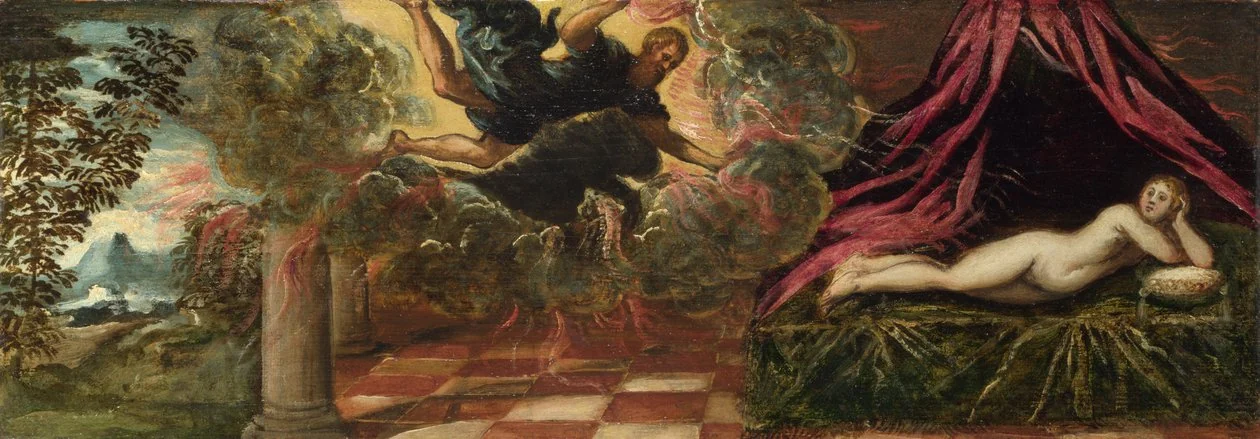
She asked her hidden lover to show her who he really was.
Opening illustration: attributed to Jacopo Tintoretto, Jupiter and Semele, about 1545. Jupiter dives toward Semele’s bed through cloud and lightning. National Gallery, London. Public domain, via Wikimedia Commons.
Cadmus had founded Thebes and married Harmonia in a wedding attended by the gods. Their household joined a Phoenician founder to the daughter of Ares and Aphrodite. Among their children were Autonoe, Ino, Agave, Polydorus, and Semele.
The family would become inseparable from the tragedies of Thebes. Autonoe would become the mother of Actaeon, and Agave the mother of Pentheus. Before Dionysus came back to demand recognition from his grandfather’s city, there was Semele, a mortal daughter of Cadmus loved by Zeus.
Hesiod gives a brief summary:
And Semele, daughter of Cadmus was joined with him in love and bare him a splendid son, joyous Dionysus,—a mortal woman an immortal son. And now they both are gods.
— Hesiod, Theogony 940–942, translated by Hugh G. Evelyn-White.1
That ending gives away what the tragedy will conceal. Semele will die. Her sisters will say she lied. Her child will survive, and the woman destroyed by divine revelation will be counted among the gods. First she has to decide whether the lover who visits her in secret is the god he says he is.
The Name Beneath the Lightning
Her name, Semelē, Σεμέλη, is probably older than its Greek setting. A long-standing etymology connects it with Phrygian zemel-, a word for earth, from the same Indo-European root as Greek chthōn, χθών, “earth,” Latin humus, “ground,” and Old Church Slavonic zemlja, земля, “earth.” The derivation is not certain. If it holds, a woman whose name belongs to the earth bears the child of the sky-god and cannot survive heaven unveiled.2
The Daughter of Cadmus
The older sources do not begin with Semele as a foolish woman who wants too much. In Hesiod she is simply the mortal mother of Dionysus, and Homer already pairs her with Zeus. By the fifth century BCE Euripides could open the Bacchae with Dionysus standing beside the place where his mother died, trusting his audience to know the family and the accusation that hung over her death.
Pseudo-Apollodorus gives a compact version of the story:
But Zeus loved Semele and bedded with her unknown to Hera. Now Zeus had agreed to do for her whatever she asked, and deceived by Hera she asked that he would come to her as he came when he was wooing Hera. Unable to refuse, Zeus came to her bridal chamber in a chariot, with lightnings and thunderings, and launched a thunderbolt. But Semele expired of fright, and Zeus, snatching the sixth-month abortive child from the fire, sewed it in his thigh.
— Pseudo-Apollodorus, Library 3.4.3, translated by J. G. Frazer.3
Diodorus Siculus tells the beginning differently, and the difference matters. In his version Zeus comes to Semele secretly and without speech, and the dissatisfaction is her own. Hera does not need to plant it. Zeus’s secrecy has already done so.
The Lover Who Came in Secret
Semelê was loved by Zeus because of her beauty, but since he had his intercourse with her secretly and without speech she thought that the god despised her; consequently she made the request of him that he come to her embraces in the same manner as in his approaches to Hera.
— Diodorus Siculus, Library of History 4.2.2, translated by C. H. Oldfather.4
Semele is not asking for spectacle. She is asking whether the difference between herself and Hera is the difference between a hidden mistress and an acknowledged wife. Zeus comes to her in darkness and silence; Hera receives him in majesty. Does he hide because a mortal body cannot withstand his unveiled presence, because Hera must not know, or because Semele holds a lesser place in his life?
Secrecy protects Semele from Hera and from Zeus’s radiance. The same secrecy makes the relationship impossible to verify, and that is the weakness Hera exploits.
The Old Woman Who Teaches Her to Doubt
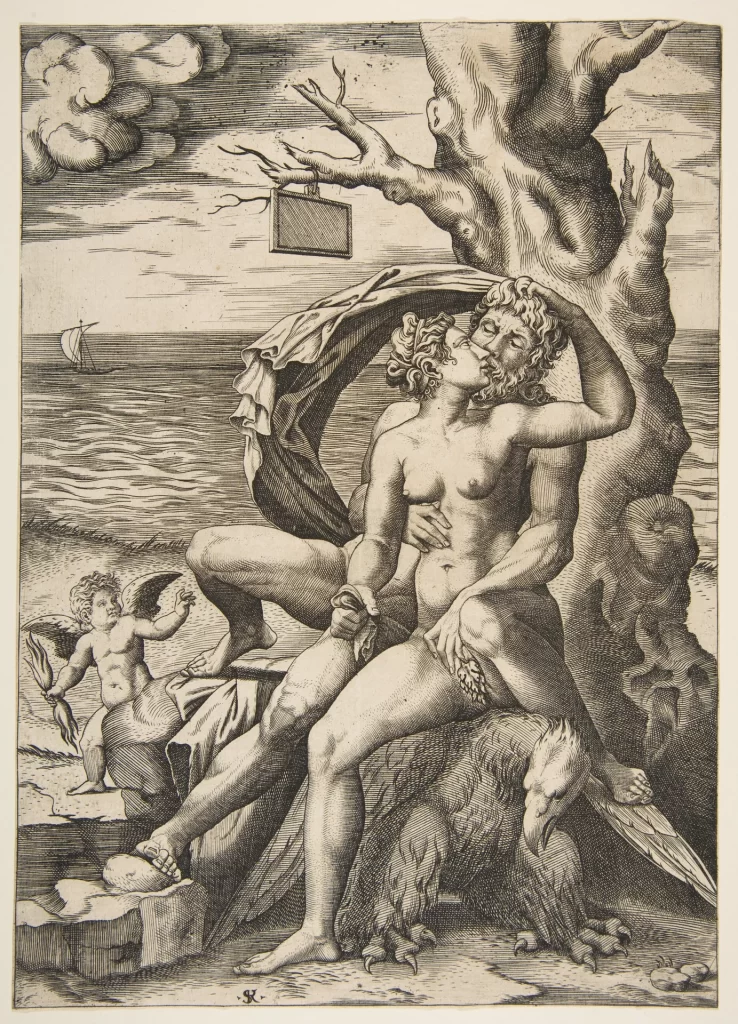
Ovid gives Hera’s attack its fullest form. Juno, as he calls her, does not come as queen of heaven. She makes herself old, with grey hair, wrinkles and a shaking walk, and takes the shape of Beroe, Semele’s nurse from Epidaurus. She does not need to overpower Semele. She needs Semele to distrust what she already has. When the talk turns to Jupiter, the old nurse sighs:
I only wish it may be Jupiter; yet I am apt to fear everything. Many a one under the name of a God has invaded a chaste bed. Nor yet is it enough that he is Jupiter; let him, if, indeed, he is the real one, give some pledge of his affection; and beg of him to bestow his caresses on thee, just in the greatness and form in which he is received by the stately Juno; and let him first assume his ensigns of royalty.
— Ovid, Metamorphoses 3.280–286, translated by Henry T. Riley.5
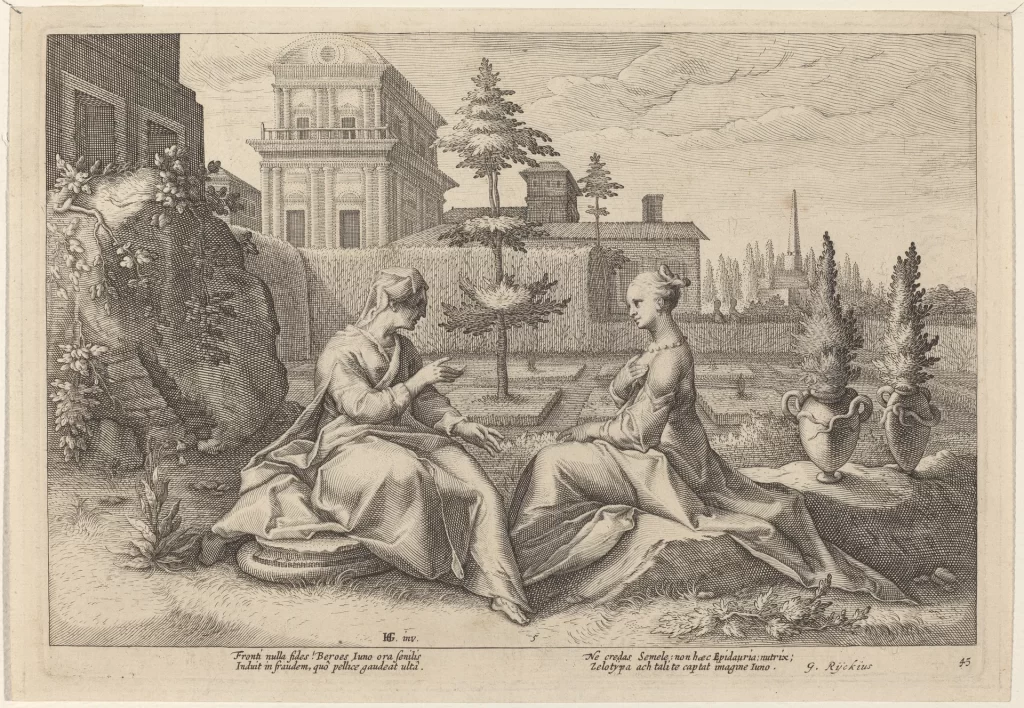
Ovid’s Latin is det pignus amoris, si modo verus is est, “let him give a pledge of love, if only he is the true one.” A pignus is a surety, the thing handed over to guarantee a debt. Hera asks for collateral.
The argument is devastating because it is not absurd. A hidden lover claiming to be a god is exactly the kind of claim that ought to invite suspicion. Hera does not tell Semele to reject Zeus. She tells her to verify him, and the verification will kill her.
A Reasonable Question with an Impossible Answer
If Semele accepts the hidden lover’s identity without evidence, she trusts an extraordinary claim. If she demands the strongest evidence, the evidence destroys her. The truth exists, and it can be demonstrated, but the person who asks for certainty cannot survive its full demonstration. Her question is not meaningless. Her body cannot receive the answer in the form she asks for it.
The myth separates truth from survivable knowledge. Zeus can love Semele while concealing his full form, and he can be truthful while appearing incompletely. The veil can be deception. It can also be mercy.
The Promise Before the Request
Semele does not tell Zeus what she wants until she has his word. In Ovid he swears by the Styx before he hears the request:
She requested of Jupiter a favor, without naming it. To her the God said, “Make thy choice, thou shalt suffer no denial; and that thou mayst believe it the more, let the majesty of the Stygian stream bear witness. He is the dread and the God of the Gods.” Overjoyed at what was her misfortune, and too easily prevailing, as now about to perish by the complaisance of her lover, Semele said, “Present thyself to me, just such as the daughter of Saturn is wont to embrace thee, when ye honor the ties of Venus.” The God wished to shut her mouth as she spoke, but the hasty words had now escaped into air. He groaned; for neither was it now possible for her not to have wished, nor for him not to have sworn.
— Ovid, Metamorphoses 3.288–298, Riley.5
The river’s name is Styx, Στύξ, “the Hateful,” from stygeō, στυγέω, “to loathe.” An oath by it binds even the gods.
The god who rules heaven is trapped by his own word. Keeping the oath will destroy the woman he swore it to; breaking it would be sacrilege. The law stays intact while the person it was meant to protect dies.
This is the trap of the blind boon. Helios swears by the same river to give Phaethon whatever he asks, and the son asks for the chariot that will kill him. Herod swears to the daughter of Herodias, “Whatsoever thou shalt ask of me, I will give it thee,” and is “exceeding sorry; yet for his oath’s sake” gives her the head of John the Baptist.6 In every version a ruler binds himself before he knows the request, and someone else pays.
Zeus Tries to Become Less Divine
Ovid does not let Zeus enjoy it. He has Zeus reduce himself as far as his nature allows:
And yet, as much as possible, he tries to mitigate his powers. Nor is he now armed with those flames with which he had overthrown the hundred-handed Typhœus; in those, there is too much fury. There is another thunder, less baneful, to which the right hand of the Cyclops gave less ferocity and flames, and less anger. The Gods above call this second-rate thunder; it he assumes, and he enters the house of Agenor. Her mortal body could not endure the æthereal shock, and she was burned amid her nuptial presents.
— Ovid, Metamorphoses 3.302–309, Riley.5
The Latin for the lesser weapon is tela secunda, the gods’ “second-best bolts.” It is still too much. Diodorus says Zeus came “in a way befitting a god, accompanied by thunder and lightning,” and that Semele was “unable to endure the majesty of the divine presence.”4
The tragedy does not need Zeus to intend her death. The danger is the disproportion between them. Semele wants the recognition Hera enjoys without Hera’s immortality, and the revelation that confirms her lover’s identity also shows the distance between her and his divine wife. She is proven right at the moment she can no longer enjoy the proof.
The God She Asked to See
Zeus comes, and the room fills with storm. Semele receives what she asked for: unmistakable evidence that the father of her child is the king of heaven. Her doubt is answered and her status confirmed. The proof consumes her.
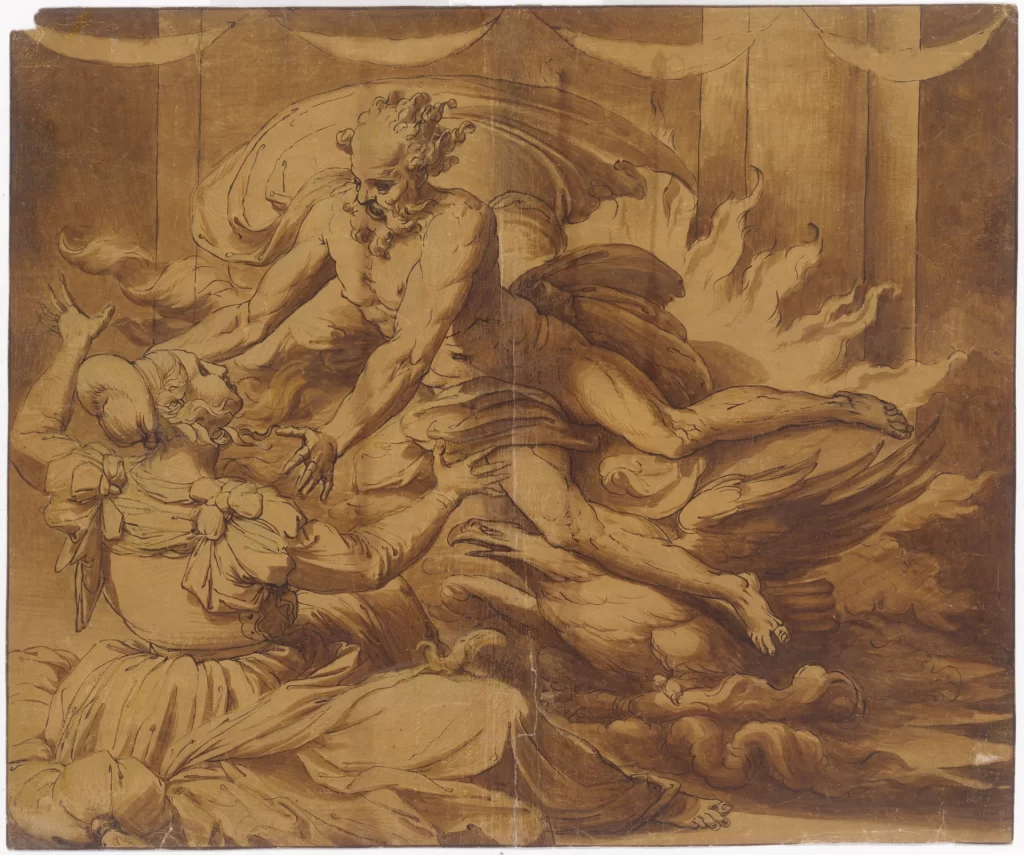
Semele’s death differs from her nephew Actaeon’s. Actaeon sees a goddess by accident and dies for seeing what he was not meant to see. Semele asks the god to reveal himself and dies because she receives exactly what she requested. The episode is more than a warning to be careful what you wish for, because Semele could not know the danger and Zeus could. The one who knew granted the fatal request of the one who did not, because an earlier oath bound him. The question is not only whether Semele consented. It is whether a powerful being keeps a promise responsibly when he knows a consequence the person asking cannot know.
A Mother Dies, a Son Is Saved
Semele is pregnant when the lightning strikes, and her death does not become her son’s. Apollodorus continues:
But at the proper time Zeus undid the stitches and gave birth to Dionysus, and entrusted him to Hermes.
— Pseudo-Apollodorus, Library 3.4.3, Frazer.3
The child passes through two bodies, first the mortal mother’s, then the immortal father’s. Zeus, who made Semele pregnant, becomes the body that finishes the pregnancy after her destruction. The divine presence that kills the mother shelters the son. Ovid’s list of the god’s titles keeps both births in view: ignigena, “fire-born,” iterum satus, “sown a second time,” and bimater, “the one with two mothers.”5
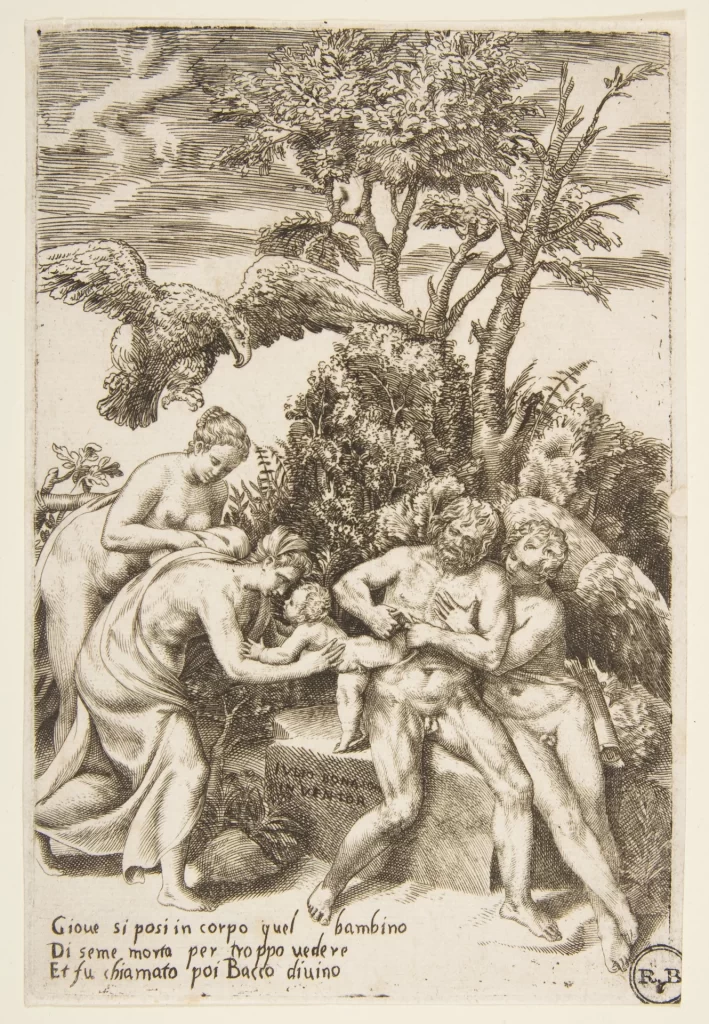
Euripides already knew a reader who found the thigh absurd. In the Bacchae the prophet Teiresias explains it away. Zeus, he says, saved the child from the fire, carried him to Olympus, and when Hera tried to cast him out, made a likeness of the child out of the aether that surrounds the earth and gave it to her:
And gave to Hera’s rage. And so, beguiled
— Euripides, Bacchae 292–297, translated by Gilbert Murray.7
By change and passing time, this tale was born,
How the babe-god was hidden in the torn
Flesh of his sire. He hath no shame thereby.
In the Greek the explanation is a pun. Zeus gave the likeness to Hera as a homēros, ὅμηρος, a hostage. Mortals, Teiresias says, changed the word and said the child was sewn into Zeus’s mēros, μηρός, his thigh. The play’s own prophet offers the oldest rationalization of the miracle, and offers it in order to defend the god.
The Dead Woman Becomes the Liar
Later celebration fixes on Dionysus: the child survives, the father carries him, the god is born twice. From Semele’s side the miracle looks different. Her body is the place the immortal child had to be rescued from. She is not a broken container, though, because the whole later conflict at Thebes turns on what people say about her.
Apollodorus preserves what may be the cruelest turn in the story:
On the death of Semele the other daughters of Cadmus spread a report that Semele had bedded with a mortal man, and had falsely accused Zeus, and that therefore she had been blasted by thunder.
— Pseudo-Apollodorus, Library 3.4.3, Frazer.3
The same thunderbolt now supports two opposite stories. In Semele’s, the lightning proves that Zeus really came to her. In her sisters’, the lightning proves that Zeus punished her for saying he did. The event does not interpret itself, and the dead woman cannot defend her version. The survivors decide what her death means, and people who were not in the room reconstruct her shame.
Her sisters looked at what was left of her and saw a liar. It is the mistake that kills the men of this family, made with words instead of hands: Actaeon’s hounds saw a stag where their master stood, and Agave will see a lion where her son stands.
The Son Who Becomes His Mother’s Evidence
The Bacchae opens with Dionysus in Thebes beside the place where Semele died, remembering what her sisters said:
For they have scorned me whom it least beseemed,
— Euripides, Bacchae 26–31, Murray.7
Semelê’s sisters; mocked my birth, nor deemed
That Dionysus sprang from Dian seed.
My mother sinned, said they; and in her need,
With Cadmus plotting, cloaked her human shame
With the dread name of Zeus; for that the flame
From heaven consumed her, seeing she lied to God.
In the sisters’ version Cadmus helped hide an ordinary pregnancy by inventing a divine father, and the lightning was heaven’s verdict on the lie. King Pentheus repeats it later in the play: the child was blasted “with his dead mother, for that mother’s lie.”7 Dionysus therefore comes back with two identities that cannot be separated. He is the god demanding recognition, and he is the son whose existence vindicates his mother. If he is divine, Semele did not invent Zeus.
The Son Who Proves the Mother
Semele belongs to a wider pattern in stories of divine sons. Danaë’s claim that Zeus fathered Perseus is rejected by her father Acrisius, who sets mother and child adrift in a chest; the extraordinary career of Perseus later makes the divine genealogy harder to dismiss. Rhea Silvia names Mars as the father of Romulus and Remus, and Rome’s later greatness gives political weight to its founder’s sacred ancestry, as Livy admits when he says that antiquity is granted the indulgence of mixing the divine with the human to make the beginnings of cities more august.8
The Gospels meet the same accusation from the other side. Matthew says Mary “was found with child of the Holy Ghost” before she and Joseph came together, and that Joseph, “not willing to make her a publick example, was minded to put her away privily.” By the second century the counter-story was in circulation. The philosopher Celsus, as Origen reports him, said that Jesus’s mother was turned out by her carpenter husband “because she was convicted of adultery,” and bore her child to a soldier named Panthera.9 As at Thebes, one pregnancy has two stories, a divine father or a hidden human one, and the son is offered as the evidence that settles it. The Gospel of John makes the son the revelation itself: “No man hath seen God at any time; the only begotten Son, which is in the bosom of the Father, he hath declared him.”
The differences are as sharp. Mary lives. Semele dies of the sight. Perseus and Romulus prove their mothers by becoming great. Dionysus proves his by coming home and saying who he is, and he drives the sisters who called her a liar out onto the mountain.
Semele’s Case Is Stranger
Semele differs from Danaë and Rhea Silvia because the evidence that seems to disprove her is the evidence that proves her. She dies by divine fire. Her sisters read the death as punishment for lying about Zeus; Dionysus reads it as the result of actually meeting Zeus. Nobody disputes that lightning struck. The dispute is over what kind of story the lightning belongs to. Facts do not always defeat mythology. They are often the material competing mythologies are made from.
Hera’s Victory Is Temporary
If Hera meant to remove Semele and deny her the status of bearing Zeus’s child, she succeeded at once. The victory carried its own reversal. Dionysus survived and became a god, and the mother Hera tried to erase received divine honor too. Hesiod already knew the end: a mortal woman, an immortal son, and now both are gods. Hera could destroy Semele’s mortal life. She could not keep her out of heaven.
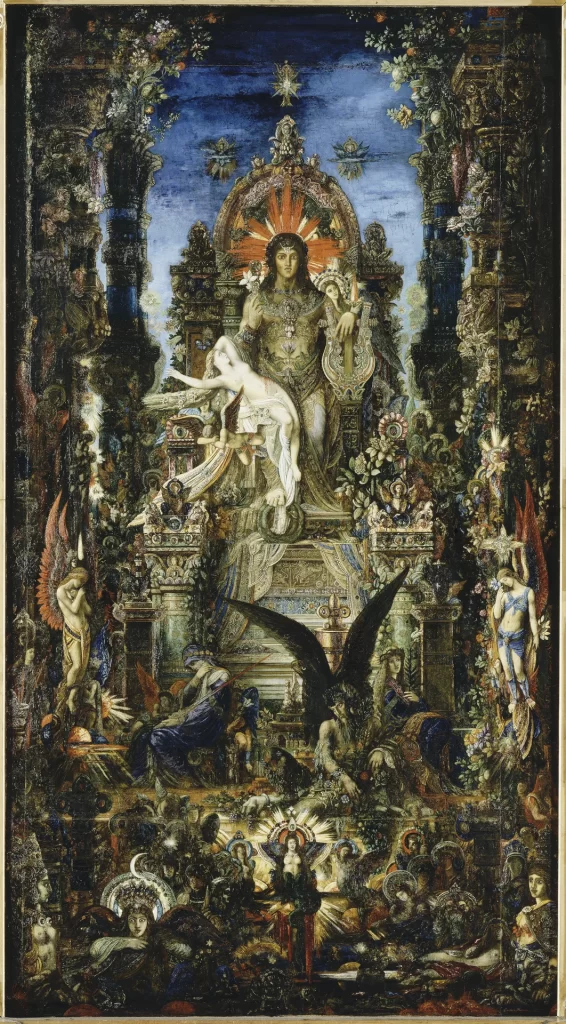
The Mother Brought Back
Later tradition makes the restoration its own episode. After his divinity is established, Dionysus goes down to the dead for his mother:
Thus men perceived that he was a god and honored him; and having brought up his mother from Hades and named her Thyone, he ascended up with her to heaven.
— Pseudo-Apollodorus, Library 3.5.3, Frazer.3
Diodorus says the same: Dionysus “brought up his mother Semelê from Hades, and that, sharing with her his own immortality, he changed her name to Thyonê.” Pausanias was shown the route. At Troezen they said Semele was brought out of the underworld in the temple of Artemis Saviour, and at Lerna the Argives showed him the bottomless Alcyonian Lake, through which Dionysus went down to fetch her. Pausanias himself would not believe that the wife of Zeus had died at all.10
Her new name is Thyōnē, Θυώνη. It is traditionally connected with thyein, θύειν, “to rush” or “to rage,” the verb behind the Thyiades, Θυιάδες, the frenzied women of Dionysus. The woman whose mortal name may belong to the earth enters heaven under a name that belongs to her son’s rites.11
The movement completes the reversal. The mother gave life to the son, and after her death the son goes back to give another life to the mother. Semele bore Dionysus once, Zeus bore him a second time, and Dionysus brings Semele through a birth of her own, out of the dead and into divine life.
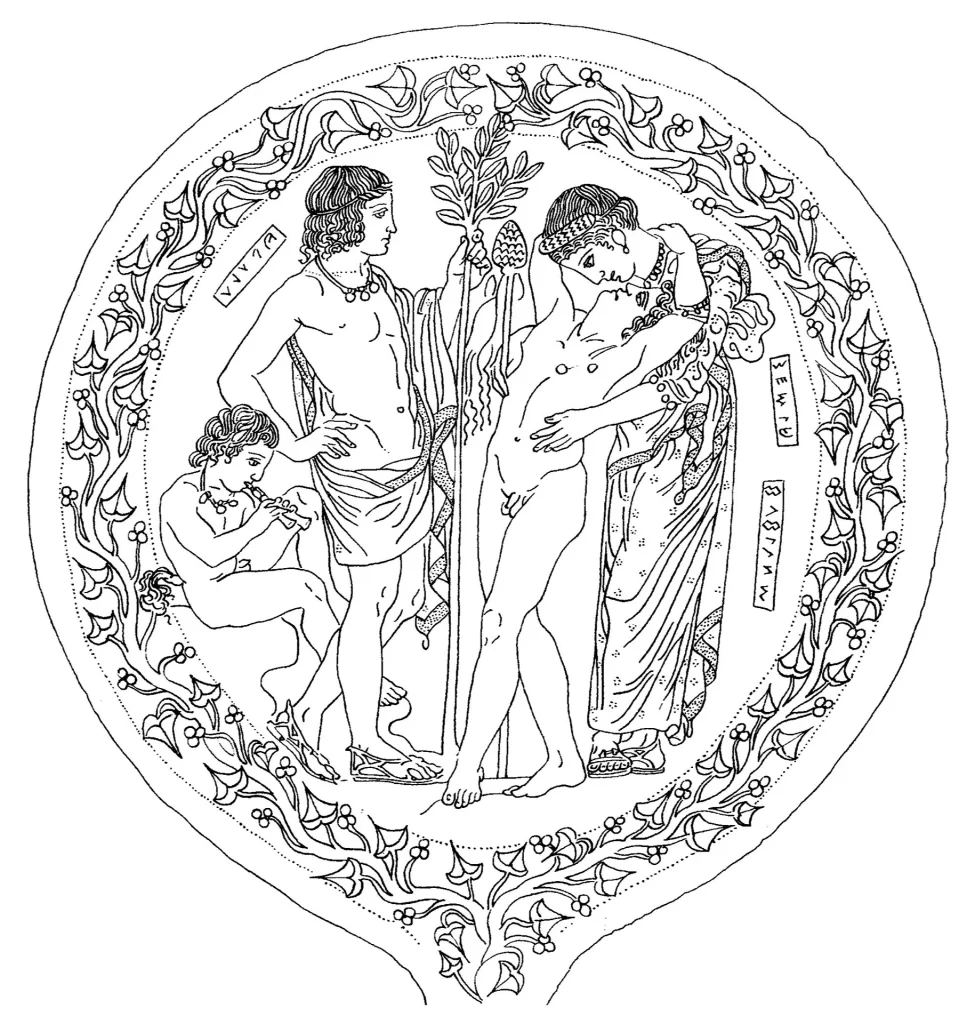
The Son Does More Than Clear Her Name
Dionysus is not only his mother’s advocate. He has his own cult, journeys, rites, loves and victories. At Thebes, though, his mother’s reputation cannot be separated from his demand for recognition, and the conflict there is a family one. The god whose cult appears foreign to Pentheus is also his cousin: Dionysus is Cadmus’s grandson through Semele, Pentheus his grandson through Agave. To recognize Dionysus means admitting that the disgraced dead aunt did not lie.
The Tomb Beside the Palace
Euripides gives Semele’s memory a physical place. In the opening lines of the Bacchae, Dionysus looks at what is left of the house where she died:
There by the castle side
— Euripides, Bacchae 6–12, Murray.7
I see her place, the Tomb of the Lightning’s Bride,
The wreck of smouldering chambers, and the great
Faint wreaths of fire undying—as the hate
Dies not, that Hera held for Semelê.
Aye, Cadmus hath done well; in purity
He keeps this place apart, inviolate,
His daughter’s sanctuary; and I have set
My green and clustered vines to robe it round.
The house is not rebuilt as though nothing happened, and the fire is still smouldering in it. The wound has become a sanctuary. Dionysus does not prove his mother innocent by erasing the lightning. He grows his vine over the place where it killed her, so the evidence of the destruction stays visible beside the life that came from it.
The palace stands next to that tomb, and in it the king of Thebes, Semele’s nephew, is about to call her story a lie and the god who came from it a fraud. The mother had asked the god to reveal himself. Years later, the child she bore came home to do the same.
Sources and Translation Notes
1. Hesiod, Theogony 940–942, in Hesiod, the Homeric Hymns, and Homerica, translated by Hugh G. Evelyn-White (1914), Project Gutenberg text. Homer names Semele as the mother of Dionysus at Iliad 14.323–325. ↩
2. Douglas Harper, “Semele,” Online Etymology Dictionary, which takes the name from Phrygian and relates it to the Proto-Indo-European root for earth, the root of Greek chthōn and Latin humus. The Phrygian connection is a long-standing proposal, not a settled derivation. ↩
3. Pseudo-Apollodorus, Library 3.4.3 and 3.5.3, translated by J. G. Frazer (1921), Theoi text. The same section reports Zeus’s agreement, the thunderbolt, the sixth-month child sewn into the thigh, the sisters’ accusation, and the birth. ↩
4. Diodorus Siculus, Library of History 4.2.1–3, translated by C. H. Oldfather (1935), LacusCurtius text. Oldfather spells the names Semelê and Thyonê. ↩
5. Ovid, Metamorphoses 3.253–315 and 4.11–13, translated by Henry T. Riley (1851), Project Gutenberg text. Latin from The Latin Library: det pignus amoris, / si modo verus is est (3.283–284); tela secunda vocant superi (3.307); ignigenamque satumque iterum solumque bimatrem (4.12). In Ovid, Juno disguises herself as Beroe, “the Epidaurian nurse of Semele.” ↩
6. Mark 6:21–26, King James Version. Helios’s oath by the Styx to Phaethon is Ovid, Metamorphoses 2.44–48. ↩
7. Euripides, Bacchae, translated into rhyming verse by Gilbert Murray (1906), Project Gutenberg text. Murray’s English does not follow the Greek line for line; the line numbers are those of the Greek. The tomb is at 6–12, the sisters’ accusation at 26–31, Pentheus’s “for that mother’s lie” at 242–245, and Teiresias’s explanation at 286–297. The Greek, from Murray’s Oxford text on the Perseus Digital Library, has Zeus give the likeness to Hera as a homēron (ὅμηρον, 293) and mortals say the child was sewn en mērōi Dios (ἐν μηρῷ Διός, 295), “changing the name” (ὄνομα μεταστήσαντες, 296). ↩
8. Danaë and Acrisius: Pseudo-Apollodorus, Library 2.4.1, Frazer, Theoi text. Rhea Silvia: Livy, History of Rome, preface 7 and 1.4.2. ↩
9. Matthew 1:18–20 and John 1:18, King James Version. Origen, Against Celsus 1.28 and 1.32, translated by Frederick Crombie, Ante-Nicene Fathers vol. 4 (1885), New Advent text. ↩
10. Diodorus 4.25.4, Oldfather, LacusCurtius text. Pausanias, Description of Greece 2.31.2 (Troezen) and 2.37.5 (Lerna), translated by W. H. S. Jones and H. A. Ormerod, Theoi text. At 2.31.2 Pausanias writes: “I cannot bring myself to believe even that Semele died at all, seeing that she was the wife of Zeus.” ↩
11. C. Saletti, “Thyone,” Enciclopedia dell’Arte Antica (1973), connects the name with θύειν, as with Thyia and the Thyiades. Riley’s note to Metamorphoses 4.13, on the epithet Thyoneus: “either from Semele, his mother, one of whose names was Thyone, or from the Greek, θύειν, ‘to be frantic,’ from which origin the Bacchanals also received their name of Thyades.” See thyias, θυιάς, in the Liddell–Scott–Jones lexicon. ↩