Source and scope. Egyptian hymns and funerary texts provide this episode’s account of restoration: especially the Eighteenth-Dynasty hymn on the stela of Amenmose, earlier Pyramid Texts, and later Egyptian lamentations. The ornate chest, the journey to Byblos, and the fourteen scattered pieces follow Plutarch’s much later Isis and Osiris, written in the Roman period. Those episodes are identified as his version, not attributed to the earliest pyramids. Quotations use public-domain translations by E. A. Wallis Budge, Samuel A. B. Mercer, and Frank Cole Babbitt. 1
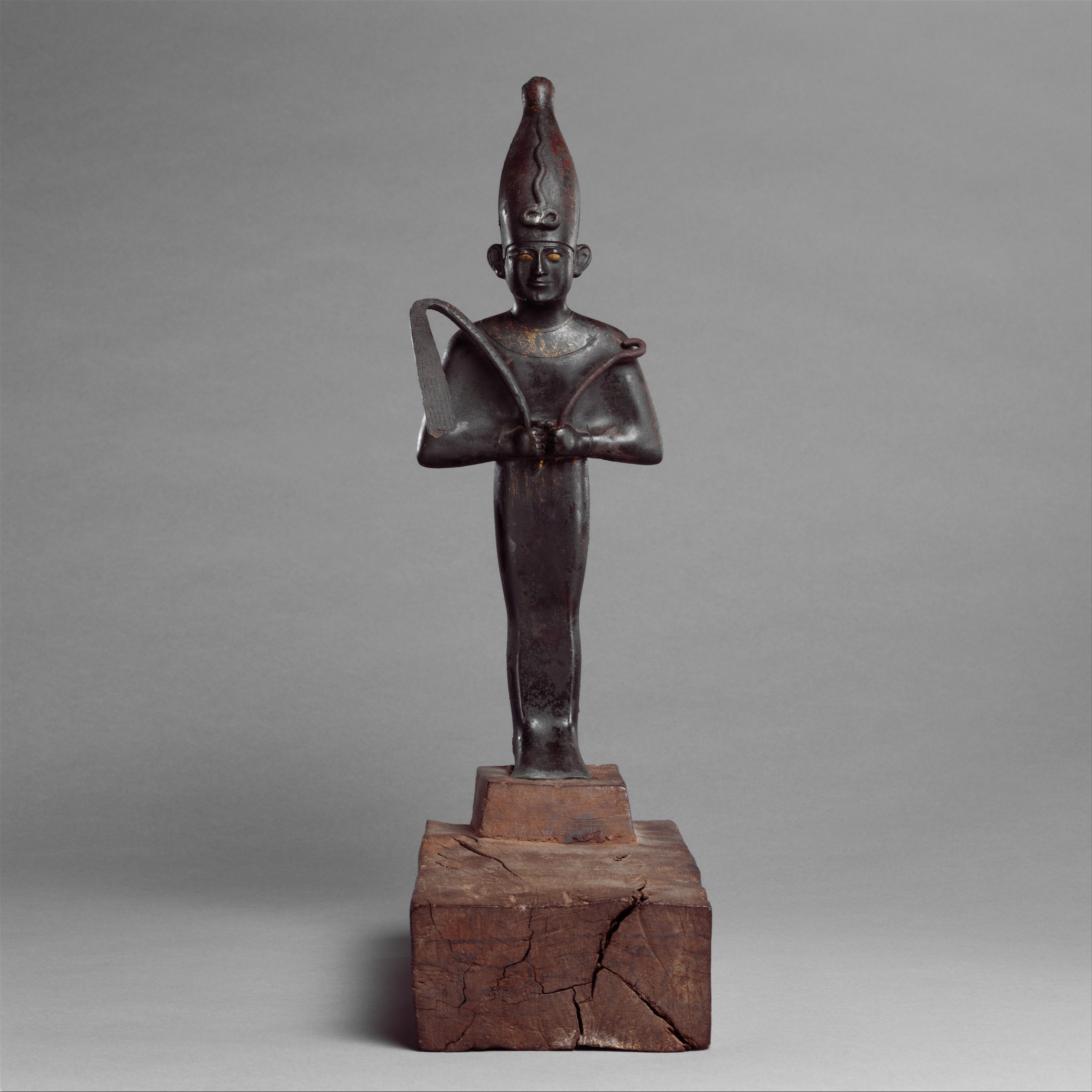
Opening illustration: Osiris offered by the astronomer Ibeb, ca. 1080–721 BCE. The god stands with crook and flail above a base bearing the donor’s inscription. The Metropolitan Museum of Art, 03.4.11a–d. Gift of Egypt Exploration Fund, 1903. Public Domain / CC0.
Before the body was broken
Before he became the god encountered by the dead, Osiris was a brother, a husband, and a ruler.
In the divine family we are following, he belongs to the children of Geb, earth, and Nut, sky. Isis is his sister and wife. Seth is his brother; Nephthys is their sister. Their relationships will outlast the violence that breaks their household. 2
Osiris comes to us through Greek; the underlying Egyptian name’s exact meaning remains uncertain. His hymn introduces him not through one definition, but through many titles and manifestations. 3
Homage to thee, Osiris, Lord of eternity, King of the gods, whose names are manifold, whose transformations are sublime, whose form is hidden in the temples
Great Hymn to Osiris, translated by E. A. Wallis Budge; opening excerpt 2
The hymn presents him as the heir of Geb, sustaining the land and establishing right order. His importance is not confined to what happens after people die. The flourishing world belongs within his sphere. 2
Plutarch develops this beneficent kingship into a story of civilization. Osiris teaches cultivation, establishes laws, and teaches reverence for the gods. He travels, winning people through persuasion, song, and music. While he is away, Isis guards the order he has established. 4
But the threat does not come only from beyond the kingdom.
His brother prepares a gift.
The chest that fits one man
In Plutarch’s account, Seth—whom the Greek author calls Typhon—secretly measures Osiris’s body. He has a magnificent chest made to those dimensions and brings it to a banquet.
The guests admire it. Seth promises it to whoever fits inside.
The game makes the victim participate in his capture. No guard has to seize the king. He needs only to lie down in the beautiful object that appears to have been made for him.
They all tried it in turn, but no one fitted it; then Osiris got into it and lay down, and those who were in the plot ran to it and slammed down the lid, which they fastened by nails from the outside and also by using molten lead. Then they carried the chest to the river and sent it on its way to the sea through the Tanitic Mouth.
Plutarch, Isis and Osiris 13, translated by Frank Cole Babbitt 4
The banquet has become a funeral without mourners. The ruler who gave things their place is enclosed in a place that leaves him no room to act.
News reaches Isis. She cuts a lock of her hair, puts on mourning clothes, and searches. She questions those she encounters, including children who have seen the chest pass toward the sea. 5
The murder is not merely the loss of someone’s life. It has also deprived the living of a body around which mourning could begin.
The king inside the pillar
The chest reaches Byblos. A plant grows around it, enfolding it within its thickening trunk. The local king admires the growth, has the trunk cut, and uses it as a pillar in his palace. He does not know what it contains. 5
The dead king has become the hidden support of another king’s house.
Isis follows the trace into that household. She gains entry as a nurse, eventually reveals her divinity, and receives the pillar. She opens the wood and takes back the chest. Plutarch’s story contains further adventures at the palace; the search reaches its emotional center afterward, when she is alone with what she has recovered:
In the first place where she found seclusion, when she was quite by herself, they relate that she opened the chest and laid her face upon the face within and caressed it and wept.
Plutarch, Isis and Osiris 17, translated by Babbitt 5
There is no magnificent speech here. One face rests upon another.
But recovery is not yet security. Back in Egypt, Isis conceals the chest. Seth discovers it while hunting by moonlight. He opens it, recognizes the body, cuts it into fourteen parts, and scatters them. Isis must search again, now for a person dispersed across the land. 6
The second attack seeks to undo what the first search achieved. A body can be found, mourned, and honored. The scattered pieces make even that difficult.
Plutarch says that one part cannot be recovered: the phallus, swallowed by fish. Isis makes a likeness and establishes its ritual honor. The god’s generative capacity becomes the point at which recovery encounters an absence. 6
The earlier Egyptian hymn approaches the aftermath differently. Its decisive image is generative power drawn from the stricken body. To hear that account, we must return from Plutarch’s extended adventures to the voices beside the bier.
The women who call him back
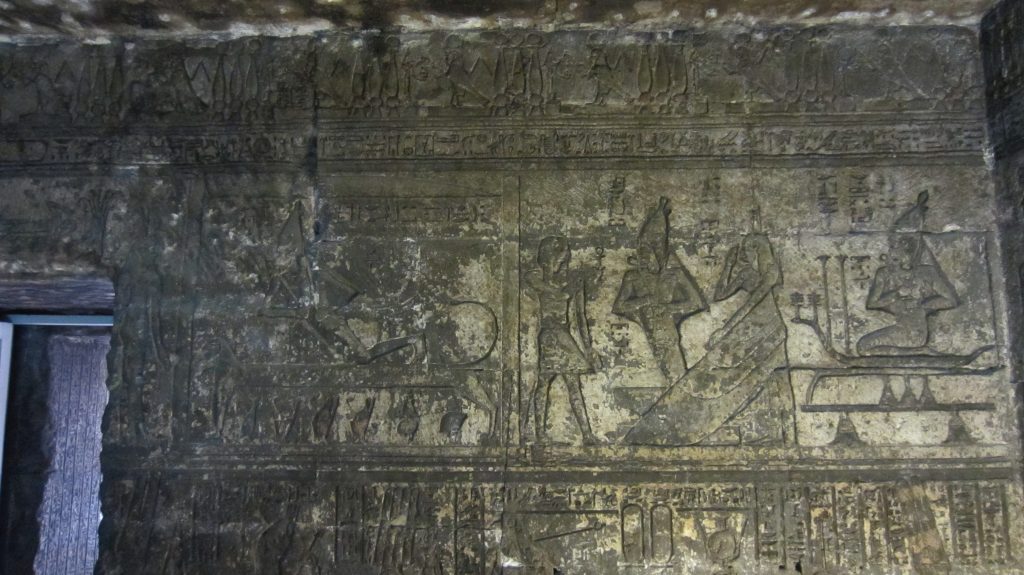
The connection between Seth’s violence and the sisters’ care is already present in the Pyramid Texts. Utterance 532 says that Isis and Nephthys find Osiris after his brother has struck him down. They protect him against decay. The ancient account is brief, but its opposition is unmistakable: what one member of the family destroys, others labor to preserve. 7
In a later Egyptian lamentation, Isis calls:
Come to thy house, come to thy house, O An, come to thy house. Thine enemy [Set] hath perished. O beautiful youth, come to thy house. Look thou upon me. I am the sister who loveth thee, go not far from me. O Beautiful Boy, come to thy house, straightway, straightway. I cannot see thee, and my heart weepeth for thee; my eyes follow thee about. I am following thee about so that I may see thee.
The Lamentations of Isis and Nephthys, Isis’s speech, translated by Budge 8
She does not address a discarded object. She addresses you: someone who still has a house, a sister, and a place within a relationship.
Nephthys answers the loss from beside her:
Thy two Sisters are nigh unto thee; they guard thy bier, they address thee with words [full of] tears as thou liest prone on thy bier. Look thou at the young women; speak to us, O our Sovereign Lord. Destroy thou all the misery that is in our hearts; the chiefs among gods and men look upon thee.
The Lamentations of Isis and Nephthys, Nephthys’s speech, translated by Budge 8
These are not only descriptions of grief. They belong to a ritual intended to restore presence and life. The voices ask the god to look, hear, and speak—to become responsive again. 8
Other funerary words give the work a bodily precision. A Pyramid Text addresses the deceased king:
O, O, raise thyself up, N.;
receive thy head, unite thy bones to thee,
collect thy limbs,
shake the earth (dust of the earth) from thy flesh.
Pyramid Texts, Utterance 373, translated by Samuel A. B. Mercer 9
The speaker gathers a person through words as the mourners gather the body through care. Death’s scattering is answered by an insistence that these parts still belong together.
A child from the motionless god
The Great Hymn to Osiris makes Isis’s perseverance central:
Thy sister [Isis] acted as a protectress to thee. She drove [thy] enemies away, she averted seasons [of calamity from thee], she recited the word (or, formula) with the magical power of her mouth, [being] skilled of tongue and never halting for a word, being perfect in command and word. Isis the magician avenged her brother. She went about seeking for him untiringly.
Great Hymn to Osiris, translated by Budge 10
She moves over the land, crying out. Her wings make air. The goddess who seeks the body also supplies the movement of breath around it. Then the hymn brings mourning and generation into the same scene:
She made to rise up the helpless members of him whose heart was at rest, she drew from him his essence, and she made therefrom an heir.
She suckled the child in solitariness and none knew where his place was, and he grew in strength. His hand is mighty (or, victorious) within the house of Keb, and the Company of the Gods rejoice greatly at the coming of Horus, the son of Osiris, whose heart is firmly stablished, the triumphant one, the son of Isis, the flesh and bone of Osiris.
Great Hymn to Osiris, translated by Budge 10
The child is Horus. The hidden place that protects him will be the setting of another episode.
For now, the family has acquired a future that Seth’s attack did not prevent. But a son is not the same person as his father. Horus’s birth does not mean that Isis receives her former life back unchanged.
Osiris’s restoration and Horus’s succession are connected victories, not identical ones.
Restored to what kind of life?
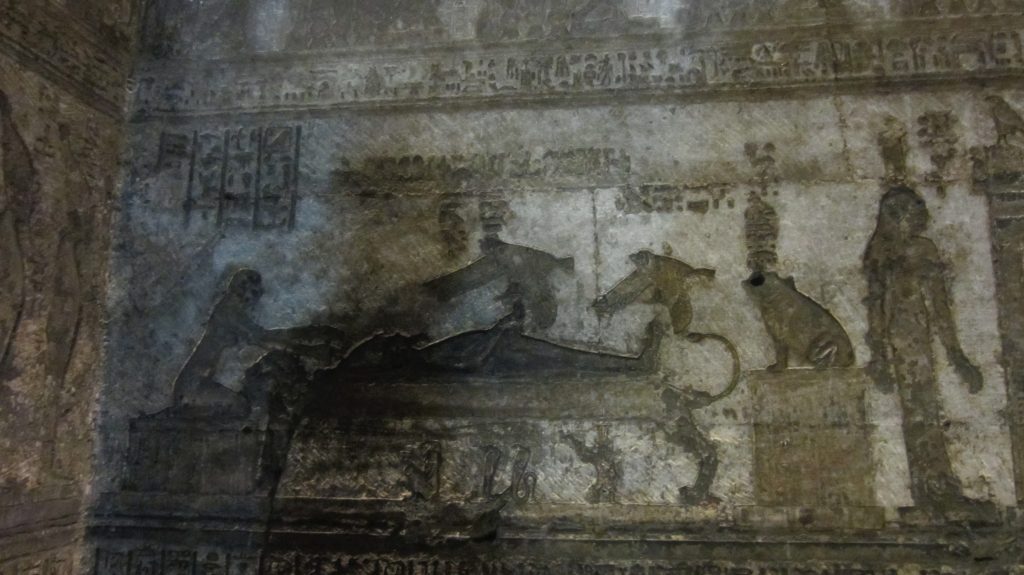
The Egyptian funerary texts do not treat Osiris as a merely remembered name. They address him as a living divine presence, and they seek a corresponding transformation for the deceased. One Pyramid Text declares:
O N., thou didst not depart dead; thou didst depart living,
(so) thou sittest upon the throne of Osiris, thy ‘bȝ-sceptre in thy hand, thou commandest the living;
Pyramid Texts, Utterance 213, translated by Mercer 11
That language should prevent an easy reduction of the story to “he lives on only through his child.” The texts claim more than biological continuity or affectionate recollection.
Yet the pattern is not simply the resumption of his former earthly reign. Horus takes up the future among the living; Osiris possesses a continuing divine life associated with the dead. Even Plutarch depicts him returning from the other world to instruct Horus, rather than resuming the throne as though the murder had never occurred. 11
One of Osiris’s titles, Khentiamentiu, means “Foremost of the Westerners”: the western realm is associated with the dead. His sovereignty has not vanished, but its setting has changed. 12
In this reading, resurrection is not the cancellation of everything death has done. It is the defeat of death’s claim to make further existence impossible.
The wound remains part of the history of the one who survives it.
Gathering a person
The story’s dismemberment-and-restoration motif gives physical form to a problem of identity. What must remain—or be recovered—for someone still to be the same person?
Seth’s second violence attacks unity itself. The body becomes separable objects, each of which can be carried somewhere else. Isis and Nephthys answer by treating the pieces as belonging to a whole that still makes a claim upon them.
Their work is not merely the discovery of the correct arrangement of bones. The lamentations restore relationships around the body: husband, brother, ruler, beloved. Physical integrity and recognition are brought together without being reduced to each other.
The body matters because this person was embodied. The relationships matter because this body belonged to someone.
Here the earlier Egyptian stories offer useful contrasts. Atum’s beginning emphasizes the power to generate without a partner. Osiris’s restoration depends upon others. Ra’s nightly journey likewise requires a company; divine existence is not always the fantasy of needing nobody. 13
The secret-name episode approaches vulnerability from another direction. There, Isis makes an injury the instrument through which she obtains guarded knowledge. Here, the injured being is someone she seeks to preserve. Her knowledge has not changed into a wholly different power; it has entered a different relationship. The same effective speech that can compel can also protect. 13
The contrast does not require declaring one story the true Isis and the other a mistake. A character becomes more substantial when power alone does not determine what she will do with it.
The coffin and the seed
Plutarch’s chest begins as an instrument of confinement. It turns the exact measure of a body into the means of imprisoning it. In the funerary material, however, an enclosing form can serve the opposite purpose: protection, preservation, and renewed life.
The container is therefore not a fixed symbol of death. Its significance depends upon what it does to what it holds.
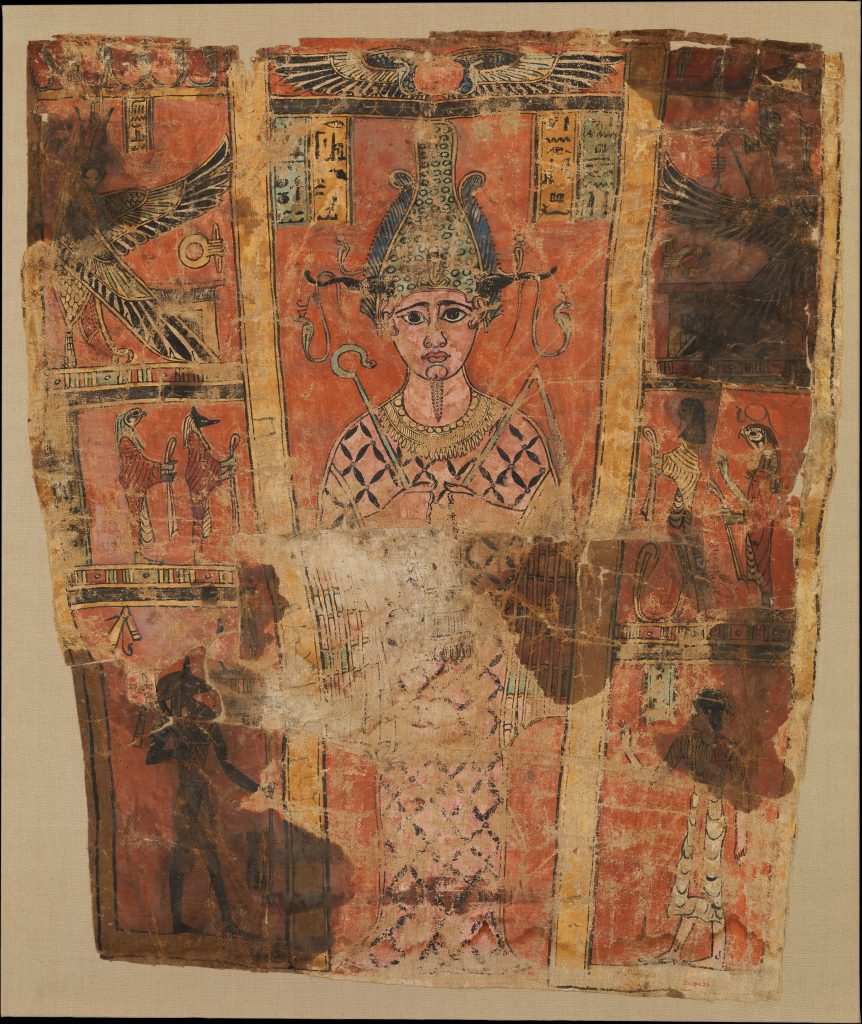
Egyptian ritual made that reversal tangible. Osiris-shaped figures containing grain and earth or sand were prepared as part of annual observances. Surviving examples include figures placed in miniature coffins. The germination of the grain represented the possibility of renewed life associated with Osiris. 14
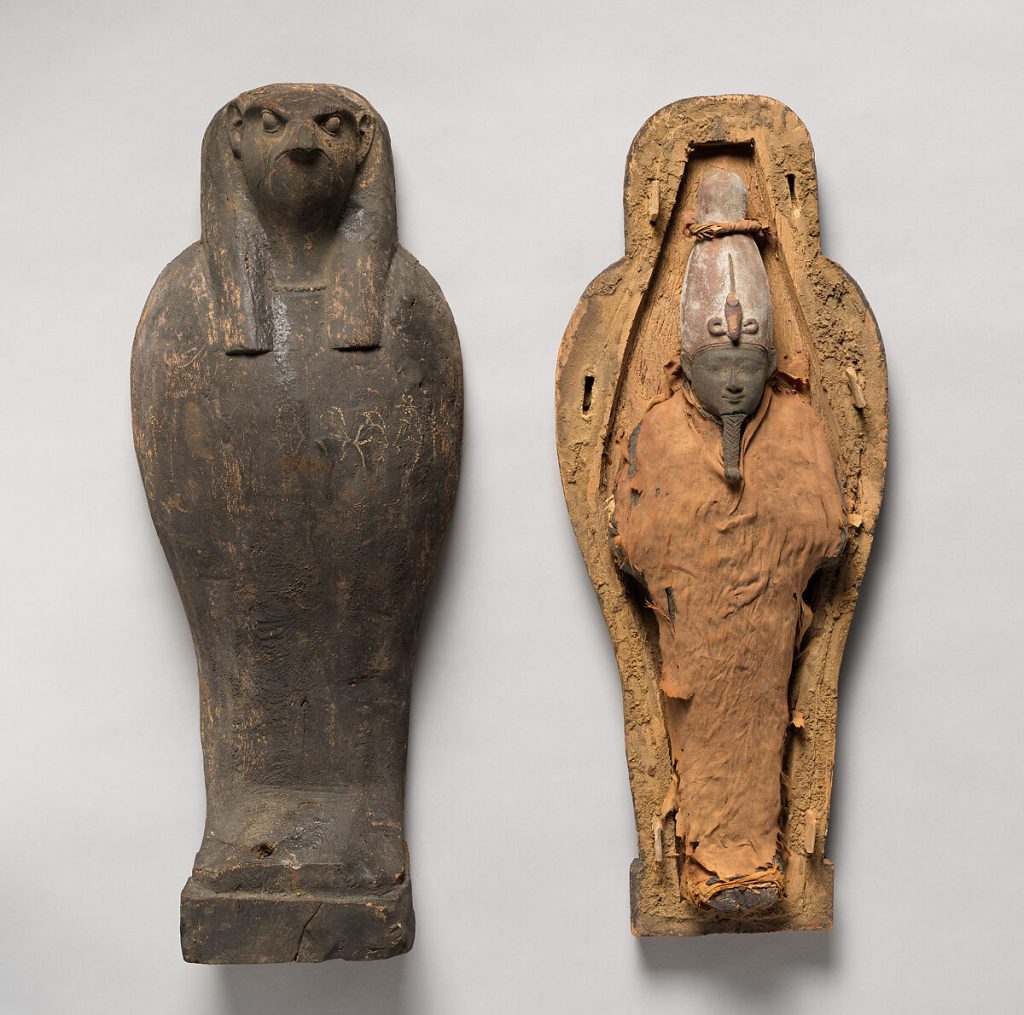
Read beside the scattered body, the seed supplies another perspective on disappearance. Something enters the earth and ceases to be visible, yet hiddenness need not be annihilation. The containing ground can become a condition of emergence.
But Osiris is not merely a crop wearing a crown. The sisters mourn a particular person. An agricultural cycle repeats; a bereaved household cannot simply replace its dead because another season arrives. The force of the myth lies partly in holding those experiences together: nature’s continuance and the irreplaceability of one life.
This also distinguishes Osiris from Ra. In the solar cycle, the returning light appears again at dawn. In the Osirian pattern explored here, continuance is distributed: the restored god, the surviving heir, the protected dead, and the grain that begins to grow. Renewal does not always mean the same thing coming back to the same place. 13, 14
A victory that does not justify the murder
Osiris does not volunteer for dismemberment so that humanity’s wrongdoing can be paid for. In the accounts used here, the death is an attack to be answered, not an atoning sacrifice freely offered. The restoration does not make Seth’s act benevolent in retrospect. 4, 7
That distinction matters when the myth becomes a language of hope. Something can grow after violence without the violence becoming the author of the good. Isis’s labor should not be credited to Seth merely because his attack made it necessary.
There is room for suspicion in the story’s resolution, too. The hymn does not end with reunion alone. The divine assembly recognizes Horus’s claim to his father’s position:
Verily those who defeat iniquity rejoice in the House of Keb to bestow the divine rank and dignity upon him to whom it belongeth, and the sovereignty upon him whose it is by right.
Great Hymn to Osiris, translated by Budge 15
The text joins the restoration of a family to the restoration of legitimate succession. That is its claim about rightful order, not independent evidence that every earthly succession modeled upon it was just.
The question this opens is whether repairing a world always means restoring its former arrangement. The hymn treats the heir’s recognition as part of the remedy; a reader can recognize the emotional force of that conclusion while still examining the authority it endorses.
But the surviving uses of Osiris’s story are not confined to royal inheritance. On a later private stela, a man named Pawerem seeks the protection of Isis and Nephthys for himself, as they protected their brother. His own identity is joined to Osiris’s name. 16
The household grief has become a pattern in which another household can seek a future.
What the earth keeps
The story has not erased death. Isis does not return to a world in which the banquet never happened. Horus’s life does not replace his father’s. The body that the sisters protect remains the body that required their protection.
Yet the scattered person has not been surrendered to scattering. Words address him. Hands gather him. A child carries his line forward, while the funerary texts insist upon a life that is his own.
The recurring rites bring this refusal into material form. A small figure is shaped and enclosed. Grain is held where a divine body is imagined. What looks inert contains the possibility of growth. 14
Beneath the shape of a shrouded god, a grain opens.
Sources and textual notes
1. Textual route and dates. The Great Hymn to Osiris is on the stela of Amenmose/Amenmes (Louvre’s Imenmes), Louvre C 286 / E 13482 BIS, assigned by the museum to the early Eighteenth Dynasty, approximately 1539–1425 BCE, with Thutmose III queried: Louvre collection record. The Pyramid Text passages below are Old Kingdom witnesses, not extracts from Plutarch. The lamentation is a later Egyptian composition, represented by Papyrus Berlin 3008; compare the text record and modern translation at Attalus, which dates the manuscript to the second century BCE. Plutarch’s Isis and Osiris belongs to the Roman period, around the beginning of the second century CE. Its detailed adventures do not all become Old Kingdom evidence because the central Osirian relationships are older. Translation sources: Budge, Legends of the Gods (1912) and The Literature of the Ancient Egyptians (1914); Mercer, The Pyramid Texts in Translation and Commentary, I (1952); Babbitt, Plutarch’s Moralia, V (1936). The online editions identify the quoted historical translations as public domain. No long modern scholarly translation is reproduced. ↩
2. Family, titles, and beneficent rule. Budge, Legends of the Gods: The Egyptian Texts, Edited with Translations (London: Kegan Paul, 1912), actual translated section “A Hymn to Osiris and a Legend of the Origin of Horus,” especially its opening, the inheritance from Keb, and the passage beginning “Thy sister [Isis] acted as a protectress”: full text. This is the hymn on Louvre C 286, not Budge’s preceding commentary about the myth. Compare the Louvre’s partial French translation in its object record. For the sibling group, compare Pyramid Texts, Utterance 600, §§1655a–c, Mercer. Geb and Nut’s family is the selected traditional genealogy, not an assertion that all Egyptian texts organize every form of Horus identically. The opening quotation ends at “temples”; the original sentence continues with further titles. Budge notes that he changes some third-person pronouns to second-person ones in this hymn; its direct address is therefore partly his translational presentation. ↩
3. The name Osiris. James P. Allen, “The Name of Osiris (and Isis),” Lingua Aegyptia 21 (2013), pp. 9–14, especially the survey on pp. 9–10 and the qualified argument on pp. 12–13: publisher’s abstract. Allen reviews multiple ancient and modern analyses and proposes his own js-jrj interpretation. The essay does not adopt that proposal, the frequently printed wsjr, or a picturesque “seat of the eye” gloss as a settled etymology. The familiar name comes through Greek; differing scholarly reconstructions do not establish a single securely recovered ancient pronunciation. ↩
4. The civilizer and the chest. Plutarch, Isis and Osiris, §13, translated by Frank Cole Babbitt, Moralia, V, Loeb Classical Library (1936): LacusCurtius text, Part 1. “Typhon” is Plutarch’s Greek identification of Seth and is not silently replaced inside quotation. The account includes conspirators and further details omitted for focus. Neither suffocation nor drowning is identified here as a medically precise cause of death. The ideals of cultivation, persuasion, and lawful rule are Plutarch’s portrayal, not a verified history of a prehistoric king. The quotation is continuous, from “They all tried it in turn” through “Tanitic Mouth.” ↩
5. Isis’s search and Byblos. Plutarch, §§14–17, Babbitt: text. Babbitt calls the growth enclosing the chest “heather”; other renderings differ, so the narration does not assert a precise botanical identification. The pillar episode is not automatically an origin story for every Egyptian pillar symbol. The nurse’s fire ordeal and the deaths associated with children in the surrounding narrative are outside this selected account, not denied or rewritten into proof of Isis’s invariably gentle conduct. The face-to-face quotation is §17. The Byblos itinerary is Plutarch’s literary account, not an archaeological demonstration that a historical Osiris traveled there. ↩
6. Dismemberment and the missing phallus. Plutarch, §18, Babbitt: text. Fourteen is this version’s count, not a universal Egyptian number of pieces. The account also offers different explanations of Osiris’s many tombs. The likeness of the phallus is associated with ritual honor; the passage does not say that a golden replacement is used to conceive the Horus of the earlier Egyptian hymn. Plutarch already has Horus being raised at Buto during the search, and §19 separately mentions the posthumous conception of Harpocrates. The article therefore changes witnesses explicitly before recounting generation from the stricken body; these chronologies are not fused into one supposedly original version. ↩
7. An early Egyptian witness to the attack and preservation. Pyramid Texts, Utterance 532, §§1255c–1257d, Samuel A. B. Mercer, The Pyramid Texts in Translation and Commentary, I (1952): translation. The sisters find Osiris after Set has felled him in Nedit; the following lines oppose decay. This attests the old relationship between attack and restoration, not Plutarch’s chest, Byblos itinerary, or exact number of fragments. Compare Utterance 366, §§628a–c, where Isis and Nephthys heal the deceased addressed as Osiris: translation. ↩
8. The two mourning voices. Budge, The Literature of the Ancient Egyptians (London: J. M. Dent; New York: E. P. Dutton, 1914), chapter V, “The Lamentations of Isis and Nephthys,” pp. 62–64: public-domain text. The first quotation is the opening of Isis’s speech, ending “so that I may see thee”; the second is from Nephthys’s speech, beginning “Thy two Sisters.” “An,” Budge’s older rendering of a designation connected with On/Heliopolis, and the vocatives remain unchanged; no argument depends upon his old “Beautiful Boy” rendering. For the manuscript and a checking translation, see Berlin 3008, Attalus. This Lamentation and the longer Songs of Isis and Nephthys in Bremner–Rhind are related but distinct compositions. The quoted speeches are translations; Budge’s surrounding account of ritual performance is commentary. The mourning’s restoring function is expressed in the ancient rubric and speeches, not inferred solely from modern grief psychology. ↩
9. Reassembling the deceased. Pyramid Texts, Utterance 373, §§654a–d, Mercer: translation. The direction “To say” is omitted, and line divisions are retained. N. is the translator’s placeholder for the deceased king’s name, not another deity and not a license to substitute “Osiris” into this quotation. Applying bodily restoration to a human deceased is part of the comparison, not a claim that this is a continuous speech from Plutarch’s narrative. ↩
10. Isis’s search and Horus’s generation. Budge, “A Hymn to Osiris and a Legend of the Origin of Horus,” from “Thy sister [Isis]” through the birth, hidden nursing, and reception of Horus: translation. The second quotation begins “She made to rise up” and continues through “the flesh and bone of Osiris.” Budge’s “essence” refers to generative substance: the Louvre’s modern partial translation explicitly describes the extraction of seed/semen and procreation of an heir. The essay does not turn that passage into a nonbodily virgin conception. Budge’s disputed “made light … from her feathers” is not quoted; the secure wing-and-air association is narrated. No golden prosthesis is inserted to reconcile this hymn with Plutarch. ↩
11. Living after death, not merely living in descendants. Pyramid Texts, Utterance 213, §§134a–b, Mercer: translation. The quotation preserves N., the parenthesis, and the older transliteration of the sceptre. Compare Utterance 532, §§1259–1262, with repeated commands to rise and live, and Plutarch, §19, where Osiris comes from the other world to instruct Horus: Plutarch. The contrast between renewed afterlife and ordinary earthly resumption is an interpretive distinction, not a claim that Osiris is immobile, unconscious, incapable of appearing, or simply dead in every Egyptian text. Different Egyptian afterlife destinations and solar/Osirian associations are not forced into an exclusive geography. ↩
12. The western title. Khentiamentiu, “Foremost of the Westerners,” is an Osirian title referring to the dead, not inhabitants of a modern geopolitical “West.” Compare Campbell Price, “Texts in Translation #17: The stela of Pawerem (Acc. no. 8134),” Manchester Museum, May 28, 2020, including the translated offering prayer: museum publication. Budge’s hymn uses the older spelling Khenti-Amenti in its opening titles. The title and its meaning are clearer evidence than a speculative translation of the name Osiris itself. ↩
13. Connections with Atum, Ra, and Isis. For solitary generation, see Pyramid Texts 527, §§1248a–d, Mercer. For Ra’s collective nocturnal passage and dawn, see Budge, The Egyptian Heaven and Hell, I: The Book of Am-Tuat (1905), chapters VII and XII: seventh hour, twelfth hour. For Isis’s deliberately manufactured danger and conditional healing, compare the separately composed “Legend of Ra and Isis” in Budge’s Legends of the Gods, checked against UCL’s Isis and the Name of Ra. These are brief motif-and-theme comparisons, without claims of a chronological sequel or an invariant moral identity. “Dismemberment-and-restoration motif” is a descriptive comparative term, not an unverified motif-index classification. ↩
14. Grain figures and annual renewal. Metropolitan Museum of Art, “Falcon-form case containing a corn mummy,” 2018.628a–c, Ptolemaic Period, 332–30 BCE: object record. The museum identifies grain and sand within a symbolic Osiris mummy, its association with Ptah-Sokar-Osiris, and annual rites in which germination represented renewed life. “Corn” here means cereal grain, not American maize. No exact modern calendar date, universal planting schedule, or claim that this particular surviving specimen visibly sprouts today is made. The contrast between enclosure as confinement and enclosure as protection is interpretation, not a documented claim that the Plutarch episode invented Egyptian coffins. The final germinating-grain image visualizes the ritual principle; it is not a verbatim ancient ending. ↩
15. Restoration and succession. Budge, “A Hymn to Osiris and a Legend of the Origin of Horus,” divine assembly following the reception of Horus: text. The quoted sentence is the hymn’s assertion of rightful sovereignty; the article attributes the claim to the text rather than endorsing an unspecified historical dynasty. The ethical distinction between attack and voluntary atonement concerns the selected narratives, not a blanket assertion that Egyptian religion had no sacrificial practices. The longer conflict between Horus and Seth is reserved for its own episode. ↩
16. A private person within the pattern. Manchester Museum 8134, the stela of Pawerem, presented and translated by Campbell Price, “Texts in Translation #17”. The museum dates the object broadly to the Graeco-Roman period and explains the individual’s identification with Osiris and hoped-for protection by Isis and Nephthys. This one later example does not establish a simple historical story in which Osirian afterlife access was first universally royal and then suddenly “democratized.” No current display or exhibition location is inferred from the 2020 post. ↩