Source and scope. The main narrative is the Egyptian poison-healing incantation commonly called Isis and the Name of Ra. Its principal Turin manuscript belongs to the Twentieth Dynasty, approximately the twelfth to early eleventh century BCE. Substantial quotations below use E. A. Wallis Budge’s public-domain translation, checked against UCL’s translation and the Museo Egizio’s manuscript record. A separate Egyptian funerary spell, Jacob’s encounter in Genesis, and a brief later folktale comparison offer different perspectives on naming—not chapters of one tradition or evidence of borrowing. 1
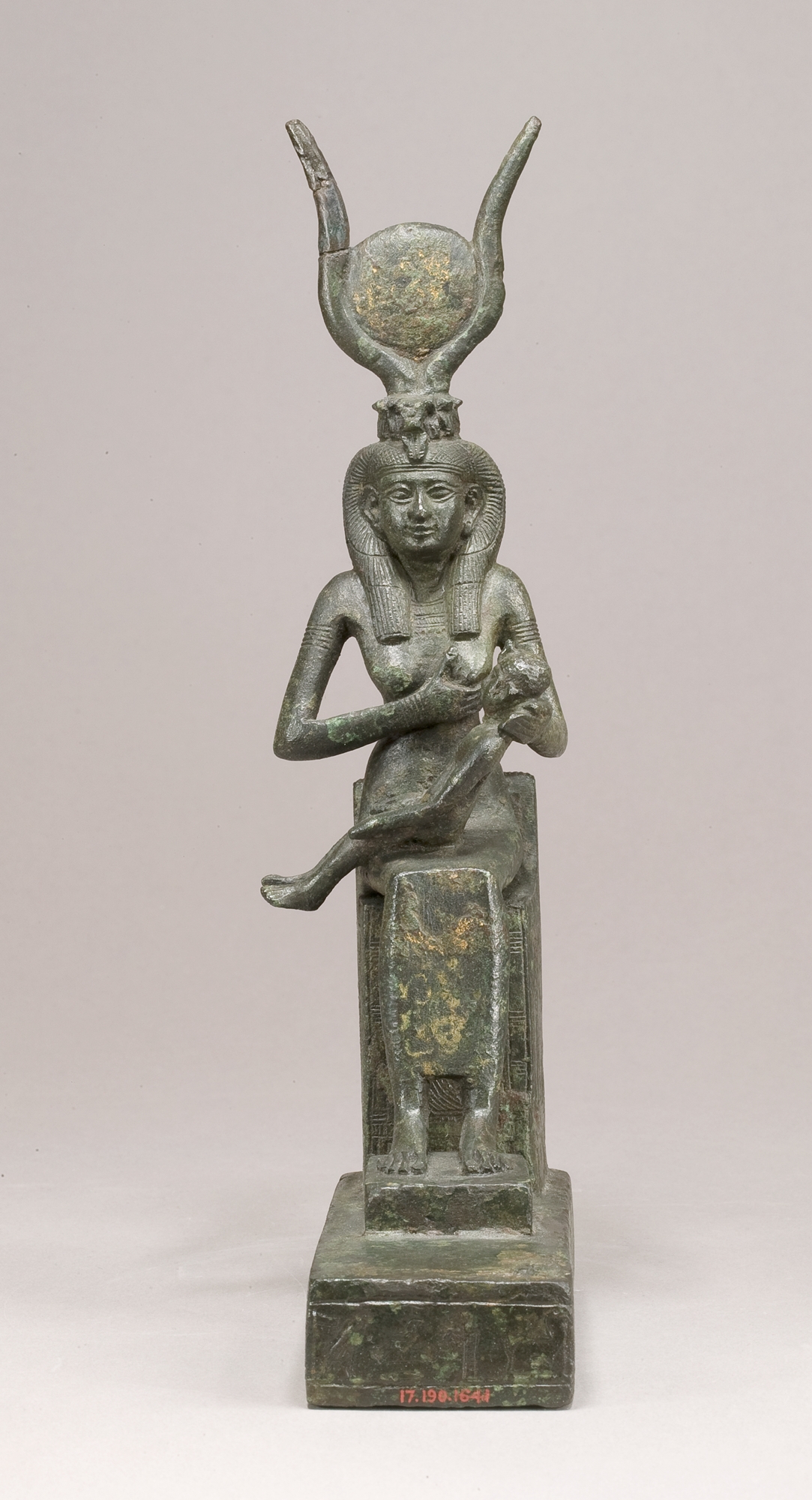
Opening illustration: Isis nursing Horus, ca. 1080–343 BCE. This image presents the goddess in her maternal role; it is not an illustration of her poisoning Ra. The Metropolitan Museum of Art, Gift of J. Pierpont Morgan, 1917, 17.190.1641. Public domain / CC0.
What the sun lets fall
The creator has many names, many forms, and one secret he intends to keep.
Each day Ra travels through the world he has made. But the god has grown old. His mouth no longer holds everything within it; saliva falls upon the earth. Something from the creator’s body lies outside his keeping.
Isis notices.
She is already a goddess skilled in powerful speech. Yet there is knowledge she does not possess, and she wants more than a place among the other gods. The narrative gives her ambition a precise object:
Was it not possible to become even as was Ra in heaven and upon earth, and to make [herself] mistress of the earth, and a [mighty] goddess—thus she meditated in her heart—by the knowledge of the Name of the holy god?
The Legend of Ra and Isis, translated by E. A. Wallis Budge 2
She gathers the fallen spittle and kneads it together with earth. From this mixture she fashions a serpent and leaves it on the road the sun god will take.
Ra passes. The serpent bites.
And the mighty god opened his mouth, and the cry of His Majesty (life, strength, health!) reached unto the heavens, and the company of the gods said, “What is it?” and his gods said, “What is the matter?” And the god found [no words] wherewith to answer concerning himself. His jaws shook, his lips trembled, and the poison took possession of all his flesh just as Hapi (i.e., the Nile) taketh possession of the land through which he floweth.
The Legend of Ra and Isis, translated by Budge 3
The ruler of the world cannot explain what is happening within his own body. When he gathers himself enough to speak, he tells the assembled gods:
I have been smitten by some deadly thing, of which my heart hath no knowledge, and which I have neither seen with my eyes nor made with my hand; and I have no knowledge at all who hath done this to me.
The Legend of Ra and Isis, translated by Budge 3
The material came from him. Its new purpose did not.
A cure with a condition
Ra calls for gods who know effective words. Isis comes among them, her speech described as the breath of life. She approaches the suffering god with a question whose innocence the reader cannot share:
What is this, O divine father? What is it? Hath a serpent shot his venom into thee? Hath a thing which thou hast fashioned lifted up its head against thee? Verily it shall be overthrown by beneficent words of power, and I will make it to retreat in the sight of thy rays.
Isis, The Legend of Ra and Isis, translated by Budge 4
He describes burning and shivering, sweat and trembling, eyes that cannot remain steady. She answers with her condition:
O my divine father, tell me thy name, for he who is able to pronounce his name liveth.
Isis, The Legend of Ra and Isis, translated by Budge 4
This is not a request for an introduction. She knows whom she is addressing. She wants the name he has concealed within his body, apart from the names by which his presence is already known.
Earlier in his appeal, Ra has explained why it is hidden: to keep those who use words of power from making their enchantments prevail against him. The secrecy protects him from a particular kind of access. 5

Rather than disclose it, he declares what he is and what he has made:
I am the maker of the heavens and the earth, I have knit together the mountains, and I have created everything which existeth upon them.
I am the maker of the Waters, and I have made Meht-ur to come into being; I have made the Bull of his Mother, and I have made the joys of love to exist. I am the maker of heaven, and I have made to be hidden the two gods of the horizon, and I have placed the souls of the gods within them. I am the Being who openeth his eyes and the light cometh; I am the Being who shutteth his eyes and there is darkness.
I am the Being who giveth the command, and the waters of Hapi (the Nile) burst forth, I am the Being whose name the gods know not. I am the maker of the hours and the creator of the days. I am the opener (i.e., inaugurator) of the festivals, and the maker of the floods of water. I am the creator of the fire of life whereby the works of the houses are caused to come into being.
Ra, The Legend of Ra and Isis, translated by Budge 6
He also names his solar forms: Khepri in the morning, Ra at noon, Atum in the evening. The poison remains.
Isis is not persuaded:
Among the things which thou hast said unto me thy name hath not been mentioned.
O declare thou it unto me, and the poison shall come forth; for the person who hath declared his name shall live.
Isis, The Legend of Ra and Isis, translated by Budge 6
The catalogue is magnificent. It is also not the answer.
From his body into hers
As the poison burns, Ra yields. The surrender is described not simply as a word spoken into the air, but as a passage between bodies:
I will allow myself to be searched through by Isis, and my name shall come forth from my body and go into hers.
Ra, The Legend of Ra and Isis, translated by Budge 7
The text places a restriction upon the knowledge’s further transmission: Horus, Isis’s son, may receive it under an oath. What she has obtained is not announced to the entire assembly. Nor does the reader receive a sequence of syllables identified as the hidden name. The story describes its disclosure without disclosing it to us. 7
Then Isis acts. She commands the poison to leave Ra. Her victory is pronounced as a reversal of their conditions:
Verily the name hath been taken away from the great god. Let Ra live, and let the poison die; and if the poison live then Ra shall die.
Isis, The Legend of Ra and Isis, translated by Budge 8
Ra survives. Isis possesses knowledge he had intended to withhold.
She has not killed the sun or explicitly taken his throne. She has forced the creator to admit another being into a part of himself that his creative achievements could not protect.
What power does a name give?
In this story, the hidden name gives Isis access to Ra as a being upon whom effective words can operate. He says secrecy protects him against enchantment; she makes its surrender the condition of the healing that follows. The text supports that connection. It does not establish that anyone who learns any name can command its owner without limit. 5678
This is a version of the secret-name motif: a concealed identity becomes consequential knowledge, and discovering it changes a relationship of power. In the much later folktale of Rumpelstiltskin, learning the helper’s name releases the queen from his claim upon her child; it does not make her master of every power he possesses. The pattern recurs, but its consequences differ. Knowledge and vulnerability are the themes; the hidden name is the narrative motif through which they take shape. 14
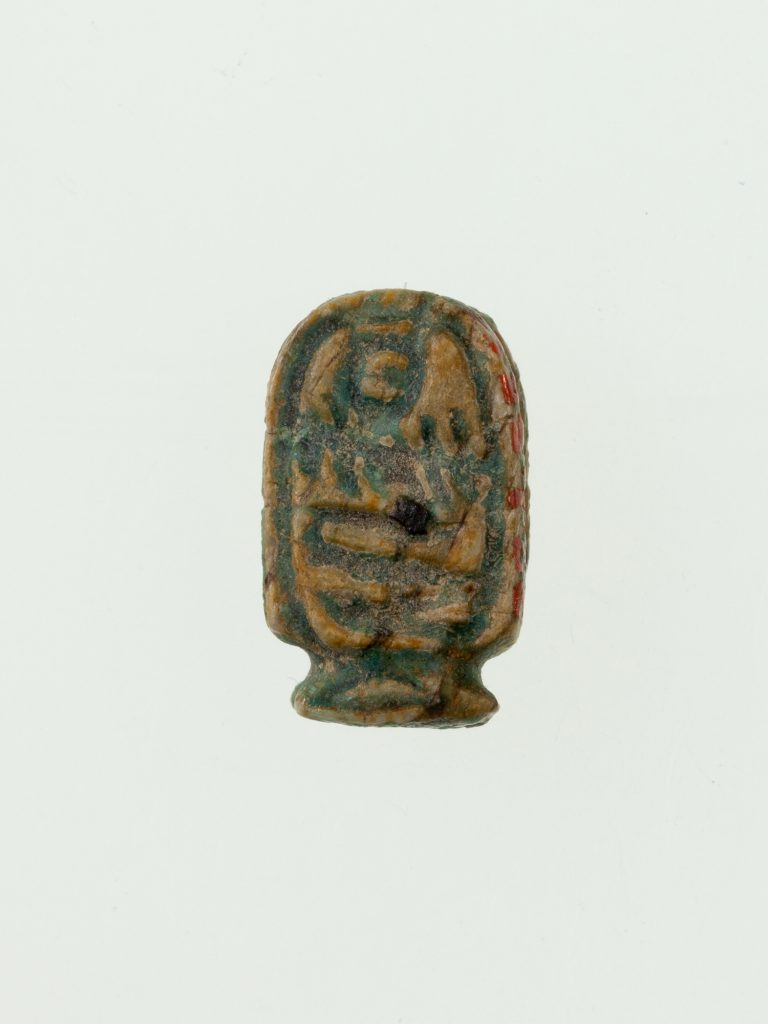
Egyptian rn, 𓂋𓈖, conventionally vocalized ren, means “name.” Here a name is more than a label attached to an otherwise complete person. Ra keeps it inside his body, and its disclosure transfers something consequential from him to Isis. Naming belongs to the being’s presence and availability, not merely to a spectator’s description. 9
The difference becomes clearer in another Egyptian text. Chapter 25 of the Book of the Dead concerns recovering one’s own name in the realm of the dead:
May my name be given unto me in the great Double House, and may I remember my name in the House of Fire on the night of counting the years and of telling the number of the months. I am with the Holy One, and I sit on the eastern side of heaven. If any god advanceth unto me, forthwith I proclaim his name.
Book of the Dead, chapter 25, Papyrus of Nebseni; translated by Budge 10
The speaker needs a name not chiefly to dominate another being, but to remain someone. The same short spell joins the recovery of personal identity to recognition of the gods encountered beyond death.
Read beside Ra’s secret, it reveals two sides of naming. To possess your name is to retain a way of being present; to place it within someone else’s knowledge is to make yourself accessible. That access can sustain or endanger you. Recognition is not automatically benevolence, just as secrecy is not automatically wisdom.
This is why “the name is a password” is a useful beginning but an inadequate ending. A password ordinarily opens something separate from the password itself. Ra’s name is imagined within his body and passes into another body. It is bound to who he is, not merely to permission to enter his house.
The distinction between his public declarations and his hidden name is equally important. He tells Isis about his works, his cosmic functions, and his changing appearances. She does not deny them. Knowing what a being does is not yet possessing the knowledge through which one can reach it.
As a philosophical reading, the secret marks the difference between the self that can be described and the self that can be addressed at its most vulnerable point. Ra can reveal an entire universe of achievements while still withholding the thing that would alter his relationship with the listener.
Isis does not need another title to admire. She needs him to become reachable.
The wound and the remedy
Her method brings together two forms of access. First she takes material that has left Ra’s body. Then she demands knowledge that he has kept inside it.
The first is obtained without permission. The second is obtained through consent extracted under suffering. The two acts belong to one design: what he loses unintentionally becomes the means of compelling what he will not give voluntarily.
This explains why the saliva is not an incidental grotesque detail. It embodies a limit to self-possession. The creator’s body produces something that another intelligence can gather, shape, and turn toward a purpose of its own.
The serpent does not simply emerge from a realm wholly foreign to him. It combines his substance with Isis’s intention. Its danger lies partly in this divided authorship: the source of the material is not the author of the act. 23
The mouth carries the same reversal. Ra’s mouth releases the spittle; later it cannot form an answer through the pain. Isis arrives with a mouth that gives life. Speech is not decoration laid upon the real action. It is one of the ways the action occurs. 34
Yet the protection of the name is no promise of invulnerability. Isis harms him before obtaining it. The tale differentiates his initial susceptibility from the knowledge she insists upon before curing him. We should not turn a particular protection into an absolute rule that the story itself contradicts. 5678
The ethical difficulty remains. Her cure is real within the narrative, but so is her responsibility for making it necessary. Her eventual assistance cannot retrospectively make the injury a gift.
There is a sharp contrast with the preceding Ra episode. There, Ra interrupts a destruction he authorized and preserves people without requiring a hidden name in payment. Here, Isis engineers the danger through which a guarded disclosure becomes obtainable. Both stories unite the source of suffering with the source of rescue, but they distribute the cost of rescue differently. 11
A sympathetic reading can recognize her intelligence, courage, and capacity to preserve life without pretending those qualities make her methods innocent. A suspicious reading can expose the coercion without pretending the recovered life is worthless.
The troubling question is not whether she heals. It is whether a person is free to refuse a healer who controls the conditions under which healing becomes necessary.
Jacob: a blessing without the name
Jacob’s encounter in Genesis 32 provides a contrast. He wrestles with a mysterious being, demands a blessing, and asks its name. The stranger renames him Israel but withholds its own name. Isis receives the god’s hidden name; Jacob receives a new name of his own. 12
In this reading, one confrontation grants access to the other’s guarded identity; the other transforms the seeker while leaving the encountered being unnamed. Jacob leaves blessed but wounded. Genesis does not say his question is an attempt at magical control. The resemblance lies in naming as a decisive encounter—not in both stories following one universal rule.
The name spoken beside the patient
Return now to Egypt, and to the purpose for which the story was written.
The narrative survives among spells against dangerous bites and stings. Its ending does not leave Isis displaying a captured secret. It brings another person into Ra’s recovery:
And similarly, a certain man, the son of a certain man, shall live and the poison shall die.
These were the words which spake Isis, the great lady, the mistress of the gods, and she had knowledge of Ra in his own name.
The Legend of Ra and Isis, translated by Budge 13
The unnamed person is a place to be filled. The patient’s identity enters the pattern of the god’s deliverance. The practitioner takes up the healer’s role; Ra’s survival supplies the precedent that the words seek to bring about again. 113
This changes the emphasis without removing the story’s moral difficulty. The person receiving the spell is not being instructed to poison someone in order to steal knowledge. A narrative of injury and successful healing is being used to seek another healing.
Nor must the patient discover the hidden name’s syllables before the story can be used. The secret remains secret to the reader, while the account of its successful use becomes repeatable. What the ritual shares is the pattern of deliverance, not necessarily the guarded knowledge itself.
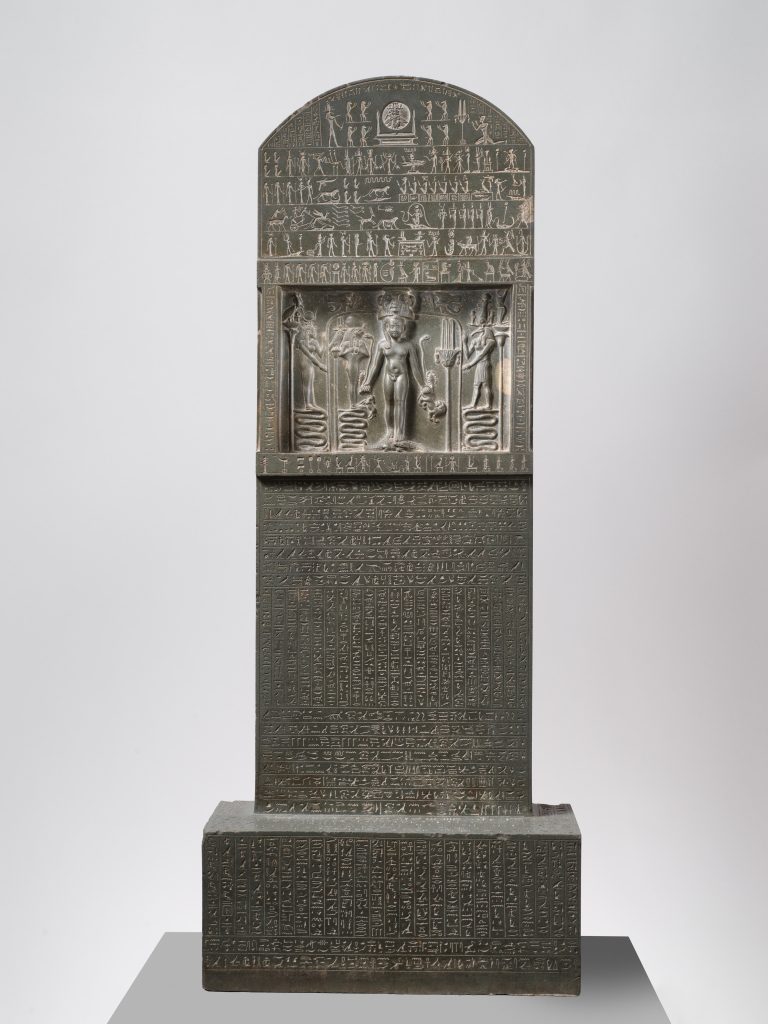
The concluding instructions join spoken words to divine images, drawn upon the patient’s hand and upon fine linen placed at the neck. The pictures on the hand are to be licked off. Speech and image approach the suffering person through the body, just as the name passed from Ra’s body into Isis’s. 13
That final comparison is the reading I would draw: knowledge becomes more than something observed from outside. It is received, carried, and brought to bear upon a life.
Ra’s name is hidden because being known can be dangerous. The human patient is named because recognition can also become the beginning of care.
A strip of linen rests against a throat. Above it, a voice supplies the name the spell has left waiting.
Sources and textual notes
1. Main witness, dating, and ritual setting. Museo Egizio, Papyrus Cat. 1993, recto 2.11–5.5, “The Tale of Isis and the Name of Re,” catalogue edited by Letizia Loprieno: manuscript record. The museum assigns the manuscript to Dynasty 20 (1190–1077 BCE in its chronology), not to the earliest pyramids or a securely dated original composition. Its provenance is given as Thebes/Deir el-Medina (?)**. The catalogue explains patient–deity and practitioner–healer identification. Other witnesses are listed at UCL Digital Egypt, “Isis and the Name of Ra”, including Papyrus Chester Beatty XI and ostraca. The UCL page dates to 2003 and does not individually identify its translator; it cites MacDowell 1999, pp. 118–120, no. 88. The article does not pretend that all witnesses are identical. ↩
2. Isis’s ambition and the fashioned serpent.* E. A. Wallis Budge, Legends of the Gods: The Egyptian Texts, Edited with Translations (London: Kegan Paul, 1912), actual translated section “The Legend of Ra and Isis,” opening through “This Isis kneaded in her hand”: public-domain text. Compare UCL paragraphs 1–3. This is not the earlier introductory commentary under a similar heading. Isis already possesses effective knowledge; the tale is not the origin of all her magical power. Budge’s wording about her “disgust” for humanity is not followed in narration; UCL describes her intelligence surpassing others. The fashioned serpent is not identified as Apep. No claim is made that Ra’s aging here chronologically follows his withdrawal in the Heavenly Cow*. ↩
3. The bite and Ra’s inability to identify its cause. Budge, “Ra and Isis,” passages beginning “And the mighty god opened his mouth” and “Then the great god made firm his heart”; compare UCL paragraph 4**. Budge; UCL. Quotations retain Budge’s brackets, parenthetical glosses, and spellings. Separate quoted passages are not silently joined across omitted material. The distinction between origin of material and authorship of its use is this article’s interpretation, not an ancient philosophical definition. ↩
4. Isis’s arrival and the condition of naming. Budge, “Ra and Isis,” from “Let there be brought unto me my children the gods” through “tell me thy name”; compare UCL paragraphs 6–8**. Budge; UCL. Budge’s formulation about a person pronouncing his own name is not made the basis for a rule requiring patient self-recitation: UCL instead connects living with being called by one’s name. “Father” and “daughter” are relational addresses within this composition, not evidence for a universal Egyptian genealogy that displaces Isis’s other parentage traditions. ↩
5. Why the name is hidden. Budge, “Ra and Isis,” paragraph beginning “My father and my mother uttered my name”; UCL paragraph 5*, especially transliteration rn.i, imn.i st m Xt.i r msw.i*, and the following anti-enchantment clause. Parallel translation and transliteration. Budge makes the parents hide the name at birth; UCL has the parents tell it to Ra and Ra hide it from his children within his body. The narration adopts their securely shared point—concealment against magical attack—without pretending that these translations have identical grammar. The claim of protection is part of the ancient narrative, not a modern claim that names have experimentally demonstrated occult effects. ↩
6. Ra’s declarations and Isis’s refusal. Budge, “Ra and Isis,” “I am the maker of the heavens and the earth” through “O declare thou it unto me”; compare UCL paragraphs 8–9**. Budge. The three-paragraph catalogue is a continuous excerpt; its subsequent solar-forms sentence is separately paraphrased, not silently altered inside quotation marks. Meht-ur, the Bull of his Mother, Hapi, and the other older forms remain as Budge printed them. His malformed parentheses in the solar-forms sentence are not reproduced because that sentence is not quoted. Modern spellings Khepri and Atum appear in narration. Isis rejects the sufficiency of the answer, not explicitly its truth. ↩
7. Transfer, Horus, and the unprinted name. Budge, “Ra and Isis,” “I will allow myself to be searched through by Isis” and following; UCL paragraph 9; Museo Egizio Cat. 1993. Budge’s “searched through” differs from UCL’s listening/ears formulation, but both describe the name passing from Ra’s body or interior into Isis’s. The modern museum account explains the transmission restriction as allowing disclosure to Horus, and UCL places him under an oath. Budge instead has a differently framed oath concerning the two eyes; his footnote’s sun/moon “fluid of life” interpretation is not** treated as ancient dialogue or established meaning. No extraction of literal eyes, permanent loss of Ra’s selfhood, dethronement, or public announcement of the hidden syllables is asserted. ↩
8. The healing declaration and limits of the victory. Budge, “Ra and Isis,” concluding speech, beginning “Verily the name hath been taken away”; compare UCL paragraph 9**. Budge; UCL. The conclusion connects Isis’s acquired knowledge with the cure; it does not supply a universal list of powers granted by true-name knowledge. The name “taken away” is Budge’s wording and is not used to claim that Ra is henceforth nameless or dead. The essay distinguishes what the plot dramatizes from a speculative rule of unlimited control. ↩
9. Egyptian “name.” Egyptian rn*, conventionally vocalized ren*, is visible in the transliteration of UCL paragraphs 5, 8, and 9, corresponding to “name.” Text. The vowels are conventional. No unrelated-language etymologies or exhaustive anatomy of a supposed Egyptian “soul” are constructed from the term. The embodied-identity interpretation is grounded in this tale’s concealment and transfer and the separate funerary text in note 10; it is not claimed to exhaust every Egyptian use of naming. Effective words are represented as healing and harming within the sources; their historical ritual use is distinguished from evidence of modern therapeutic efficacy. ↩
10. A name preserved beyond death.* Budge, The Book of the Dead: The Papyrus of Ani in the British Museum* (London: British Museum, 1895), Plate XV commentary/translation, p. 307, appendix: chapter XXV, explicitly taken from the Papyrus of Nebseni, not from Ani. Full passage. The supplied chapter heading is “The Chapter of Causing the Deceased to Remember His Name in Neter-Khert.” The entire quoted speech is reproduced with intratextual line numbers removed. The edition’s title does not make the appended witness an Ani passage. This is a separate funerary spell, not an additional scene in the Isis narrative. ↩
11. Comparison with the previous Ra episode.* Budge, Legends of the Gods*, “The Legend of the Destruction of Mankind,” chapter I, especially Ra’s declaration that he must protect humanity from the destructive goddess: text. The contrast concerns different narrative distributions of injury and rescue. It does not establish a chronological sequel, identical motives, or a systematic doctrine that Ra always saves without conditions. The ethical descriptions of coercion and manufactured dependence are interpretations of the secret-name plot, not quotations of an ancient moral verdict. ↩
12. Jacob’s name and the unnamed wrestler. Genesis 32:22–32, especially the exchange at 32:26–29, consulted in the King James Version and paraphrased without a direct quotation: Genesis 32. Genesis first calls the wrestler a man at 32:24, gives Jacob’s divine identification at 32:30, and the limp at 32:31. Compare Hosea 12:3–5, especially 12:4**, for the angel: Hosea 12. References follow English verse numbering. The text does not explicitly state that Jacob asks the name to work magic. The comparison concerns consequential naming, withheld identity, and transformation; it does not identify the traditions’ gods or assert Egyptian borrowing. ↩
13. The patient and the concluding rubric. Budge, “Ra and Isis,” final speech and instructions; UCL paragraph 9 and “Concluding instructions for recitation”**; UCL text. Budge’s “a certain man, the son of a certain man” is retained only inside quotation; UCL renders the patient formula as an unspecified person born of an unspecified parent, so the article does not require a father’s name. UCL supplies the fuller instructions about images on the hand, licking them off, and linen at the neck. These describe an ancient practice, not medical instructions or evidence that it treats venom. The closing linen-and-voice image is an imaginative visualization of the documented ritual form, not a claim about a particular recorded patient or a verbatim ancient closing sentence. ↩
14. Motif, theme, and the later folktale.* “Secret-name motif” is a descriptive comparative label for a recurring narrative element, not a claim that every tradition follows the same law of magical control. For the later example, Jacob and Wilhelm Grimm, Kinder- und Hausmärchen*, vol. 1 (Göttingen: Dieterich, 1857), no. 55, “Rumpelstilzchen,” pp. 281–284; D. L. Ashliman’s translation and source notes, University of Pittsburgh. Ashliman’s English translation is copyrighted (2002) and is paraphrased, not quoted. His notes identify the folktale as ATU 500, “Guessing the Helper’s Name.” That tale-type designation applies to the folktale, not automatically to Isis or Jacob. The Grimm version is a much later comparison; no BCE date, common origin, or direct transmission is inferred from the resemblance. “Knowledge,” “power,” and “vulnerability” name interpretive themes; the hidden name and consequential disclosure are narrative motifs. ↩