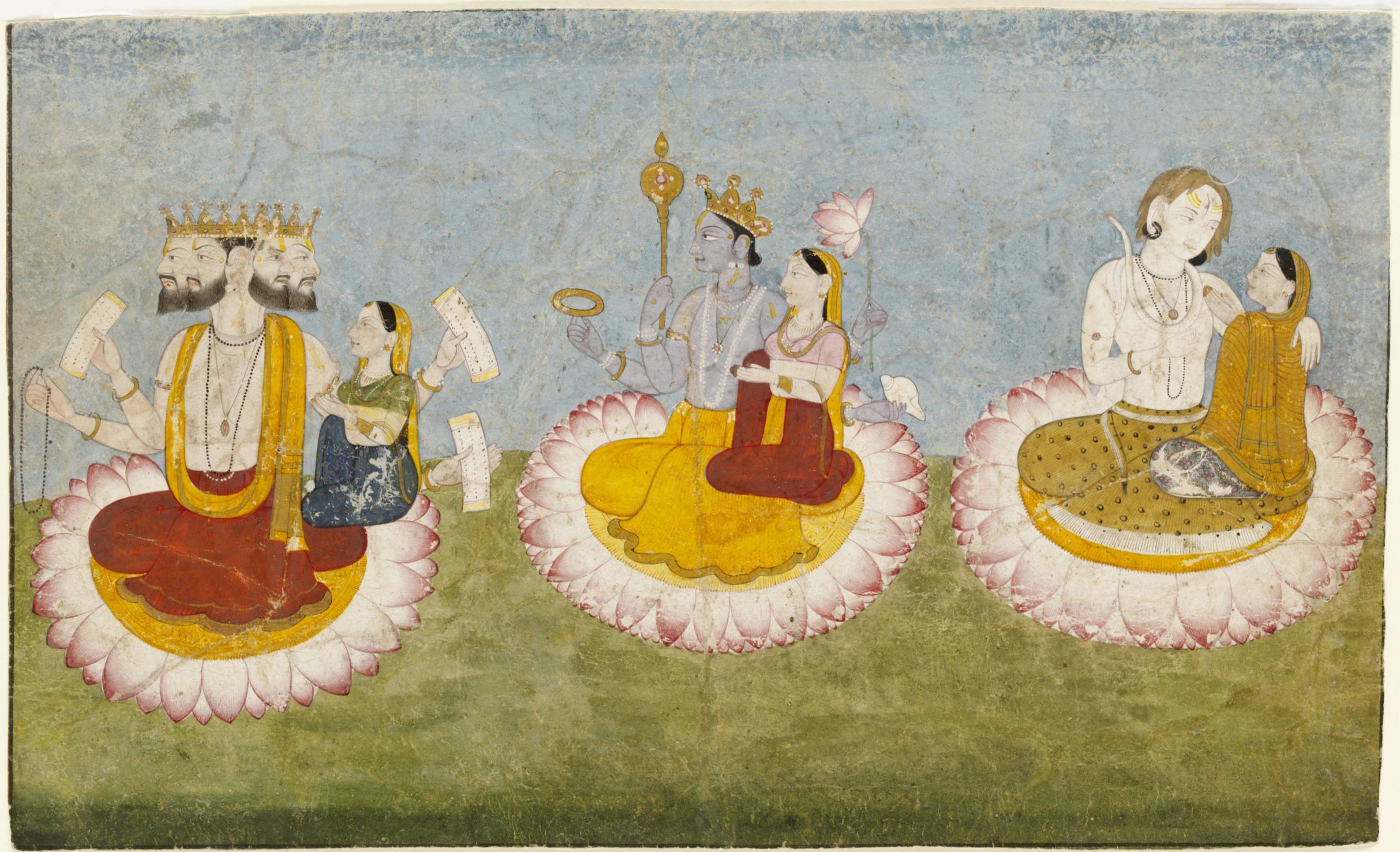
A withheld bow, a spoken insult, and a kick to the chest.
Opening illustration: Brahmā, Vishnu, and Shiva with their consorts. Unknown artist, Guler, ca.1770. Opaque watercolor on paper. Victoria and Albert Museum, IS.169-1951. Public-domain reproduction via Wikimedia Commons.
What makes a god worthy of worship?
Power might explain why a being is feared. It does not, by itself, explain why that being should be loved. The ability to destroy an offender proves that the offender is vulnerable. Whether it proves the greatness of the one who destroys him is another question.
In the Bhāgavata Purāṇa, a gathering of sages disputes which of three gods—Brahmā, Shiva, or Vishnu—is greatest. They send Bhṛgu to investigate. His method is neither prayer nor philosophical argument. He will withhold the reverence the gods ordinarily receive and discover what appears beneath it.1
Source and translation note: The extended passages below are close English renderings prepared for this article from the Sanskrit of Bhāgavata Purāṇa 10.89.1–20. Additional context comes from Prabhupāda’s Kṛṣṇa, the Supreme Personality of Godhead, chapter 89; his brief description of Shiva’s ashes is quoted in his own wording.12
Bhṛgu: a name associated with fire
Bhṛgu, Sanskrit भृगु, is commonly written Bhrigu in English. Monier-Williams connects the name with the root bhrāj, भ्राज्, meaning to shine, beam, or glitter. His dictionary also records the close association of the Bhṛgus, an ancient family of sages, with the discovery and transmission of fire.3
That association offers a fitting image for the journey. Bhṛgu carries provocation from one divine presence to another. In one, anger catches and is extinguished. In another, it threatens to consume him. In the last, his provocation finds nothing upon which to feed.
Before Brahmā: the honor that is withheld
Śuka said:
Once, O King, sages were conducting a sacrificial session on the bank of the Sarasvatī. A debate arose among them: which of the three great lords was greatest?
Wishing to learn the answer, they sent Bhṛgu, the son of Brahmā, to investigate. He entered Brahmā’s assembly.
To test his goodness, Bhṛgu offered him neither a bow nor a hymn of praise. The lord became angry with him, blazing with his own fiery power.
But the self-born lord subdued, through his own judgment, the anger that had arisen within him against his son, just as fire is quenched by water that springs from it.
Bhāgavata Purāṇa 10.89.1–4.4
The first offense is an omission. Bhṛgu does not bow. He does not offer the expected praise. Nothing is broken, no accusation is spoken, and no blow is struck. What is withheld is recognition.
Brahmā becomes angry, but the encounter does not end in punishment. The father restrains himself, and the son proceeds to the next test.
Before Shiva: the embrace refused
From there he went to Kailāsa. The god Maheśvara [Shiva] rose joyfully and approached to embrace his brother.
Bhṛgu refused. “You have strayed from the path,” he said. The god became angry; with a fierce gaze, he raised his trident and made to kill him.
The Goddess fell at his feet and soothed him with her words. Then Bhṛgu went to Vaikuṇṭha, where the god Janārdana [Vishnu] dwells.
Bhāgavata Purāṇa 10.89.5–7.5
The Sanskrit accusation, utpatha-ga, उत्पथग, describes someone who has departed from the proper path. Prabhupāda’s retelling gives the insult a concrete object: Shiva’s ash-covered body. Bhṛgu says:
“Because you smear your body with ashes, you are not very clean. Please do not touch me.”
Prabhupāda, Kṛṣṇa, the Supreme Personality of Godhead, chapter 89.2
The welcome is rejected as contaminating. Shiva approaches as a brother; Bhṛgu refuses him as someone unfit to touch.
Pārvatī intervenes before the raised trident becomes a fatal blow. Prabhupāda explains her action through the three guṇas, गुण, or qualities of nature: goodness, passion, and ignorance. She calls forth Shiva’s goodness and brings his anger under control. Bhṛgu leaves alive and continues his journey.2
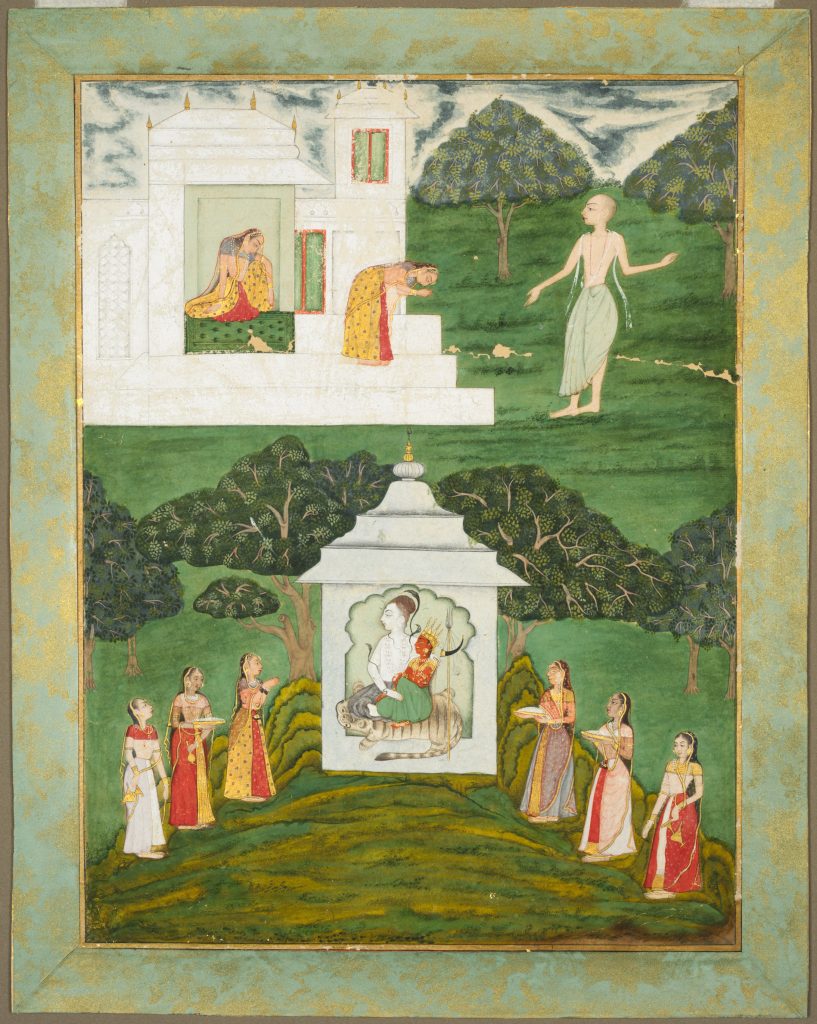
Before Vishnu: the foot against the chest
He struck with his foot the chest of the lord who lay in Śrī’s [Lakṣmī’s] lap. Then the lord, the destination of the good, rose together with Lakṣmī.
Descending from his couch, he bowed his head before the sage and said:
“Welcome, Brahmin. Sit here upon this seat for a moment. Forgive us, master, for not knowing that you had arrived.
“Purify me, together with my realm and the guardians of the worlds devoted to me, through the water from the washing of your feet—the water that gives even places of pilgrimage their sacredness.
“Today, venerable one, I have become Lakṣmī’s exclusive abode. Fortune shall dwell upon my breast, for your foot has banished my impurity.”
Bhāgavata Purāṇa 10.89.8–11.6
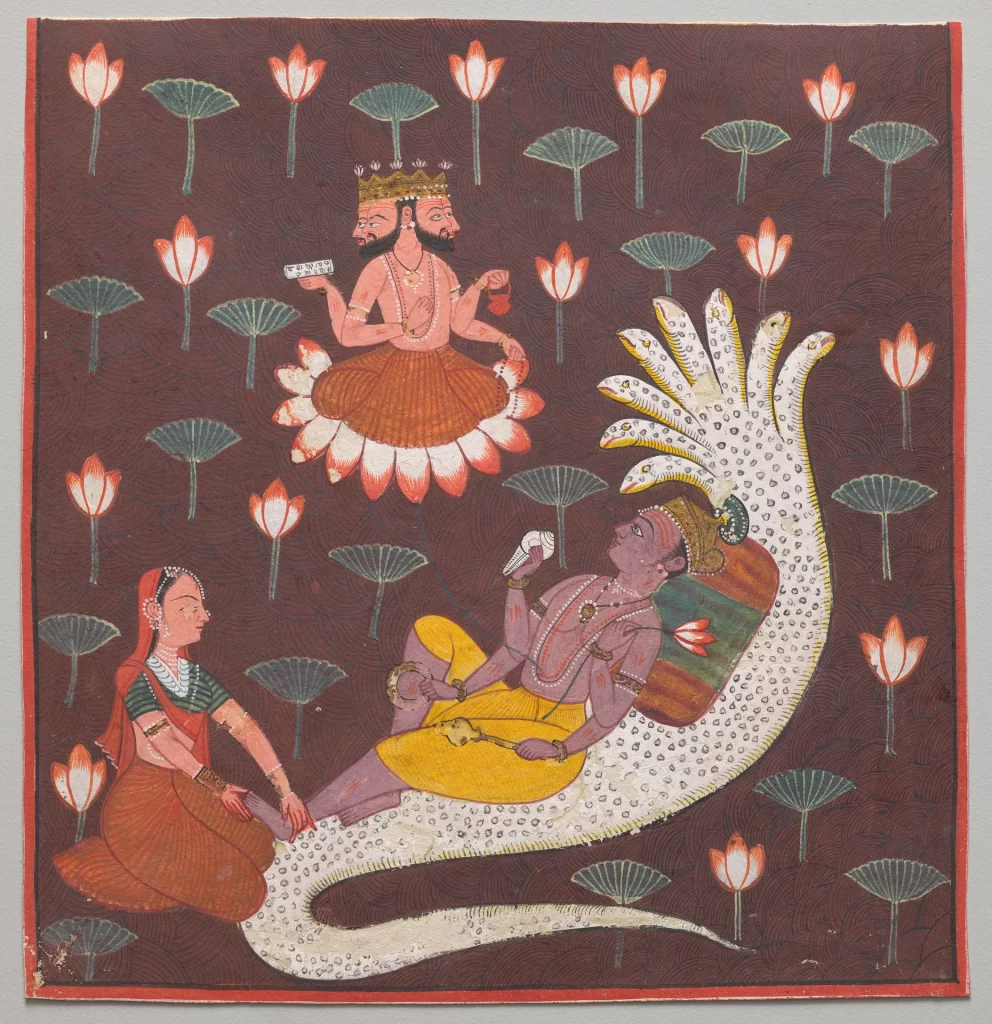
The third offense is physical. Bhṛgu does not merely reject the god’s hospitality. He kicks him.
Vishnu answers by offering the hospitality the visitor has interrupted. He rises, bows, provides a seat, and asks forgiveness. The foot that has struck him becomes the foot whose washing water he requests. The chest that has received the insult becomes, in his speech, newly fit to receive Fortune herself.
An additional verse preserved in some editions continues the scene:
“Your feet are exceedingly tender, dear one, great sage.”
Having spoken thus, he rubbed the Brahmin’s feet with his own hand.
Additional verse recorded after Bhāgavata Purāṇa 10.89.11.7
Prabhupāda develops the gesture as concern that Bhṛgu’s soft feet might have been hurt against Vishnu’s hard chest. The god attends not to the injury done to his dignity, but to the person who has struck him.2
Lakṣmī and the offended goddess of fortune
In Prabhupāda’s retelling, Lakṣmī withholds her favor from Brahmins after Bhṛgu’s offense, providing a religious explanation for their poverty.2
Bhṛgu returns: the report, the verdict, and the worship
The test does not end at Vishnu’s couch.
Śuka said:
As Vaikuṇṭha [Vishnu] spoke in this way, Bhṛgu was soothed and satisfied by his deep voice. Filled with longing devotion, his eyes wet with tears, he remained silent.
Then, O King, he returned to the sacrifice of the sages who discoursed on Brahman. He recounted, without leaving anything out, what he had himself experienced.
Bhāgavata Purāṇa 10.89.12–13.8
The sages hear what happened in all three encounters. Their answer concerns not only who possesses the greatest power, but where peace and freedom from fear are to be found.
Upon hearing this, the sages were astonished, and their uncertainty fell away. They placed their faith in Vishnu as the greater, since from him come peace and fearlessness.
From him arise dharma itself, knowledge and the detachment accompanying it, the eightfold sovereign powers, and the glory that removes the self’s defilement.
He is said to be the highest destination of the good sages who have laid down the rod, who are peaceful and equal-minded, and who possess nothing.
Goodness is his beloved embodiment, and Brahmins are the deities he honors. Those who are peaceful, discerning, and seek no blessings worship him.
Bhāgavata Purāṇa 10.89.14–17.9
The passage then places that verdict within its account of the qualities of nature:
His manifestations are threefold—rākṣasas, asuras, and gods—created by māyā with its qualities. Among those qualities, goodness is the means to the sacred goal.
Śuka said:
Thus the Brahmins beside the Sarasvatī, bringing an end to people’s doubts, reached his destination through service to the lotus feet of the Supreme Person.
Bhāgavata Purāṇa 10.89.18–19.10
The verdict becomes a practice. The sages do not merely announce Vishnu’s greatness and resume their debate. They worship him, and the narrative declares that this worship brings them to him.
Finally, the narrator turns the story outward, toward those who hear it:
Sūta said:
This nectar of the Supreme Person’s noble praise, fragrant from the lotus mouth of the sage’s son, breaks the fear of worldly existence. The wayfarer who continually drinks it through the vessels of his ears casts off the weariness of wandering upon the road.
Bhāgavata Purāṇa 10.89.20.11
The invitation is no longer addressed only to the sages beside the river. It reaches the listener who has followed Bhṛgu’s journey.
The moral questions
Does the power to punish an insult establish a right to worship? A being may command obedience because resistance is dangerous. But is reverence freely given to goodness the same thing as submission extracted by fear?
What does the absence of retaliation reveal? Is Vishnu merely indulging a privileged visitor, or does he possess a freedom the offended gods have not displayed—a greatness that does not depend upon another person acknowledging it?
Can a worthy purpose justify an unworthy method? Bhṛgu discovers something through deliberate disrespect and violence. Does the result vindicate his conduct, or can the test reveal Vishnu’s goodness without making the kick itself good?
And what should worship seek? The granting of wealth and power, or release from the desires that make wealth and power seem indispensable?
Three escalating insults
The story proceeds through withheld reverence, verbal condemnation, and physical assault. Prabhupāda interprets these as offenses of mind, speech, and body, increasing in severity.2
Brahmā is denied a courtesy. Shiva is accused of following an improper path. Vishnu is kicked.
Yet the greatest offense receives the gentlest answer.
This reversal gives the final encounter its force. Had Bhṛgu merely forgotten to bow before Vishnu, the welcome might have seemed ordinary. The kick removes that possibility. The provocation is unmistakable, and so is the care with which it is answered.
Brahmā checks his own anger. Shiva’s anger yields to Pārvatī’s intervention. Vishnu answers with welcome. The difference lies not merely in whether Bhṛgu survives, but in what each god must overcome—or does not need to overcome—to let him leave unharmed.456
To master an angry impulse is an achievement. To accept another person’s intervention also prevents harm. The final scene imagines something beyond both: a response in which the offender’s hostility does not determine the offended person’s conduct.
Read this way, greatness is not simply the ability to govern others. It is freedom from being governed by their provocations.
The god who does not need to defend his greatness
Vishnu’s response is more unsettling than a formal pardon.
A pardon can preserve the familiar arrangement: the superior announces the offense, establishes the offender’s guilt, and chooses to remit the penalty. The hierarchy remains visible throughout.
Here, the god bows.
The gesture does not make Bhṛgu stronger than Vishnu. It makes strength an inadequate explanation of what has happened. The sage can strike the god, but he cannot compel the god to become angry. His foot reaches Vishnu’s chest without determining Vishnu’s answer.6
The scene invites a distinction between possessing greatness and needing greatness to be acknowledged.
Someone dependent upon homage must continually watch for its withdrawal. An omitted bow becomes a threat because recognition is part of what sustains the person’s sense of himself. The offender is dangerous not only because of what he does, but because he exposes that dependence.
Vishnu is presented differently. His welcome does not depend upon receiving the welcome he deserves. He even describes the touch as purifying him: what should have dishonored the host becomes, in the host’s own words, an occasion of honor.6
This also changes the meaning of Bhṛgu’s silence. He began by withholding praise before Brahmā. He ends unable to speak before Vishnu, his eyes filled with tears. The first silence belongs to the test; the second belongs to devotion.48
Violence could have silenced him through terror. Kindness silences him through recognition.
The examiner has not been crushed. The terms by which he understands greatness have changed.
Wealth or liberation?
The preceding chapter raises a related problem. Parīkṣit asks why Shiva’s worshippers commonly enjoy prosperity when Shiva himself lives austerely, whereas the worshippers of Hari—the husband of Lakṣmī, goddess of fortune—do not necessarily enjoy the same advantages.12
The answer refuses to identify divine favor with material success. Krishna describes a disturbing form of favor:
“When I favor someone, I gradually take away his wealth. Then his own people abandon him in his poverty, and he suffers distress upon distress.
“When his efforts have failed and he becomes weary of pursuing wealth, and when he has formed friendships with those devoted to me, I shall show him my grace.”
Bhāgavata Purāṇa 10.88.8–9.12
Within the passage’s reasoning, enrichment and liberation are different gifts. Losing wealth can expose the frailty of relationships built around it and redirect the sufferer toward devotion.
Placed beside Bhṛgu’s test, the question becomes sharper:
Is a god worthy of worship because he gives us what we desire—or because devotion to him transforms what we desire?
The sages’ verdict emphasizes peaceful people who possess nothing and worship without seeking blessings. Their choice is not a comparison of which deity offers the most profitable arrangement.9
But this explanation also deserves suspicion.
Calling deprivation a divine favor can make material failure incapable of counting against the god. Prosperity may be praised as a blessing; poverty may be praised as a deeper blessing. What possible outcome would then challenge the claim?
The devotional reading sees the breaking of attachment. The suspicious reading asks whether suffering has been given a sacred explanation that protects the reputation of its supposed author.
Neither question should be dismissed too quickly. Possessions can become dependencies. Yet the language of liberation can also be used to make deprivation harder to protest.
When does losing what we possess free us—and when does calling loss a blessing merely make suffering harder to question?
A test of divinity—and a claim about authority
The narrative makes a Vishnu-centered argument: the supreme refuge is revealed through forbearance, peace, and goodness. Its arrangement of the encounters makes the final response decisive.9
The gods face different provocations, in different relationships, with different people present. This is a literary argument rather than a controlled experiment. The escalating offenses disclose the qualities that the narrative asks its audience to trust.
A second reading concerns the standing of the examiner.
Bhṛgu is Brahmā’s son, not an anonymous visitor. Vishnu receives him as a Brahmin, and the concluding verses expressly identify Brahmins as those whom Vishnu honors. The social and religious status of the offender belongs to the text itself.469
This permits a more suspicious question:
Does the story elevate kindness toward an offender, or the exceptional privileges of this particular offender?
If even the greatest god honors the sage who strikes him, the scene can also be read as an extraordinary affirmation of priestly dignity. The religious specialists who decide which god deserves worship discover that the greatest god is the one who honors a member of their own order.
That observation need not exhaust the story. A narrative can express a genuine moral ideal while also reinforcing the standing of those who transmit it. Its spiritual generosity and its social hierarchy can inhabit the same scene.
The challenge is to ask how far the generosity extends. Would the same welcome be offered to an unknown person without Bhṛgu’s ancestry or religious standing? The episode does not test that case.
Its wider ethical promise depends upon whether readers extend the principle beyond the privileged visitor: whether they recognize greatness in a response that can meet even an undeserving person without cruelty.
The test does not make the insult innocent
Bhṛgu’s conduct is deliberate. His omission before Brahmā begins the test; the physical blow brings it to its climax.46
We do not have to call his behavior good in order to recognize goodness in Vishnu’s response.
Indeed, making the kick harmless or morally justified would weaken the encounter. Forbearance matters because there is something to forbear. Vishnu’s generosity is not a reward Bhṛgu has earned by behaving properly.
There is also a difference between a powerful being freely declining retaliation and a vulnerable person being told to remain available for mistreatment. The story can challenge vindictiveness without abolishing the duty to protect.
Refusing revenge for an injury to oneself is not the same thing as abandoning someone else to injury.
Its strongest moral question is therefore not, “Must every offense go unanswered?”
It is, “Must every injury to pride be answered by an injury to the offender?”
Short comparisons
King Shibi: the divine test reversed
In the king’s test recounted in the Shibi article, Indra and Agni arrive as a hawk and a dove. The king’s own flesh becomes the cost of protecting the creature that has sought his refuge. The gods test whether a ruler’s reputation for virtue survives a terrible demand.13
Bhṛgu’s episode reverses the direction of examination. Here, a sage approaches the gods and tests their claims to greatness.
The stories can be read as companion questions: what will a worthy ruler endure for someone under his protection, and what will a worthy god endure from someone in his presence?
Their difference matters. The king protects an innocent creature. Vishnu shows kindness to an offender. Protection and mercy are related virtues, but they are not interchangeable.
Arachne: the challenger who is struck
Ovid’s Arachne offers a sharper contrast. Her weaving exposes the misconduct of the gods. Athena responds by destroying the tapestry and striking its maker; the eventual transformation preserves Arachne’s life while perpetuating her punishment.14
In that episode, a divine figure answers a challenge with an assault. In Bhṛgu’s final encounter, a divine figure answers an assault with hospitality.
Placed beside one another, these particular scenes ask what happens when someone refuses to honor a superior—and whether the superior’s response confirms the greatness being claimed.
Christ: refusing to return the injury
The Christian description of Christ in 1 Peter offers another point of comparison:
“Who, when he was reviled, reviled not again; when he suffered, he threatened not; but committed himself to him that judgeth righteously.”
1 Peter 2:23, King James Version.15
The same letter directs its audience beyond merely withholding retaliation:
“Not rendering evil for evil, or railing for railing: but contrariwise blessing; knowing that ye are thereunto called, that ye should inherit a blessing.”
1 Peter 3:9, King James Version.15
The shared attitude is non-retaliatory benevolence: hostility is not answered with matching hostility, and the response becomes positively generous. Vishnu’s welcome suggests more than anger held behind closed teeth; it portrays active care for the offender.
This resemblance does not establish universal pacifism. The neighboring Vṛkāsura episode has Vishnu bring about the aggressor’s death to rescue Shiva. The Christian passage likewise leaves judgment with God rather than declaring judgment meaningless.1215
The narrower resemblance is already powerful enough: greatness need not answer an injury by returning it.
Conclusion: the one who bowed first
Bhṛgu’s journey begins with a dispute over divine supremacy. It ends by unsettling the ordinary signs through which supremacy is recognized.
An imposing presence can demand a bow. A raised weapon can silence an insult. Neither act, by itself, establishes that the being demanding reverence is good.
The story asks us to look at what happens when reverence is withdrawn.
Brahmā masters his anger; Pārvatī restrains Shiva’s. Vishnu receives the harshest offense and turns toward the offender with care. His response makes punishment unnecessary to the revelation of greatness.456
And the sages’ answer is more than admiration. They choose the god whose response embodies the peace they seek, then turn that choice into worship. The narrative moves from testing greatness to placing trust in it.910
Read beyond its immediate argument for Vishnu’s supremacy, the episode asks what kind of power deserves our trust: not merely power capable of overcoming an opponent, but power capable of refusing an opponent’s terms.
Bhṛgu can place his foot against Vishnu’s chest. He cannot make Vishnu’s response resemble his own.
He went looking for the god before whom he ought to bow.
He found him in the one who bowed first.
Source notes
1. Bhāgavata Purāṇa (Śrīmad Bhāgavatam) 10.89.1–20. The Sanskrit is available alongside the Bhaktivedanta Book Trust’s translation and commentary. The long verse passages in this article are editorial English renderings of the Sanskrit, not verbatim excerpts from that modern translation. The additional Krishna-and-Arjuna narrative later in chapter 89 is a separate episode. ↩
2. A. C. Bhaktivedanta Swami Prabhupāda, Kṛṣṇa, the Supreme Personality of Godhead, chapter 89, “The Superexcellent Power of Kṛṣṇa”. Source for the brief direct quotation about ashes and for the paraphrased discussions of Pārvatī, the offenses of mind/speech/body, Lakṣmī’s favor, and the concern for Bhṛgu’s foot. ↩
3. Monier Monier-Williams, A Sanskrit-English Dictionary (1899), s.v. bhṛgu and bhrāj. The dictionary’s bhṛgu entry is reproduced under “Sanskrit dictionary” in Wisdomlib’s entry; see also bhrāj. The antiquity of the name is distinct from the date of this particular episode. ↩
4. Bhāgavata Purāṇa 10.89, verse 1, verse 2, verse 3, and verse 4. The last verse retains the text’s image of water arising from fire. ↩
5. Bhāgavata Purāṇa 10.89.5 and 10.89.6–7. The accusation is utpatha-ga. The verses recount Pārvatī’s intercession without supplying a speech for her. ↩
6. Bhāgavata Purāṇa 10.89.8–9 and 10.89.10–11. ↩
7. The commentary to Bhāgavata Purāṇa 10.89.10–11 records an additional Sanskrit verse found in some editions after verse 11: atīva-komalau tāta / caraṇau te mahā-mune / ity uktvā vipra-caraṇau / mardayan svena pāṇinā. Its English rendering appears in the narrative above. ↩
8. Bhāgavata Purāṇa 10.89.12 and 10.89.13. ↩
9. Bhāgavata Purāṇa 10.89.14–17. “Laid down the rod” renders nyasta-daṇḍa, न्यस्तदण्ड, expressing the sages’ renunciation of violence. ↩
10. Bhāgavata Purāṇa 10.89.18 and 10.89.19. ↩
11. Bhāgavata Purāṇa 10.89.20. Sūta is the speaker here; the sage’s son whose speech is praised is Śuka. ↩
12. Bhāgavata Purāṇa 10.88, especially verses 1–12 for the wealth-and-devotion discussion and verses 8 and 9 for the quoted passage. The Vṛkāsura narrative follows in verses 13–40. The claims about fortune are theological explanations within these sources, not demographic findings about present-day worshippers. ↩
13. Joel Alan, “King Shibi: The Dove, the Hunter, and the Sacrificial King,” School of Suspicion, including the source references given there for the hawk-and-dove test. ↩
14. Ovid, Metamorphoses 6.1–145. Public-domain English translation by Sir Samuel Garth, John Dryden, and others, Book VI. ↩
15. 1 Peter 2:23 and 1 Peter 3:9, King James Version. ↩