
An asura cuts the flesh from his own body to win a boon from Shiva, asks for a hand that kills whatever head it touches, and tries it first on the god. Vishnu saves Shiva with a lie, in a story that Vishnu’s own book tells about the other god
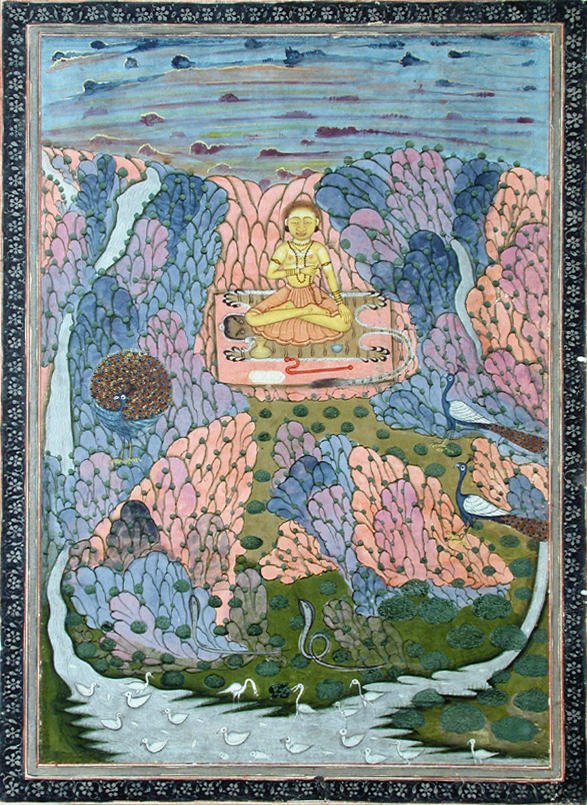
Opening illustration: Vishnu Comes to Shiva’s Aid, a leaf from a manuscript of the Bhāgavata Purāṇa made at Datia in central India about 1800. The whole story is on the one sheet. It begins at the lower left, and the narrator and his listener sit in the pavilion at the top. Opaque watercolour and gold on paper. The San Diego Museum of Art, Edwin Binney 3rd Collection. Image: Princeton University Art Museum; the painting is in the public domain.
A king has a question about money. He has noticed that the worshippers of two gods end up in opposite conditions. Those who worship Shiva, the god of ascetics, are generally rich. Those who worship Vishnu, the husband of the goddess of fortune, are generally not. His phrase for the first group is a pun: ye bhajanty aśivaṃ śivam, ये भजन्त्यशिवं शिवम्, “those who worship Shiva the unkind.” Śiva, शिव, means kindly, and aśiva, अशिव, is the same word with a “not” in front of it.
The king is Parīkṣit, to whom the Bhāgavata Purāṇa is being told, and the sage Śuka answers him. Shiva and Brahmā bless and curse on the spot, he says, and Vishnu does not. He quotes Vishnu himself, speaking as Krishna to the king’s own grandfather: yasyāham anugṛhṇāmi hariṣye tad-dhanaṃ śanaiḥ, यस्याहमनुगृह्णामि हरिष्ये तद्धनं शनैः, “The man I favour, I take his wealth away, slowly.” So people leave him for gods who are āśu-toṣebhyo, आशुतोषेभ्यो, “quickly pleased.” They get kingdoms from them, grow proud, and insult the givers.
Then Śuka gives an example. “On this they tell an old story.” His word is itihāsa, इतिहास, which is three words run together, iti ha āsa, “so indeed it was.” The first sentence gives the ending away: varaṃ dattvāpa saṅkaṭam, वरं दत्त्वाप सङ्कटम्, “he gave a boon and landed in a strait.” The subject of the sentence is Shiva. What follows is told in Vishnu’s book, about the other god, to show why it is safer to worship the one who pays slowly.1
An asura named Vṛka, a son of Śakuni, met Nārada on the road. He was evil-minded, and he asked which of the three gods was quickest to please.
Nārada said: “Go to the god of the mountain and you will soon have what you want. Small merits and small faults are enough for him. He is quickly pleased and quickly angered.
“He was pleased with ten-headed Rāvaṇa and with Bāṇa when they sang his praises like bards. He gave them power without equal, and it brought him great trouble.”
— Bhāgavata Purāṇa 10.88.14–16, new translation from the Sanskrit.2
Vṛka, वृक, is the Sanskrit for a wolf, and the dictionary takes it to mean “the tearer.” His father’s name, Śakuni, शकुनि, is the word for a large bird. Asura, असुर, is the name of the gods’ rivals. The narrator calls him durmatiḥ, दुर्मतिः, evil-minded, before he has done anything.
His question uses the word of the king’s frame. He asks for the god who is āśutoṣa, आशुतोष, quick to please, and the dictionary lists that adjective as a name of Shiva. The question had its answer in it. Nārada’s description is two verbs, tuṣyati kupyati, तुष्यति कुप्यति, “is pleased, is angered,” and one comparison: the god can be had by praise vandinor iva, वन्दिनोरिव, “as from bards,” the men paid to sing a king’s titles. He calls him Giriśa, गिरिश, “inhabiting mountains.”
The Flesh in the Fire
So instructed, the asura worshipped Hara at Kedāra. He cut the raw flesh from his own limbs and offered it into the fire, which is the god’s mouth.
When he had won no sight of the god, on the seventh day, in despair, with his hair wet from the water of that holy place, he set an axe to his own head.
Then Dhūrjaṭi, greatly compassionate, as any of us would be, rose out of the fire like the fire-god himself. He caught the asura’s arms in both of his and stopped him, and at his touch the body was whole again.
He said: “Enough, friend, enough! Choose from me whatever you desire, and I will give you that boon. I am pleased with water from people who come to me for shelter. Ah, you have tortured your body cruelly, and for nothing.”
— Bhāgavata Purāṇa 10.88.17–20, new translation.3

Kedāra is Shiva’s place in the Himalaya. The offering is made ātma-kravyeṇa, आत्मक्रव्येण, “with his own raw flesh.” Kravya, क्रव्य, is the dictionary’s word for “raw flesh, carrion.” He pours it juhvāno ‘gni-mukhaṃ haram, जुह्वानोऽग्निमुखं हरम्, “into Hara, whose mouth is the fire.” The wolf is feeding the god meat. After a week he turns the axe on his head, śiro ‘vṛścat, शिरोऽवृश्चत्, and the verb is vraśc, to cut off or hew, the root that the dictionary suspects inside the name vṛka. The tearer has started on himself.
Shiva is mahā-kāruṇiko, महाकारुणिको, “greatly compassionate,” and he stops the sacrifice with his hands. The body is restored tat-sparśanād, तत्स्पर्शनाद्, “at his touch.” Then he says what he would have accepted. Prīyeya toyena, प्रीयेय तोयेन: “I would be pleased with water.” Vishnu says the same in the Bhagavad Gītā, where a leaf, a flower, a fruit or water is enough, patraṃ puṣpaṃ phalaṃ toyaṃ, पत्रं पुष्पं फलं तोयं. The two gods agree on the price. The week of cutting was vṛthā, वृथा, “in vain”: tvayātmā bhṛśam ardyate vṛthā, त्वयात्मा भृशमर्द्यते वृथा, “your body is tortured by you, sorely, for nothing.”
Paul puts a body in the fire in the same sentence as the word for nothing. “Though I give my body to be burned, and have not charity, it profiteth me nothing,” ouden ōpheloumai, οὐδὲν ὠφελοῦμαι. Paul names what was missing. Shiva names it too. His water has to come from people prapadyatām, “who come for shelter,” and Vṛka had come to make a purchase. The King Shibi article has a man who cuts flesh from his own body for a dove that did come to him for shelter. The Gītā has a verse for Vṛka’s kind of offering: mūḍha-grāheṇātmano yat pīḍayā kriyate tapaḥ, मूढग्राहेणात्मनो यत्पीडया क्रियते तपः, “austerity done with a deluded grip, by torturing oneself,” parasyotsādanārthaṃ vā tat tāmasam udāhṛtam, परस्योत्सादनार्थं वा तत्तामसमुदाहृतम्, “or to destroy another, is called the dark kind.” Vṛka’s is both.4
The Hand on the Head
The sinner chose from the god a boon that brought fear to every creature: “On whosesoever head I put my hand, let him die.”
When the lord Rudra heard it he seemed troubled. Then he laughed, said “Om,” and gave it to him, as one gives nectar to a snake.
To test the boon, the asura at once tried to put his hand on the head of Śambhu, and Shiva was afraid of what he himself had done.
— Bhāgavata Purāṇa 10.88.21–23, new translation.5
A boon is a vara, वर, and the word means a choice. Shiva’s offer was vṛṇīṣva me, वृणीष्व मे, “choose from me.” He had agreed before he heard what would be chosen.
The asura has just been healed by a hand. He asks for a hand that kills: yasya yasya karaṃ śīrṣṇi dhāsye sa mriyatām iti, यस्य यस्य करं शीर्ष्णि धास्ये स म्रियतामिति. The Acts of the Apostles has the request almost word for word. Simon the sorcerer watches the apostles lay hands on people and offers them money: “Give me also this power, that on whomsoever I lay hands, he may receive the Holy Ghost,” hō ean epithō tas cheiras, ᾧ ἐὰν ἐπιθῶ τὰς χεῖρας. Both men have seen a god’s power pass through a hand, and both try to buy the hand. Simon pays in silver and Vṛka in flesh. Peter refuses: “Thy money perish with thee, because thou hast thought that the gift of God may be purchased with money.” Shiva has said “choose,” and cannot refuse.
He is durmanā iva, दुर्मना इव, “as if low in spirits,” and then he laughs and says om iti, ॐ इति. The dictionary calls om “a word of solemn affirmation and respectful assent” and compares it with Amen. The holiest syllable in Sanskrit is used here to mean yes. Ovid has a god in the same position. Bacchus offers Midas optandi arbitrium, “the choice of a wish,” and Midas asks that whatever his body touches turn to gold. Adnuit optatis nocituraque munera solvit Liber et indoluit, quod non meliora petisset: “Liber nodded to the wish and paid out the gift that would do harm, and was sorry he had not asked for something better.” Midas repents when his food turns to metal, and Bacchus takes the gift back. Vṛka does not repent, and Shiva runs.
The narrator’s own verdict on the gift is dade ‘her amṛtaṃ yathā, ददेऽहेरमृतं यथा, “he gave it like nectar to a snake.” Vṛka’s first thought is tad-vara-parīkṣārthaṃ, तद्वरपरीक्षार्थं, “to test that boon.” Parīkṣā, परीक्षा, is a test or a trial by ordeal, and the nearest head belongs to the giver. So ‘bibhyat sva-kṛtāc chivaḥ, सोऽबिभ्यत् स्वकृताच्छिवः: “Shiva was afraid of what he himself had done.” A modern retelling in the same tradition, Prabhupāda’s, adds a second motive. The asura means to kill Shiva and take the goddess Gaurī for himself. The painter of the picture at the head of this article knew that version. He put her at Shiva’s side at the fire, and alone on the mountain at the right.6
The Student on the Road
Pursued by him, terrified and trembling, he ran from the north as far as the ends of the sky, the earth and the directions.
The lords of the gods knew no remedy and stayed silent. Then he came to Vaikuṇṭha, shining beyond the darkness,
where Nārāyaṇa himself lives, the last refuge of renouncers, of the peaceful who have laid down the rod, the place from which no one who has gone there returns.
The Lord who removes distress saw his danger from far off and came out to meet the asura. By his magic he had become a boy student,
with belt, deerskin, staff and prayer beads, blazing like fire with his own light. With sacred grass in his hand he greeted him as if he were humble.
— Bhāgavata Purāṇa 10.88.24–28, new translation.7
The other gods tūṣṇīm āsan, तूष्णीमासन्, “sat silent.” Only Vishnu’s heaven has an answer, which is the point the chapter set out to make. That heaven is the goal of nyasta-daṇḍānāṃ, न्यस्तदण्डानां, “those who have laid down the rod,” and its lord comes out of it carrying one, since a daṇḍa, दण्ड, is also a student’s staff. He has become baṭuko yoga-māyayā, बटुको योगमायया, “a boy, by his magic.” His manner is vinīta-vat, विनीतवत्, “like a humble man’s.”
In the telling most people know, the asura is not called Vṛka. He is Bhasmāsura, भस्मासुर, the ash-demon, whose hand burns its victim to ashes, and Vishnu comes to him as Mohinī, the dancer of the Churning article, and has him copy her steps until his hand is on his own head. That name is not in the Purāṇas. In the Bhāgavata Vishnu brings no dance. He brings an argument.
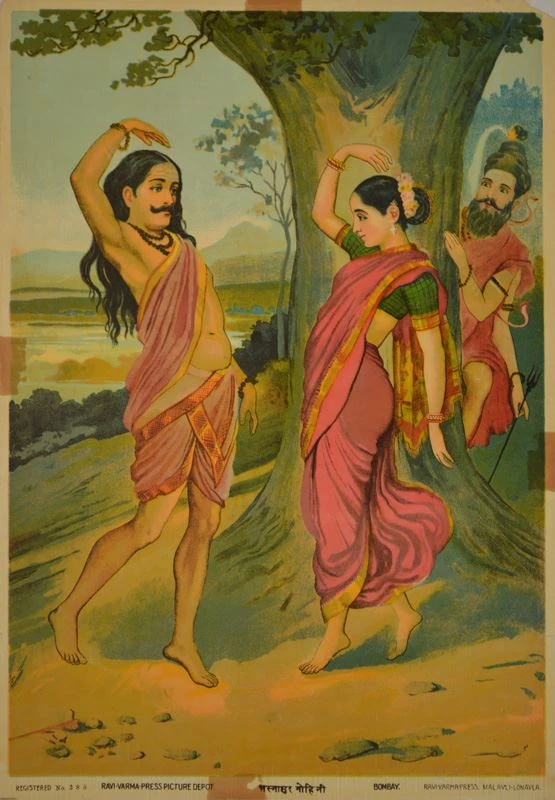
“Son of Śakuni, you are plainly tired. Have you come far? Rest a moment. A man’s own body is the cow that gives him everything he desires.
“If your purpose is fit for us to hear, mighty one, tell it. A man generally gets what he is after with the help of others.”
The asura told him everything he had done. The Lord said:
“If that is so, we for our part put no faith in his word. By Dakṣa’s curse he became a ghoul. He is the king of ghosts and ghouls.
“But if you trust him, lord of the Dānavas, as the teacher of the world, then quickly put your hand on your own head and find out.
“And if Śambhu’s word turns out in any way untrue, bull of the Dānavas, then kill the liar, so that he never tells a lie again.”
— Bhāgavata Purāṇa 10.88.29–34, new translation, with verse 31 shortened.8
The student opens with the body. Puṃsa ātmāyaṃ sarva-kāma-dhuk, पुंस आत्मायं सर्वकामधुक्: a man’s body is his kāma-dhuk, the cow that can be milked of every wish. He says it to someone who has spent a week cutting his body up. Śuka says that these words rained nectar, vacasāmṛta-varṣiṇā, वचसामृतवर्षिणा. It is the second time in the story that the snake is given nectar.
Then he runs Shiva down. Na vayaṃ śraddadhīmahi, न वयं श्रद्दधीमहि, “we put no faith” in him. He is preta-piśāca-rāṭ, प्रेतपिशाचराट्, “king of ghosts and ghouls,” and the dictionary thinks that the piśāca demons were named for their fondness for flesh. The words are part of a trick. They are also the only account of Shiva that Vishnu gives until the danger is over, and the plot lets Vishnu’s book say them aloud. The bait is one title, jagad-gurau, जगद्गुरौ, “the teacher of the world”: if you trust such a teacher, try what he gave you. Sva-śirasi hastaṃ nyasya pratīyatām, स्वशिरसि हस्तं न्यस्य प्रतीयताम्, “put your hand on your own head and find out.” A test was what the asura had wanted from the start.
In the Gospels a proposal of this kind comes from the devil. He sets Jesus on the roof of the temple and says, “If thou be the Son of God, cast thyself down: for it is written, He shall give his angels charge concerning thee.” It is a promise to be tried on one’s own body. The answer is “Thou shalt not tempt the Lord thy God,” ouk ekpeiraseis, Οὐκ ἐκπειράσεις, “you shall not put him to the test.” In Matthew the tempter proposes and the son refuses. In the Purāṇa the god proposes and the asura accepts.
Christian writers later gave their own God the student’s method. Gregory of Nyssa, in the fourth century, wrote that in Christ “the Deity was hidden under the veil of our nature, that so, as with ravenous fish, the hook of the Deity might be gulped down along with the bait of flesh.” He admitted that this was “in some measure a fraud and a surprise,” and defended it as the moment “by which the deceiver was in his turn deceived.” Gregory’s fish is the devil, who had lied first. Vṛka had deceived nobody. He asked openly for what he wanted and was given it. The lie in this story is the student’s yady asatyaṃ vacaḥ śambhoḥ, यद्यसत्यं वचः शम्भोः, “if Śambhu’s word is untrue.” He knows that it is true, and he is counting on it.9
On His Own Head
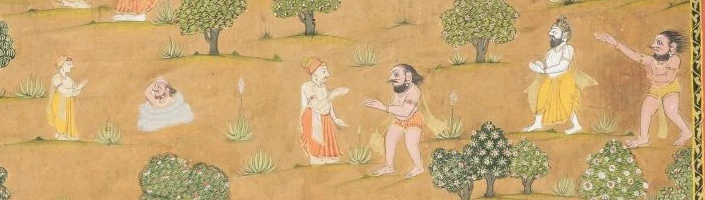
So the Lord’s wonderful and very sweet words split his wits. The fool forgot, and put his own hand on his head.
He fell that instant with his head split, as if a thunderbolt had struck him. In the sky there were shouts of “Victory!” and “Homage!” and “Well done!”
With the wicked Vṛkāsura dead, the gods, sages, ancestors and heavenly singers rained down flowers. Shiva was freed from danger.
— Bhāgavata Purāṇa 10.88.35–37, new translation.10
The Sanskrit uses one participle twice in two lines. The words leave him bhinna-dhīr vismṛtaḥ, भिन्नधीर्विस्मृतः, “with split wits, forgetting,” and the hand leaves him bhinna-śirāḥ, भिन्नशिराः, “with a split head.” The words are su-peśalaiḥ, सुपेशलैः, very peśala, पेशल, and the dictionary’s senses for that adjective run from “beautiful, charming” through “expert, skilful, clever” to “fraudulent, crafty.”
There are three touches in the story. Shiva’s touch puts a body back together. Vṛka asks for a touch that kills. The killing touch lands on him.
The Psalms have the same death as a general rule. “His mischief shall return upon his own head, and his violent dealing shall come down upon his own pate”: yashuv ʿamalo be-rosho, ve-ʿal qodqodo ḥamaso yered, יָשׁוּב עֲמָלוֹ בְרֹאשׁוֹ וְעַל קָדְקֳדוֹ חֲמָסוֹ יֵרֵד. Vishnu’s summary to Shiva says what the Psalm says: svena pāpmanā hataḥ, स्वेन पाप्मना हतः, “killed by his own evil.” In the Psalm the man falls into a pit that he dug himself. Vṛka was walked to his by a god in disguise, and the god’s sentence leaves that out.
Then Vishnu addresses the god he has just called king of the ghouls. Aho deva mahā-deva, अहो देव महादेव, “Ah, god, great god.” Who could wrong the great and be safe, he asks, and how much less one who has wronged you, lord of all, jagad-gurau, “the teacher of the world”? It is the title he used as bait. Shiva does not reply. His last word in the chapter was Om. He is mocitaḥ saṅkaṭāc chivaḥ, मोचितः सङ्कटाच्छिवः, “Shiva, freed from the strait,” which is the word of the story’s first line. The sky’s three shouts are jaya-śabdo namaḥ-śabdaḥ sādhu-śabdo, जयशब्दो नमःशब्दः साधुशब्दो, “Victory,” “Homage,” “Well done.”11
What the Story Pays
The king had asked why one god’s people are rich. The next chapter of the Purāṇa, in the Bhṛgu article, settles a larger question. The sages send Bhṛgu to try all three gods, and Vishnu is judged the greatest. A question about money has turned into a ranking, and this story is the step between the two.
Its last verse is addressed to the audience. Giritra-mokṣaṃ kathayec chṛṇoti vā vimucyate saṃsṛtibhis tathāribhiḥ, गिरित्रमोक्षं कथयेच्छृणोति वा विमुच्यते संसृतिभिस्तथारिभिः: whoever tells or hears how Hari rescued the mountain’s lord “is freed from rebirths, and from enemies too.” Mokṣa, मोक्ष, is the Sanskrit for final release. Here it is the word for getting Shiva out of a scrape, and in the same verse it is promised to the listener.
Vṛka asked on the road which god pays quickest. The last verse of his story says what the story pays, and to whom: anyone who tells it, and anyone who listens.12
Sources and Translation Notes
The passages set apart in italics are new translations from the Sanskrit of the Bhāgavata Purāṇa, made for School of Suspicion. The Sanskrit was read verse by verse in the Devanagari and transliteration at Vedabase, whose English is not used. Meanings of single Sanskrit words are from Monier Monier-Williams, A Sanskrit-English Dictionary (1899), at the Cologne Digital Sanskrit Dictionaries. English that stands beside a Sanskrit, Greek, Latin or Hebrew phrase without a translator’s name is the site’s own. Bible quotations are from the King James Version, with the Greek of the SBL Greek New Testament and the Hebrew of Mechon Mamre.
1. Bhāgavata Purāṇa 10.88.1–13. The king’s question is verses 1–2; Krishna’s answer to Yudhiṣṭhira, “your grandfather,” is 6–11; Śuka on the three gods is 12, sadyaḥ śāpa-prasādo, “instant in curse and favour”; the story is announced in 13. Monier-Williams, śiva, “auspicious, propitious, gracious, favourable, benign, kind”; aśiva, “unkind”; itihāsa, “so indeed it was.” ↩
2. Bhāgavata Purāṇa 10.88.14–16: वृको नामासुरः पुत्रः शकुनेः पथि नारदम्. Monier-Williams, vṛka, “(prob. ‘the tearer’ connected with √vraśc),” “a wolf”; śakuni, “a bird (esp. a large bird)”; āśutoṣa, “easily pleased or appeased,” with this Purāṇa cited, and “N. of Śiva”; vandin, “a praiser,” “bard”; giriśa, “inhabiting mountains.” ↩
3. Bhāgavata Purāṇa 10.88.17–20. Monier-Williams, kravya, vraśc (“to cut down or off or asunder”) and vṛthā (“in vain, vainly, uselessly”). ↩
4. Bhagavad Gītā 9.26 and 17.19, Sanskrit at Vedabase; the English is new. 1 Corinthians 13:3; Greek from the SBL Greek New Testament, Bible Gateway. Joel Alan, “King Shibi: The Dove, the Hunter, and the Sacrificial King”, School of Suspicion. ↩
5. Bhāgavata Purāṇa 10.88.21–23. Monier-Williams, vara, “act or object of choosing,” and “boon, gift, reward”; durmanas, “in bad or low spirits”; om; parīkṣā, “test, trial by ordeal.” ↩
6. Acts 8:17–20; Greek from the SBL Greek New Testament, Bible Gateway. Ovid, Metamorphoses 11.100–105 and 131–135: Latin text; Midas’s words are effice, quicquid corpore contigero, fulvum vertatur in aurum. A. C. Bhaktivedanta Swami Prabhupāda, Kṛṣṇa, the Supreme Personality of Godhead, chapter 88, “The Deliverance of Lord Śiva”, for the plan to “take away Gaurī.” ↩
7. Bhāgavata Purāṇa 10.88.24–28. Monier-Williams, nyastadaṇḍa, “one who has laid down the rod”; baṭuka, “a boy, lad”; yogamāyā, “magic.” ↩
8. Bhāgavata Purāṇa 10.88.29–34. Verse 31 in full: questioned by the Lord with words that rained nectar, the asura lost his weariness and told him what he had done. Monier-Williams, kāmaduh (nominative kāmadhuk); piśāca, “possibly so called either from their fondness for flesh” or from their colour; jagadguru. For Bhasmāsura and Mohinī, Bhasmasura, which notes that he “does not appear in the Puranas”; Monier-Williams, bhasman, “ashes.” ↩
9. Matthew 4:5–7; Greek from the SBL Greek New Testament, Bible Gateway. Gregory of Nyssa, The Great Catechism 24 and 26, translated by William Moore and Henry Austin Wilson, Nicene and Post-Nicene Fathers, second series, volume 5 (1893), at the Christian Classics Ethereal Library: chapter 24 and chapter 26. ↩
10. Bhāgavata Purāṇa 10.88.35–37. Monier-Williams, bhinna, “split, broken, shattered,” and peśala. ↩
11. Psalm 7:16 (7:17 in the Hebrew numbering); Hebrew from Mechon Mamre. Bhāgavata Purāṇa 10.88.38–39. Monier-Williams, saṃkaṭa, “a narrow passage, strait,” and “difficulty,” “danger.” ↩
12. Bhāgavata Purāṇa 10.88.40 and 10.89.1–19. Monier-Williams, mokṣa, “emancipation, liberation, release,” and “release from worldly existence or transmigration.” ↩