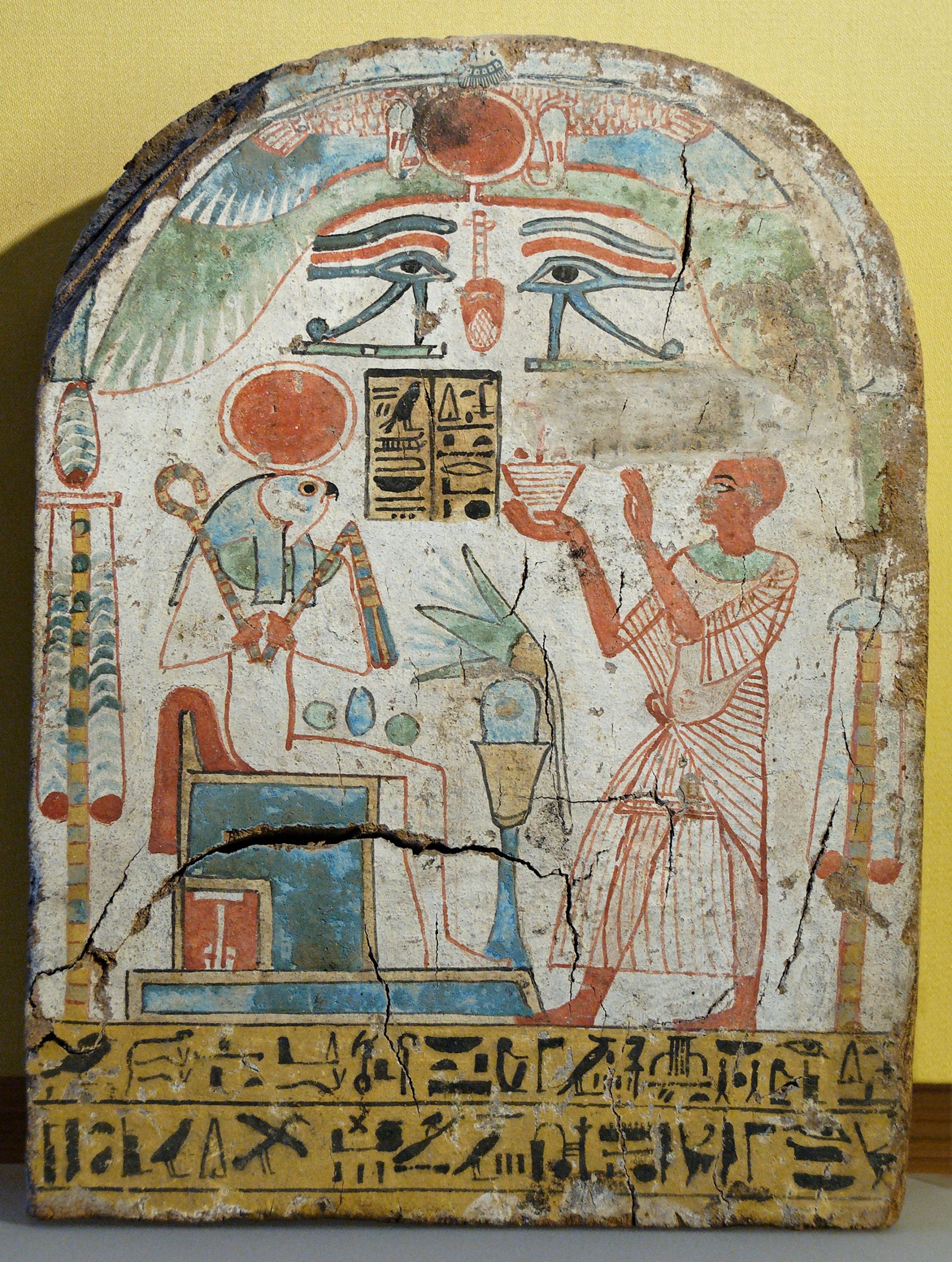
Source and scope. Creation account A in the Bremner–Rhind Papyrus, the Book of the Heavenly Cow, and the Amduat provide this episode’s main route. They are distinct compositions, not chapters of one ancient biography. The creation manuscript is late fourth-century BCE; the other two have New Kingdom witnesses. Quotations use E. A. Wallis Budge’s public-domain translations, with one short passage from R. O. Faulkner. Numbered notes distinguish the ancient texts, older translation problems, and this article’s interpretations. 1
Before there was anyone to rule
Before Ra could rule a world, there had to be a world—and beings who were not simply himself.
There was Nun, the primordial watery expanse. Not a sea beneath a familiar sky, but a condition before the distinctions that make a sea recognizable: water and shore, above and below, somewhere to stand and somewhere else to go.
Ra, Egyptian rꜥ, 𓂋𓂝𓇳, is the word for the sun. Atum is associated with tm, 𓏏𓍃𓅓, completeness. In the creation traditions we are following, these are closely related creator identities, not two kings who successively inherit an already finished universe. 2
The creation monologue names its speaker Neb-er-tcher, “Lord of All,” manifesting as Khepri. He remembers being alone:
I was [then] one by myself, for I had not emitted from myself the god Shu, and I had not spit out from myself the goddess Tefnut; and there existed no other who could work with me. I laid the foundations [of things] in my own heart, and there came into being multitudes of created things, which came into being from the created things which were born from the created things which arose from what they brought forth.
Bremner–Rhind Papyrus, Creation A, translated by E. A. Wallis Budge 3
Without a partner, the creator makes his own body the means of generation. Shu and Tefnut emerge; the family extends toward Geb, earth, and Nut, sky, and then toward Osiris and Isis. 3
Humanity also comes from the divine body:
Now after these things I gathered together my members, and I wept over them, and men and women sprang into being from the tears which came forth from my Eye.
Creation A, translated by Budge 4
Egyptian rmṯ, 𓂋𓍿𓀀, people, echoes the word for weeping. The wordplay gives the narrative an image: what leaves the creator becomes someone capable of living apart from him. Creation produces relationship, but not necessarily obedience. 4
The king and his Eye
The Book of the Heavenly Cow begins with that relationship already endangered. Ra has grown old. His bones are silver, his flesh gold, his hair lapis lazuli. His splendor has not prevented humanity from plotting against him.
He secretly gathers the gods and addresses Nun:
O thou first-born god from whom I came into being, O ye gods of ancient time, my ancestors, take ye heed to what men and women [are doing]; for behold, those who were created by my Eye are uttering words of complaint against me.
Tell me what ye would do in the matter, and consider this thing for me, and seek out [a plan] for me, for I will not slay them until I have heard what ye shall say to me concerning it.
The Legend of the Destruction of Mankind, chapter I, translated by Budge 5
The council recommends that he send his Eye. Humanity has fled into the mountain-desert country; the Eye follows as Hathor and begins the slaughter.
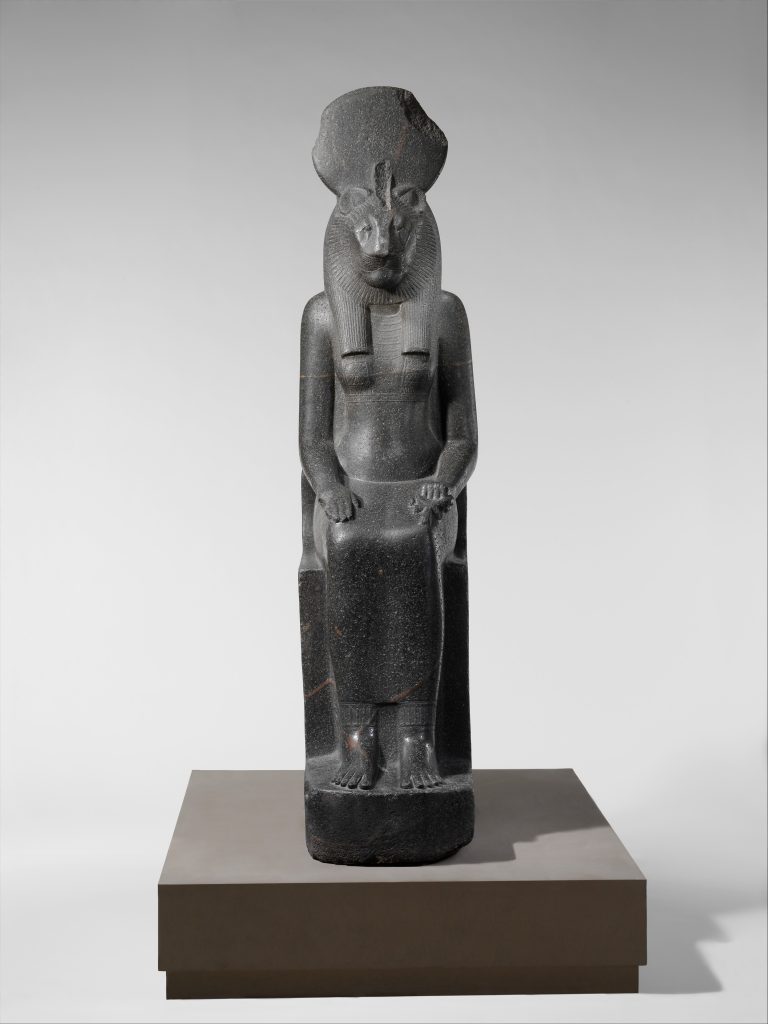
Hathor’s name means “House of Horus.” Her associations include royal motherhood, music, and joy. Here, however, she exercises the terrible power also associated with Sekhmet, the “Powerful One.” The story’s goddess cannot be contained within the label “goddess of love” or “goddess of war.” 6
Returning to Ra, she says:
Thou hast made me to live, for when I gained the mastery over men and women it was sweet to my heart.
Hathor, Destruction of Mankind, chapter I, translated by Budge 5
The Eye is more than a symbol of seeing. It is the creator’s power extended into the world, capable of acting beyond his immediate presence. Read beside the creation account, the reversal is stark: the Eye through which humanity arose becomes the agency that threatens it.
The desert intensifies that reversal. As a symbolic reading, flight from the sun’s sovereignty becomes exposure to the sun’s force. What nourishes life can also burn it. The people seek refuge, but the landscape offers no refuge from the power they have offended. 7
The goddess’s words add another danger. Destruction is not merely a duty reluctantly performed. It has become sweet.
Beer instead of blood
Ra’s next intervention reverses the direction of the story.
He has red mineral pigment brought from Elephantine and mixed into beer. Seven thousand vessels are prepared. The drink resembles blood. Inspecting the brewing, he declares:
It is good, it is good, nevertheless I must protect men and women against her.
Ra, Destruction of Mankind, chapter I, translated by Budge 8
Before dawn, the beer is poured across the fields where the goddess will come. She encounters the red flood, drinks, becomes intoxicated, and ceases to attend to the people she had been pursuing. 8
Ra has changed his immediate intention. He sent the goddess to kill; now he acts to keep the survivors alive. He does not destroy Hathor or condemn her as a traitor. He redirects the force he himself unleashed.
The substitution is precise: blood-colored beer takes the place of the further human blood that slaughter would produce. No additional people have to be killed to fill the cups. Ra uses a bloodlike substitute to divert her, while intoxication brings the killing to an end. The tale does not describe a failed command to stop; it gives Ra an indirect, effective means of stopping what he authorized. 8
This invites a sacrificial reading—but a particular one. The crucial movement is from killing to a substitute that permits life to continue. Beer supplies the appearance of blood without its human cost. The story can therefore be read as an interruption of sacrificial violence, rather than a celebration of another victim’s death.
Ra does not save humanity from a foreign enemy. He saves it from the consequences of his own decision. Mercy here is not the opposite of cunning. Cunning is the means through which mercy acts.
The narrative connects the event with beer prepared for the goddess’s festivals. Nadine Guilhou also relates its imagery to seasonal renewal: destructive heat gives way to the inundation, and the red flood recalls the silt-bearing waters that restore the land. 9
On that reading, the same landscape can pass from barrenness toward fertility, and the same divine power from danger toward delight. The celebration does not forget the threatened bloodshed. It commemorates the moment when the cups could be filled without killing their drinkers.
Why the god leaves
Rescue does not restore intimacy. Ra tells the gods:
I live, but my heart hath become exceedingly weary with existence with them (i.e., with men); I have slain [some of] them, but there is a remnant of worthless ones, for the destruction which I wrought among them was not as great as my power.
Ra, Destruction of Mankind, chapter I, translated by Budge 10
His reversal is not an uncomplicated confession of remorse. The survivors remain objects of his dissatisfaction. He has chosen not to destroy them all, but he no longer wishes to live among them.
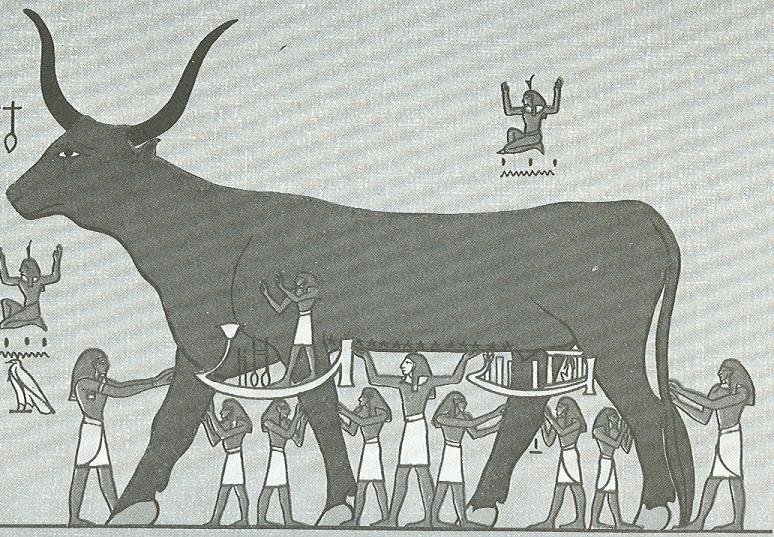
Nun directs Nut to carry him. The sky goddess becomes a cow; Ra mounts her back. Humans appeal to him to remain, and some attack the remaining rebels. Their late loyalty does not prevent his departure.
Nut rises and trembles at the height. Shu supports her. Ra establishes celestial regions and distributes responsibilities among other gods, including Geb and Thoth. The creator’s withdrawal becomes a reorganization of the world. 10
This is not retirement into idleness. It is distance: the end of immediate companionship between creator and creatures.
The god leaves their company. His light does not leave their world.
The creator’s defense—and the king’s
Another Egyptian text gives the creator a defense of his intentions. In Coffin Text 1130, the Lord of All recalls providing breath and an inundation that sustains the poor as well as the powerful. He then says:
I made every man equal to his fellow, and I forbade them to do wrong, but their hearts disobeyed what I had said.
Coffin Texts, Spell 1130, translated by R. O. Faulkner 11
This is a separate composition, not another speech at Ra’s council. Its sympathetic argument is clear: to create other beings is to create hearts that do not merely repeat the creator’s intention. Breath and nourishment can be given. Right conduct cannot be supplied in quite the same way.
The suspicious reading asks who is allowed to describe the failure. In the Heavenly Cow, the council hears the ruler’s accusation, not humanity’s defense. We know the rebels through the judgment pronounced upon them. 5
The political setting makes that imbalance consequential. The Heavenly Cow survives in royal funerary settings, and its version associated with Ramesses VI substitutes the king’s name for Ra’s first-person voice at points. Royal identity enters the divine drama rather than merely observing it. 12
My reading is that these narratives can turn the recurring insecurity of kingship into a cosmic pattern. A sovereign grows old; subjects resist; force is mobilized; continuity must be secured. The later nighttime struggle gives this pattern another form: the passage of the ruler of the cosmos is threatened, and his company must defend it.
For successive rulers, this provides a language in which preserving sovereignty can be presented as preserving the world itself. It is not a coded chronicle of identifiable uprisings. It is a repeatable model through which threats to authority can be understood—and claims to authority reinforced. 12
That does not settle whether a particular human opponent is unjust. The point of suspicion is precisely to question the transfer: when resistance to a ruler is pictured as resistance to existence itself, what becomes of the grievance?
Egyptian literature also turns the divine analogy back upon the powerful. In The Eloquent Peasant, a petitioner addresses an official:
O my Lord Rensi, the steward! Thou art Rā, the lord of heaven with thy great chiefs. The affairs of all men [are ruled by thee].
The Eloquent Peasant, third petition, translated by Budge 13
He then demands:
Exterminate the robber, be thou the advocate of those who are in misery, and be not towards the petitioner like the water-flood that sweepeth him away.
The Eloquent Peasant, third petition, translated by Budge 13
To resemble Ra is therefore not only to possess authority. It can also mean being answerable for whether one’s power sustains people or overwhelms them. The same religious language that elevates the ruler can supply a standard against which the ruler is challenged.
The beer episode leaves that question open within Ra’s own conduct. The people must survive not only their rebellion, but also its punishment.
Into the hidden country
The Heavenly Cow describes a decisive separation. The Amduat—“What Is in the Netherworld”—describes a recurring journey through twelve regions of the night. We now move from an exceptional event to a cycle. 14

At sunset, Ra enters the Duat, the hidden realm of the dead, traveling in a boat with a divine company. His nocturnal form is ram-headed. His presence gives light and renewed activity to beings who remain beyond the daylight world. 15
Around the sixth hour, the journey reaches its regenerative center. Ra’s moving life encounters its bodily presence in relation to Osiris, the god of the dead. A voice in this region asks:
… let my soul be with me, let me rest (or, unite myself) to my bodies, and let me pass by you in peace. These gods hear the voice of Ra every day, and they have their life through his voice.
Amduat, sixth hour, translated by Budge 15
Read philosophically, this is not immortality obtained by keeping death at a distance. Renewal requires a return to the hidden body. The sun passes through the realm into which human beings disappear and finds there a condition of its own return.
This is also not an atoning sacrifice in which Ra is executed to pay for humanity’s wrongdoing. The nightly pattern is death and regeneration, not a second punishment for the earlier rebellion. What the journey requires is transformation, not compensation.
Death’s country, however, contains both the possibility of renewal and powers that would prevent it.
The road without water
In the seventh hour, Apep, also called Apophis, obstructs the passage. Ra’s boat faces a route where its ordinary means fail:
The hidden road of Ament. The great god maketh his way over it in his holy boat, and he passeth over this road which has no water, and none to tow.
Amduat, seventh hour, translated by Budge 16
Isis speaks protective words; other agents bind and attack the serpent. Ra participates in the effective utterance through which the obstruction is overcome. He does not travel as a solitary warrior. 16
Nor does “serpent” simply mean “evil.” Mehen, another serpent, shelters the solar god. Apep obstructs the passage; Mehen protects it. The distinction lies in their relationships and actions, not merely their shape.
The text invites its user into that cooperation:
Whosoever shall utter them shall become one of those who are in the boat of Ra, both in heaven and upon earth.
Amduat, seventh hour, translated by Budge 16
Here renewal is work shared among beings. The creator who began without a partner continues through a company.
Apep must be repelled, but the night itself must not be destroyed. Darkness contains what threatens the journey and what makes rebirth possible. The task is to pass through it without losing the capacity to emerge.
The sun that returns
At the twelfth hour, the boat enters another serpent, ANKH-NETERU in Budge’s translation:
This great god in this picture journeyeth along through this City by means of the faithful servants (amkhiu) of this hidden image ANKH-NETERU. His gods draw him along by a cord, and he entereth into his tail and cometh forth from his mouth, and cometh to the birth under the form of Khepera, and the gods who are in his boat [do] likewise.
Amduat, twelfth hour, translated by Budge 17
Khepri belongs to the Egyptian word family ḫpr, 𓆣𓂋: to become, to come into being. His scarab form makes that meaning visible at the end of the journey. The god comes forth not merely as a surviving old body, but as renewed becoming. 18
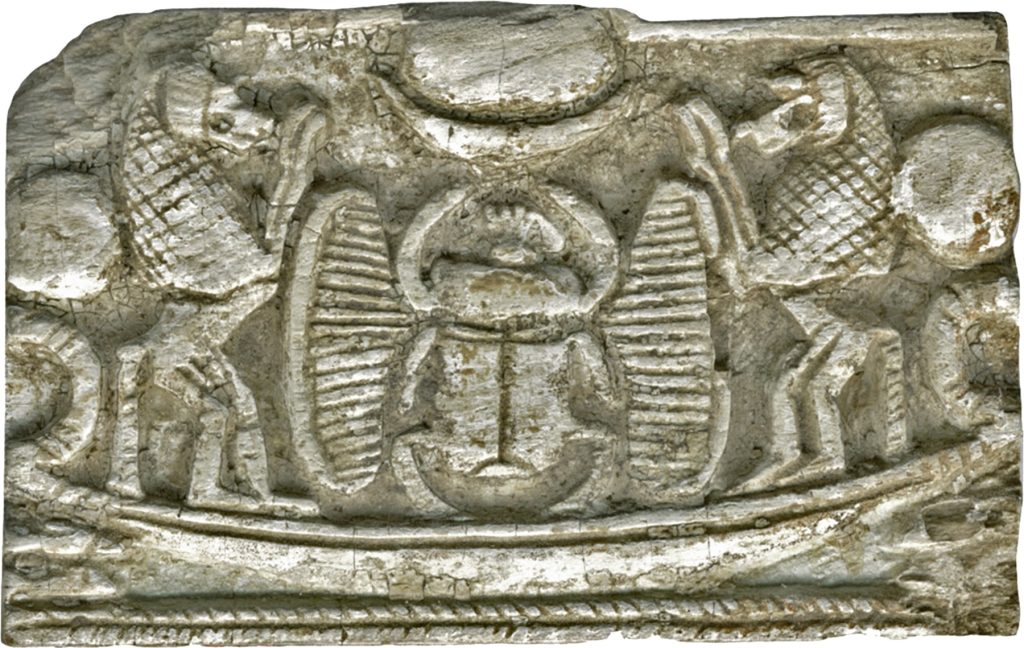
In this image, the boundary between devouring and birth is overturned. One serpent threatens to stop the sun; passage through another brings the sun into life again. What appears to swallow can also become a way out.
These narratives therefore give us different kinds of renewal. Beer interrupts a threatened extinction and becomes part of repeated celebration. The nightly passage makes another dawn possible. Neither simply restores the beginning unchanged: humanity remains separated from Ra, and the hidden world remains after the sun has passed. 917
The Amduat surrounded the dead king in his tomb, offering a pattern in which disappearance need not be final. Its solar journey was later adapted for other deceased people as well. The promise was not that nothing would be lost, but that hiddenness could contain a further becoming. 14
At the eastern horizon, the account concludes:
Then this great god taketh up his position in the Eastern Horizon of heaven, and Shu receiveth him, and he cometh into being in the East.
Amduat, twelfth hour, translated by Budge 17
Beneath the new sun, Shu raises his hands.
Sources and textual notes
1. Main sources and chronology.* Bremner–Rhind Papyrus, British Museum EA 10188, Creation A 26,21–27,5, parallel B 28,21–29,5, within the Book of Overthrowing Apophis, 22,1–32,12: Thesaurus Linguae Aegyptiae manuscript record and text record. For the New Kingdom Heavenly Cow witnesses, see Nadine Guilhou, “Myth of the Heavenly Cow,” UCLA Encyclopedia of Egyptology (2010), pp. 1–4. For the Amduat*, see note 14. This thematic arrangement does not establish order of composition or one canonical Egyptian biography. Older spellings and translators’ brackets remain in quotations; explanatory prose is not passed off as ancient speech. ↩
2. Ra, Atum, Nun.* UCL Digital Egypt, “Gods and goddesses in Ancient Egypt: creation,” sections “Before creation” and “The creator emerges”: Nun, watery expanse; Ra, Egyptian word for sun; Atum associated with tm*, complete. “Ra” and “Re” are conventional vocalizations, not securely recoverable ancient pronunciation. Completeness is a useful name association, not proof of a uniform philosophical system. No speculative connections to words in unrelated languages are proposed. ↩
3. Creation, names, and genealogy.* E. A. Wallis Budge, Legends of the Gods: The Egyptian Texts, Edited with Translations* (London: Kegan Paul, 1912), actual translated section “The History of Creation—A,” within Bremner–Rhind 26,21–27,5; public-domain edition. Quotation begins “I was [then] one by myself.” The speaker is Neb-er-tcher, manifesting as Khepera; the heading refers to Ra. Atum’s name is not inserted into the quotation. Budge prints “[Seb and] Nut”—Geb/Seb is an editorial supplement—and includes an additional Horus in the next generation. Account B telescopes the genealogy in his translation; neither is silently harmonized with every other creation account. ↩
4. Tears and people. Budge, Creation A*, paragraph beginning “Then Shu and Tefnut rejoiced”; text. UCL’s creation overview, “The reign of Ra and its end”, identifies the wordplay between rmṯ, people, and rmt, weeping. This is Egyptian wordplay, not a biological explanation or a claim that tears are unequivocally grief or joy. The Eye-return dispute in Creation A is omitted rather than transferred to the Heavenly Cow*. ↩
5. Old age, accusation, council, and slaughter. Budge, “The Legend of the Destruction of Mankind,” chapter I*, opening through Hathor’s return; translation. This is the first narrative portion of the Book of the Heavenly Cow*. His “words of complaint” should not establish that the offense was merely harmless criticism; the narrative describes a challenge to sovereignty. No demands or motives are invented for the humans. “Punishment has become pleasure” is an interpretation of the goddess’s reported sweetness. ↩
6. Hathor and Sekhmet.** For Hathor’s name, “House of Horus,” and royal maternal associations, see the Global Egyptian Museum glossary, “Hathor”. For joy, music, and appeasement alongside her dangerous power, see Argyro Grigoraki, “A magical rattle, unlike the others!”, National Archaeological Museum, Athens, especially notes 2 and 5. For Sekhmet as a mighty/powerful goddess, compare UCL Digital Egypt. Budge’s chapter I connects mastery with “Sekhet”; divine names are not silently exchanged within quotations, and no transformation mechanics absent from the selected narrative are invented. ↩
7. Eye and desert: interpretation, not a fixed symbol dictionary. Budge, Destruction, chapter I**, “mountain lands” and “mountain (or, desert land)”; text. The Eye’s agency and its role in both creation and punishment are in the selected texts. The reading of desert exposure and the sun’s nourishing/destructive powers is this essay’s interpretation; it does not claim the desert always means evil, that all desert populations were rebels, or that the episode reports an identifiable flight into a named region. The Eye of Ra is not simply substituted for every occurrence of the restored Eye of Horus in Egyptian religion. ↩
8. Ra’s reversal and the red beer. Budge, Destruction, chapter I, preparation of seven thousand vessels, protective declaration, flooding, and intoxication; translation. His “mandrakes” and addition of actual human blood are not followed.** Modern Egyptology identifies red ochre/hematite used to make beer bloodlike: Guilhou, p. 2. The corrected ingredient is narrated, not inserted into a falsified Budge quotation. Ra’s change of immediate purpose is explicit; a failed stop order, inability to command Hathor, condemnation of her obedience, complete repentance, and historical abolition of human sacrifice are not established. “Sacrificial substitution” is a comparative interpretation of nonlethal replacement, not a reported Egyptian doctrinal label. ↩
9. Festival and seasonal reading. Budge, Destruction, chapter I**, instructions for beer at the goddess’s festivals; text. For the seasonal reading—destructive heat, red flood, inundation, and appeasement—see Guilhou, pp. 3–4. This interpretation is attributed, not asserted as the sole original meaning. The article does not synchronize all later drunkenness festivals, the drifting civil calendar, and the annual inundation into one unchanging date. ↩
10. Weariness, ascent, and responsibilities. Budge, Destruction, chapter I, beginning “I live, but my heart…” through Nut’s ascent and Shu’s support; chapter III, Geb; chapter IV*, Thoth; translation. The parenthesis “i.e., with men” is Budge’s explanatory insertion. His harsh “worthless ones” is retained as his translation, not introduced as the essay’s assessment of humanity. The source for Nut’s ascent and Shu’s support here is the Heavenly Cow* itself, not an imported episode punishing Geb and Nut for intercourse. The myth already has terrestrial places before the ascent; it is not treated as a mechanically consistent chronology of physical cosmology. ↩
11. The creator’s defense.* R. O. Faulkner, The Ancient Egyptian Coffin Texts, III: Spells 788–1185 & Indexes (Warminster: Aris & Phillips, 1978), Spell 1130, p. 167, corresponding to Adriaan de Buck, The Egyptian Coffin Texts, VII, 462–465, quoted sentence VII 464; searchable edition. The direct quotation is 23 words. The speaker is the Lord of All, not a newly added council member. His claim does not prove egalitarian social practice, a complete doctrine of free will, or his innocence in the separate Heavenly Cow* narrative. ↩
12. Royal ideology and the limits of the historical inference.* Guilhou, “Myth of the Heavenly Cow,” pp. 3–4, on royal setting, titulary, and Ramesses VI’s identification with Ra. Compare the Amduat*’s royal funerary use in Pozzi, note 14. These are evidence for royal appropriation and cosmic legitimation, not proof that a particular Apep episode encrypts a named rebellion. The recurring-sovereignty reading is the author’s interpretation. No assertion is made that every dynasty faced the same uprising, that cosmic enemies were merely disguised peasants, or that funerary theology was only cynical political fabrication. An authority’s portrayal of its opponents is not independently verified by that portrayal. ↩
13. The petitioner’s countervoice.* Budge, The Literature of the Ancient Egyptians (London: J. M. Dent; New York: E. P. Dutton, 1914), “The Story of the Educated Peasant Khuenanpu,” third petition, p. 176 (the composition conventionally called The Eloquent Peasant*); public-domain edition. The first excerpt ends after “The affairs of all men [are ruled by thee]”; the intervening comparison to the flood is omitted by using two separately identified excerpts. The second begins “Exterminate the robber.” The petitioner addresses Rensi, an official, not Ra himself. This literary demand illustrates a possible critical use of divine analogy, not a transcript of the rebels’ lost speech. Budge’s broader historical commentary is not adopted as ancient testimony. ↩
14. The Amduat and its audiences.* Enrico Pozzi, “The Amduat Papyri in the Museo Egizio: Tradition and Innovation Between the Twenty-first and Twenty-second Dynasties,” Rivista del Museo Egizio 8 (2024), §§3.1–3.3, DOI 10.29353/rime..6577. The first complete surviving version is in Thutmose III’s tomb, KV 34; earlier fragments and later nonroyal papyri are distinguished. “Amduat” is the conventional designation “What Is in the Netherworld,” also associated with the title Book of the Hidden Chamber*. Its arrangement combines text and images. Ra’s withdrawal is not made the cause of the nightly cycle. ↩
15. Midnight and bodily regeneration.* Budge, The Egyptian Heaven and Hell, I: The Book of Am-Tuat (London: Kegan Paul, 1905), chapter VI, pp. 117–122, 134–135; quotation at p. 134, excerpted with an editorial opening ellipsis. Translation and scenes. Compare Pozzi, §3.1, and Erik Hornung, Immortal Pharaoh: The Tomb of Thutmose III*, exhibition leaflet, “Sixth Hour”, for Ra’s regenerative encounter with bodily/Osirian presence. Budge’s “soul” is not used to impose a strict Platonic separation of immaterial spirit and worthless flesh. The contrast with atoning sacrifice is analytical, not a claim that Egyptians formulated that later comparative category. ↩
16. Apep, Mehen, and effective utterance.* Budge, Book of Am-Tuat*, chapter VII, pp. 139–147; participation quotation p. 141, binding Apep pp. 142–143, dry-road quotation pp. 146–147. Chapter. Mehen’s shelter is distinct from Apep’s obstruction. Isis’s participation does not import her secret-name episode or make it the origin of her power here. No Seth-spearing-Apep scene is imported. The dry road is not claimed to share an identical cause with every other region’s lack of water. ↩
17. The final passage and dawn.* Budge, Book of Am-Tuat*, chapter XII, especially pp. 257–261; both quotations p. 259, middle-register boat inscription. Chapter. Compare Hornung, “Twelfth Hour”, for rejuvenation, Khepri and Shu, and Osiris remaining in the hidden realm. ANKH-NETERU and Khepera retain Budge’s forms. Passing through this serpent is not defeating Apep again; it is a different image and action. It does not imply every inhabitant of the Duat returns bodily to earth. ↩
18. Khepri and becoming.* The name belongs to the ḫpr* word family, “become/come into being.” Compare Budge, Creation A, opening and footnote 49, text, and the repeated language of becoming in the twelfth-hour inscription, note 17. Only the becoming/coming-into-being association is used; Budge’s wider old glosses involving “rolling” are not treated as a secure etymology of every related word. The article does not claim scarab beetles actually reproduce without females or that their behavior mechanically explains all solar theology. ↩
Image credits are given beneath each illustration. Opening illustration: Padiuiset offers incense to Ra-Horakhty-Atum. Painted wooden stela, Twenty-second Dynasty. Louvre N 3795. Photograph: Jastrow (2007), public domain.