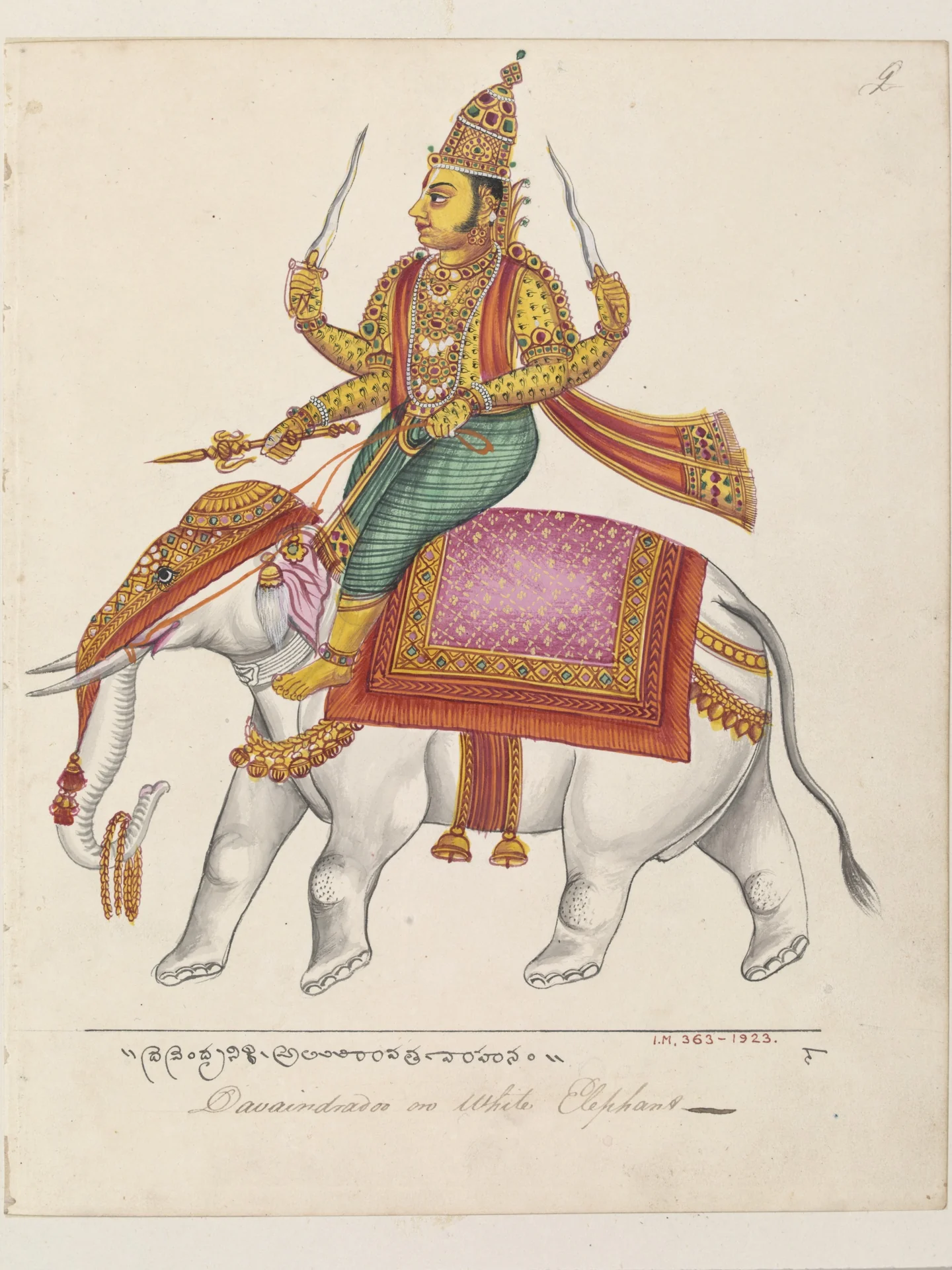
The waters run free. The victor is still afraid.
Opening illustration: Indra, four-armed, riding his white elephant Airāvata; the painting is inscribed “Davaindradoo on White Elephant.” Tiruchchirappalli, 1820–1825. Victoria and Albert Museum, IM.363-1923. Public domain, via Wikimedia Commons.
I WILL declare the manly deeds of Indra, the first that he achieved, the Thunder-wielder.
— Rigveda 1.32.1, translated by Ralph T. H. Griffith.1
He slew the Dragon, then disclosed the waters, and cleft the channels of the mountain torrents.
The waters exist, but they cannot reach where they must go. A serpent lies upon the mountain, holding back what should descend into the world.
Against him comes Indra, armed with the thunderbolt.
The hymn opens by announcing a victory. Before its fifteen stanzas are finished, it asks the victor why he ran.
Its first words are indrasya nu vīryāṇi pra vocaṃ, इन्द्रस्य नु वीर्याणि प्र वोचं, “now I will proclaim the manly deeds of Indra.” Vīryāṇi, वीर्याणि, is built on vīra, वीर, “man, hero,” the cognate of Latin vir, the word behind virile and virtue. The deed itself follows: ahann ahim anv apas tatarda, अहन्नहिमन्वपस्ततर्द, “he slew the serpent, then bored a way for the waters.”2, 3
Vṛtra, the one who holds back
Vṛtra, वृत्र, belongs to the language of covering and restraint. It is built on the root vṛ, वृ, to cover or enclose, and its Avestan cognate is vərəθra, 𐬬𐬆𐬭𐬆𐬚𐬭𐬀. The name gives the adversary a function before it gives him a personality: he is the obstruction.3
The Śatapatha Brāhmaṇa hears a different root in the name, vṛt, वृत्, to roll. Of the creature’s birth it says: “since it so developed whilst rolling onwards (vrit), it became Vritra; and since he sprang forth footless, therefore he was a serpent.”4
The hymn’s other name for him is ahi, अहि, serpent. It is an old word, cognate with Avestan aži, 𐬀𐬲𐬌, and Greek óphis, ὄφις.3
Indra’s own name has no secure etymology. The Avesta, the scripture of the Iranian cousins of the Vedic poets, preserves it as Iṇdra, 𐬌𐬧𐬛𐬭𐬀, and counts him among the daēvas, the demons. His weapon is unmistakable: the vajra, वज्र, the thunderbolt, cognate with Avestan vazra, 𐬬𐬀𐬰𐬭𐬀, the mace of Mithra.3
One of his defining titles is Vṛtrahan, वृत्रहन्, “Vṛtra-slayer.” The defeated enemy becomes part of the victorious god’s name. Avestan has the same compound as vərəθrajan, 𐬬𐬆𐬭𐬆𐬚𐬭𐬀𐬘𐬀𐬥, and through Parthian it reached Armenia as the name of a god, Vahagn, Վահագն, whom Armenian tradition calls Vahagn višapakʻaġ, Վահագն վիշապաքաղ, “Vahagn the Dragonslayer.” In the Iranian world Indra became a demon while his title lived on.3
The thunderbolt and the mountain
He slew the Dragon lying on the mountain: his heavenly bolt of thunder Tvaṣṭar fashioned.
Like lowing kine in rapid flow descending the waters glided downward to the ocean.Impetuous as a bull, he chose the Soma and in three sacred beakers drank the juices.
Maghavan grasped the thunder for his weapon, and smote to death this firstborn of the dragons.When, Indra, thou hadst slain the dragon’s firstborn, and overcome the charms of the enchanters,
— Rigveda 1.32.2–4, translated by Ralph T. H. Griffith.1
Then, giving life to Sun and Dawn and Heaven, thou foundest not one foe to stand against thee.
Tvaṣṭṛ, त्वष्टृ, is the divine craftsman who fashions the weapon. Maghavan, maghavan, मघवन्, is an epithet of Indra: the one who has maghá, मघ, bounty, the giver of gifts. Soma, सोम, is the sacred drink that strengthens him for the encounter.3
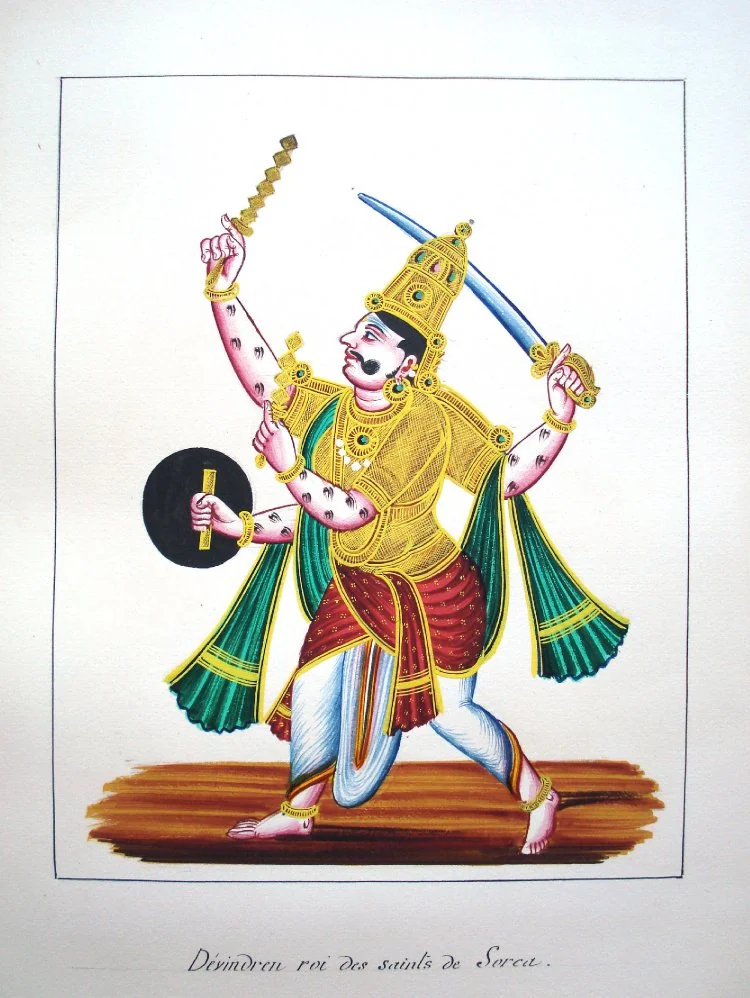
The waters descend like a herd released. The Sanskrit says vāśrā iva dhenavaḥ, वाश्रा इव धेनवः, “like lowing milk-cows,” and Griffith’s kine is the old English word for cattle. The comparison places the cosmic event within a familiar world of living wealth.2
The victory does more than remove a dangerous creature. Water moves, light appears, and the world opens. The force that breaks the mountain makes ordinary life possible.
The serpent that challenges the thunder
Indra with his own great and deadly thunder smote into pieces Vṛtra, worst of Vṛtras.
As trunks of trees, what time the axe hath felled them, low on the earth so lies the prostrate Dragon.He, like a mad weak warrior, challenged Indra, the great impetuous many-slaying Hero.
He, brooking not the clashing of the weapons, crushed—Indra’s foe—the shattered forts in falling.Footless and handless still he challenged Indra, who smote him with his bolt between the shoulders.
— Rigveda 1.32.5–7, translated by Ralph T. H. Griffith.1
Emasculate yet claiming manly vigour, thus Vṛtra lay with scattered limbs dissevered.
What stood as an overwhelming obstruction now lies like timber beneath an axe.
This is the victor’s praise. Vṛtra is formidable enough to make the deed magnificent, yet his resistance is described as the presumption of a weaker opponent.
He challenges. Indra answers. The thunderbolt decides whose strength will be celebrated.
Griffith’s “Indra’s foe” is one word in the Sanskrit, indraśatruḥ, इन्द्रशत्रुः. The Śatapatha Brāhmaṇa hangs the whole war on it. Indra had killed Viśvarūpa, the three-headed son of the craftsman Tvaṣṭṛ, and drunk his Soma uninvited. Tvaṣṭṛ poured what was left into the fire, saying, “Grow thou, having Indra for thy foe!” The compound reads two ways, and the Brāhmaṇa says that had he said instead, “Grow thou, the foe (slayer) of Indra!” Vṛtra “would certainly have forthwith slain Indra.”2, 4
Sanskrit grammarians remembered this as a lesson in pronunciation. Patañjali’s great commentary on grammar warns that a word spoken wrongly becomes a weapon against the one who speaks it: saḥ vāgvajraḥ yajamānam hinasti yathā indraśatruḥ svarataḥ aparādhāt, सः वाग्वज्रः यजमानम् हिनस्ति यथा इन्द्रशत्रुः स्वरतः अपराधात्, “that thunderbolt of speech strikes the sacrificer, as indraśatru did, through a fault of accent.” The grammarians’ word is vāgvajra, वाग्वज्र, speech made into Indra’s weapon. The father who wanted an avenger lost the war on the accent of one word.5
The mother beneath the waters
There as he lies like a bank-bursting river, the waters taking courage flow above him.
The Dragon lies beneath the feet of torrents which Vṛtra with his greatness had encompassed.Then humbled was the strength of Vṛtra’s mother: Indra hath cast his deadly bolt against her.
The mother was above, the son was under and like a cow beside her calf lay Danu.Rolled in the midst of never-ceasing currents flowing without a rest for ever onward.
The waters bear off Vṛtra’s nameless body: the foe of Indra sank to during darkness.Guarded by Ahi stood the thralls of Dāsas, the waters stayed like kine held by the robber.
— Rigveda 1.32.8–11, translated by Ralph T. H. Griffith.1
But he, when he had smitten Vṛtra, opened the cave wherein the floods had been imprisoned.
Dānu, the serpent’s mother, is struck as well. She lies above her son, compared to a cow beside her calf.
Her name belongs to an old vocabulary of water. In Sanskrit dānu, दानु, means a drop of liquid or dew; it goes back to a reconstructed Indo-European ∗déh₂nu, “river” and “river goddess,” and its Avestan cognate dānu, 𐬛𐬁𐬥𐬎, simply means river. The mother of the one who holds back the waters bears a name whose Avestan cognate means river. The Śatapatha adds that Danu and Danāyū received the newborn Vṛtra “like mother and father, whence they call him Dânava,” दानव, the name of a whole race of the gods’ enemies.3, 4
The cattle imagery has crossed the battlefield. The released waters resemble a herd; the defeated mother and son resemble another familiar bond within that same living world.
The poem does not pause to mourn them. It preserves their relationship all the same. The obstruction has a mother. The enemy’s death belongs to someone besides the victor.
The waters pass over both.
The victory that should be complete
A horse’s tail wast thou when he, O Indra, smote on thy bolt; thou, God without a second,
Thou hast won back the kine, hast won the Soma; thou hast let loose to flow the Seven Rivers.Nothing availed him lightning, nothing thunder, hailstorm or mist which had spread around him:
— Rigveda 1.32.12–13, translated by Ralph T. H. Griffith.1
When Indra and the Dragon strove in battle, Maghavan gained the victory for ever.
The horse-tail image is obscure, but the declaration that follows is emphatic: cattle, Soma, and rivers have been recovered. The enemy’s storm cannot save him.
The Seven Rivers are sapta sindhūn, सप्त सिन्धून्. Sindhu, सिन्धु, “river,” is also the name of the Indus. Persian speakers said it Hindu, Greek borrowed it as Indós, Ἰνδός, and English inherited India. The rivers Indra lets loose gave a subcontinent its name.2, 3
Who will avenge the dragon?
Whom sawest thou to avenge the Dragon, Indra, that fear possessed thy heart when thou hadst slain him;
— Rigveda 1.32.14, translated by Ralph T. H. Griffith.1
That, like a hawk affrighted through the regions, thou crossedst nine-and-ninety flowing rivers?
The god who broke the obstruction is now fleeing.
The Sanskrit asks aher yātāraṃ kam apaśya indra, अहेर्यातारं कमपश्य इन्द्र, “whom did you see as the serpent’s avenger, Indra?” Yātṛ, यातृ, is the Vedic word for an avenger.2, 3
The rivers that marked his achievement become the measure of his flight. He crosses them like a frightened hawk, moving rapidly through the world his deed has opened.
The question gives no name to the feared avenger. It leaves Indra looking beyond the dead opponent toward something the killing may have set in motion.
The frightened god is proclaimed king
Indra is King of all that moves and moves not, of creatures tame and horned, the Thunder-wielder.
— Rigveda 1.32.15, translated by Ralph T. H. Griffith.1
Over all living men he rules as Sovran, containing all as spokes within the felly.
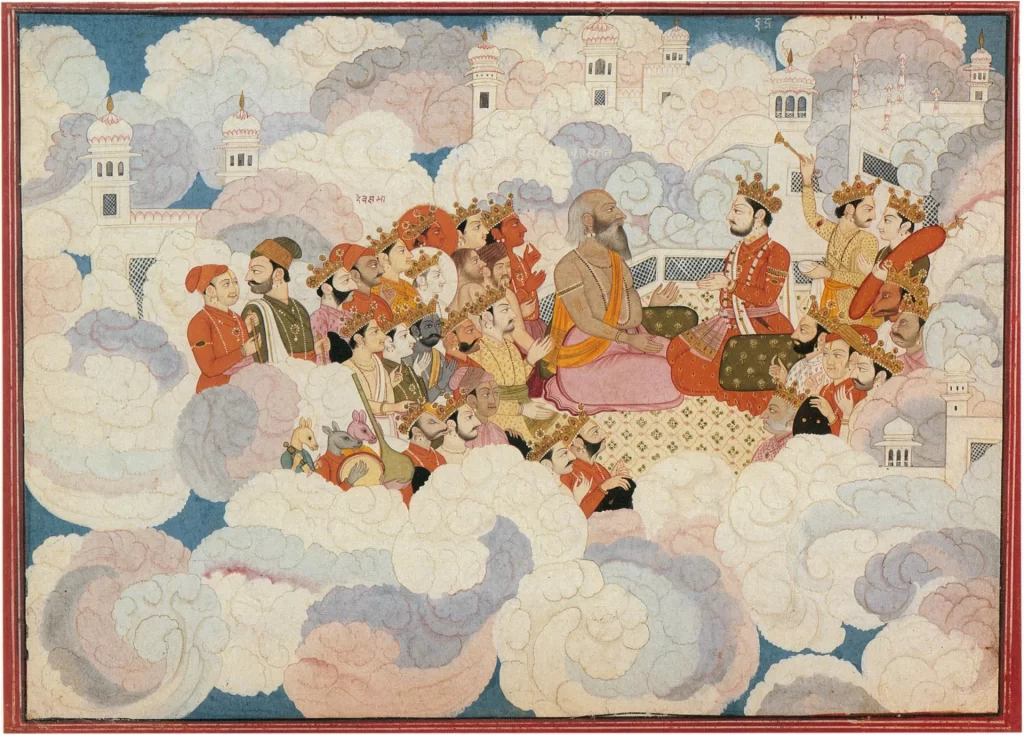
The felly, nemi, नेमि, is the wheel’s rim. The final image gathers the living world into an order held together by Indra.
Fear does not cancel his sovereignty. Sovereignty does not explain away his fear.
The hymn leaves both within the same portrait.
The evil of holding back
Vṛtra does not have to destroy the waters to deprive the world of them. He only has to stop them moving. The hymn imagines them as a captive herd, shut away until Indra opens their enclosure.1
The image can be read through the coming of rain and the breaking of drought, or more broadly: what the world needs exists, and something stands between the source and those who depend on it.
Lugal-e, the Sumerian poem of Ninurta, tells the deed the other way round. Ninurta kills the stone demon Asag, and the good water coming out of the earth still does not reach the fields. He has to heap the stones of the mountain into a wall and turn the flood onto the land. Indra releases water by breaking what holds it back. Ninurta releases it by building what holds it back. In both poems the water ends up answering to the warrior who killed the monster.6
The dead may still have claims
The hymn’s question puts vengeance at the center of Indra’s flight. The opponent is dead, but the god looks toward whoever might answer for him. Dānu and her son show why he might: even in the victorious hymn, Vṛtra belongs to someone.
The later tradition turns the question around. In the Bhāgavata Purāṇa, Vṛtra is himself the avenger. His story begins hata-putras tatas tvaṣṭā, हतपुत्रस्ततस्त्वष्टा, “then Tvaṣṭṛ, whose son had been killed,” pouring offerings into the fire and calling out, “O enemy of Indra, grow, and kill your foe without delay.” The same craftsman who forged Indra’s thunderbolt in the hymn raised the dragon to answer for his own dead child.7
The Mahābhārata gives the same discovery to a human king. At the opening of the Śānti Parva, Nārada asks Yudhiṣṭhira whether he rejoices in his victory, and the king answers that, having caused the deaths of Subhadrā’s son and the sons of Draupadī, “this victory, O holy one, appears to me in the light of a defeat.” Indra fears an avenger; Yudhiṣṭhira grieves for kinsmen, and his dead have names, mothers and wives. Both stories leave the winning king answerable to relationships the victory cannot extinguish.8
A victory the victor cannot trust
The Śatapatha Brāhmaṇa explains Indra’s flight through uncertainty, and then lets him speak:
When Indra had hurled the thunderbolt at Vritra, thinking himself to be the weaker, and fearing lest he had not brought him down, he concealed himself and went to the farthest distances. Now the gods knew that Vritra had been slain and that Indra had concealed himself.
Agni of the deities, Hiranyastûpa of the Rishis, and the Brihatî of the metres, set about searching for him. Agni discovered him and stayed with him (as a guest) that (day and) night. He (Indra), namely, is the Vasu of the gods, for he is their hero.
Indra said, ‘When I had hurled the thunderbolt at Vritra, I was terrified, and (in consequence of this fright) I am much emaciated. This (cake) does not satiate me: prepare for me what will satiate me!’
— Śatapatha Brāhmaṇa 1.6.4.1–2, 4, translated by Julius Eggeling.4
The others know the enemy is dead. Indra does not trust that his blow has accomplished it.
Snorri’s Thor meets the same pattern in the body rather than the mind. At the world’s end he kills the Midgard Serpent, strides “away nine paces from that spot,” and falls dead “because of the venom which the Snake has blown at him.” Thor’s poisoning is physical and Indra’s fear and guilt are not, but in both the enemy’s death comes before the end of the victor’s ordeal.9
Agni finds him and stays. The gods then prepare an offering for the two together, “as one would cook a dish of rice or a goat in common for two relatives or friends who have come to stay with him.” Indra, still depleted, asks for something that will satisfy him, and the gods prepare Soma.4
The Brāhmaṇa makes this night the reason the new-moon sacrifice includes a rice-cake for Indra and Agni together. The gods say their hero “is this day dwelling together,” amā vas, with Agni, and the new-moon night is amāvāsyā, अमावास्या, from amā, अमा, “together,” and vas, वस्, “to dwell.” Astronomy reads the name as the sun and moon sharing one place in the sky. The Brāhmaṇa plays on the frightened god lodging with the one who found him, but when it names the night it explains the word by Soma, the moon, which on that night comes down and dwells here with the waters and the plants.3, 4
The god who can break the mountain still needs to be found, accompanied, and fed.
The resurrection meals of the gospels run the same scene with the roles reversed. In John the companions hide behind shut doors “for fear of the Jews,” and the victor comes to them; in Luke he asks, “Have ye here any meat?” and eats a piece of broiled fish before them. Both scenes join victory, fear, concealment, a finding and food. But Indra killed and hides, while Jesus was killed and comes looking. Agni goes out to find the frightened god and the gods feed him because he is depleted; the risen man goes out to find his frightened friends and asks them to feed him, eating to show them he is bodily present.10
When the enemy is sacred
The Bhāgavata Purāṇa makes the cost of victory explicit. Indra kills the enemy after being encouraged by Brahmins, yet their encouragement does not protect him from the consequence:
Śuka said: Urged on in this way by the Brahmins, Indra killed his enemy. When the enemy was slain, the sin of Brahmin-killing came upon Indra.
Indra suffered its torment; peace did not enter him. Even good qualities give no comfort to a man who is ashamed and has fallen under reproach.
— Bhāgavata Purāṇa 6.13.10–11, rendered from the Sanskrit.7
The sin is brahmahatyā, ब्रह्महत्या, “Brahmin-killing.” Its second half, hatyā, हत्या, comes from han, हन्, to slay, the same verb as ahann in the hymn’s first stanza. The word for the victory has become the word for the crime. And the verse adds shame to his fear: hrīmantaṃ, ह्रीमन्तं, “one who has shame.” The deed that secures his victory leaves him exposed to reproach, and power and prosperity cannot make it disappear.3, 7
The next verses give the sin a body. An old woman chases him, trembling, her clothes soaked in blood, her grey hair loose, calling after him tiṣṭha tiṣṭha, तिष्ठ तिष्ठ, “stop, stop.” He flees toward Lake Mānasa. The narrative then describes a hiding place astonishingly small for the ruler of heaven:
The thousand-eyed one passed through the sky and all directions, O king. Hastening northeast, he entered Lake Mānasa.
He dwelt within the fibers of a lotus stalk, deprived of his share because his messenger was Agni. Unseen within, he remained for a thousand years, pondering release from the killing of a Brahmin.
— Bhāgavata Purāṇa 6.13.14–15, rendered from the Sanskrit.7
The reference to Agni concerns the delivery of sacrificial offerings: the fire-god cannot reach Indra in his watery refuge. In the Brāhmaṇa, Agni found the hiding god, and the gods fed them both. Here the same messenger cannot reach him, and the god who survived the battle goes without the nourishment ordinarily brought to him.
This Purāṇa also gives the opponent a religious life. Before the last battle Vṛtra prays to Hari, dāsānudāso bhavitāsmi bhūyaḥ, दासानुदासो भवितास्मि भूयः, “may I again become the servant of your servants.” His position as an enemy does not exhaust his identity.7
Indra’s victory cannot erase the status of the one he kills. The story eventually provides purification: the Brahmins bring him home and initiate him into a horse sacrifice offered to the Supreme Person. The need for purification remains part of the account. Another victory would not have solved the problem.7
The enemy is dead. What Indra did to him is not finished with Indra.
The kingdom behind the dragon
Vṛtra can also be read as the image of a conquered power.
The hymn gives him control over waters, associates his fall with shattered forts, and ends by proclaiming the victor’s rule over the living world. These elements permit a reading concerned with resources, conquest, and the establishment of sovereignty.
The Sanskrit of stanza eleven sharpens it. The captive waters stood dāsapatnīr ahigopā, दासपत्नीरहिगोपा, “with the Dāsa for their husband and the serpent for their herdsman.” In the Rigveda dāsa, दास, can name the enemy, a demon or a barbarian, but it can also mean servant or slave: in 7.86.7 Griffith translates dāso na, दासो न, as “Slavelike may I do service.” When the Bhāgavata’s Vṛtra prays to be dāsānudāsa, the servant of servants, he uses for devotion a word the hymn applies to its enemy. A history of conquest cannot be inferred from these meanings alone. In a separate European example, English slave comes through Medieval Latin Sclavus, originally “Slav,” “because of the many Slavs sold into slavery by conquering peoples.”2, 3, 7, 11
Vṛtra’s enclosure imprisons. Indra’s enclosing wheel holds together. The hymn condemns one containment and praises the other, and the difference lies in who is said to benefit. Whether the new ruler keeps the waters moving or becomes the next possessor of their source is a question the hymn does not ask.
A conquered community that hears itself described as a monster has no verse in the poem. The mother and son remain in it all the same, and so does the god’s fear.
The empty throne
Indra’s flight left the gods needing another king.
In the Mahābhārata’s telling, the seers and gods went to a mortal ruler and said, “Let the handsome Nahusha be crowned as king of the gods.” Nahuṣa, नहुष, refused at first: “I am feeble; I am not capable of protecting you; it is a powerful person who should be your king; it is Indra who hath always been possessed of strength.” They crowned him anyway.12
The Bhāgavata gives what followed a single verse. Nahuṣa ruled heaven by his learning, austerity and yogic power, until he was sampad-aiśvarya-madāndha-buddhir, सम्पदैश्वर्यमदान्धबुद्धिर्, “his mind blinded by the intoxication of wealth and lordship.” He sent for Indra’s wife, Śacī, शची, to come to his house.7, 12
In the Mahābhārata’s account, Nahuṣa made the seers carry him, declared certain Vedic hymns inauthentic, and touched Agastya’s head with his foot. The seer Agastya pronounced his sentence: “For ten thousand years, thou shalt, in the form of an enormous snake, roam over the earth.”12
Indra killed a serpent to free the waters and was proclaimed king for it. While he hid from what he had done, the throne he left empty made a serpent of the next man who sat on it.
Source and translation notes
The hymn. Rigveda 1.32 is quoted in full, in order, from Ralph T. H. Griffith’s translation of 1896, with his “Tvaṣṭar” and diacritics kept as printed. The Sanskrit phrases are quoted from the Wikisource text of the hymn.1, 2
The Brāhmaṇa and the grammarians. The Śatapatha Brāhmaṇa is quoted from Julius Eggeling’s translation (Sacred Books of the East, volume 12, 1882), with his transliteration retained in the quotations: 1.6.3 for Viśvarūpa, Tvaṣṭṛ’s curse and Vṛtra’s birth, and 1.6.4 for Indra’s flight, Agni’s search and the new-moon offering. The verse on the misaccented indraśatru is from the opening chapter (Paspaśāhnika) of Patañjali’s Mahābhāṣya.4, 5
The Purāṇa. The Bhāgavata Purāṇa passages (6.9.11, 6.11.24, 6.13.10–18) are rendered from the Sanskrit for this article, checked against the verse-by-verse word glosses on Vedabase; they are not the Bhaktivedanta Book Trust’s published English.7
Comparisons. The Mahābhārata is quoted from Kisari Mohan Ganguli’s translation (Śānti Parva 1; Udyoga Parva 9, 11 and 17), Gylfaginning from Arthur Gilchrist Brodeur’s 1916 translation, and the gospels from the King James Version. Etymologies follow Wiktionary’s Sanskrit, Avestan and Armenian entries and the Online Etymology Dictionary.3, 10, 11, 8, 9, 12
1. Rigveda 1.32, translated by Ralph T. H. Griffith, The Hymns of the Rigveda (1896), Internet Sacred Text Archive. sacred-texts.com ↩
2. Rigveda 1.32, Sanskrit text, with Sāyaṇa’s commentary, Sanskrit Wikisource: 1.32.1 इन्द्रस्य नु वीर्याणि प्र वोचं … अहन्नहिमन्वपस्ततर्द; 1.32.2 वाश्रा इव धेनवः; 1.32.6 इन्द्रशत्रुः; 1.32.11 दासपत्नीरहिगोपा; 1.32.12 सप्त सिन्धून्; 1.32.14 अहेर्यातारं कमपश्य इन्द्र. sa.wikisource.org ↩
3. Etymologies, Wiktionary. वृत्र (vṛtra): “from Proto-Indo-European ∗h₂wer- + ∗-trom. Cognate with Avestan 𐬬𐬆𐬭𐬆𐬚𐬭𐬀”; अहि (ahi): “Cognates include Avestan 𐬀𐬲𐬌 (aži), Ancient Greek ὄφις (óphis)”; इन्द्र (indra): “Cognate with Avestan 𐬌𐬧𐬛𐬭𐬀 (iṇdra, name of a daeva)”; वज्र (vajra): “Cognate with Avestan 𐬬𐬀𐬰𐬭𐬀 (vazra, “mace; main weapon of Mithra”)”; वृत्रहन् (vṛtrahan): “Cognate with Avestan 𐬬𐬆𐬭𐬆𐬚𐬭𐬀𐬘𐬀𐬥”; Old Armenian Վահագն (Vahagn): “from Parthian ∗Varhraγn, ultimately from Proto-Indo-Iranian ∗Wr̥tragʰnás,” with Վահագն վիշապաքաղ, “Vahagn the Dragonslayer”; वीर (vīra): “Cognate with … Latin vir (“man”)”; मघ (maghá): “gift, reward, bounty”; दानु (dā́nu): “from Proto-Indo-European ∗déh₂nu (“river (deity)”). Cognate with Avestan 𐬛𐬁𐬥𐬎 (dānu, “river”)”; सिन्धु (síndhu), citing Rigveda 1.32.12, and Old Persian Hiⁿduš, whence “Ancient Greek Ἰνδός (Indós) … English: India”; यातृ (yātṛ́): “(Vedic) avenger”; दास (dāsá): “demon, barbarian, … servant”; अमावास्या (amāvā́syā): “From अ॒मा (amā́, “together”) + वास्य (vāsya, “dwelling”), from the root वस् (vas, “to dwell”)”; हत्या (hatyā́): “From the root हन् (han, “to kill, slay, destroy, strike down”).” The servant/slave comparison already occurs in Rigveda 7.86.7: दासो न, dāso na, “Slavelike may I do service” (Griffith). Sanskrit: sa.wikisource.org; translation: sacred-texts.com. Dictionary entries checked 20 October 2026. ↩
4. Śatapatha Brāhmaṇa 1.6.3–4, translated by Julius Eggeling, Sacred Books of the East 12 (1882). 1.6.3.1–2: “Tvashtri had a three-headed, six-eyed son … Indra hated him and cut off those heads of his”; 1.6.3.8–10, the curse and Vṛtra’s birth; 1.6.4.3: “Our Vasu, who has gone to live away from us, is this day dwelling together (amâ vas, viz. with Agni).” sacred-texts.com; sacred-texts.com ↩
5. Patañjali, Mahābhāṣya, Paspaśāhnika: दुष्टः शब्दः स्वरतः वर्णतः वा मिथ्या प्रयुक्तः न तम् अर्थम् आह । सः वाग्वज्रः यजमानम् हिनस्ति यथा इन्द्रशत्रुः स्वरतः अपराधात् । Sanskrit Wikisource. sa.wikisource.org ↩
6. Ninurta’s Exploits (Lugal-e), Electronic Text Corpus of Sumerian Literature, t.1.6.2, lines 334–359. etcsl.orinst.ox.ac.uk ↩
7. Bhāgavata Purāṇa, Sanskrit text and word glosses, Vedabase. 6.9.11 हतपुत्रस्ततस्त्वष्टा जुहावेन्द्राय शत्रवे । इन्द्रशत्रो विवर्धस्व मा चिरं जहि विद्विषम्; 6.11.24 अहं हरे तव पादैकमूल–दासानुदासो भवितास्मि भूयः; 6.13.10–15, the killing, the pursuit and the lotus stalk; 6.13.16 on Nahuṣa, स सम्पदैश्वर्यमदान्धबुद्धिर्नीतस्तिरश्चां गतिमिन्द्रपत्न्या; 6.13.17–18, Indra’s return and the horse sacrifice. vedabase.io ↩
8. Mahābhārata, Śānti Parva, section 1, translated by Kisari Mohan Ganguli. sacred-texts.com ↩
9. Snorri Sturluson, Gylfaginning 51, translated by Arthur Gilchrist Brodeur, The Prose Edda (1916). sacred-texts.com ↩
10. King James Version. John 20:19; Luke 24:37, “But they were terrified and affrighted”; Luke 24:41–43. biblegateway.com ↩
11. Online Etymology Dictionary, “slave”: “from Old French esclave (13c.) and directly from Medieval Latin Sclavus “slave” … originally “Slav” … so used in this secondary sense because of the many Slavs sold into slavery by conquering peoples.” etymonline.com ↩
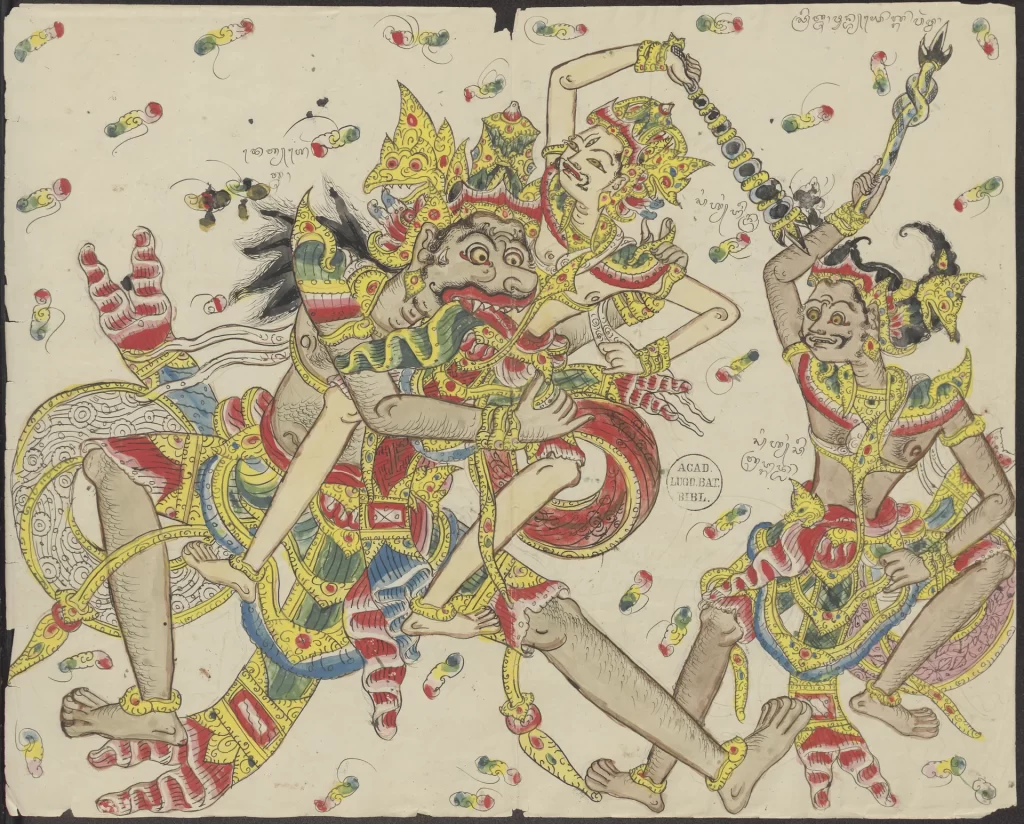
12. Mahābhārata, Udyoga Parva, sections 9, 11 and 17, translated by Kisari Mohan Ganguli. Section 9, the fight that the Balinese drawing shows: “the heroic Vritra seized the celestial lord … he whirled Indra and threw him into his mouth.” Section 11: “Let the handsome Nahusha be crowned as king of the gods,” his refusal, and his demand, “Let Sachi make haste and visit me at my house”; section 17, Agastya’s curse. sacred-texts.com; sacred-texts.com; sacred-texts.com ↩