When civilization changes hands, is it a gift, a theft—or the beginning of a new authority?
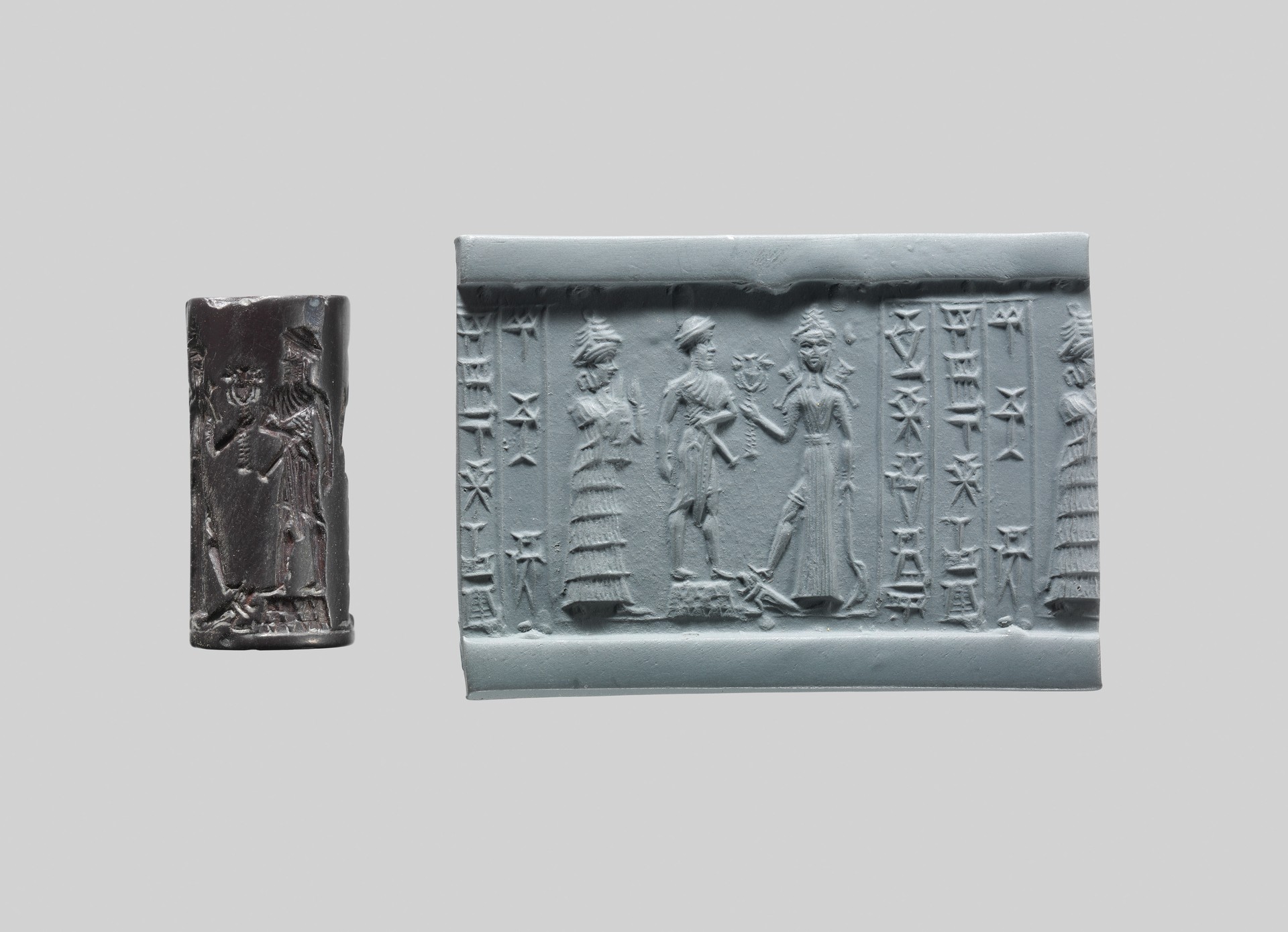
Opening illustration: Ishtar, Inanna’s Akkadian counterpart, appears armed on an Old Babylonian cylinder seal and its modern impression, c. 18th–17th centuries BCE. Her foot rests on a lion-headed eagle. This is divine iconography, not an illustration of the voyage in Inanna and Enki. The Metropolitan Museum of Art, Gift of Martin and Sarah Cherkasky, 1987, 1987.96.5. Public domain / CC0.
A city can receive its destiny at a drinking table.
In the Sumerian story of Inanna and Enki, the goddess of Uruk visits the god who possesses the powers of civilization. He welcomes her, feasts with her, and gives her extraordinary gifts. She accepts them, loads her boat, and departs. When the pleasure of the banquet has passed, the giver wants his gifts returned. 1
The departure is only the beginning of the difficulty. Enki can issue orders from the home Inanna has left behind. Between his command and her destination stand messengers, pursuing beings, repeated seizures—and an attendant whose faithfulness helps the goddess keep what she has received. 1
What follows is a struggle over whether a powerful being must remain faithful to his own word. It is also a struggle over what civilization brings with it. Craftsmanship, wisdom, and justice are not the whole cargo. Destruction and deception travel with them. 1
The boat carries the means to build a world. It also carries the means to ruin one.
Source note: This Sumerian-language composition survives in ancient manuscripts, including an Old Babylonian witness dated approximately 1900–1600 BCE. The extended verse quotations are Samuel Noah Kramer’s early translation, first published in 1944 and reproduced in the revised 1961 Sumerian Mythology. The narrative also consults Oxford’s later composite translation. Dots inside quotations preserve gaps or uncertainties in Kramer’s rendering. A damaged passage is not an invitation to invent the missing action. 123
The goddess, the city, and the attendants
Inanna belongs to Uruk, called Erech in Kramer’s translation. The city already exists when this story begins. She seeks not an empty site on which to build, but powers that will advance her city’s prosperity and her own renown. 1
Her name is conventionally interpreted as “Lady of Heaven,” although the derivation is disputed. Ishtar is her Akkadian counterpart. Here her important relationship is with Enki, the god of wisdom at Eridu: he addresses her as his daughter, and she addresses him as her father. That language belongs to this story; it need not settle every genealogy preserved elsewhere. 14
Two attendants must also be named. Isimud is Enki’s messenger. Ninshubur is Inanna’s minister and helper. They are not interchangeable background figures. Isimud carries the host’s instructions, remembers his generosity, and later conveys his reversal. Ninshubur helps prevent that reversal from becoming Inanna’s defeat. 1
The gods make the promises. Other hands must sustain—or undo—what those promises have set in motion.
A welcome at the waters of wisdom
The surviving opening is fragmentary but striking: Inanna crowns herself and celebrates her genitals before setting out to address Enki persuasively. Enki already knows her intentions before she arrives. 2
This is not the entrance of a goddess ashamed of desire. Read symbolically, her self-delight places bodily confidence beside ambition. She does not have to become less embodied in order to seek a greater place in the world.
Her destination is the abzu, Enki’s watery deep at Eridu. He does not bar the door. He tells Isimud to receive her:
Come, my messenger, Isimud, give ear to my instructions,
Inanna and Enki, translated by Samuel Noah Kramer, p. 65. 1
A word I will say to thee, take my word.
The maid, all alone, has directed her step to the Abzu,
Inanna, all alone, has directed her step to the Abzu,
Have the maid enter the Abzu of Eridu,
Have Inanna enter the Abzu of Eridu,
Give her to eat barley cake with butter,
Pour for her cold water that freshens the heart,
Give her to drink date-wine in the ‘face of the lion,’
. . . for her . . . . make for her . . .,
At the pure table, the table of heaven,
Speak to Inanna words of greeting.
Isimud carries out the welcome. His first task in the story is not to threaten the visitor but to make her reception possible. Later, when he comes after the boat, it will be the same messenger delivering a very different command. 1
The two gods feast and drink. Their encounter moves from formal hospitality into the instability of intoxication. 1 The table has brought them together; it will not guarantee that they agree about what happened there afterward.
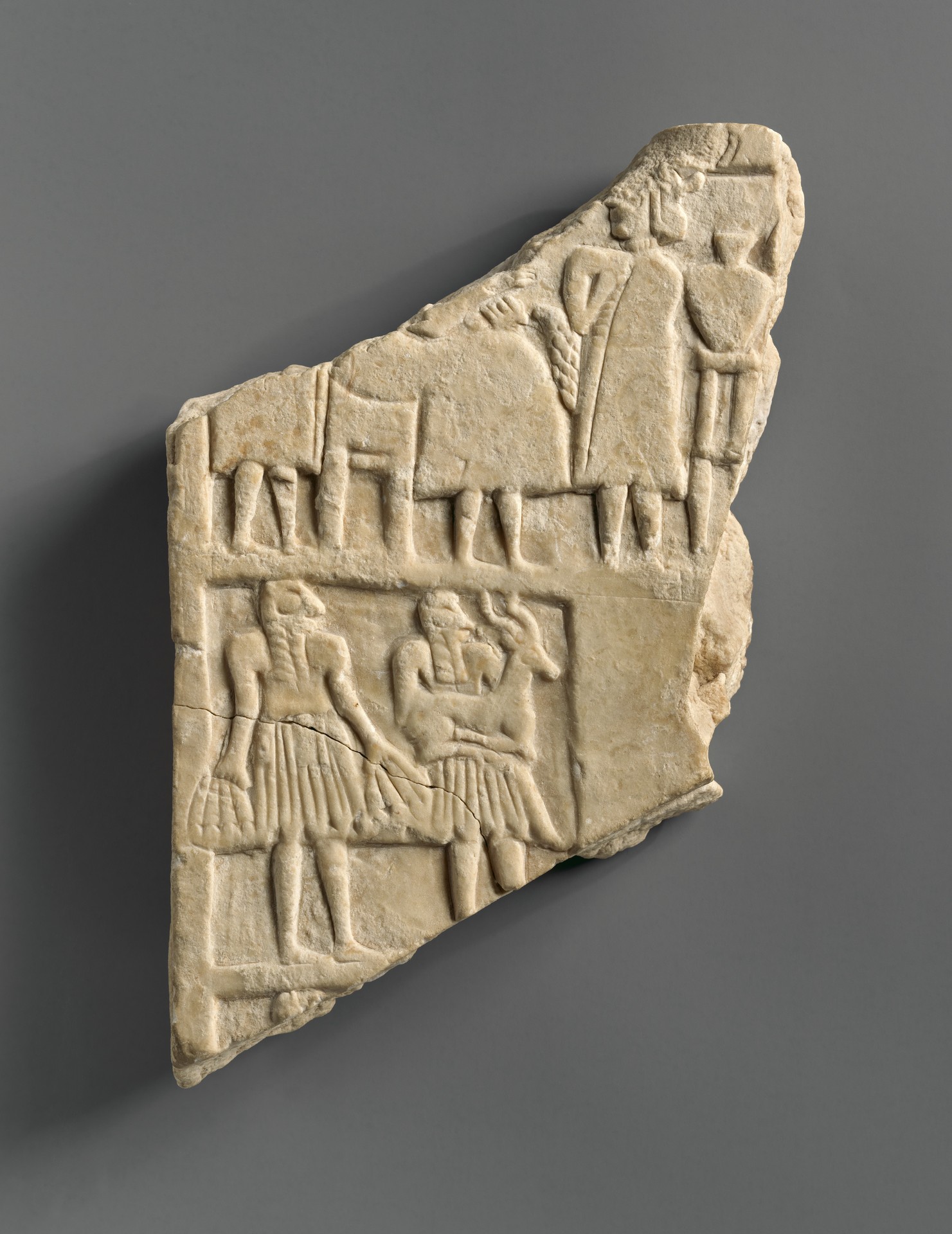
The setting matters. The powers of civilization are not first obtained on a battlefield. The action begins in hospitality: the open door, the shared table, the cup offered to another.
Enki’s foreknowledge complicates a simple tale of an innocent host surprised by a scheming guest. He receives her despite knowing that she has intentions of her own. 2 The poem gives us hospitality and ambition at the same table. It does not give us grounds to reconstruct an unrecorded sexual bargain or a secret plan agreed upon by both gods.
The gifts that cannot be reduced to things
Enki begins to give.
The gifts are the me, a Sumerian term often rendered as divine powers or decrees. No single ordinary English word captures the whole catalogue. These are not simply inventions, and they are not merely laws in the sense of a written legal code. The poem groups together offices, skills, emblems of authority, activities, and conditions of collective life. 12
Kramer translates one sequence:
O name of My power, O name of my power,
To the pure Inanna, my daughter, I shall present . . ..
Lordship, . . .-ship, godship, the tiara exalted and enduring, the throne of kingship.Pure Inanna took them.
O name of my power, O name of my power,
To the pure Inanna, my daughter, I shall present . . . .
The exalted scepter, staffs, the exalted shrine, shepherdship, kingship.Pure Inanna took them.
Kramer, p. 66. 1
The repeated acceptance gives the scene its rhythm. An offering is made; it is received. The catalogue expands, and the transfers accumulate.
Enki gives more than the visible ornaments of command. Among the gifts are practical arts:
O name of my power, O name of my power,
To the bright Inanna, my daughter, I shall present . . .
The arts of woodworking, metalworking, writing, toolmaking, leatherworking. . . . building, basketweaving.Pure Inanna took them.
Kramer, discussion accompanying plates XV–XVI, p. 64. 1
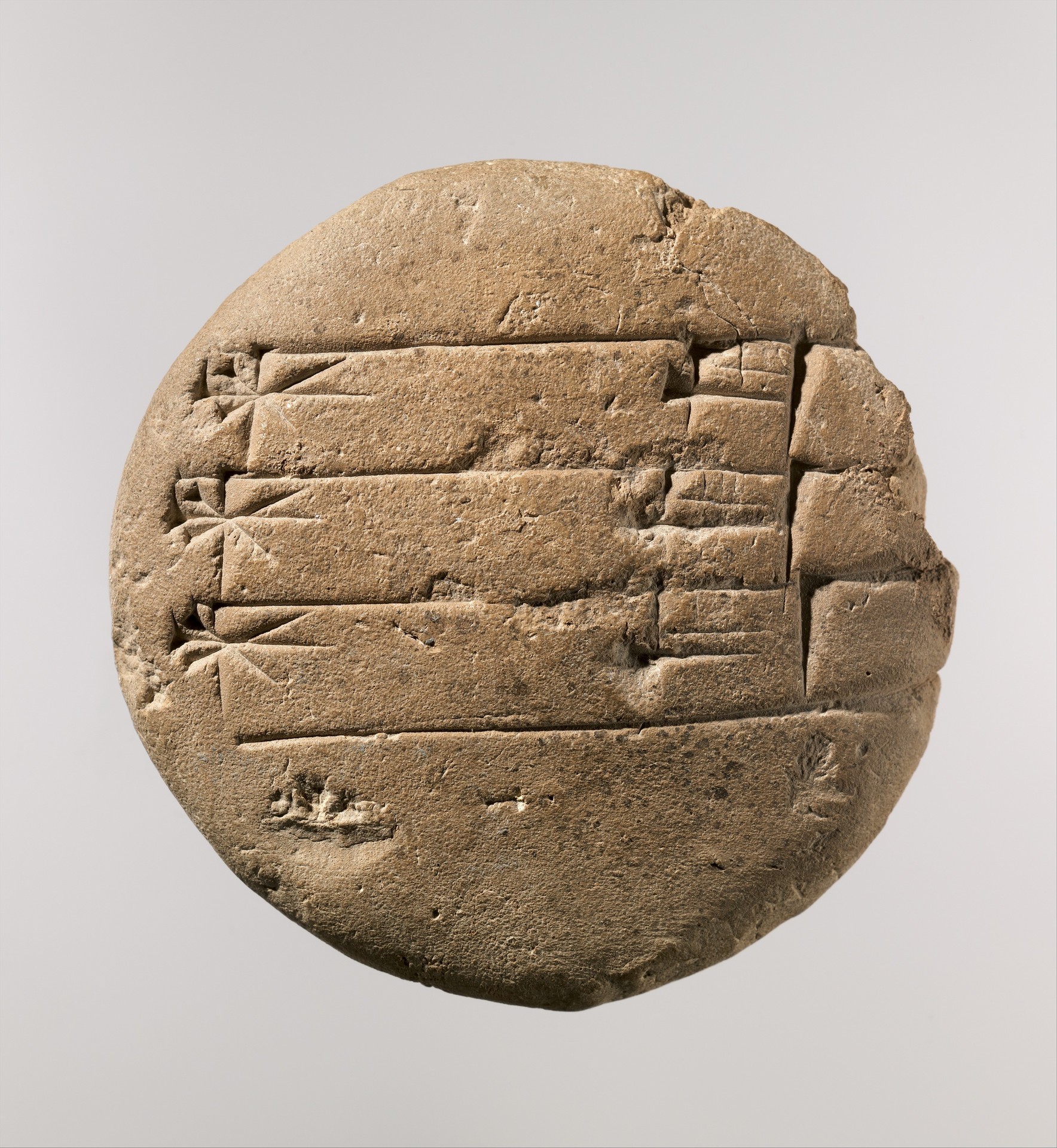
The imagination of the poem gives these powers a remarkable portability. What seems embedded in a way of life can be received, loaded, and taken elsewhere. These are the powers by which a city can become more than an accumulation of bodies. Materials can be shaped, buildings raised, words recorded, and tasks organized. But the gifts extend beyond practical production: music, sexual activity, religious offices, judgment, and counsel also belong to the catalogue. 1
Then the inventory becomes morally disturbing.
Truth is accompanied by falsehood. There are powers associated with justice and wisdom, but also enmity, the destruction of cities, and the lamentation that follows destruction. The poem includes rejoicing as well as grief. 1
Civilization is arriving with contradictory capacities inside it.
That does not require us to conclude that the poem approves every activity it names. It does prevent us from treating the gifts as a simple inventory of virtues. A society’s sophistication and its goodness are not the same achievement.
Isimud remembers what Enki gave
Inanna takes the gifts aboard the Boat of Heaven and leaves for Uruk. Enki’s generosity has acquired a destination beyond his own dwelling. 1
Once the effects of the drink have worn off, he discovers the absence. He asks Isimud where the powers have gone. His messenger reminds him that they have not simply vanished: Enki himself gave them to Inanna. 1
The scene reverses the banquet’s rhythm. There, an offering was followed by acceptance. Here, an inquiry is answered by the recollection of that offering. The giver’s present wish cannot erase his earlier act.
Isimud’s importance becomes clearer. He is not merely the servant sent to perform a task after the important decisions have been made. His memory connects the two versions of Enki: the host who bestowed the gifts and the master who now wants them recovered. Without that reminder, the disappearance might look like an unexplained theft. With it, the coming pursuit follows a grant the giver regrets.
There is comedy in the reversal. The god of wisdom needs someone else to remind him of his own conduct. But Isimud’s answer is not a declaration of rebellion. The same messenger will obey the command to recover what he has just acknowledged was given. 1
His position lets us see two forms of fidelity beginning to pull apart: accuracy about what the master did, and obedience to what the master now demands. The poem need not supply his private thoughts for that tension to become visible.
Enki resolves to send him after the boat. The gifts have left the house. The authority that held them does not intend to let them go.
The first interception
Enki asks where the boat has reached. Isimud answers, and the command follows:
The prince calls his messenger Isimud,
Enki gives the word to the “good name of heaven”:
“Oh my messenger Isimud, ‘my good name of heaven’.”“Oh my king Enki, here I stand, forever is praise.”
“The ‘boat of heaven,’ where now has it arrived?”
“At the quay Idal it has arrived.”
“Go, and let the sea monsters seize it from her.”
Kramer, p. 67. The place-name and the identification of these beings differ in later readings. 12
The welcome has become an interception. Isimud overtakes Inanna, but he speaks first in the language of kinship and unquestionable authority:
Oh my queen, thy father has sent me to thee,
Oh Inanna, thy father has sent me to thee,
Thy father, exalted is his speech,
Enki, exalted is his utterance,
His great words are not to go unheeded.
Inanna asks him to name the command:
My father, what has he spoken to thee, what has he said to thee?
His great words that are not to go unheeded, what pray are they?
Isimud replies:
My king has spoken to me,
Kramer, p. 67. 1
Enki has said to me:
“Let Inanna go to Erech,
But thou, bring me back the ‘boat of heaven’ to Eridu.”
She may leave. The source of her newly acquired power may not.
Inanna does not merely claim that she is strong enough to keep it. She appeals to what Enki has already said:
My father, why pray has he changed his word to me,
Kramer, p. 68. 1
Why has he broken his righteous word to me,
Why has he defiled his great words to me?
My father has spoken to me falsehood, has spoken to me falsehood,
Falsely has he uttered the name of his power, the name of the Abzu.
The question takes his authority seriously enough to hold it to account. If his speech is exalted, why should the later command cancel the earlier promise? If his words cannot be ignored, which of his conflicting words must govern what happens next?
Yet the argument does not suspend the command. While Inanna is still speaking, the pursuing beings seize the boat. 1
The story has reached the point where an appeal to the giver’s honor requires something more than words to remain effective.
Ninshubur’s unwavering hands
Inanna calls upon her own attendant:
Come, my true messenger of Eanna,
Kramer, p. 68. 1
My messenger of favorable words,
My carrier of true words,
Whose hand never falters, whose foot never falters,
Save the ‘boat of heaven,’ and Inanna’s presented decrees.
Ninshubur helps her regain the boat and its gifts. But the recovery does not end Enki’s pursuit. 1
The appeal’s language deserves attention. Inanna calls for truthfulness and steadiness: words carried faithfully, hands and feet that do not fail. These qualities answer the instability that has driven the action. Enki has changed his intention; Ninshubur is summoned because she can be depended upon.
The text does not explain a particular weapon, spell, or maneuver by which every recovery is accomplished. 2 That limits what can be narrated, not whether the attendant matters. Inanna’s own appeal places Ninshubur inside the action at its moment of danger.
A goddess may receive the powers of civilization and still need help keeping hold of her boat.
The river does not end the argument
Enki’s command follows the boat onward. A victory at one stopping place does not make the gift secure at the next. The messenger returns, receives another instruction, and again confronts the departing goddess. 1
In the first encounter, the later translation calls the seizing beings enkum. At the second, Enki sends fifty giants of Eridu. The third pursuit brings fifty lahama of the subterranean waters, meeting the boat at UL.MA hill. 2
The names change; the dispute does not. Isimud again speaks for the giver. Inanna again insists upon the gift. Ninshubur is again the helper on whom she calls. What could have been a single successful escape becomes a test of endurance. 1
Then come the great fish, in the fourth encounter at Field Hill. In the fifth, the pursuers are called the guardians of Uruk. A sixth encounter places the boat at Id-surungal, but the agents’ description is damaged. 2
The appearance of Uruk’s guardians gives the movement home an unexpected complication. The city toward which the boat travels does not make the route automatically safe. This need not be turned into a historical claim that Uruk’s citizens opposed Inanna. Within the poem, beings associated with her destination can be enlisted in the attempt to stop her. 2
Again, the force comes through a chain of command. Enki need not stand in the boat himself to make his will felt there. Isimud carries the order; the pursuers act; Inanna protests; Ninshubur is called. Authority travels in one direction, and the gifts travel in another. 1
The recurring speeches are not merely obstacles to summarizing the plot. They keep the same moral question before the listener. Nothing about moving farther from Eridu has answered it. Nor has hearing the demand repeatedly made it just from Inanna’s point of view. A command does not become a settled agreement simply because it is issued again.
The surviving text develops six encounters and then preserves a broken reference to a seventh. 2 We should not supply a final monster or a spectacular last battle to complete the pattern. What survives already establishes the pressure: the gift has to be defended beyond the moment of receiving it.
The moment of possession is not yet the achievement of a homecoming. The boat must arrive before Inanna can turn acceptance at Enki’s table into a public triumph at Uruk.
Ninshubur announces the homecoming
At Uruk’s Gate of Joy, it is Ninshubur who announces their arrival. She tells Inanna:
Now there will be rejoicing in our city.
Inana and Enki, ETCSL 1.3.1, segment H, lines 218–223. 2
The city she anticipates rejoicing is not only her mistress’s. She speaks of it as theirs. The helper is not only a name invoked in danger. She has a voice at the threshold of success. After the repeated commands sent from Eridu, her announcement turns attention toward the community that will receive the cargo.
Inanna answers with a vision of celebration. The powers are brought into Uruk amid the anticipation of offerings, music, and public praise. 12 She has wanted the journey to enlarge the city, but she does not conceal the enlargement of her own name:
The foreign lands shall declare my greatness. My people shall utter my praise.
Inana and Enki, ETCSL 1.3.1, segment H, lines 224–248. 2
The city’s prosperity and the goddess’s reputation meet at the same quay. Their joining need not make the gifts worthless. It does keep us from describing the benefactor as someone wholly indifferent to the honor she receives.
The cargo is unloaded. What was disputed along the journey can now be displayed and celebrated at its destination. 1
Enki still asks where the boat has reached; Isimud names the White Quay, but the ensuing instructions are broken. 2 The concluding exchange is also damaged. A complete reconciliation cannot be confidently reconstructed, nor can an everlasting feud. 1
That uncertainty belongs at the edge of the story, not in place of everything that survives. The transfer has succeeded. Enki’s attempted recovery has not prevented Inanna from bringing the powers home.
Ninshubur’s announcement lets the homecoming belong, for a moment, to more than the goddess alone. The triumph has depended on a gift, a dispute, a messenger’s memory, an attendant’s help, and a city ready to receive what they have carried.
The generous reading: a gift must be allowed to leave
The strongest defense of Inanna begins with the repeated act of giving. She has not merely entered a storehouse and taken possessions that Enki refused her. His own messenger recalls that he bestowed them. 1
Read sympathetically, her refusal protects an agreement against the greater power of the person now regretting it. Enki seems to want the honor of generosity without accepting the independence that a real gift makes possible.
A gift that can never pass beyond its giver’s control has not been fully given.
The father-and-daughter language sharpens the question. Can the younger figure receive something she may use on her own terms, or only borrow authority that remains revocable whenever she becomes too independent? The story does not have to represent an ordinary family to make that tension recognizable.
Her ambition is also more than private accumulation. The gifts include capacities through which a community can organize, create, remember, and celebrate. 1 The fact that Inanna seeks renown does not make every benefit to Uruk unreal. Mixed motives do not necessarily make an achievement worthless.
Yet the drinking complicates this defense. Someone’s spoken promise is not automatically fair merely because it can be repeated afterward. Intoxication raises a question about the conditions in which consent was obtained.
Two questions therefore remain distinct: was the acquisition fair, and may the giver simply seize back what he gave? An answer to one does not settle the other. Enki’s regret deserves consideration without making his force self-justifying; Inanna’s appeal deserves a hearing without making her methods beyond question.
The suspicious reading: who receives the glory?
From Uruk, the arrival looks like enrichment. From Enki’s position at Eridu, it looks like loss. The story associates Inanna’s acquisition with the advancement of her city and her own reputation. 1 It does not follow that we possess a neutral account of everyone affected.
A benefactor may make others more capable while also increasing her authority over them. The arrival of civilization’s powers does not tell us how evenly their benefits will be shared. Nor does a celebration at the destination settle what the departure means for those left behind.
This makes the attendants more than a narrative detail. The conspicuous gift passes between gods; the work of sustaining its consequences belongs partly to figures whose names are easier to overlook. Isimud’s memory keeps the original act visible. Ninshubur’s reliability helps make Inanna’s success possible. The goddess’s renown can grow from work that is not hers alone.
The suspicion should not erase their different roles. Isimud cannot simply be called a liar: his recollection of the grant is truthful. Nor does obedience to Enki make every order he transmits right. Ninshubur’s loyalty can be admirable without proving that everything her mistress desires is just.
Read this way, the narrative distinguishes virtues that are often too quickly treated as identical. Truthfulness is not the same as obedience. Reliability is not the same as agreement. Successful service is not the same as receiving recognition.
The myth can also make Uruk’s cultural standing appear as the outcome of a memorable divine arrival. But it is not a dated chronicle proving that every named craft originated at Eridu, or that one historical transfer created civilization. The story gives cultural entitlement a face and a voyage; that is different from documenting the labor through which a city actually developed.
Another account of a goddess claiming her place
Two other Sumerian compositions approach Inanna’s authority from different directions. They belong beside this episode as comparisons, not inside it as missing chapters.
Near the end of Enki and the World Order, Inanna complains that other deities have received responsibilities while she has been neglected. Enki answers by reminding her of powers already associated with her. 7 Here the dispute is over recognition and assignment, rather than the recovery of a drunken gift.
The damaged Inanna and An tells a different acquisition story, concerning Eanna. Helpers—including Utu and the fisherman Adagbir—participate in the action. 8 Again, divine ambition does not act entirely alone.
Taken together, these compositions let us ask whether a deity’s place is allotted by an older authority, acknowledged after protest, or acquired through her own action. They do not establish the order in which these things happened in a single life. The recurring question is about authority; the differences between the answers remain part of the evidence.
What travels with civilization?
The catalogue places destructive capacities inside the gift, not merely in a later corruption of it. 1 That is the story’s deepest complication for any celebration of progress.
One reading is that the poem names organized life in its fullness, including what its inhabitants fear. Another asks whether powers used for flourishing can also support domination. The ability to organize may sustain a community or make coercion more efficient. Recording words may preserve a promise or give a false accusation a long life.
These possibilities do not make skill itself wicked. They mean that skill cannot decide every question about its own use.
Read beside Enki and Ninmah, the change of emphasis is striking. There humanity is assigned work, and lives receive places within an ordered world. Here powers associated with ordering collective life can leave the authority that possessed them. 1 What appears divinely settled in one frame becomes contested possession in another. This is an editorial juxtaposition, not an ancient sequence of chapters.
The story’s images hold that tension without needing a fixed symbolic dictionary. The drink permits fellowship while unsettling judgment. The boat gives portable form to what seems embedded in a city’s identity. The promise is an act of speech whose consequences become material: a journey, a seizure, an appeal for help.
The me, 𒈨, may have been received at a table, but keeping them requires relationships. Civilization is not only what fits aboard the boat. In this reading, it is also the capacity to remember a commitment, honor it, or protect someone whose claim is being overridden.
Other bearers of civilization
Cadmus offers a useful comparison. Herodotus credits the Phoenicians who came with Cadmus with bringing the alphabet and other learning to Greece. In that account, cultural achievement arrives through contact with outsiders rather than emerging from a people entirely unaided. Read beside Inanna’s voyage, the comparison opens a question about cultural pride: can a community celebrate what it has become while acknowledging what it received? It does not establish a direct borrowing between the narratives. 5
The Prometheus story in Plato’s Protagoras offers a sharper moral contrast. Prometheus brings humanity fire and technical arts, but these are insufficient to sustain cities: people continue to injure one another. Zeus sends Hermes to bring reverence and justice, qualities that make common life possible. The comparison distinguishes having powerful capacities from knowing how to live together. Inanna’s catalogue is different because judgment and destructive capacities travel in the same collection. Neither story allows technical accomplishment alone to settle the human problem. 6
After the boat is unloaded
Inanna can be defended without becoming innocent of every difficulty. Enki can have grounds for regret without making every attempt at recovery just. The attendants can be indispensable without becoming the celebrated owners of the achievement.
The gifts arrive, but possession offers no guarantee of restraint.
Acquiring civilization is not the same as learning how to use it.
A city may become more capable without becoming more humane. It may preserve a promise—or enforce a command after the promise has become inconvenient. It may celebrate its own flourishing without asking whose loss or uncelebrated labor made the celebration possible.
The boat reaches the quay. The songs begin. Ninshubur has helped bring it home; Isimud has carried words that could not all be honored together.
What kind of world will be made from the cargo remains the question for those who receive it.
Endnotes and sources
1. Samuel Noah Kramer, Sumerian Mythology, first published 1944; revised edition, University of Pennsylvania Press, 1961. Main narrative and extended quotations: “Inanna and Enki: The Transfer of the Arts of Civilization from Eridu to Erech,” pp. 64–68. The comparison with human creation uses the adjacent section, pp. 68–72. Read the chapter. This is an early translation, not the final word on damaged phrases. “Erech” remains in quotations; the surrounding narrative uses Uruk. Quotation punctuation has been typographically standardized; wording and gap markers have not been silently modernized. The archive identifies the edition as public domain in the United States due to nonrenewal. Edition and rights notice. Archive attribution: “Scanned at sacred-texts.com, October 2004. John Bruno Hare, redactor.” The archive also asks that attribution be retained and specifies noncommercial reuse of its digitized files; no whole archive file is reproduced in this article. ↩
2. University of Oxford, ETCSL 1.3.1, “Inana and Enki.” Read the composite translation. A–B: fragmentary opening and Enki’s foreknowledge; C: hospitality; D–F: the gifts and their recollection. H 1–33: first interception (enkum); 34–67: fifty giants; 68–101: fifty lahama at UL.MA hill; 102–135: great fish and Field Hill; 136–169: guardians of Uruk; 170–205: Id-surungal, with the agents’ description damaged. H 206–217 preserves a fragmentary seventh reference, not an equally complete seventh action scene. H 218–223: Ninshubur’s arrival speech; 224–248: Inanna’s projected celebrations and praise; 257–266: the White Quay and Enki’s broken instructions. J: unloading/catalogue material and the damaged concluding exchange. Some action and naming are uncertain even within these ranges. Kramer’s “Idal” and “sea monsters” are retained as his older readings inside his quotation; they are not silently substituted for the later composite’s readings. No specific rescue technique is invented. Scholarly bibliography, including Gertrud Farber’s 1973 critical edition and subsequent studies. The two brief quotations in the arrival section total 21 words from this modern translation. Kramer’s unfaltering hands and feet are also an older rendering; Oxford instead has water not touching them. The interpretation of steadfast hands follows the explicitly quoted Kramer version, while the shared emphasis on reliable speech is present in both. ↩
3. Cuneiform Digital Library Initiative, P269824 / CBS 15283: a Sumerian-language witness from Nippur, Penn Museum, assigned to the Old Babylonian period, c. 1900–1600 BCE. A manuscript date is not a demonstrated date of original composition. Catalogue record. ↩
4. ORACC, Ancient Mesopotamian Gods and Goddesses, “Inana/Ištar.” Background for the conventional but disputed “Lady of Heaven” etymology, Sumerian and Akkadian names, and differing genealogies. Reference entry. No precise etymology for the attendants’ names is needed to establish their narrative functions. ↩
5. Herodotus, Histories 5.58–59, translated by A. D. Godley, Loeb Classical Library, 1922. The comparison concerns Herodotus’s account of Phoenician cultural transmission, not proof of direct dependence between the myths. Read the passage. ↩
6. Plato, Protagoras 320c–322d, translated by Benjamin Jowett. The myth is narrated by the dialogue’s character Protagoras; it is not assumed to state Plato’s own view without qualification. Read the dialogue. ↩
7. University of Oxford, ETCSL 1.1.3, “Enki and the world order,” especially lines 387–446. The independent composition juxtaposes Inanna’s complaint with Enki’s account of her powers. It is not presented here as a prequel. Read translation. ↩
8. University of Oxford, ETCSL 1.3.5, “Inana and An.” Its damaged narrative concerns Eanna and includes assistance from Utu and Adagbir. It is not used to fill gaps in Inanna and Enki. Read translation. ↩