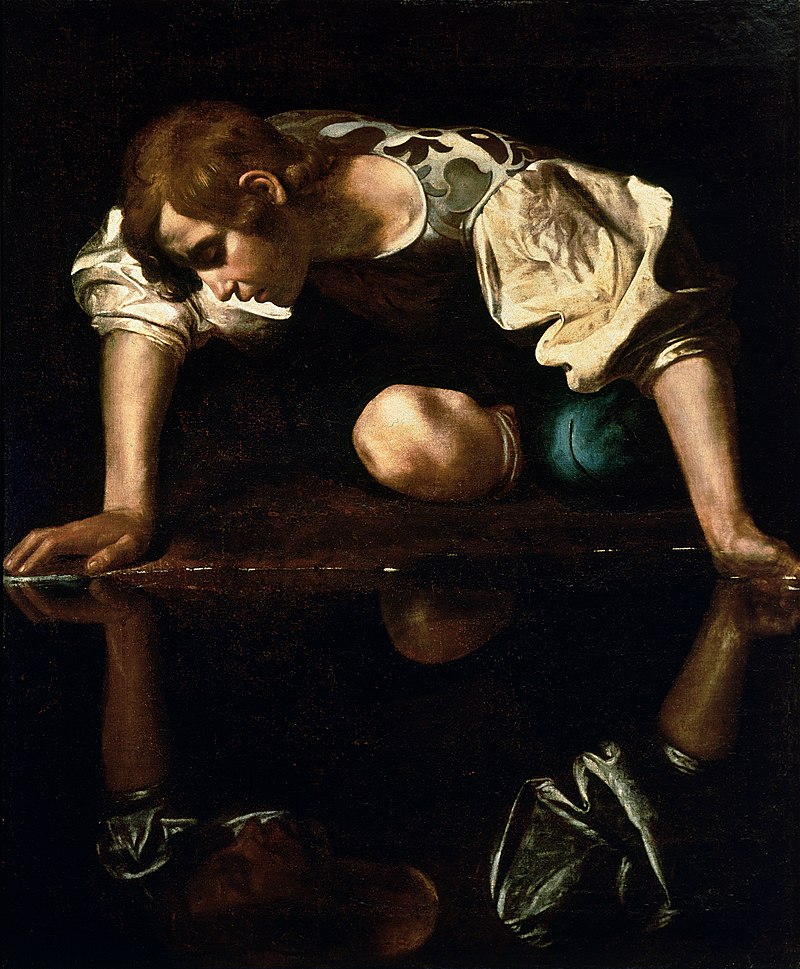
Beauty discovers itself in the water, and the life that carried it is transformed.
Narcissus comes to the water thirsty. What holds him there is something water cannot satisfy.
A face appears beneath his own. Its movements answer his movements; its attention never wanders. When he reaches toward it, it reaches toward him. At first he sees another beautiful youth. Only later does he recognize himself. Ovid, Metamorphoses 3.407–473
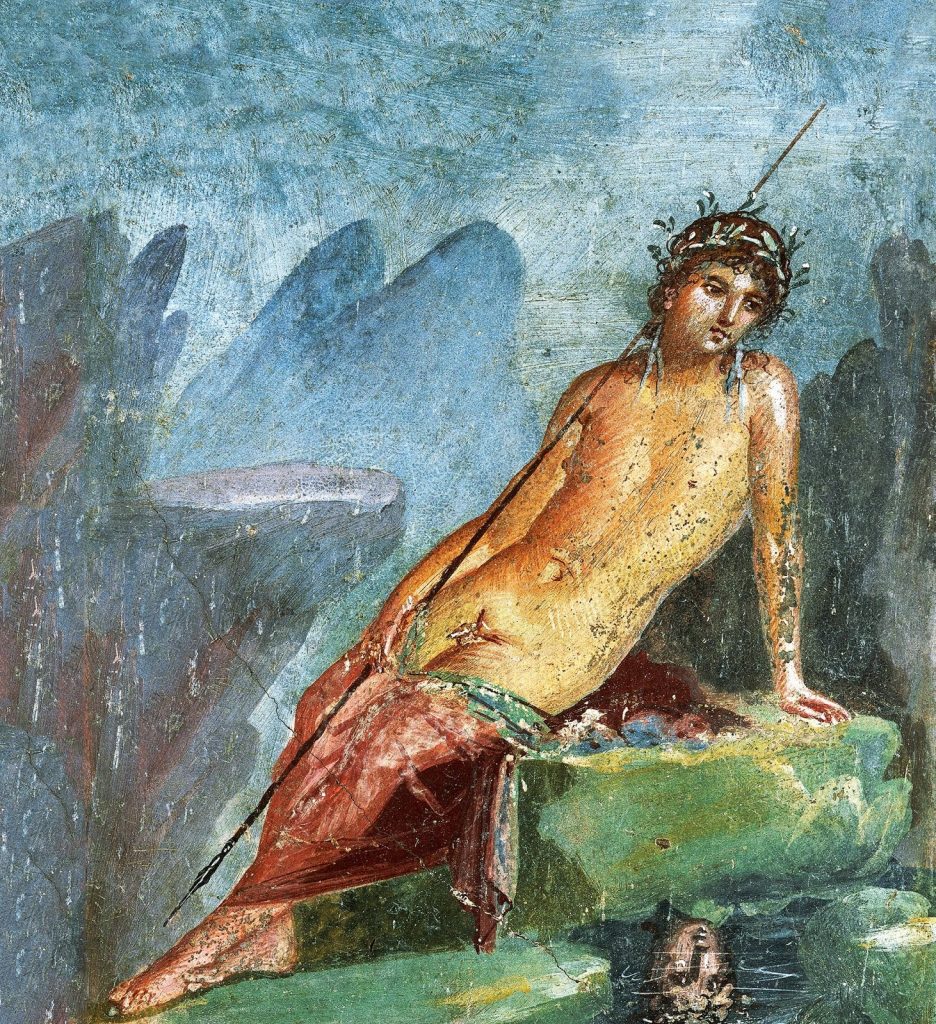
To call this vanity is not enough. Beauty is genuinely worth loving. What happens when a person encounters his own beauty as though it belonged to someone else? The thing that has drawn others toward Narcissus now draws Narcissus out of himself. He becomes both the lover and the beloved, the one who sees and the beautiful thing seen.
His name: the flower and the numbness
Narcissus is the Latin form of Greek Narkissos (Νάρκισσος), the name shared with the flower, νάρκισσος. Its deeper origin is uncertain. An ancient explanation connects it with narkē (νάρκη), meaning numbness or torpor, the root behind the word narcotic. Name and word history
Pliny the Elder gives the association a voice of its own:
“it has received its name, from ‘narce,’ and not from the youth Narcissus, mentioned in fable.”
Pliny, Natural History 21.75, translated by John Bostock and H. T. Riley (1855). Read passage
Pliny derives the flower’s name from its association with numbness rather than from the youth. The linguistic derivation remains disputed, with a pre-Greek plant-name also proposed. The ancient association nevertheless gives the myth a suggestive double movement: beauty awakens consciousness while fascination numbs the rest of life. Etymological discussion
Narcissus becomes intensely awake to one thing. Hunger, companionship, movement, and the passing hours recede. The world has not vanished; it has ceased to matter beside what he sees. His name gathers the flower’s delicacy and the stillness of someone held motionless by delight.
The prophecy of self-knowledge
Before Narcissus can look into the pool, someone has already spoken about the danger of his knowing himself. His mother, Liriope, asks Tiresias whether her child will reach old age:
“Being consulted concerning him, whether he was destined to see the distant season of mature old age; the prophet, expounding destiny, said, ‘If he never recognizes himself.’ Long did the words of the soothsayer appear frivolous; but the event, the thing itself, the manner of his death, and the novel nature of his frenzy, confirmed it.”
Ovid, Metamorphoses 3.346–350, translated by Henry Thomas Riley (1851). Read passage

The prophecy makes recognition dangerous. Narcissus can possess beauty without being consumed by it; the crisis begins when he encounters it as an object of his own desire.
Ovid places him at sixteen, between boyhood and youth. A life lies before him, but its possibilities have not yet hardened into a settled history. His beauty has not been earned through achievement or confirmed by public office. It belongs to him before he has decided what kind of man to become. Ovid, 3.351–355
That is the threshold on which the story turns. The beautiful youth must meet the beauty he has so far embodied. What was simply lived will become something contemplated, desired, and claimed.
The prince of nature: beauty outside society
Narcissus is the son of the river god Cephisus and the nymph Liriope. Water belongs to his origin as well as to his fate. He carries a distinction that precedes any title a city could bestow. Ovid, 3.342–346
Nonnus, writing in Egypt in the fifth century AD, gives him a different father. In his telling Narcissus is the son of Endymion, the moon’s bridegroom, born on leafy Latmos. The two youths meet within an ancient genealogy: one absorbed by the beauty he sees, the other kept asleep beneath a divine gaze. Nonnus, Dionysiaca 48.582ff.
He is a prince of nature. His nobility lies in what he is, rather than in an office, a fortune, or a victory. Where social rank depends on recognition by others, his beauty appears to carry its own authority.
Ovid describes the resistance that accompanies it:
“And now the son of Cephisus had added one to three times five years, and he might seem to be a boy and a young man as well. Many a youth, and many a damsel, courted him; but there was so stubborn a pride in his youthful beauty, that no youths, no damsels made any impression on him.”
Ovid, Metamorphoses 3.351–355, translated by Henry Thomas Riley (1851). Read passage
The social meaning of this refusal extends beyond courtship. Narcissus rejects the social obligations and civic duties of labor and marriage. He refuses to make his beauty useful by turning it into the possession of a household, the promise of descendants, or a body spent in service. He wants to remain what he is before anyone tells him what he is for.
Labor would bind his time to a task; marriage would bind his life to a household. His withdrawal preserves a realm in which beauty need not justify itself through either productivity or reproduction. Nature becomes the refuge of an individual unwilling to exchange his own completeness for a place in the social order.
Aristotle’s familiar alternative gives this solitude its stark outline: the one who lives outside society must be a beast or a god.
“But he who is unable to live in society, or who has no need because he is sufficient for himself, must be either a beast or a god: he is no part of a state.”
Aristotle, Politics I.2, 1253a, translated by Benjamin Jowett (1885). Read passage
Narcissus stands between those possibilities: a hunter among wild creatures and the son of a river god. His solitude can appear as a departure below the human community or an elevation beyond it. To the community, he withholds himself; to himself, he preserves something that the community did not create.
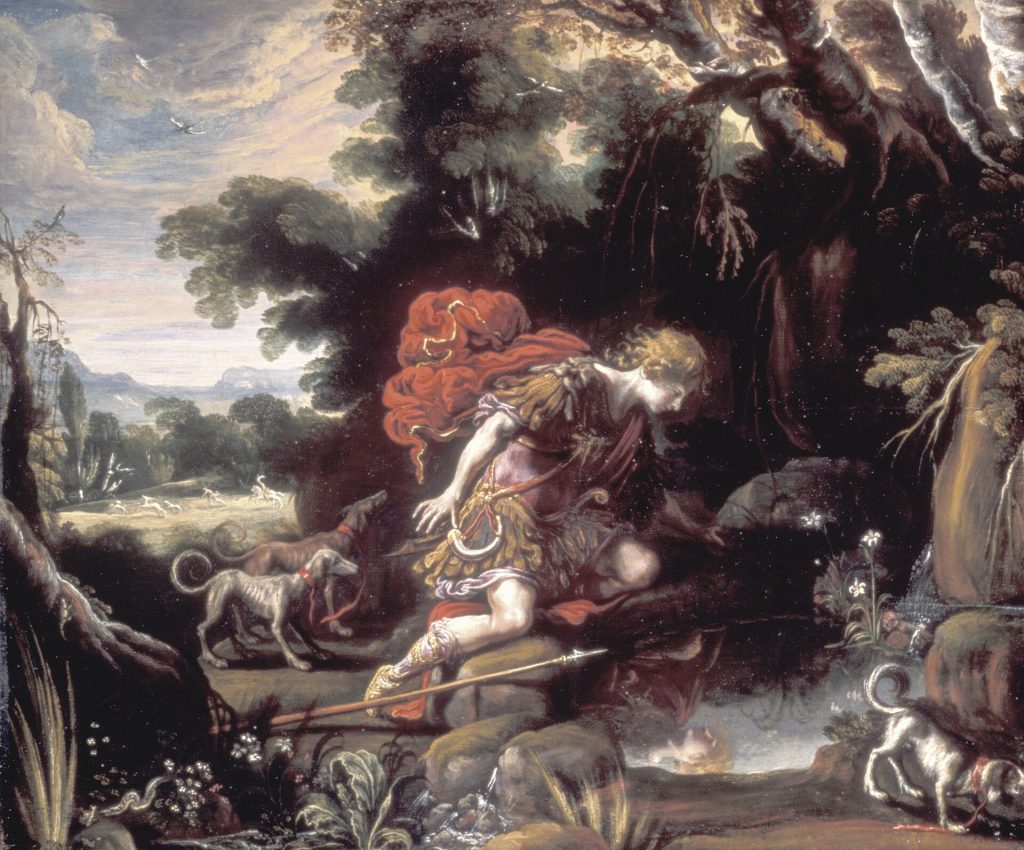
The pool gives that self-sufficiency a visible form. He will find someone as beautiful as himself, someone whose every movement answers his own, and he will discover that this perfect correspondence is still not possession.
Echo: the voice before the image
Before the water returns his face, Echo returns his words.

In Ovid’s telling, Juno has deprived her of the freedom to begin a conversation. She can repeat what another has just said. When Narcissus becomes separated from his hunting companions, their exchanged calls seem to promise a meeting. Echo comes out of the woods to embrace him. Ovid, 3.359–389
“He flies; and as he flies, he exclaims, ‘Remove thy hands from thus embracing me; I will die first, before thou shalt have the enjoyment of me.’ She answers nothing but ‘Have the enjoyment of me.’ Thus rejected, she lies hid in the woods, and hides her blushing face with green leaves, and from that time lives in lonely caves; but yet her love remains, and increases from the mortification of her refusal.”
Ovid, Metamorphoses 3.390–395, translated by Henry Thomas Riley (1851). Read passage
His refusal already joins possession to death. Rather than belong to another, he would cease to live. At the pool, he will desire what cannot belong to him in the way he desires it.
Echo and the reflection prepare two kinds of return. Her speech repeats his speech, but another living desire stands behind it. The water repeats his movements without a second life beneath the surface. What sounds like sameness can conceal another person; what looks like another person can conceal only sameness.
Echo wastes away until her voice remains. Narcissus will also lose his body, leaving a different trace. Their stories meet in the loss of the bodily form through which each first became desirable. Ovid, 3.396–401, 499–510
The clear water
After another rejected admirer prays that Narcissus should love without possessing what he loves, Nemesis grants the prayer. The scene moves to a spring untouched by the ordinary traffic of the world. Ovid, 3.402–406
“There was a clear spring, like silver, with its unsullied waters, which neither shepherds, nor she-goats feeding on the mountains, nor any other cattle, had touched; which neither bird nor wild beast had disturbed, nor bough falling from a tree. There was grass around it, which the neighboring water nourished, and a wood, that suffered the stream to become warm with no rays of the sun. Here the youth, fatigued both with the labor of hunting and the heat, lay down, attracted by the appearance of the spot, and the spring; and, while he was endeavoring to quench his thirst, another thirst grew upon him.”
Ovid, Metamorphoses 3.407–415, translated by Henry Thomas Riley (1851). Read passage
The water’s purity belongs to the revelation. Away from the demands of society, Narcissus encounters his own form without the voices that ordinarily surround it. The spring clears a space in which he can see what he is.
At first he takes the reflection for another youth. Ovid likens his stillness to a marble statue and compares the beauty of his features with the gods. The young man has become a spectator before an image worthy of contemplation. Yet he also wants to kiss and embrace it. Ovid, 3.416–436
Every gesture is returned; every attempt at contact disturbs the thing he reaches for. The image offers perfect correspondence and withholds the independent body that could answer his desire.
Recognition finally breaks through:
“In thee ’tis I, I now perceive; nor does my form deceive me. I burn with the love of myself, and both raise the flames and endure them. What shall I do? Should I be entreated, or should I entreat? What, then, shall I entreat? What I desire is in my power; plenty has made me poor. Oh! would that I could depart from my own body! a new wish, indeed, in a lover; I could wish that what I am in love with was away.”
Ovid, Metamorphoses 3.463–468, translated by Henry Thomas Riley (1851). Read passage
He knows the face is his. Knowledge does not extinguish the desire. Instead, it reveals the contradiction: he possesses everything he sees, yet cannot obtain it as another person.
He wishes to leave his own body so that the beautiful thing might stand apart from him. The self longs to divide, to become both the one who loves and the one who can freely be loved. What began as the sight of another becomes an encounter with a division inside himself.
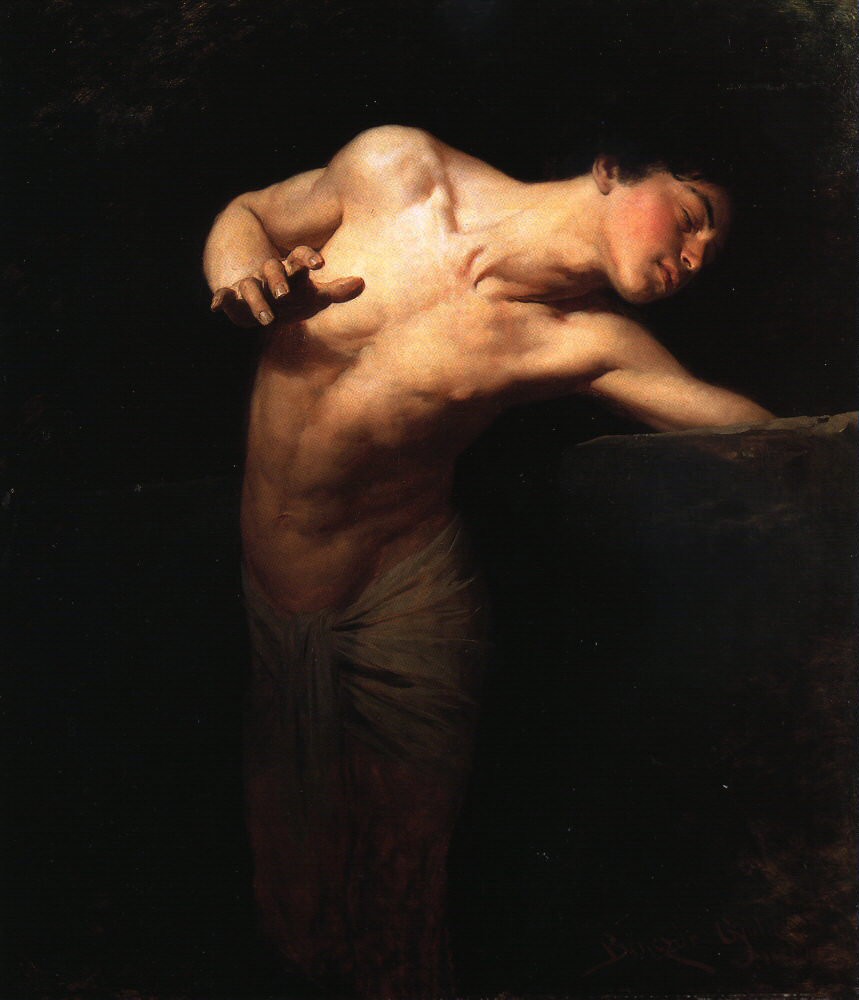
Conon: the lover at the door
Conon tells a harsher version, preserved in Photius’s summary of his Narrations. Here the rejected lover is Ameinias, and the story ends not only with a flower but with a community honoring Eros. Conon, Narrations 24, preserved in Photius, Bibliotheca.
“In Thespiae in Boeotia, a city not far from Helicon, a boy named Narcissus was born, exceptionally handsome and disdainful of Eros and of lovers. The other lovers gave up their pursuit, but Ameinias persisted, pleading with him. Narcissus would not receive him and even sent him a sword. Ameinias killed himself before Narcissus’s doors, earnestly beseeching the god to avenge him.
Narcissus saw his own face and form reflected in the water of a spring and became, strangely, the first and only man to be his own lover. At last, finding no way out, and believing that he suffered justly for having outraged Ameinias’s love, he took his own life.
From that time the Thespians resolved to honor and revere Eros more greatly, and to sacrifice to him privately as well as in their public rites. The inhabitants believe that the narcissus flower first sprang from the ground upon which Narcissus’s blood had been shed.”
Conon, Narrations 24, as preserved by Photius. New English translation prepared for this article from the surviving Greek. Greek text reproduced here; compare Brady Kiesling’s English translation.
The sword makes the refusal tangible. Narcissus sends it outward; Ameinias dies at his door. At the spring, the direction of longing reverses. The youth who dismissed another’s desire becomes the lover who cannot obtain what he wants.
His recognition now has a second edge. He discovers not only his own beauty but the suffering of the lover he rejected. Eros is no longer merely something other people feel for him. He experiences the power he had treated with contempt.
Conon takes the story from private refusal to public ritual. The community responds by honoring the god Narcissus scorned. His fate becomes a religious lesson: beauty does not place its possessor beyond the power of love. Conon, Narrations 24.
Pausanias: the sister in the water
Pausanias records another tradition, in which the face in the pool carries the memory of a twin sister:
“There is another tradition about him, not so well known as the other, viz. that he had a twin-sister, and that the two were almost facsimiles in appearance and hair and dress, and used to go out hunting together, and that Narcissus was in love with this sister, and when she died he used to frequent this fountain and knew that it was his own shadow which he saw, yet though he knew this it gratified his love to think that it was not his own shadow but the image of his sister that he was looking at.”
Pausanias, Description of Greece 9.31.8, translated by A. R. Shilleto (1886), vol. II, pp. 198–199. Read passage
Here the feminine counterpart belongs to the remembered life of Narcissus. The two once dressed alike and hunted together. Their likeness survives the death that separates them, allowing his face to bear the image of hers.
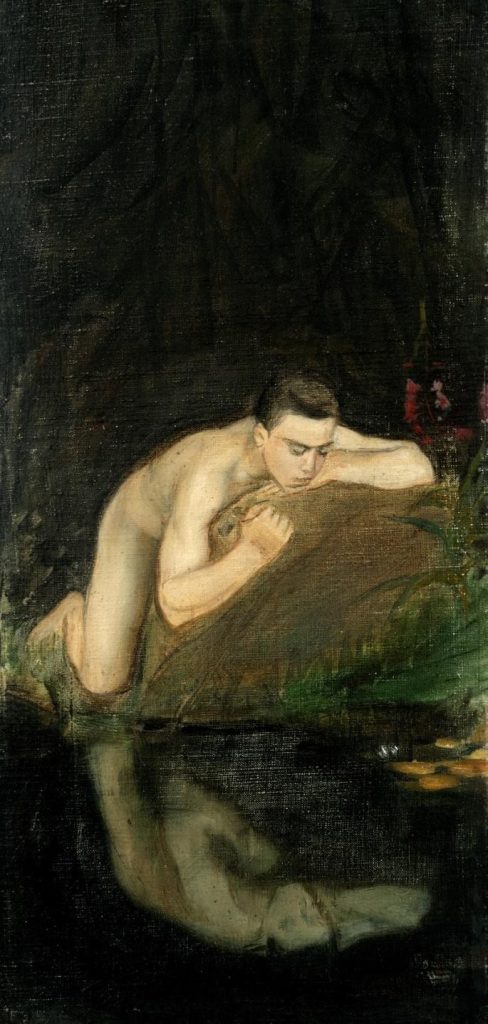
The water becomes a place where a lost unity can still be contemplated. He knows whose reflection it is; what holds him is the other person it allows him to remember. Self and beloved have become inseparable in the same appearance.
This telling deepens the significance of the double. A person does not encounter only an isolated individual when looking at himself. A face can carry kinship, resemblance, and the memory of someone absent. The boundaries of the self become uncertain precisely where its outline appears most clear.
In Ovid, desire survives self-recognition. In the account preserved by Pausanias, love survives bereavement. Both bring Narcissus to a likeness that knowledge can identify but cannot exhaust.
Hegel: beauty-in-itself
Narcissus begins as beauty-in-itself: beautiful before he has made that beauty the object of his own consciousness. Others see it; he lives it without yet confronting its image. At the pool, what existed in him becomes something that appears before him. Beauty awakens to itself.
Hegel gives the distinction in a single sentence:
“The beauty of Nature is only beautiful for another, that is for us, the consciousness that apprehends its beauty.”
G. W. F. Hegel, The Philosophy of Fine Art, vol. I, “The Beauty of Nature,” p. 171, translated by F. P. B. Osmaston (1920). Read the passage.
The myth folds these two positions into one person. The natural form is his body; the consciousness before which it appears is his own. He crosses from being beautiful for others to encountering his beauty for himself.
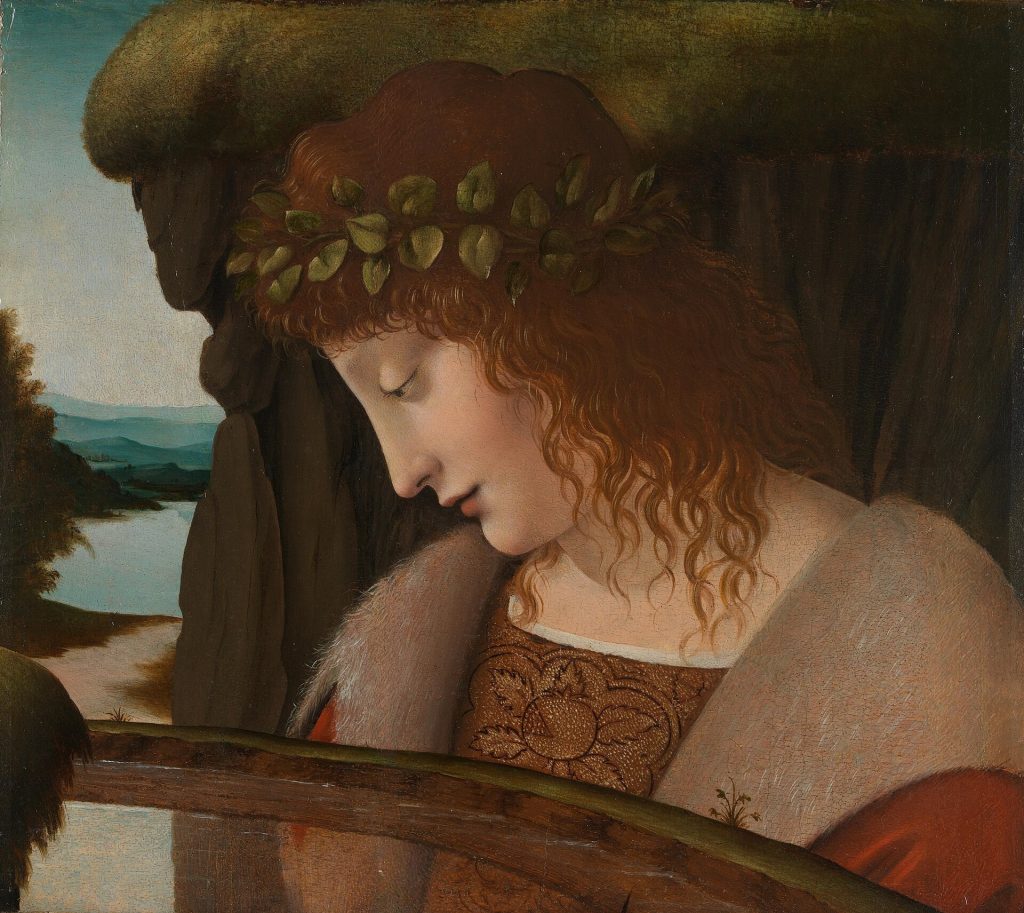
That is more than the pleasure of being admired. He no longer needs another person’s praise to make his beauty present to him. Its worth seems to stand before him directly, freed from usefulness, reward, and reputation.
Yet seeing and possessing remain different things. He can contemplate the image while leaving the water still; when he reaches to embrace it, his hand breaks the surface. He becomes both the witness of his beauty and the lover who cannot take possession of it.
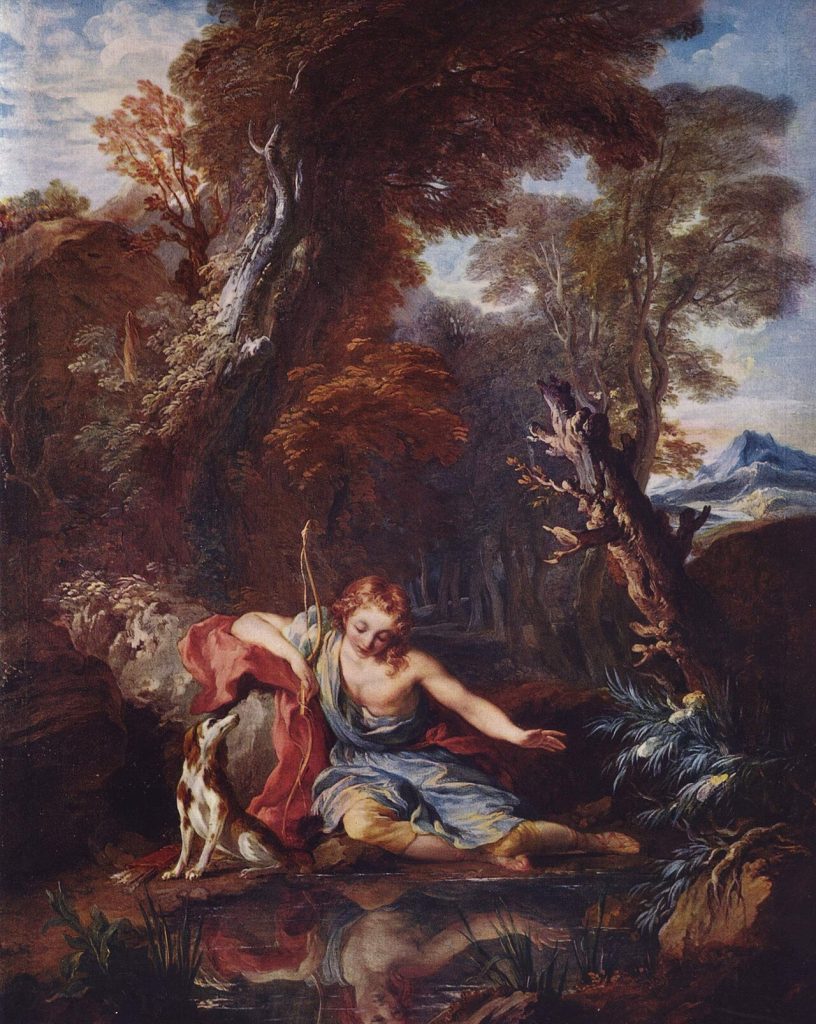
The flower will carry the argument beyond his individual body. What Narcissus encounters as exclusively his is not confined forever to him.
What the flower preserves
The body that first drew his attention begins to lose the features he admired. Echo, still wounded by his rejection, returns his cries and mourns with him. At the end, Ovid gives the farewell and the continuing gaze together. Ovid, 3.487–505
“His last accents, as he looked into the water, as usual, were these: ‘Ah, youth, beloved in vain!’ and the spot returned just as many words; and after he had said, ‘Farewell!’ Echo, too, said, ‘Farewell!’ He laid down his wearied head upon the green grass, when night closed the eyes that admired the beauty of their master; and even then, after he had been received into the infernal abodes, he used to look at himself in the Stygian waters.”
Ovid, Metamorphoses 3.499–505, translated by Henry Thomas Riley (1851). Read passage
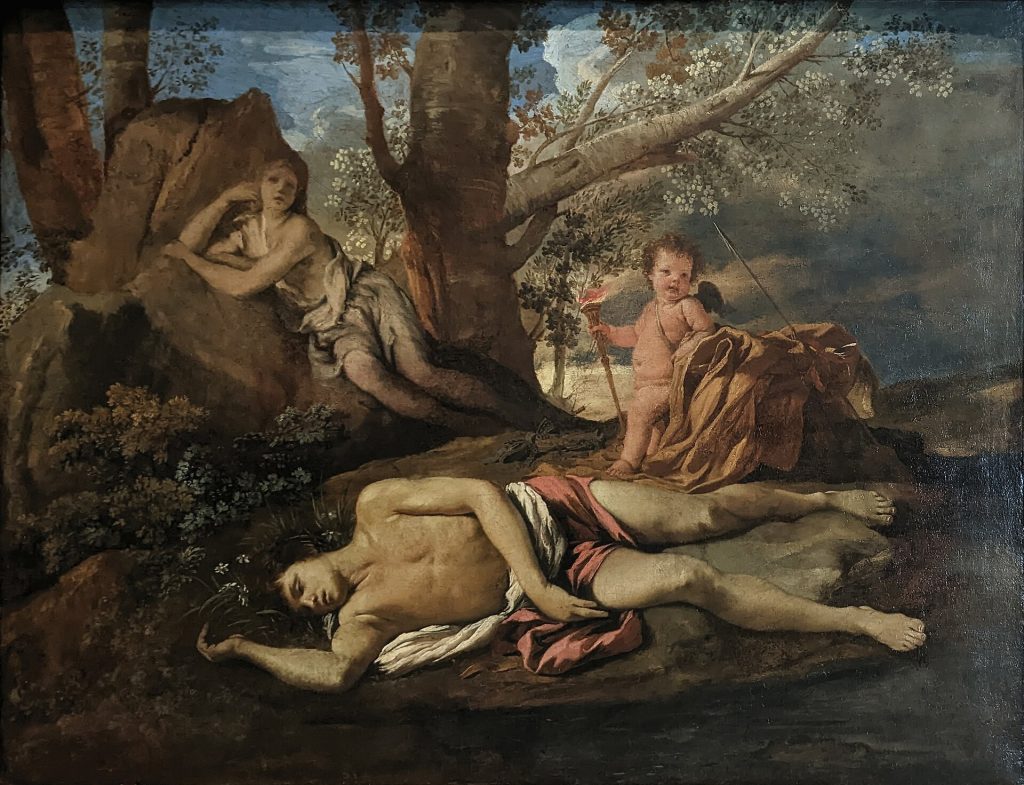
Above those dark waters, the mourners find another form:
“His Naiad sisters lamented him, and laid their hair, cut off, over their brother; the Dryads, too, lamented him, and Echo resounded to their lamentations. And now they were preparing the funeral pile, and the shaken torches, and the bier. The body was nowhere to be found. Instead of his body, they found a yellow flower, with white leaves encompassing it in the middle.”
Ovid, Metamorphoses 3.506–510, translated by Henry Thomas Riley (1851). Read passage
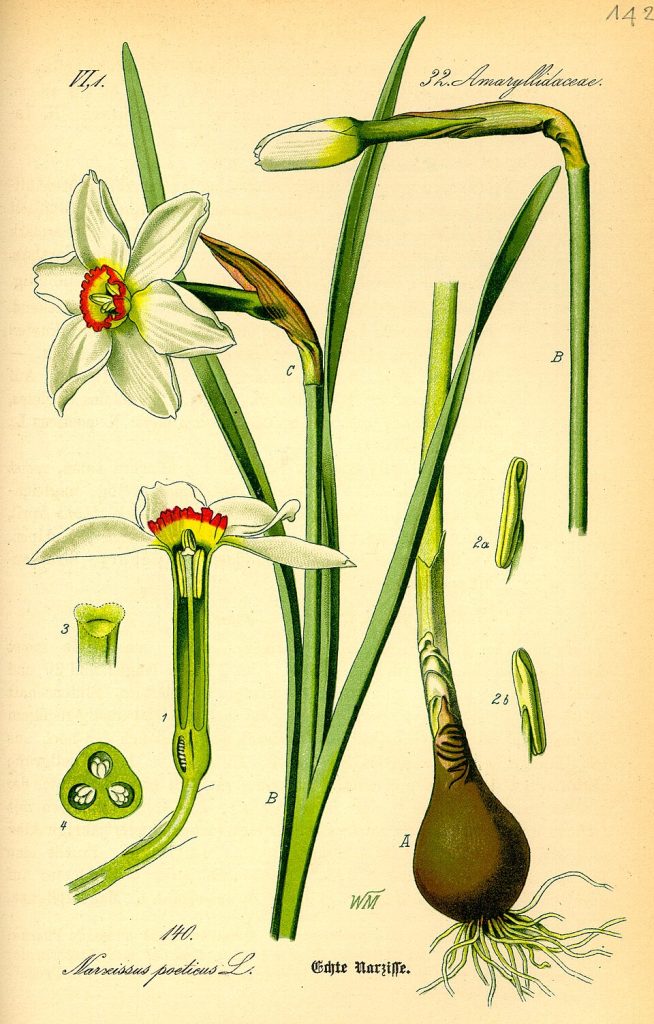
The individual body disappears, but beauty remains visible. What belonged to a single youth now lives in the image of a flower. His name passes from the person into nature, and the spring receives a beauty no longer enclosed in the body that first contemplated it.
Claudian places Narcissus beside Hyacinthus among the flowers gathered by the goddesses:
“Thee also, Hyacinthus, they gather, thy flower inscribed with woe, and Narcissus too — once lovely boys, now the pride of flowering spring. Thou, Hyacinthus, wert born at Amyclae, Narcissus was Helicon’s child; thee the errant discus slew; him love of his stream-reflected face beguiled; for thee weeps Delos’ god with sorrow-weighted brow; for him Cephisus with his broken reeds.”
Claudian, The Rape of Proserpine II, flower-gathering passage, translated by Maurice Platnauer (1922), vol. II, p. 329. Read passage
The grief remains, but the beautiful form is renewed. Read through the movement from the individual to the universal, the flower releases beauty from exclusive possession by one person. The youth’s particular life ends; what made that life worthy of contemplation returns in a form others can encounter.
Pausanias adds that the flower was already known before the youth, appealing to a poem attributed to Pamphus about Persephone gathering it. His account reverses the movement: the flower need not receive its existence from Narcissus for the story to give its beauty a human face. Pausanias, 9.31.9
Ovid leaves two images together: a shade bent over dark water and a flower opening in the world above. One preserves the longing of the individual; the other gives beauty back to nature.
Narcissus and Christ: water and cleansing
Water is symbolic of cleansing in both Narcissus’s encounter and Christian baptism. The clear spring draws Narcissus away from the claims of society and into an encounter with his own nature. In the Christian tradition, water likewise signifies purification and renewal.
“Let us draw near with a true heart in full assurance of faith, having our hearts sprinkled from an evil conscience, and our bodies washed with pure water.”
Hebrews 10:22, King James Version. Read passage
The outward purity of water makes inward cleansing visible. In this symbolic reading, Narcissus’s spring washes away the surrounding social world so that beauty can appear; baptism expresses the cleansing through which a life is renewed. The connection is the water itself: a return to clarity, a laying aside of what obscures, and an encounter with what remains.
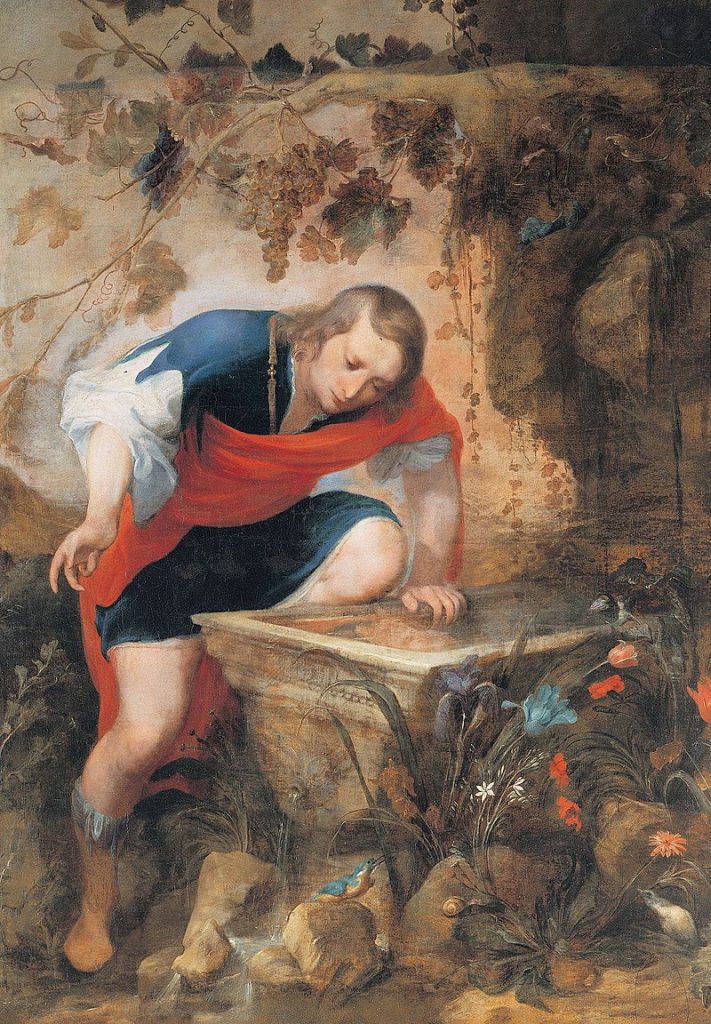

Jan Roos, Narcissus at the Spring, painted between 1610 and 1638, and Piero della Francesca, The Baptism of Christ, after 1451, National Gallery, London. Narcissus bends over the water to look at himself. Christ stands in it to be washed. Piero paints the Jordan so still that the landscape behind is mirrored in its surface.
A mirror for the reader
The spring has the structure of a dream. Someone is before you; every movement promises recognition; the least possible distance remains uncrossable. Then the face becomes your own, or the face of someone you have lost.
Imagine the discovery before explaining it. You have gone out into the world and met something beautiful. Only afterward do you realize that what drew you beyond yourself was already bound to you. Recognition changes the meaning of the desire without taking away its force.
Narcissus makes that awakening visible. He refuses a life measured only by its usefulness to others, discovers a beauty that seems sufficient in itself, and reaches for a unity the reflected form cannot give him. His solitude holds both the freedom of withdrawal and the intensity of a bond he cannot release.
The body passes; the name moves into a flower. What he tried to possess as his alone opens on the bank for other eyes.
Primary texts and editions
Ovid: Metamorphoses 3.339–510, translated by Henry Thomas Riley (1851), in the historical reprints transcribed by Project Gutenberg. The Latin is available here. The edition’s separate “Explanation” sections are later commentary, not Ovid’s narrative.
Pausanias: Description of Greece 9.31.7–9, translated by A. R. Shilleto (1886), vol. II, pp. 198–199. Read source. The twin-sister account is introduced as the alternative Pausanias records.
Pliny: Natural History 21.75, translated by John Bostock and H. T. Riley (1855). Read source. His explanation of the flower-name is an ancient etymological association. Modern discussion of its disputed derivation is in the Online Etymology Dictionary.
Aristotle: Politics I.2, 1253a, translated by Benjamin Jowett (1885). Read source.
Hegel: The Philosophy of Fine Art, vol. I, “The Beauty of Nature,” p. 171, translated by F. P. B. Osmaston (1920). Read source. Beauty-in-itself and its awakening in Narcissus are the essay’s philosophical application of this passage.
Claudian: The Rape of Proserpine II, translated by Maurice Platnauer (1922), vol. II, p. 329. Read source.
Bible: Hebrews 10:22, King James Version. Read passage. The comparison concerns water as a symbol of cleansing.
Conon: Narrations 24, known only from the summary in Photius, Bibliotheca codex 186, ninth century. Quoted in a new English translation prepared for this article from the Greek. Greek text; compare Brady Kiesling’s modern translation on ToposText. Conon’s full text does not survive.
Nonnus: Dionysiaca 48.582ff., translated by W. H. D. Rouse (Loeb, 1940). Paraphrased. The passage names Endymion as father and does not name a mother. Greek text.
Philostratus the Elder: Imagines 1.23, and Callistratus: Descriptions 5, both translated by Arthur Fairbanks (Loeb, 1931). Consulted, not quoted. The painting Philostratus describes has not been identified with any surviving work. Read Philostratus.
Papyrus: P.Oxy. LXIX 4711 preserves fragmentary Greek elegiac verses describing attraction to a reflected form and blood shed upon the earth. W. B. Henry proposed Parthenius as the author; Hans Bernsdorff argued against the attribution and for a later composition. The date of the papyrus copy is not the date of the poem, and the surviving fragment is too broken to reconstruct a complete story.
Further allusions: Ovid, Fasti 5.222ff.; Statius, Thebaid 7.340ff.; and Claudian, The Rape of Proserpine 2.130ff., quoted above, are short references to the flower and to mourning. Plotinus, Enneads I.6.8, “On Beauty,” uses an unnamed figure who follows a beautiful appearance in water and is lost, in an argument about sensible and intelligible beauty. John Tzetzes, Chiliades I, story 9, lines 235–266, is a twelfth-century Byzantine account that describes a drowning and the naming of the flower.
The English historical translations quoted above are public-domain texts in the United States. Original translated wording is retained; quotation-mark styles and line wrapping are normalized. Nonnus is paraphrased rather than quoted, because the available English translation is modern. The Conon passage is a new translation made for this article. The essay’s social, philosophical, and symbolic readings accompany the primary narratives rather than forming additional episodes in them. These notes record the principal surviving narrative and interpretive witnesses consulted, not every ancient reference to Narcissus.