The sleeper who receives what other heroes pursue.
Most heroes enter their stories with a deed. Endymion enters ours with a surrender of effort.
The hand relaxes. The day’s vigilance loosens its hold. What seemed impossible to put down a moment before passes out of reach: the task, the worry, the need to remain in command. Sleep does not argue with these demands. It lets them fall silent.
Endymion gives that familiar release a mythic body. He is the beautiful youth loved by Selene, the moon: a shepherd in the pastoral telling, a king in the royal tradition. In the account preserved by Pseudo-Apollodorus, perpetual sleep is not merely something done to him: it is the destiny he chooses. Library 1.7.5
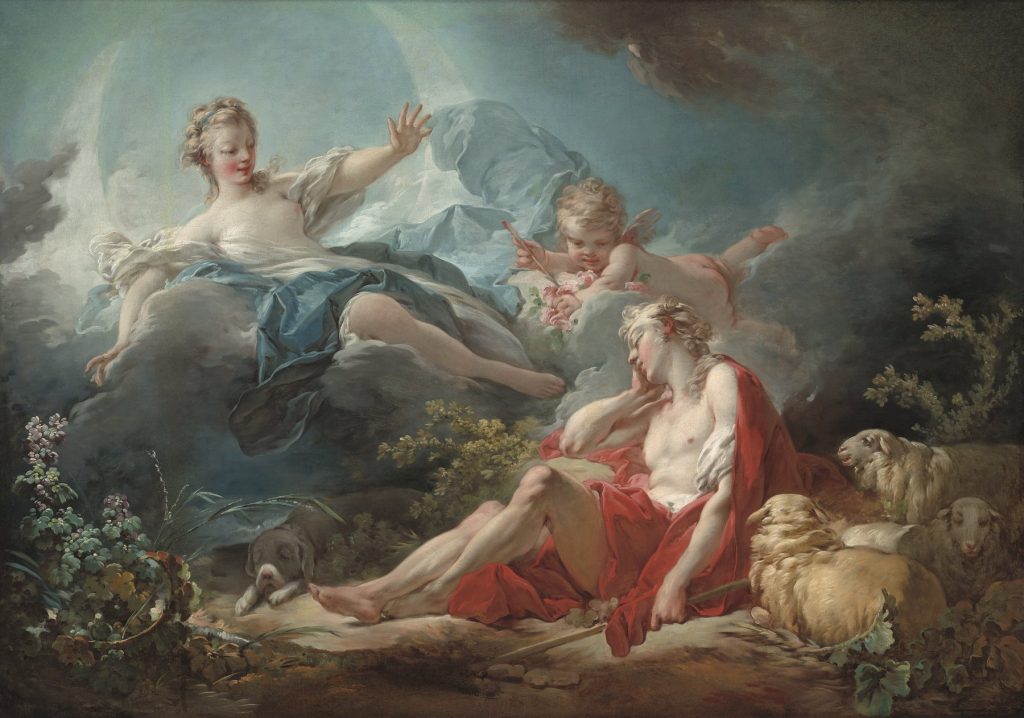
What would it mean to be loved when one is no longer performing, producing, defending, or proving anything? The story brings a goddess to the place where a man has laid those activities aside.
The shepherd and the astronomer
Before the beloved sleeper, there is the young shepherd beneath the open sky. In the pastoral tradition, Endymion tends his animals on Latmus; Quintus Smyrnaeus places him asleep beside his cattle when Selene descends to him. The beauty she discovers belongs to a life already lived outdoors. Quintus, Fall of Troy 10.127ff.
Picture him keeping the night watch, his shepherd’s staff at hand. His attention moves from the animals on the hillside to the stars above them. The moon rises over the ridge, lights the ground around his flock, and travels on. Another night brings another position, another shape. What begins as vigilance over the animals becomes a patient study of the heavens.
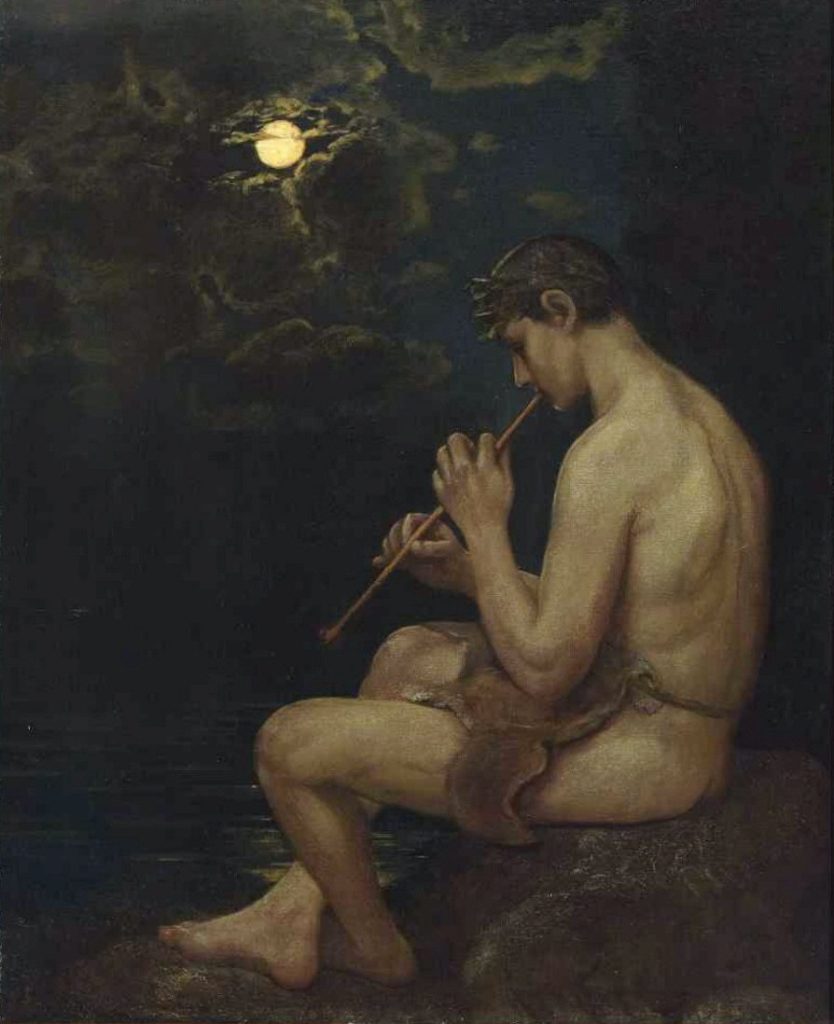
Endymion is also an astronomer of myth. Pliny credits him as the first man to recognize the changes he describes in the moon’s course. The lover’s story grows around the observer’s knowledge. Pliny, Natural History 2.43, Latin text
“Sometimes she is low down, sometimes she is high up, and that not according to one uniform course, being at one time raised up to the heavens, at other times almost contiguous to the mountains; now elevated in the north, now depressed in the south; all which circumstances having been noticed by Endymion, a report was spread about, that he was in love with the moon.”
Pliny the Elder, Natural History 2.43, translated by John Bostock and H. T. Riley (1855). Read the passage
He watches often enough to recognize the differences that a passing glance would miss. What first appears to be the same light returning becomes a presence with its own rhythms. His nights give him time to learn what daylight conceals.
Nonnus makes the astronomical work more tangible. Among the discoveries foretold in his poem, Endymion follows the moon’s changes by counting on his fingers:
“And wise Endymion, bending his fingers in different ways, will learn the three changing phases of the returning Moon.”
Nonnus, Dionysiaca 41.379–381. New English rendering from the Greek prepared for this article. Read the Greek
The hand that tends the flock becomes a means of reckoning the heavens. His attention is not merely a beautiful stare: it notices, remembers, and counts.
This astronomer’s reputation reaches even to Galileo. In L’Adone (1623), Giambattista Marino celebrates Galileo’s telescopic observation by addressing him as a new Endymion:
“You, a new Endymion, will be able to gaze upon her naked, with no veil hiding anything.”
Giambattista Marino, L’Adone X.43, final two lines. New English rendering from the Italian prepared for this article. Read the stanza
The telescope becomes another way of approaching the beloved. Greater knowledge brings her closer without exhausting the wonder that first drew the watcher’s eye.
Observation turns into devotion when knowing the movements of a thing is no longer separable from loving its return.
The myth answers that attention with attention. The man watches the moon; the moon begins to watch the man.
His name: sinking into sleep
Endymion comes from Greek Endymiōn (Ἐνδυμίων). A proposed derivation connects it with endyein (ἐνδύειν), entering or sinking into something, hence the suggested meanings “diver” or “plunger.” The same family of imagery can describe a heavenly light sinking from sight. This is a proposed name-history, not a certain explanation of the myth’s origin. Name and word history
Beside the name stands the word at the center of his fate: hypnos (ὕπνος), sleep or slumber, also the name of the god Sleep. Greek lexical entry
To sink into sleep is to pass beneath the surface on which the waking person is recognized: his speech, his work, his visible intentions. Endymion’s retreat into the mountain carries that movement into the landscape. The man disappears from ordinary activity without disappearing from divine attention.
The cave gives sleep a dwelling. Beyond its threshold, the daylight world continues; within it, the sleeper is held apart from the hours that would otherwise spend his life.
The gift he chose
Pseudo-Apollodorus places the choice inside a life that already has ancestry and a kingdom:
“Calyce and Aethlius had a son Endymion who led Aeolians from Thessaly and founded Elis. But some say that he was a son of Zeus. As he was of surpassing beauty, the Moon fell in love with him, and Zeus allowed him to choose what he would, and he chose to sleep for ever, remaining deathless and ageless.”
Pseudo-Apollodorus, Library 1.7.5, translated by J. G. Frazer (1921). Read the passage
The choice is the turning point. Offered the power to determine his condition, Endymion does not ask for an endless succession of conquests or another kingdom. He chooses the repose itself.
For a mortal, more time ordinarily means more change. The body that receives a lover’s first attention cannot remain exactly as it was. A wish for endless life therefore leaves another question unanswered: what kind of life will continue, and what will time do to it?
Endymion’s gift joins three things that ordinary experience separates: sleep, freedom from death, and freedom from aging. His rest does not consume the youth it preserves. What would normally be a brief retreat between one day’s demands and the next becomes a condition without an approaching summons.
He has not earned a holiday before returning to his labors. The myth imagines rest no longer justified by the work it enables afterward.
That gives his beauty a peculiar independence. It need not become useful, productive, or victorious in order to remain worthy of a goddess’s attention. The hand can release its weapon without losing what drew her to him.
The goddess comes down
Lucian lets Selene describe the visit herself.
In his dialogue, Aphrodite teases the moon about stopping her chariot over Caria to gaze at Endymion. Selene blames Eros; Aphrodite, who has troubles enough with her own son, eventually asks about the mortal who has caused all this commotion:
APHRODITE: “But tell me, is Endymion handsome? That is always a comfort in our humiliation.”
SELENE: “Most handsome, I think, my dear; you should see him when he has spread out his cloak on the rock and is asleep; his javelins in his left hand, just slipping from his grasp, the right arm bent upwards, making a bright frame to the face, and he breathing softly in helpless slumber. Then I come noiselessly down, treading on tiptoe not to wake and startle him—but there, you know all about it; why tell you the rest? I am dying of love, that is all.”
Lucian, Dialogues of the Gods, “Aphrodite and Selene,” 19 (11), translated by H. W. and F. G. Fowler (1905). Read the dialogue
The shepherd’s staff and the hunter’s javelins give Endymion two familiar identities of life outdoors. Lucian shows us the hunter: the javelins are slipping, and the hand once ready to act no longer holds its weapons firmly. His cloak has become a bed, and the raised arm frames the face rather than shielding it. Selene sees him when the hunt has left him. Pastoral staff; Lucian’s dialogue
Nothing in that moment has to be won by force. His beauty requires no performance. The goddess does not ask him to resume his task, prove his worth, or rise to meet the demands of heaven. She comes down.
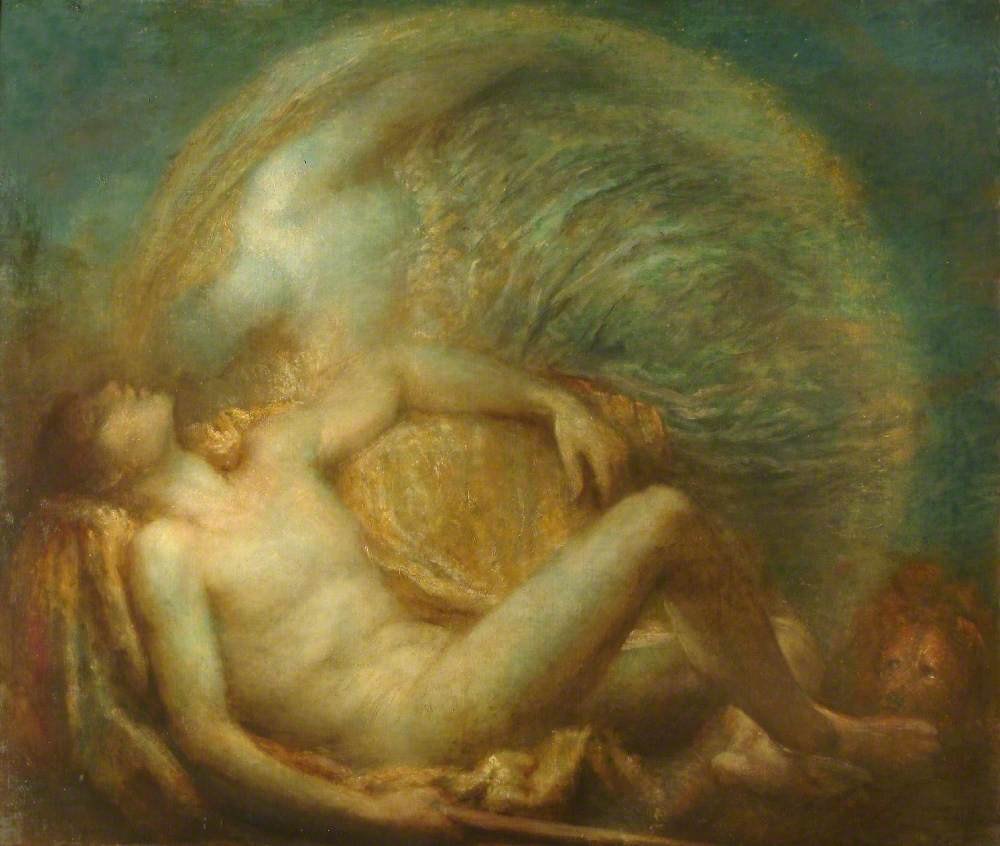
Her careful steps give the descent its intimacy. Something powerful enough to travel above the earth becomes attentive to the smallest disturbance it might cause upon it. The sleeping man does not adapt himself to her arrival; she adjusts her approach to his rest.
The movement reverses the familiar longing to leave the earth behind. Here the mortal rests upon it, and something divine crosses the distance. His stillness does not make him invisible. It makes possible another kind of being seen.
The cave and the restless moon
Endymion’s stillness does not mean that Selene’s love is always tranquil.
In Apollonius of Rhodes, the moon sees Medea fleeing in distress over Jason. Remembering how Medea’s magic has interrupted her own journeys, Selene recognizes another lover caught by the power that draws her to Endymion:
“Not I alone then stray to the Latmian cave, nor do I alone burn with love for fair Endymion; oft times with thoughts of love have I been driven away by thy crafty spells, in order that in the darkness of night thou mightest work thy sorcery at ease, even the deeds dear to thee. And now thou thyself too hast part in a like mad passion; and some god of affliction has given thee Jason to be thy grievous woe. Well, go on, and steel thy heart, wise though thou be, to take up thy burden of pain, fraught with many sighs.”
Apollonius of Rhodes, Argonautica 4.57–65, translated by R. C. Seaton (1912). Read the passage
The goddess speaks with the sharp satisfaction of someone no longer alone in her predicament. Medea’s knowledge cannot place her beyond longing, any more than Selene’s divinity places her beyond it.
This gives the scene two different kinds of time. Endymion rests; Selene travels, desires, and returns. The still body becomes the destination of a moving heaven.
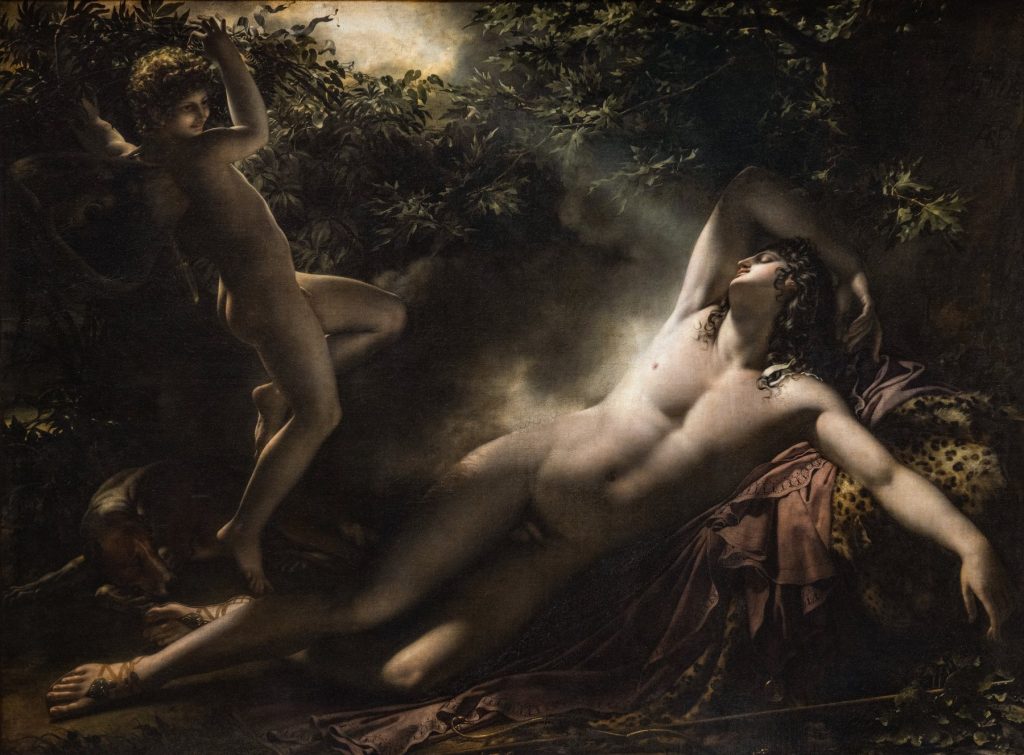
The cave is therefore more than a place of withdrawal. It is a meeting place. The darkness that removes the sleeper from ordinary sight also shelters the arrival of the light that seeks him.
His repose does not empty the world of desire. It gives desire somewhere to return.
When Sleep falls in love
Another ancient telling makes Sleep himself the lover.
Athenaeus preserves the poet Licymnius’s account of Hypnos and Endymion. The nineteenth-century translator Charles Duke Yonge uses the Latin name Somnus for the god:
“And Licymnius the Chian, saying that Somnus was in love with Endymion, represents him as refusing to close the eyes of the youth even when he is asleep; but the God sends his beloved object to sleep with his eyelids still open, so that he may not for a single moment be deprived of the pleasure of contemplating them.”
Athenaeus, Deipnosophistae 13.17, 564c, reporting Licymnius; translated by C. D. Yonge (1854), vol. III, pp. 902–903. Read the passage
The alteration is small and extraordinary. The power that ordinarily closes the eyes keeps these eyes open because it loves what would otherwise be hidden.
Endymion need not remain awake to preserve their beauty. Sleep finds a way to possess its own contrary: a face surrendered to rest that still appears to look outward.
This is the divine gaze in its most concentrated form. Selene descends to contemplate the sleeper; Hypnos changes the conditions of sleep so that contemplation need never cease. In both, Endymion’s beauty outlasts his conscious effort to present himself.
His stillness is not the absence of a relationship. It becomes the condition around which the lover arranges one.
The sleeper who was also a king
Pausanias preserves a different expanse of Endymion’s life: wives, children, a contest, and a throne.
“The Moon, they say, fell in love with this Endymion and bore him fifty daughters. Others with greater probability say that Endymion took a wife Asterodia—others say she was Cromia, the daughter of Itonus, the son of Amphictyon; others again, Hyperippe, the daughter of Arcas—but all agree that Endymion begat Paeon, Epeius, Aetolus, and also a daughter Eurycyda. Endymion set his sons to run a race at Olympia for the throne; Epeius won, and obtained the kingdom, and his subjects were then named Epeans for the first time.”
Pausanias, Description of Greece 5.1.4, translated by W. H. S. Jones and H. A. Ormerod (1926). Read the passage
The royal branch gives “prince of dreams” another resonance. Endymion is not remembered only as a figure removed from human affairs. He also belongs to the ancestry through which communities explain their names and succession.
The race makes a useful contrast with the sleeping figure. His sons must move to determine who will inherit. Their father’s place in the tale is already established. One generation strains toward a future that the other prepares to leave behind.
Pausanias also preserves two local answers to the question of where Endymion went:
“As to the death of Endymion, the people of Heracleia near Miletus do not agree with the Eleans for while the Eleans show a tomb of Endymion, the folk of Heracleia say that he retired to Mount Latmus and give him honor, there being a shrine of Endymion on Latmus.”
Pausanias, Description of Greece 5.1.5, translated by W. H. S. Jones and H. A. Ormerod (1926). Read the passage
A tomb fixes the end of a life in the community’s memory. A retirement into the mountain lets absence remain something other than a final departure. Both give the missing man a place where he can still be approached.
The branches need not become one continuous biography to illuminate one another. Endymion can belong to a royal past and to a night that never finishes. The community remembers what he founded; the lover preserves what she finds beautiful.
Nonnus: the father of Narcissus
Nonnus supplies an ancient connection to another beautiful figure held outside ordinary activity. In a passage describing flowers around a spring, he makes Endymion the father of Narcissus:
“There were clustered blossoms bearing the name of graceful Narcissus, whom Endymion, the bridegroom of horned Selene, begot beside leafy Latmus. The beautiful youth had once seen the water shape itself into a likeness of his own form; beguiled by its silent appearance, he died gazing at the shadowy image of his form.”
Nonnus, Dionysiaca 48.581–586. New English rendering from the Greek prepared for this article. Read the Greek
In this genealogy, the father rests beneath another’s gaze, while the son is held by his own. Both withdraw from the ordinary movement of a life, but the direction of attention differs.
Narcissus bends toward an appearance he cannot embrace. Endymion is the one approached. The spring gives the son his own beauty back to him; the moon brings the father a beauty beyond himself.
Their stories also preserve beauty differently. Narcissus passes into the flower. Endymion remains the sleeping body that time is not allowed to alter. One survives through transformation; the other through suspension.
Read beside Narcissus: Beauty Awakens, Endymion becomes more than another example of an exceptionally beautiful youth. He is the other side of the encounter: not the one who cannot stop looking, but the one whose beauty continues to draw a gaze after his own eyes have closed.
Sleep links humanity to the unchangeable
The unchangeable in this reading is not the moon’s visible shape. Pliny has already shown us a light continually altering its appearance. What the story preserves is the relationship between that returning light and the figure who remains beneath it.
Ordinary life carries an almost endless sequence of demands: finish this task, answer this person, prepare for tomorrow. Even rest can become another obligation, undertaken only to restore the strength needed for further work.
Endymion gives repose a value that does not depend on its usefulness afterward. His sleep does not serve a coming day. It is the condition in which the myth holds him close to something enduring.
The aesthete whose papers appear in Kierkegaard’s Either/Or gives a mischievous expression to this wish:
“I divide my time this way: for half of it I sleep; for the other half I dream. When I sleep I never dream—that would be a pity; for sleeping is genius at its highest.”
Søren Kierkegaard, Either/Or, Part I, “Diapsalmata” (1843), the voice of A. New English rendering from the Danish prepared for this article. Read the original
The wit lies in making the surrender of effort sound like an accomplishment. Endymion carries that reversal into myth. Where other heroes distinguish themselves by what they do, his most enduring distinction arrives when action ceases.
Imagine the moment just before sleep, when the room remains around you but its objects stop asking to be used. The unfinished work is still there. So is tomorrow. Yet neither can quite hold you. A thought begins to lose its edges; a familiar place becomes another place; something no longer governed by intention approaches.
Endymion gives that threshold a face. The dreamlike force of the scene lies in being present without having to remain in command of one’s presence, and in letting the world go without becoming lost to it.
Return, then, to Lucian’s sleeper. His cloak rests on the rock. The javelins loosen in his hand. Selene steps down quietly, careful not to startle him.
He does not rise to meet the sky.
Endymion sleeps, and the sky remembers him.
Primary texts and editions
Pseudo-Apollodorus: Library 1.7.5, J. G. Frazer’s 1921 translation. The full paragraph supplies the ancestry, founding of Elis, the moon’s love, and the chosen deathless, ageless sleep. Text
Pliny: Natural History 2.43, in chapter II.9 of the Bostock–Riley translation (1855). Pliny supplies an ancient explanation of the love story through lunar observation. His Latin explicitly credits Endymion as the first man to discern the lunar variations just described (hominum primus). That is Pliny’s attribution within an ancient account, not an independently established priority in the history of astronomy. The historical English quotation is retained without alteration. English text · Latin text
Lucian: Dialogues of the Gods, “Aphrodite and Selene,” H. W. and F. G. Fowler (1905). The dialogue is numbered 11 in Fowler and 19 in the alternative numbering used by Theoi. The quotation reproduces the closing question and Selene’s complete answer; the earlier conversation is summarized. Text
Apollonius of Rhodes: Argonautica 4.57–65, R. C. Seaton (1912). Selene’s speech concerns Medea’s flight and the goddess’s own love for Endymion. Text
Athenaeus: Deipnosophistae 13.17, 564c, reporting Licymnius; C. D. Yonge (1854), vol. III, pp. 902–903. The quoted prose is Athenaeus’s report, not a complete surviving poem by Licymnius. “Somnus” is retained from Yonge. Text
Pausanias: Description of Greece 5.1.4–5, in vol. II of the Loeb edition, translated by W. H. S. Jones and H. A. Ormerod (1926). The family, succession race, and differing local memories are presented as Pausanias records them. Text
Nonnus: Dionysiaca 41.379–381 describes Endymion’s finger-reckoning and the moon’s threefold changes; 48.581–586 names him as Narcissus’s father and then recalls the reflection. Both English passages are newly rendered from the ancient Greek, not taken from W. H. D. Rouse’s twentieth-century translation. The second passage calls Endymion Selene’s bridegroom; it does not separately identify Narcissus’s mother. Book 41, Greek · Book 48, Greek
Kierkegaard: Either/Or, Part I, “Diapsalmata” (1843), consulted in the Danish text of the 1878 edition. The English aphorism is newly rendered here. Its speaker is A, the work’s aesthete. Danish text
Quintus Smyrnaeus: Fall of Troy 10.127ff., the passage placing Endymion beside his cattle at Latmus, paraphrased from A. S. Way’s translation. The imagined night-watch scene brings the pastoral and astronomical traditions together; it is not quoted as an episode narrated in full by one ancient author. Primary-text excerpt
Giambattista Marino: L’Adone (1623), canto X, stanza 43. The last two lines are newly rendered from the Italian. Marino addresses Galileo as a “new Endymion”; this is not a statement by Galileo that Endymion was the first astronomer. The quoted lines concern the unveiled view of the moon. Original Italian
Staff and javelins: The pastoral staff is attested, for example, in the Metropolitan Museum’s catalogue description of Guercino’s Endymion Sleeping. Lucian’s dialogue instead gives him javelins, and its quoted wording is preserved. Museum catalogue description
Words: The proposed derivation of Endymiōn follows the Online Etymology Dictionary. The meaning of hypnos is attested in Liddell–Scott–Jones. Name interpretation, dream imagery, and the reading of repose are the essay’s analysis, not additional episodes attributed to the ancient authors.
The historical English editions quoted here date from 1854–1926 and are public-domain texts in the United States. The Nonnus, Marino, and Kierkegaard renderings were prepared for this article. Quotation marks, paragraph layout, and dash spacing have been normalized; no historical translation has been silently rewritten.