The gods asked him to settle their quarrel. They took his eyes for the answer, and gave him the future in exchange
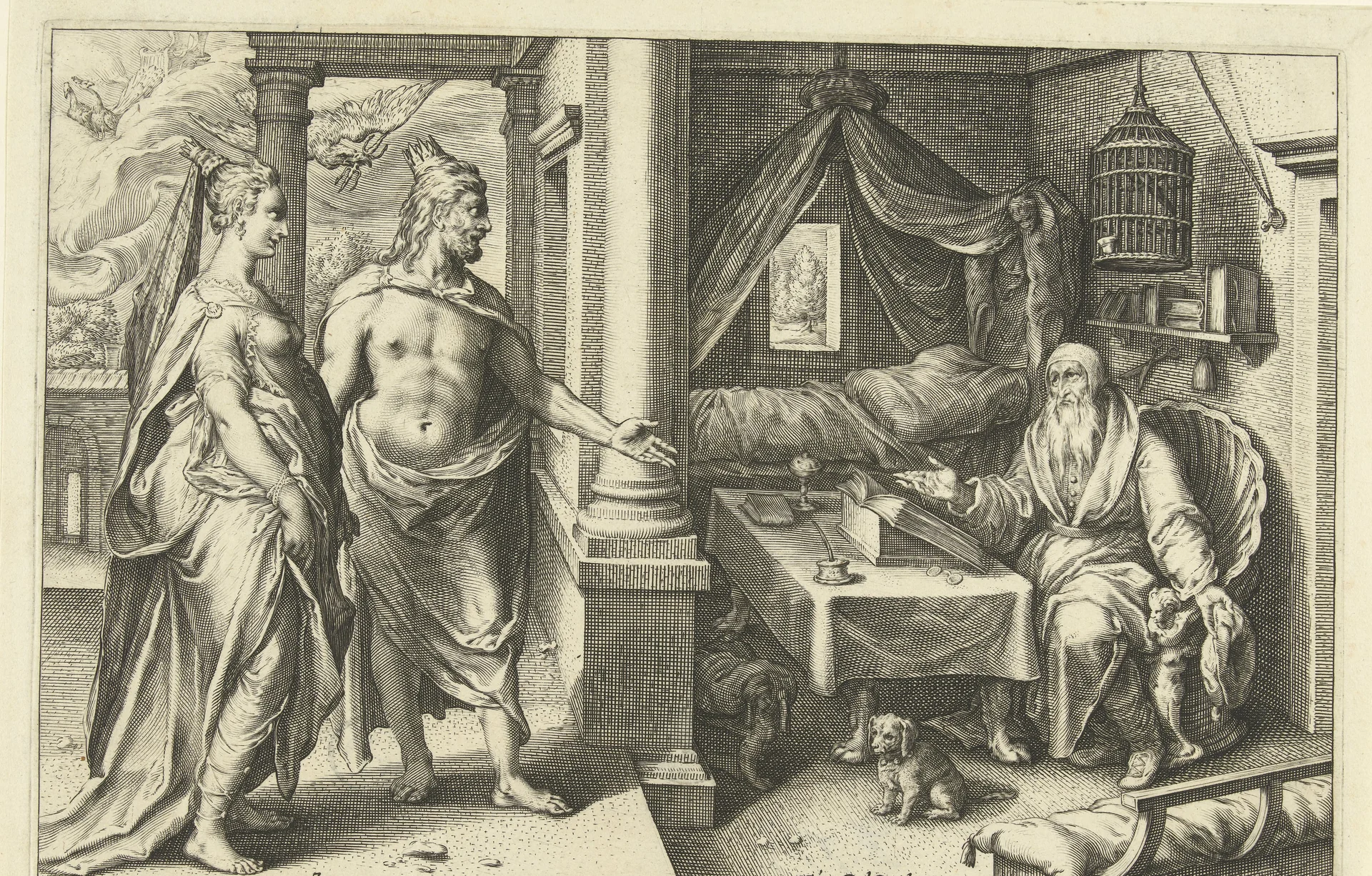
Opening illustration: Juno and Jupiter come to consult Tiresias, engraving after Hendrick Goltzius, published by Robert de Baudous in a series of prints after Ovid’s Metamorphoses, 1615. Rijksmuseum, Amsterdam, RP-P-1882-A-6389. CC0.
Zeus and Hera disagree about pleasure. He says women receive more of it than men; she denies it. They decide to consult someone whose experience crosses the line they are arguing about.
Tiresias has lived as both a man and a woman. He has not yet received the gift that will make him famous, the ability to know what is coming.1
Apollodorus names his parents as Everes and the nymph Chariclo and traces his family to Udaeus, one of the Spartoi. Udaeus was one of the five who survived the field where Cadmus threw stones among the armed men sown from the dragon’s teeth, and each took his brother for the attacker. The future seer comes from the line that began with that mistake.2
The gods come to him for something he already knows.
The Two Lives
And while these things are transacted on earth by the law of destiny, and the cradle of Bacchus, twice born, is secured; they tell that Jupiter, by chance, well drenched with nectar, laid aside all weighty cares, and engaged in some free jokes with Juno, in her idle moments, and said: “Decidedly the pleasure of you, females, is greater than that which falls to the lot of us males.” She denied it. It was agreed between them, to ask what was the opinion of the experienced Tiresias.
To him both pleasures were well known. For he had separated with a blow of his staff two bodies of large serpents, as they were coupling in a green wood; and (passing strange) become a woman from a man, he had spent seven autumns.
In the eighth, he again saw the same serpents, and said, “If the power of a stroke given you is so great as to change the condition of the giver into the opposite one, I will now strike you again.” Having struck the same snakes, his former sex returned, and his original shape came again. He, therefore, being chosen as umpire in this sportive contest, confirmed the words of Jove.
The daughter of Saturn is said to have grieved more than was fit, and not in proportion to the subject; and she condemned the eyes of the umpire to eternal darkness.
But the omnipotent father (for it is not allowed any God to cancel the acts of another Deity) gave him the knowledge of things to come, in recompense for his loss of sight, and alleviated his punishment by this honor.
— Ovid, Metamorphoses 3.316–338, translated by Henry Thomas Riley.1
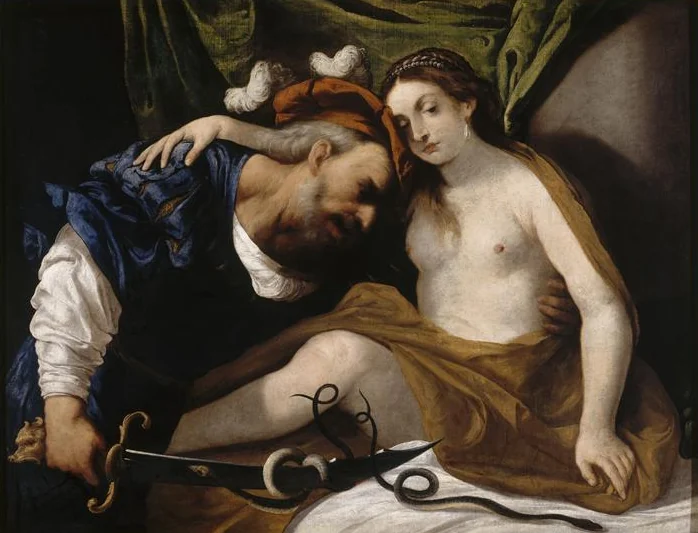
The beginning is almost casual. Zeus has been drinking, and the immortals have set aside their serious business for a quarrel that costs them nothing. The cost falls on the person invited to settle it.
The Staff in the Wood
The snakes are coupling, not attacking. Tiresias strikes the joined bodies and finds his own body changed. Ovid gives no reason for the power that answers the blow, and neither snake is said to die.1
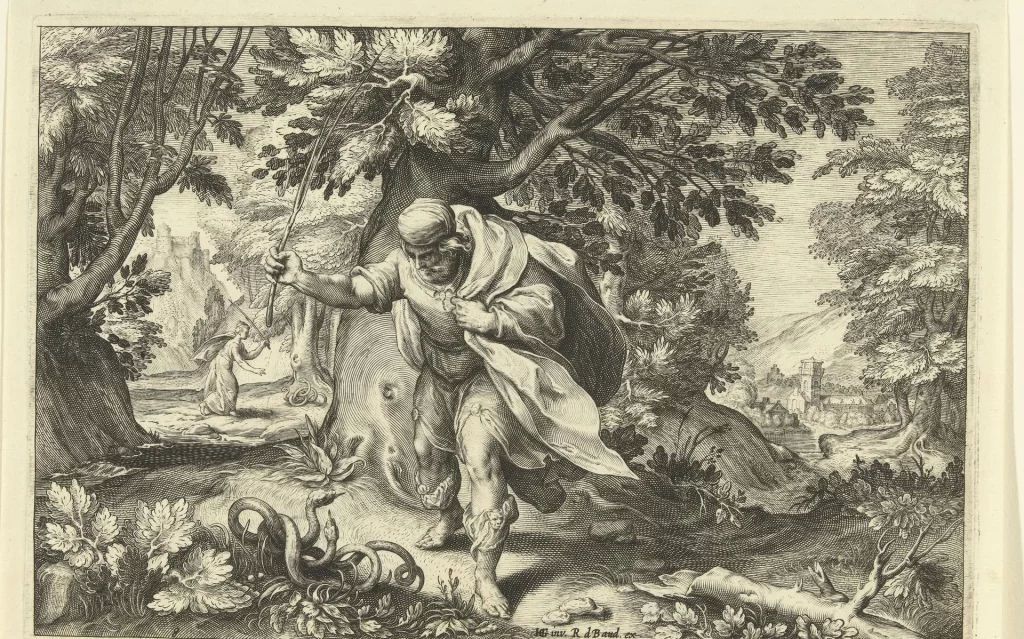
At the second meeting Tiresias has what the first could not give him: knowledge of what the blow can do. He reasons from what happened before, strikes again, and gets his own shape back. The first change was something that happened to him, and he lived inside it for seven autumns. The second is a choice made from the memory of that life.
That memory is why the gods send for him. They do not want a man who has only watched women, or a woman who can speak only from one side. They want someone who has crossed from one condition to the other and kept his mind across the crossing. It is his first kind of knowledge, and it comes from having lived, not from any god’s gift. Hera’s punishment falls between it and the second kind.
His Mother’s Companion
Callimachus tells the beginning another way. In his hymn the young Tiresias has no quarrel to settle and no years as a woman. His mother’s friendship brings him close to the gods:
Maidens, one nymph of old in Thebes did Athena love much, yea beyond all her companions, even the mother of Teiresias, and was never apart from her. But when she drave her steeds towards ancient Thespiae or towards Coroneia or to Haliartus, passing through the tilled fields of the Boeotians—or toward Coroneia where her fragrant grove and altars are set by the river Coralius—often did the goddess set the nymph upon her car and there was no dalliance of nymphs nor sweet ordering of dance, where Chariclo did not lead.
— Callimachus, Hymn 5: The Bath of Pallas 57–67, translated by A. W. Mair.3
One day the two bathe at the Horse’s Fountain on Helicon. Tiresias, ranging nearby with his dogs and parched with thirst, comes to the water and sees them without meaning to. Athena speaks in anger, and darkness takes his eyes. He stands unable to speak or move.3
His mother speaks for him, first to the goddess and then to the hill where her son had hunted:
Is such the friendship of you goddesses? Thou hast taken away the eyes of my son. Foolish child! Thou hast seen the breast and body of Athena, but the sun thou shalt not see again. O me unhappy! O hill, O Helicon, where I may no more come, surely a great price for little has been exacted. Losing a few gazelles and deer, thou hast taken the eyes of my child.
— Callimachus, Hymn 5, from lines 82–92, translated by A. W. Mair.3
She takes him in her arms and leads him away. Athena pities her, asks her to take back her angry words, and denies that she herself caused the blindness: Zeus’s law and the fate spun at his birth decided it, and it cannot be undone. But the friendship still counts for something, and the goddess offers what she says is in her power:
Therefore, O comrade, lament not; for to this thy son—for thy sake—shall remain many other honours from me. For I will make him a seer to be sung of men hereafter, yea, more excellent than any other. He shall know the birds—which is of good omen among all the countless birds that fly and what birds are of ill-omened flight.
Many oracles shall he utter to the Boeotians and many unto Cadmus, and to the mighty sons of Labdacus in later days. Also will I give him a great staff which shall guide his feet as he hath need, and I will give him a long term of life. And he only, when he dies, shall walk among the dead having understanding, honoured of the great Leader of Peoples.
— Callimachus, Hymn 5, from lines 117–130, translated by A. W. Mair.3
The Leader of Peoples is Hades. The promise reaches past a lifetime of prophecy to a place among the dead, where he alone will keep his mind.
In Apollodorus the mother asks for her son’s sight back, and the goddess, unable to restore it, gives other gifts instead. In Callimachus, Chariclo cries out against the blinding and asks whether this is the friendship of goddesses, and Athena answers with prophecy, a staff and a long life. Neither version gives him back the sun.
The Birds and the Cornel-Wood Staff
Apollodorus preserves a third version, which he credits to Pherecydes. Here Athena blinds Tiresias herself, covering his eyes with her hands. When Chariclo asks her to undo it, she cannot, so she changes what he can hear:
And when Chariclo asked her to restore his sight, she could not do so, but by cleansing his ears she caused him to understand every note of birds; and she gave him a staff of cornel-wood, wherewith he walked like those who see.
— Pseudo-Apollodorus, Library 3.6.7, translated by James George Frazer.2
The goddess who denies the blinding in the hymn does it with her own hands in Pherecydes. The versions agree that it cannot be reversed, and they agree on the staff. In Ovid, a staff struck the snakes and changed his life. Here a staff is given to help him walk through the life it changed.
The Mahābhārata asks the same question and finds nearly the same witness. Yudhiṣṭhira asks Bhīṣma which of the two, man or woman, “derives the greater pleasure from an act of union,” and Bhīṣma answers with King Bhaṅgāśvana, भङ्गाश्वन. Indra, nursing a grudge, sends him lost and thirsty to a lake, as Callimachus’s hunter came thirsty to Athena’s spring, and the water turns him into a woman. She leaves the kingdom to her hundred sons, bears a hundred more to an ascetic, and watches all two hundred kill one another at Indra’s prompting. Indra relents, brings them back and offers her either body. She stays a woman: “the pleasure that women enjoy is always much greater than what is enjoyed by men.” He says, “So be it.” The two witnesses give one answer. Tiresias has gone back to being a man and pays for his testimony with his eyes. Bhaṅgāśvana has paid before anyone asks her, and she keeps the body she is speaking from.4
What the Judge Is Allowed to Say
Ovid calls Tiresias an arbiter, “umpire,” and the word holds the whole problem. In classical Latin an arbiter could be an eyewitness as well as an umpire or judge. The gods chose a witness to settle their quarrel, and the punishment for his testimony was his eyes.5
Zeus and Hera authorise him to answer. They do not give up the power to punish the answer. He is not punished for speaking out of turn, since he was asked, and the narrator does not say he lied. His answer is the one thing his experience qualified him to give. The consultation promised that someone outside the quarrel would settle it, and Hera’s anger takes that promise back. A witness is welcome until his verdict goes the wrong way.
Ovid tilts the scene. He calls Hera’s anger excessive but gives her no speech; Zeus gets the witness’s support and the credit for the compensation. And Zeus’s help has its own limit: “it is not allowed any God to cancel the acts of another Deity.” He can add a gift. He cannot take away the punishment. The gods restrain one another, and the mortal bears what both of them did.1
An Honour Its Bearer Questions
A fragment of the Melampodia, a lost poem credited to Hesiod, gives Tiresias a voice of his own, speaking to Zeus:
Father Zeus, would that you had given me a shorter span of life to be mine and wisdom of heart like that of mortal men! But now you have honoured me not even a little, though you ordained me to have a long span of life, and to live through seven generations of mortal kind.
— Melampodia, fragment 2, translated by Hugh G. Evelyn-White.6
The occasion is lost. What survives is the seer refusing to call his long life and his wisdom a blessing. Seven generations is long enough to warn a city again and again, and to outlive everyone he warned. A gift made after a loss can give a life its meaning without making the loss just.
A Prophet in Thebes
Ovid follows the new seer’s gift with his first prophecy, the one about Narcissus, and when it comes true his fame spreads. Then a king mocks the mark of his injury:
This thing, when known, brought deserved fame to the prophet through the cities of Achaia; and great was the reputation of the soothsayer. Yet Pentheus, the son of Echion, a contemner of the Gods above, alone, of all men, despises him, and derides the predicting words of the old man, and upbraids him with his darkened state, and the misfortune of having lost his sight.
— Ovid, Metamorphoses 3.511–516, translated by Henry Thomas Riley.7
Pentheus looks at the one man in Thebes who can see what is coming and takes him for a blind old man. The seer answers him:
He, shaking his temples, white with hoary hair, says: “How fortunate wouldst thou be, if thou as well couldst become deprived of this light, that thou mightst not behold the rites of Bacchus. For soon the day will come, and even now I predict that it is not far off, when the new God Liber, the son of Semele, shall come hither. Unless thou shalt vouchsafe him the honor of a temple, thou shalt be scattered, torn in pieces, in a thousand places, and with thy blood thou shalt pollute both the woods, and thy mother and the sisters of thy mother. These things will come to pass; for thou wilt not vouchsafe honor to the Divinity; and thou wilt complain that under this darkness I have seen too much.”
— Ovid, Metamorphoses 3.517–525, translated by Henry Thomas Riley.7
The king who mocks a blind man will die for what he goes to see. The Greek for a seer is mantis, μάντις, from mainesthai, μαίνεσθαι, “be inspired,” the verb that also names the mainades, the madwomen of Dionysus who will tear Pentheus apart. Plato has Socrates say that the old name for prophecy was the manic art, manikē, μανική, and that “nowadays people call prophecy the mantic art, tastelessly inserting a T in the word.” Pentheus scorns the seer and the god’s women alike; in Greek they come from one word.8
John’s Gospel ends its story of the man born blind with the same reversal. After the healed man has been thrown out by people who would not accept his account, Jesus says he came “that they which see not might see; and that they which see might be made blind,” and tells those who ask whether they are blind too, “now ye say, We see; therefore your sin remaineth.” In both stories the people who say they see are the blind ones, and the blind man is the one who knows. They differ in what the speaker can do. Jesus gives the blind man his sight as well as judging the seeing; Tiresias can only say what is coming, to a king who will not hear it.9
Pentheus drives the old man away.
What is coming does not leave with him.
Sources and Translation Notes
1. Ovid, Metamorphoses 3.316–338, translated by Henry Thomas Riley (1851), Project Gutenberg; Latin at The Latin Library. The whole passage is quoted, with paragraphing adjusted and Riley’s marginal numbers removed. Bacchus is Dionysus; Jupiter or Jove and Juno are Zeus and Hera. Ovid gives seven autumns, a green wood, strokes of the staff rather than the killing of a snake, and no ratio of pleasure. Riley’s appended “Explanation” is his own commentary. ↩
2. Pseudo-Apollodorus, Library 3.6.7, translated by J. G. Frazer (1921), Theoi: Tiresias, “son of Everes and a nymph Chariclo, of the family of Udaeus, the Spartan,” where “Spartan” means one of the Spartoi. The five survivors of the stones, among them Udaeus and Echion, are at 3.4.1. Apollodorus also gives the Hesiodic version in which Tiresias judges that a woman has nine parts of the pleasure to a man’s one. ↩
3. Callimachus, Hymn 5, The Bath of Pallas, translated by A. W. Mair (1921), ToposText and Theoi. Lines 57–67 (Chariclo and Athena), 82–92 (her protest, quoted from its second question), 93–130 (Athena’s answer, quoted from “Therefore, O comrade”). Callimachus also has Athena compare Tiresias’s fate with Actaeon’s; that comparison is told in the Actaeon article. Callimachus wrote more than two centuries before Ovid, and his version of the blinding is a different tradition, not an earlier episode in the same life. ↩
4. Mahābhārata, Anuśāsana Parva, section 12, translated by Kisari Mohan Ganguli, Internet Sacred Text Archive. ↩
5. Ovid, Metamorphoses 3.332–334: arbiter and iudicis. Douglas Harper, “arbiter,” Online Etymology Dictionary: Latin arbiter, “one who goes somewhere (as witness or judge),” in classical Latin “used of spectators and eye-witnesses.” ↩
6. Melampodia, fragment 2 in Hugh G. Evelyn-White’s numbering (1914), quoted by Tzetzes on Lycophron 682, Theoi. The original setting of the speech is lost. Fragment 3, from a scholion on Odyssey 10.494, tells the snake story with a verdict of one part to the man and ten to the woman. ↩
7. Ovid, Metamorphoses 3.339–350 (Narcissus) and 3.511–527, Riley; Latin meque sub his tenebris nimium vidisse quereris, 3.525. Pentheus drives him away at 3.526. ↩
8. Douglas Harper, “mantic,” Online Etymology Dictionary: Greek mantis, “one who divines, a seer,” from mainesthai. Plato, Phaedrus 244c, translated by Harold N. Fowler (1914), Perseus. ↩
9. John 9:39–41, King James Version; Greek of 9:39 from the SBL Greek New Testament: ἵνα οἱ μὴ βλέποντες βλέπωσιν καὶ οἱ βλέποντες τυφλοὶ γένωνται. The questioning of the healed man is 9:13–34. ↩