He tried to cut away the stranger’s power. The blade fell within his own house
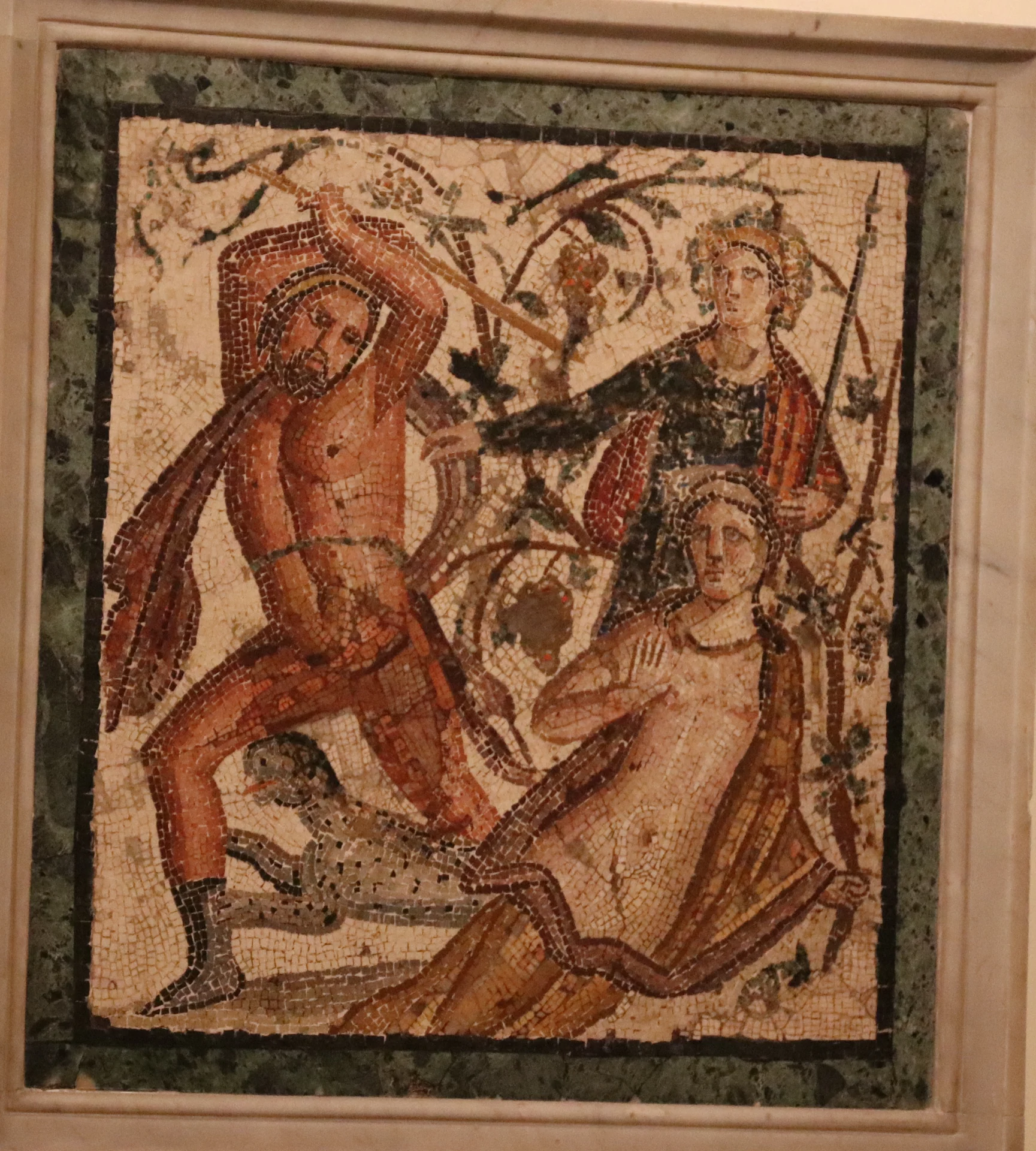
Opening illustration: the madness of Lycurgus. The king raises his axe over the nymph Ambrosia as she turns into a vine, while Dionysus looks on. Roman mosaic from Herculaneum, first century CE. National Archaeological Museum, Naples, inv. 9988. Photograph by Gary Todd, public domain, via Wikimedia Commons.
Before Lycurgus takes up the axe, he carries an ox-goad.
It is a tool for driving cattle. In Homer’s telling, he turns it on the women around Dionysus. The king knows how to scatter a company. He does not yet know what follows when it comes back.1
Dionysus Beneath the Waves
Dionysus left Phrygia wearing the costume Rhea gave him and set out through Thrace. The first king there to stand in his way was Lycurgus, son of Dryas, in Apollodorus king of the Edonians beside the river Strymon. In Apollodorus’s order of events the meeting comes after the purification at Cybela and before the passage through India and the return to Thebes.2
Homer recalls the confrontation in the middle of the Trojan War. Before fighting Glaucus, Diomedes asks whether the stranger is a mortal. He has no wish to repeat Lycurgus’s mistake:
Nay, for even the son of Dryas, mighty Lycurgus, lived not long, seeing that he strove with heavenly gods—he that on a time drave down over the sacred mount of Nysa the nursing mothers of mad Dionysus; and they all let fall to the ground their wands, smitten with an ox-goad by man-slaying Lycurgus.
But Dionysus fled, and plunged beneath the wave of the sea, and Thetis received him in her bosom, filled with dread, for mighty terror gat hold of him at the man’s threatenings. Then against Lycurgus did the gods that live at ease wax wroth, and the son of Cronos made him blind; and he lived not for long, seeing that he was hated of all the immortal gods.
— Homer, Iliad 6.130–140, translated by A. T. Murray.1
Homer’s word for the ox-goad is bouplēx, βουπλήξ, “ox-striker,” from bous, βοῦς, “ox,” and plēssō, πλήσσω, “to strike.” The king drives the god’s nurses the way a herdsman drives cattle. Homer calls them tithēnai, τιθῆναι, “nurses,” and puts them on the sacred mount of Nysa: they are the nymphs who, in the Homeric hymn, took the infant into their laps, raised him in a cave and then followed him through the woods as their leader. Lycurgus is breaking up the company that raised the god.
The fear matters. This Dionysus does not smile while his persecutor walks into a trap. Homer’s god is frightened enough to run, Dionysos de phobētheis, Διώνυσος δὲ φοβηθεὶς, “and Dionysus, terrified,” and Thetis, the sea goddess, takes him into her lap. Set beside the story of the pirates, this changes what the sea means. There it received the men whom Dionysus transformed. Here it receives Dionysus himself. The place where his enemies lost their bodies is also a place where he can be held. It is not the first time the sea has taken in his own. His foster-mother Ino leapt into it with her son Melicertes and came up a goddess, Leucothea, and in Nonnus’s version of this flight Dionysus’s host beneath the waves is that son: Lycurgus threatens to set fire to xeinodokon Bromioio … Melikertēn, ξεινοδόκον Βρομίοιο … Μελικέρτην, “Melicertes, the host of Bromius.”3
Homer’s account ends with Zeus’s punishment. A fuller telling brings the consequences inside the king’s family.
The Captives Are Released
In Apollodorus, Dionysus arrives with a history of his own suffering. Hera has driven him mad, and he has wandered through Egypt and Syria before Rhea purified and initiated him in Phrygia. He knows what it is to lose command of himself before he imposes that loss on another. Then:
But Lycurgus, son of Dryas, was king of the Edonians, who dwell beside the river Strymon, and he was the first who insulted and expelled him. Dionysus took refuge in the sea with Thetis, daughter of Nereus, and the Bacchanals were taken prisoners together with the multitude of Satyrs that attended him. But afterwards the Bacchanals were suddenly released, and Dionysus drove Lycurgus mad.
— Apollodorus, Library 3.5.1, translated by James George Frazer.2
The Bacchanals are Dionysus’s ecstatic women; the satyrs belong to his company. The release gives the captives back their freedom, and it does not finish the encounter. The reprisal has begun. The king who could lock other people up can no longer govern the perceptions he acts on.
Dionysus had himself been driven mad by Hera before Rhea purified him. The god who was made mad now makes a king mad.2
The Branch He Cuts
Lycurgus has a son, also named Dryas. The older Dryas is the king’s father; the younger carries his name into the next generation.
And in his madness he struck his son Dryas dead with an axe, imagining that he was lopping a branch of a vine, and when he had cut off his son’s extremities, he recovered his senses.
— Apollodorus, Library 3.5.1, translated by James George Frazer.2
The last words are the cruelest. Understanding comes back when it can no longer stop anything. The king’s hands have stayed skilful while his judgment failed. He has made a familiar motion against something that is not what he thinks it is, and when the mistake becomes visible, his ability to recognise his son has outlived the son.
The boy’s name makes the mistake worse. Dryas, Δρύας, is built on drys, δρῦς, “tree, oak,” the word behind the dryads, the nymphs of trees. The king who believes he is pruning a vine cuts down a boy whose name comes from the word for tree. Child and vine meet as two forms of continuation, each carrying life past the one who bears it. Lycurgus thinks he is cutting away an unwanted growth. He destroys the person through whom his own house would have gone on.
This punishment has happened before, from the other side. When Hera sent the Fury into the house of Athamas and Ino for sheltering the infant Dionysus, Athamas saw a lioness and her cubs and dashed his son Learchus against the rocks; in Apollodorus he hunted the boy as a deer. Now Dionysus sends madness into the house of the king who persecuted him, and another father kills another son, taking him for something that is not a child. Hera used the weapon on the household that protected Dionysus. Dionysus uses it on the household of the man who attacked him. The sides are opposite, the method is the same, and in both houses a son pays.4
In Thebes, a mother will take her son for a lion.
The persecutor has become a bereaved father. That does not make his earlier violence innocent. It gives the man who did it a reality the label “enemy of Dionysus” cannot hold. And the father’s grief is not the only loss. Dryas has his own life to lose. The story gives him no offence, and no voice with which to answer the quarrel he has been drawn into. If his death is read as something that happens to Lycurgus, the child disappears a second time. First his father mistakes him for a branch. Then the interpretation mistakes him for a punishment. A guilty father does not make his child a debt that can be collected.
The Country Must Give Up Its King
The household is not the last boundary of the catastrophe:
But the land remaining barren, the god declared oracularly that it would bear fruit if Lycurgus were put to death. On hearing that, the Edonians led him to Mount Pangaeum and bound him, and there by the will of Dionysus he died, destroyed by horses.
— Apollodorus, Library 3.5.1, translated by James George Frazer.2
The people who lived under Lycurgus now hand him over to die. Keeping their king and keeping their country have become incompatible. The oracle gives the killing a purpose beyond revenge: the land will bear fruit. It makes the death necessary to a future other households still need. Apollodorus ends at the execution. The promised harvest stays a promise, and no scene of green fields follows to soften what happened on the mountain. An oracle that says the harvest will come back when the king is dead is a powerful thing to hold over a people. It does not promise Dryas back.
The Frenzy He Wanted to End
The vocabulary holds a reversal. Maenad, from Greek mainas, μαινάς, belongs to the family of mainesthai, μαίνεσθαι, “to rage, to go mad.” Homer applies the same verb to the god himself: the women Lycurgus drives are the nurses of mainomenoio Diōnysoio, μαινομένοιο Διωνύσοιο, “raving Dionysus.” Frenzy is in the name of the company. The king cannot keep it on the far side of his command. The loss of self-possession he opposes among the worshippers comes back to him as the madness in which he kills his child.5
Sophocles preserves another version. In the Antigone, after Antigone is led away to be walled up, the chorus remembers others whom power or fate shut in, and Lycurgus is among them:
And bonds tamed the son of Dryas, swift to wrath, that king of the Edonians; so paid he for his frenzied taunts, when, by the will of Dionysus, he was pent in a rocky prison. There the fierce exuberance of his madness slowly passed away. That man learned to know the god, whom in his frenzy he had provoked with mockeries; for he had sought to quell the god-possessed women, and the Bacchanalian fire; and he angered the Muses that love the flute.
— Sophocles, Antigone 955–965, translated by R. C. Jebb.6
Here confinement becomes a hard education. The ruler who tried to suppress the women’s rites is himself held down, and his frenzy slowly drains away. The chorus gives him no release and no restored kingdom. What it gives him is recognition: inside the prison, he learns to know the god. The Muses widen the account of what he attacked. Dionysus’s company carries ritual, movement and music, not only one god’s claim to rank.
Read sympathetically, the king mistakes jurisdiction for ownership. Because he rules a country, he assumes he may decide which forms of life can appear in it. His strength lets him scatter the worshippers. It does not settle whether they deserved to be scattered. The ox-goad makes the assumption visible: people are driven as if a ruler’s job were to herd them into obedience.
Acts tells a story of the same shape with a different ending. Saul of Tarsus “made havock of the church, entering into every house, and haling men and women committed them to prison,” and on the road to Damascus a voice says to him, “Saul, Saul, why persecutest thou me? it is hard for thee to kick against the pricks.” The Greek, sklēron soi pros kentra laktizein, σκληρόν σοι πρὸς κέντρα λακτίζειν, is an old proverb. Aeschylus uses it, and in Euripides’ Bacchae Dionysus warns another king who has jailed his worshippers not to “kick against the pricks; thou a mortal, he a god,” pros kentra laktizoimi thnētos ōn theōi, πρὸς κέντρα λακτίζοιμι θνητὸς ὢν θεῷ. The kentron, κέντρον, is the pointed goad, the same kind of tool Lycurgus used on the god’s women. Both men imprison the followers of a god they refuse, hear that they are fighting that god, and are blinded. The difference is what the blindness is for. Lycurgus is blinded as a sentence, hated by every god, and in Apollodorus torn apart by horses; Sophocles lets him come to know the god only in a cell. Saul is blind for three days, and then “there fell from his eyes as it had been scales: and he received sight forthwith, and arose, and was baptized.” The persecutor becomes the apostle, and is himself imprisoned again and again.7
The Crown after the Victory
Diodorus gives the encounter a different course. His Dionysus leads a travelling army that brings rites, holds festivals and makes peace, while also crushing resistance. The story of Lycurgus becomes a treaty broken, an army coming back, and a kingdom changing hands:
For the myth relates that when Dionysus was on the point of leading his force over from Asia into Europe, he concluded a treaty of friendship with Lycurgus, who was king of that part of Thrace which lies upon the Hellespont. Now when he had led the first of the Bacchantes over into a friendly land, as he thought, Lycurgus issued orders to his soldiers to fall upon them by night and to slay both Dionysus and all the Maenads, and Dionysus, learning of the plot from a man of the country who was called Charops, was struck with dismay, because his army was on the other side of the Hellespont and only a mere handful of his friends had crossed over with him.
Consequently he sailed across secretly to his army, and then Lycurgus, they say, falling upon the Maenads in the city known as Nysium, slew them all, but Dionysus, bringing his forces over, conquered the Thracians in a battle, and taking Lycurgus alive put out his eyes and inflicted upon him every kind of outrage, and then crucified him.
Thereupon, out of gratitude to Charops for the aid the man had rendered him, Dionysus made over to him the kingdom of the Thracians and instructed him in the secret rites connected with the initiations …
— Diodorus Siculus, Library of History 3.65.4–6, translated by C. H. Oldfather.8
The narrative gives Dionysus a strong case. Lycurgus offered friendship while preparing murder. Charops, a local man, warned the visitor. Dionysus escaped, and the women left behind did not. His return answers a massacre.
The aftermath does more than punish the man responsible. The victor decides who will rule the country, and Charops receives both the crown and the rites. Read sympathetically, this is gratitude joined to the removal of a treacherous king. Read with suspicion, it is a conquest whose settlement puts political rule and religious knowledge into the same rewarded hands. The defender of the company becomes the one who hands out another country’s kingship.
Diodorus has already given an image for how close worship and war sit in his account. Just before the Lycurgus story, he says Dionysus gave the women, “instead of the thyrsi, lances whose tips of iron were covered with ivy leaves,” so that the kings who saw them came unprepared. The ivy can dress a rite and hide the point of a spear.
Diodorus tells the opposite exchange a book later: when revellers drunk on unmixed wine began killing one another with wooden staves, Dionysus gave them the light, hollow narthex instead. In Book 4 the god trades weapons for wands to keep his worshippers from killing each other. In Book 3 he trades wands for weapons so that his worshippers can kill kings.
Answering his betrayal justly does not make everything won by the victory just. The company began this encounter depending on a treaty. It ends with its protector choosing the king.8
The Woman Who Resists
In the Dionysiaca, written in the fifth century CE, Nonnus sets the encounter in Arabia. While Dionysus is still under the sea, Lycurgus tries to drag off Ambrosia, one of his nurses, as a captive. She calls on Earth:
Ambrosia, dressed in saffron, fled the fierce man and prayed to Mother Earth that she might escape Lycurgus. Fruit-bearing Earth opened a hollow and received the living Ambrosia, attendant of Bromius, into her loving embrace. As the nymph vanished, she changed her form into a plant and became a vine-shoot. Winding a coil of her own around Lycurgus, she bound his neck in a choking knot; after the thyrsus, she fought with a threatening cluster of grapes.
Mighty Rhea gave the plant a voice, to please Dionysus, lord of the vines. Ambrosia cried aloud and spoke with living breath:
“Even as a plant I will not shrink from fighting you. With branches I will wound your body; instead of a bronze chain, may I clasp you tight with leaves that cannot be loosened. Even as a vine I arm myself against you, so that someone may say: ‘Even in their leaves the Bacchants kill their killers.’ Beware the plants that fight: vines strike their enemies, and fruit takes up the spear. I fought you while alive, and in perishing I shall overcome you. Such are the mighty deeds of Dionysus’s nurses.
“Have you heard of the sea’s ship-holding fish, how a small, powerless fish has often troubled sailors, pulling them back, and with the little opening of its throat stopped a long cargo-ship and held it fast? Receive me as the ship-holder of dry land; receive the self-fastening, ironless bonds of leaves in this battle of grapes. Stay here for me; remain here, awaiting Thyone’s son until he returns from the hollows of the sea.”
So Ambrosia, the long-leaved vine, spoke with a cluster-bearing voice while Lycurgus struggled.
— Nonnus, Dionysiaca 21.24–54, new translation from the Greek.9
Bromius and “Thyone’s son” are Dionysus. The ship-holding fish is the echenēis, ἐχενηΐς, from echein, ἔχειν, “to hold,” and naus, ναῦς, “ship,” a small fish the ancients believed could stop a vessel; Ambrosia uses it for the small body that can hold back a stronger one. Her own name is ambrosia, ἀμβροσία, the food of the gods, from a-, ἀ-, “not,” and brotos, βροτός, “mortal”: immortality. Earth takes her in alive, and the nurse named Immortality comes back as a vine that will not let go.
Here the plant does not hide a child from the man who should protect him. It keeps an attacked woman able to resist. Rhea, who purified Dionysus at Cybela, gives the vine a voice, and Ambrosia’s changed body still speaks her refusal. Nonnus did not invent the scene: a mosaic from Delos, made in the late second century BCE, already shows Lycurgus raising his axe over Ambrosia as the vine grows around her. He also divides heaven over the king. Hera comes with the iron sword of Ares, cuts through Ambrosia’s leaves and frees him, so that he may be counted among the immortals. The Arabs, Nonnus says, will one day worship the son of Dryas as a god, pouring for him not the honey-sweet fruit of Dionysus but blood, abakcheutōi Lykoorgōi, ἀβακχεύτῳ Λυκοόργῳ, “to Lycurgus who has no part in Bacchus.” First, though, Zeus makes him a blind wanderer.9
Arabia did have a god who kept away from the cup. At Palmyra, in the month of Elul of the Seleucid year 443, which is 132 CE, a Nabataean named Obaidu who had served in the cavalry dedicated two altars to Shayʿ al-Qawm, شيع القوم, “the good and generous god” who “does not drink wine.” His name is usually taken to mean the protector of the people, and caravans and soldiers looked to him. Nonnus does not name him and wrote three centuries later, but his Arabs pour blood for a king with no part in Bacchus in a country that had honoured a god with no part in wine.10
The vine can be the shape in which a person is lost. It can also become the shape in which someone refuses to be taken.
The King in the Cup
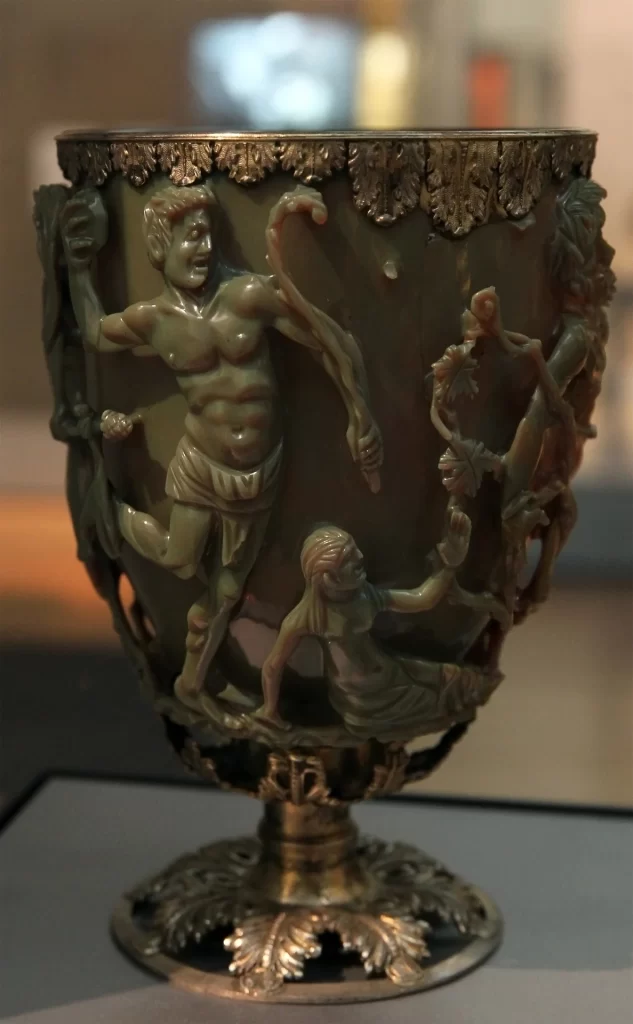
The story outlived every version of the king. In the fourth century CE a Roman glassworker carved it into a cup now in the British Museum. Lycurgus is caught in the vine, struggling as its shoots close round his body, while Dionysus and two of his followers taunt him. The glass is green when light falls on it from outside. Lit from within, it turns red: the glass holds microscopic particles of gold and silver, though how its makers produced the effect is still uncertain.11
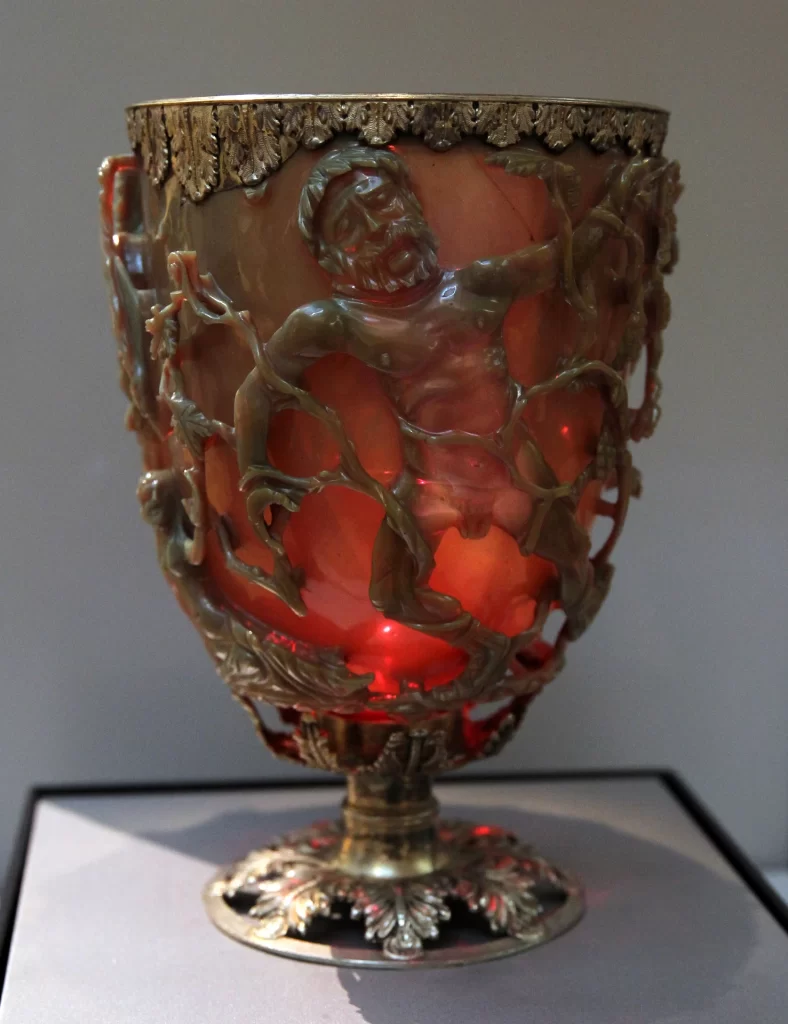
The king who tried to drive the god of wine out of Thrace is held in the vine for good, on a cup that glows the colour of wine.
Sources and Translation Notes
1. Homer, Iliad 6.128–143, translated by A. T. Murray (1924), Theoi Classical Texts; Greek from the Perseus Digital Library: βουπλῆγι at 6.135, Διώνυσος δὲ φοβηθεὶς at 6.135, Θέτις δ᾽ ὑπεδέξατο κόλπῳ at 6.136. ↩
2. Apollodorus, Library 3.5.1, translated by James George Frazer (1921), Theoi Classical Texts. The three blocks give the whole Lycurgus episode, from “But Lycurgus” to the death by horses; Frazer’s note numbers are omitted. ↩
3. Homeric Hymn 7, to Dionysus, 43–59, translated by Hugh G. Evelyn-White (1914), Project Gutenberg, beside Iliad 6.135–137. Ino’s leap and her new name: Ovid, Metamorphoses 4.525–542, and Apollodorus, Library 3.4.3. Nonnus, Dionysiaca 21.146, ξεινοδόκον Βρομίοιο καταφλέξω Μελικέρτην, Greek text at Greek Wikisource. The nurses of Nysa: Homeric Hymn 26 and Iliad 6.132, Διωνύσοιο τιθήνας. ↩
4. Ovid, Metamorphoses 4.512–519, the lioness and her cubs; Apollodorus, Library 3.4.3, Learchus hunted as a deer. ↩
5. Douglas Harper, “maenad,” Online Etymology Dictionary. Homer, Iliad 6.132, μαινομένοιο Διωνύσοιο τιθήνας. ↩
6. Sophocles, Antigone 955–965, translated by R. C. Jebb, Internet Classics Archive. ↩
7. Acts 8:3, 9:1–9, 9:17–18 and 26:14, King James Version; Greek of 26:14, σκληρόν σοι πρὸς κέντρα λακτίζειν. Euripides, Bacchae 794–795, translated by E. P. Coleridge, Internet Classics Archive, Greek from the Perseus Digital Library. The same proverb appears in Aeschylus, Prometheus Bound 323 and Agamemnon 1624. Paul’s later imprisonments: 2 Corinthians 11:23, “in prisons more frequent.” ↩
8. Diodorus Siculus, Library of History 3.65.3–6, translated by C. H. Oldfather (1935), LacusCurtius; the edition states that this English translation is in the public domain in the United States. The ivy-covered lances are at 3.65.3; the narthex replacing the wooden staves is at 4.4.6–7. The excerpt stops where Diodorus turns to Charops’s descendants, Oeagrus and Orpheus. ↩
9. Nonnus, Dionysiaca 21.17–66 and 21.145–169. The block is a new prose translation of 21.24–54 from the Greek text at Greek Wikisource; Rhea gives the plant speech at 21.33–34 (καὶ φυτόν αὐδῆεν ζαμενὴς ποιήσατο Ῥείη), and the ἐχενηΐς is at 21.45 and 21.49. W. H. D. Rouse’s 1940 translation, ToposText, was consulted for the wider narrative. The Delos mosaic of Lycurgus and Ambrosia, late second century BCE, is in the Archaeological Museum of Delos. ↩
10. The altar of Obaidu son of Animu, from Palmyra, published in Enno Littmann, Semitic Inscriptions (1904); text at the Biblical Archaeology Society. On the god’s name and his caravans and soldiers: “Nabataean religion”, Wikipedia. ↩
11. The Lycurgus Cup, Roman, fourth century CE, British Museum 1958,1202.1. For the glass and the uncertainty about how it was made, see Ian Freestone, Nigel Meeks, Margaret Sax and Catherine Higgitt, “The Lycurgus Cup, A Roman Nanotechnology,” Gold Bulletin 40 (2007), 270–277. ↩