Inherited gods, a promised name, and the road to Canaan
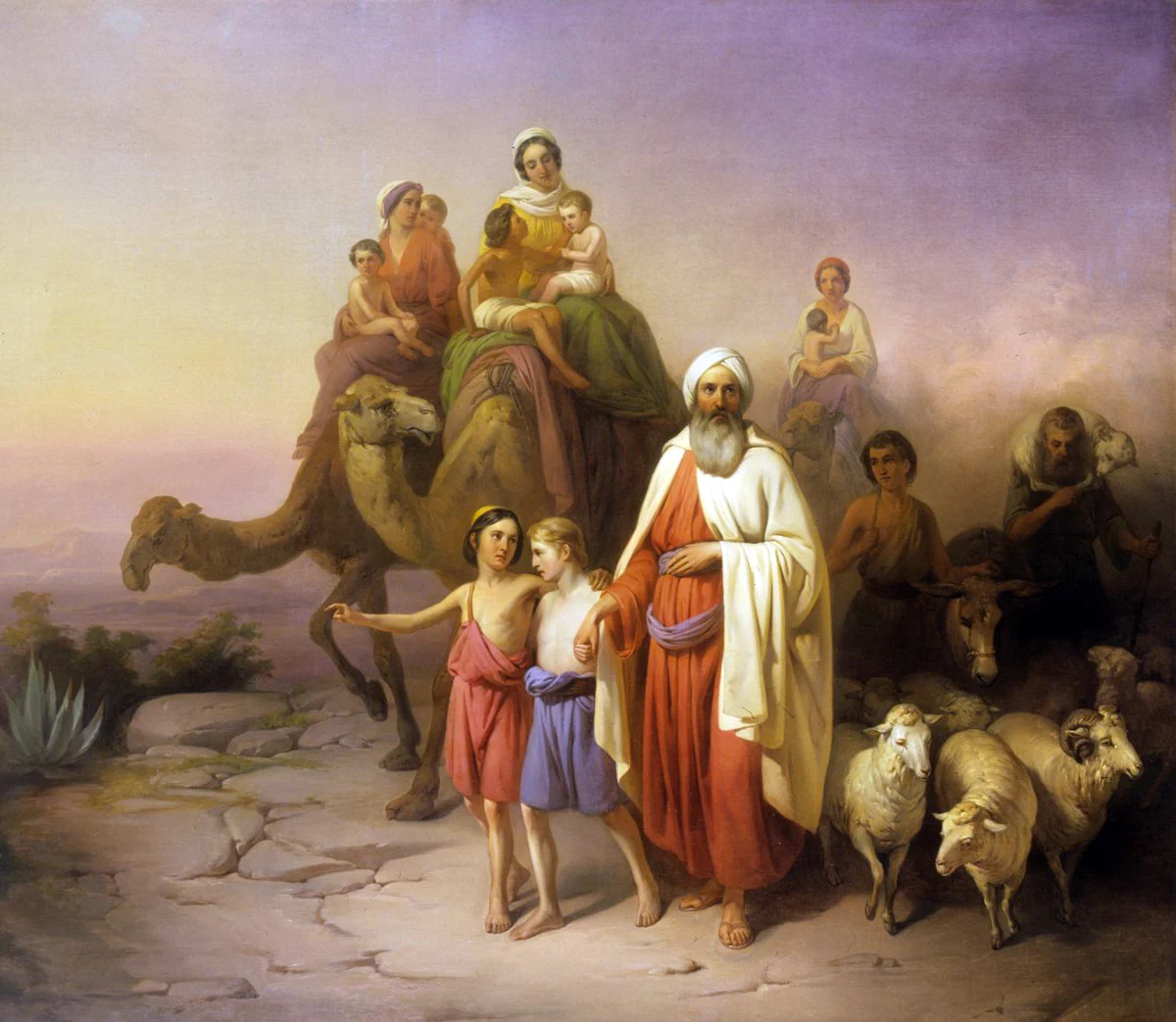
Opening illustration: József Molnár, The Departure of Abraham, 1850. Hungarian National Gallery. Public-domain reproduction via Wikimedia Commons. A nineteenth-century painting of the household on the road, not a reconstruction of every traveler.
Before he becomes the father of a people, Abram must leave the world that made him a son.
Now the Lord had said unto Abram, Get thee out of thy country, and from thy kindred, and from thy father’s house, unto a land that I will shew thee:
And I will make of thee a great nation, and I will bless thee, and make thy name great; and thou shalt be a blessing:
And I will bless them that bless thee, and curse him that curseth thee: and in thee shall all families of the earth be blessed.
— Genesis 12:1–3, King James Version.1
The command identifies what must be left more precisely than what will be found. Country, kindred, father’s house: the familiar circles of belonging narrow until the departure reaches the household itself.
Abram is offered a future, but not immediate possession of it. He must leave before the promise has become something he can show to anyone else.
At Babel, the builders sought a name by gathering around one place. Here a name is promised to someone called away from his place.
The father’s unfinished journey
Abram does not begin as a solitary stranger. Genesis introduces him within a family already marked by marriage, death, and an uncertain continuation.
Now these are the generations of Terah: Terah begat Abram, Nahor, and Haran; and Haran begat Lot.
And Haran died before his father Terah in the land of his nativity, in Ur of the Chaldees.
And Abram and Nahor took them wives: the name of Abram’s wife was Sarai; and the name of Nahor’s wife, Milcah, the daughter of Haran, the father of Milcah, and the father of Iscah.
But Sarai was barren; she had no child.
And Terah took Abram his son, and Lot the son of Haran his son’s son, and Sarai his daughter in law, his son Abram’s wife; and they went forth with them from Ur of the Chaldees, to go into the land of Canaan; and they came unto Haran, and dwelt there.
— Genesis 11:27–31, King James Version.1
The first departure belongs to Terah.
He takes the household from Ur with Canaan as its destination, but they settle at Haran. Abram’s later journey will therefore continue toward a place his father had already intended to reach. Genesis does not explain here why Terah leaves Ur or why he stops before completing the journey.
The family also carries a death. Haran, Abram’s brother and Lot’s father, has died. Lot’s presence means that the household’s future includes an obligation inherited from a life already ended.
Then comes the brief statement about Sarai: she has no child.
The narrative names this condition before the promise of a great nation. It does not explain it as punishment or blame her for it. Instead, the promised future will have to confront something the household has not been able to resolve.
Before the road opens, the story has already placed loss behind the family and uncertainty ahead of it.
A name awaiting its future
At this stage, he is Abram, not yet Abraham.
The Hebrew ʾAvrām, אַבְרָם, is commonly rendered “exalted father,” with “the father [a divine title] is exalted” another explanation recorded in the Brown–Driver–Briggs lexicon. In the second explanation, “the father” is a divine title rather than a description of Abram himself. The name is not itself a prediction that its bearer will have children.2
Nevertheless, read within this narrative, it acquires an irony. A man whose name contains fatherhood belongs to a marriage introduced through childlessness.
His name precedes the future that later readers associate with him.
The promised greatness is therefore not merely an enlargement of something already secure. Abram is not shown possessing the nation he will become, the descendants who will inherit, or the land that will sustain them.
His beginning consists of relationships and expectations whose continuation remains unresolved.
This makes the father’s world important in more than a geographical sense. A household passes down names, occupations, obligations, and ways of recognizing the sacred. Leaving it can mean losing the framework through which life has previously made sense.
What, then, were the gods of the house Abram was called to leave?
The gods in the workshop
Genesis does not narrate Abram’s childhood or describe a youthful campaign against his father’s religion. Another biblical passage supplies the religious background:
And Joshua said unto all the people, Thus saith the Lord God of Israel, Your fathers dwelt on the other side of the flood in old time, even Terah, the father of Abraham, and the father of Nachor: and they served other gods.
— Joshua 24:2, King James Version.3
Here “the flood” means the river boundary, the Euphrates, not Noah’s catastrophe. The ancestors are remembered as coming from a religious world that was not already devoted exclusively to Abram’s God.
Jewish storytellers give that background a domestic setting. In Genesis Rabbah 38:13, Terah leaves Abraham in charge of his idol shop. The son embarrasses customers by contrasting their age with the recent manufacture of the objects they intend to worship.
A woman then brings an offering of flour. Abraham breaks the images and places the club in the hand of the largest. When Terah returns, his son explains that the images quarreled over who should eat first, and the largest smashed the others. Terah objects that they possess no understanding.
The son answers:
“Do your ears not hear what your mouth is saying?”
— Genesis Rabbah 38:13.4
The force of the scene lies in the father’s own explanation. To reject the son’s invented story, Terah must acknowledge the helplessness of the objects.
The son does not merely contradict an inherited belief. He arranges a situation in which the father speaks the contradiction himself.
Read symbolically, the workshop exposes a reversal between maker and made. People manufacture objects and then place themselves beneath them. The hands that produce the sacred image disappear from view once the image receives authority.
The story is a polemic against image-worship, not a neutral account of every way ancient worshippers understood religious images. Its argument depends upon making the contradiction visible in the simplest possible form: the gods cannot perform the actions attributed to them, and the man defending them knows it.
The episode also makes the religious disagreement inseparable from the family’s livelihood. Abram’s challenge threatens not only what his father believes but what his father does.
A son entrusted with continuing the business becomes the person who interrupts its reproduction.
The father who knows, and remains afraid
Another Jewish work, Jubilees, gives Terah a different response.
When Abram challenges the worship of lifeless images, his father does not simply insist that the images possess power. He admits the difficulty and explains why he continues:
And his father said unto him, “I also know it, my son, but what shall I do with a people who have made me to serve before them?
And if I tell them the truth, they will slay me; for their soul cleaveth to them to worship them and honour them. Keep silent, my son, lest they slay thee.”
— Jubilees 12:6–7, translated by R. H. Charles.5
This father is not simply too foolish to understand his son. He understands and fears the consequences.
An inherited religious order can survive not because nobody questions it, but because questioning it openly is dangerous.
Terah asks his son for silence. That request can be read as an attempt to preserve conformity, but also as a frightened father’s effort to keep his child alive. The two motives need not exclude one another.
Jubilees then makes Abram’s break with the images more disturbing than an argument. He sets fire to their house at night. His brother Haran attempts to rescue them and dies in the flames. This is Jubilees’ explanation, not the explanation Genesis gives for Haran’s death. Genesis records the death without this scene.5
The contrast with traditions in which Abraham survives a furnace is severe. In this telling, he begins the fire, and another member of the household does not survive it.
The text does not say that Abram intends to kill his brother, and it gives him no speech of remorse.
A sympathetic reading sees determination to reject what cannot save. A suspicious reading asks what happens when a person’s certainty authorizes the destruction of what others hold sacred.
The founder’s separation is not automatically innocent.
The lights that cannot remain
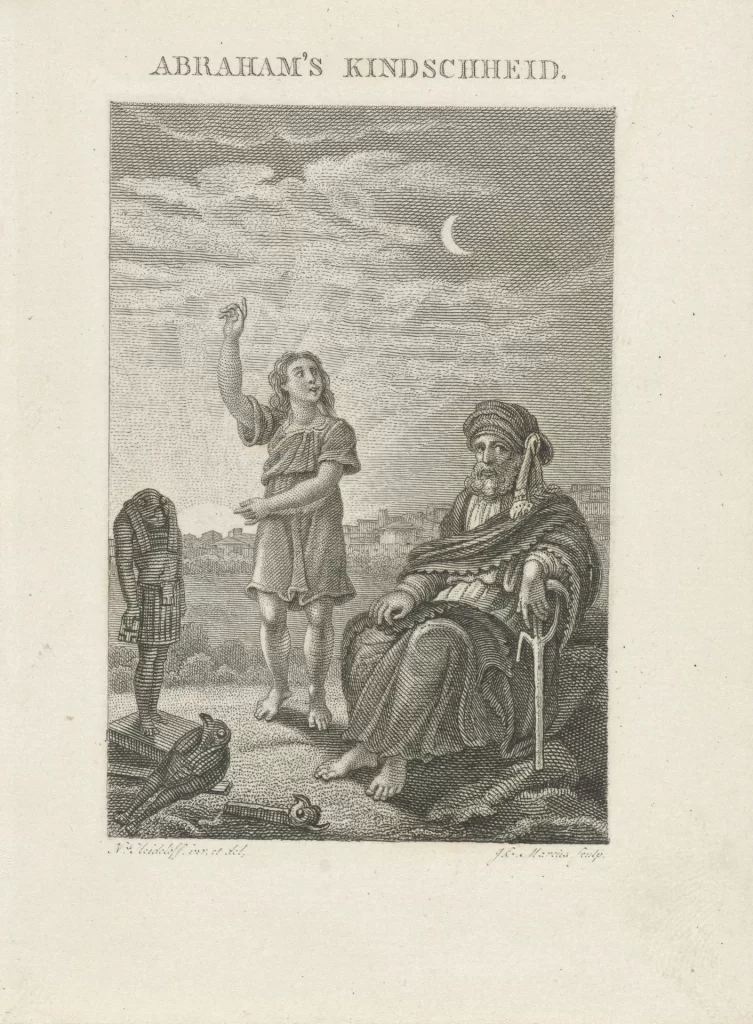
The Qur’an gives Abraham (Ibrāhīm) another encounter with the religious world around him. The question moves from objects made by human hands to the lights of heaven.
Thus did We show Abraham the kingdom of the heavens and the earth that he might be of those possessing certainty:
When the night grew dark upon him he beheld a star. He said: This is my Lord. But when it set, he said: I love not things that set.
And when he saw the moon uprising, he exclaimed: This is my Lord. But when it set, he said: Unless my Lord guide me, I surely shall become one of the folk who are astray.
And when he saw the sun uprising, he cried: This is my Lord! This is greater! And when it set he exclaimed: O my people! Lo! I am free from all that ye associate (with Him).
Lo! I have turned my face toward Him Who created the heavens and the earth, as one by nature upright, and I am not of the idolaters.
— Qur’an 6:75–79, translated by Marmaduke Pickthall.6
The scene increases the apparent greatness of its objects. A star gives way to the moon, the moon to the sun. But greater brightness does not answer the underlying objection. Each light sets.
The movement can appear to dramatize a search in which successive candidates prove inadequate. Ibn Kathir, however, interprets Abraham as arguing against his people’s worship, not personally converting from one celestial deity to another. On that reading, the sequence demonstrates the weakness of their position: the heavenly bodies follow an order rather than independently governing it.7
Either way, the scene does more than transfer devotion from a small object to a larger one. It rejects the assumption that the most impressive thing visible must therefore be the ultimate source of what exists.
The lights can mark time without being its sovereigns. Their beauty does not make them independent of the order through which they move.
The moon is the second light Abraham rejects, and the road Genesis gives his family runs through its cities. Ur in the south and Harran in the north were the two chief seats of the moon god, Nanna or Sîn, 𒀭𒂗𒍪. Joshua’s “other gods” are not named, and Genesis never mentions him, but a household that moved from Ur to Harran had not left his country. In the sixth century BCE Nabonidus, the last king of Babylon, was still rebuilding the god’s temple at Harran.8
Jubilees offers a related, though different, account. Abram watches the heavens in an attempt to anticipate the year’s rainfall, then concludes that the signs of sun, moon, and stars lie under God’s authority. The point is not that the sky contains nothing worth observing. It is that observing the sky does not make its signs the final power upon which life depends.5
These accounts give the departure an intellectual dimension.
Abram must leave not only a place but a way of identifying what deserves his ultimate trust.
Peace to the father he cannot follow
In another Qur’anic passage, the conflict returns from the heavens to the household.
When he said unto his father: O my father! Why worshippest thou that which heareth not nor seeth, nor can in aught avail thee?
O my father! Lo! there hath come unto me of knowledge that which came not unto thee. So follow me, and I will lead thee on a right path.
O my father! Serve not the devil. Lo! the devil is a rebel unto the Beneficent.
O my father! Lo! I fear lest a punishment from the Beneficent overtake thee so that thou become a comrade of the devil.
He said: Rejectest thou my gods, O Abraham? If thou cease not, I shall surely stone thee. Depart from me a long while!
He said: Peace be unto thee! I shall ask forgiveness of my Lord for thee. Lo! He was ever gracious unto me.
I shall withdraw from you and that unto which ye pray beside Allah, and I shall pray unto my Lord. It may be that, in prayer unto my Lord, I shall not be unblest.
— Qur’an 19:42–48, translated by Marmaduke Pickthall.9
The repeated address, “O my father,” keeps the relationship present inside the disagreement.
Abraham does not speak as though the man before him has ceased to matter. He claims knowledge his father does not possess, warns him, and asks him to follow. The direction of instruction has reversed: the son offers to lead the father.
The father hears rejection and threatens violence.
The son’s answer combines separation with peace. At this moment, he refuses both submission to the inherited worship and retaliation against the person who demands it.
This is not a scene in which all beliefs are declared equally true. Abraham’s language about error, the devil, and punishment is uncompromising. But disagreement does not erase his desire that his father be forgiven.
He can reject the worship without wishing for the worshipper’s destruction.
That distinction makes the departure more difficult than a triumphant escape from an obvious villain. The person he must leave is also someone for whom he still offers prayer.
The Qur’an names Abraham’s father Āzar in 6:74, while Genesis names him Terah.6
What does it mean to leave?
Returning to Genesis, the command begins lekh-lekha, לֶךְ־לְךָ.
The first word is the imperative “go.” The second contains a preposition and a pronoun directed toward the person addressed; the expression can be rendered idiomatically as “go forth” or “go for thyself.”1
Rashi reads the phrase as departure for Abram’s benefit and good. His commentary associates the journey with the promised descendants and reputation. The command, in that interpretation, does not demand loss merely for the sake of loss. It directs Abram toward a future unavailable where he remains.10
The sequence of what must be left also matters: country, kindred, father’s house.
The movement is toward increasing intimacy. A person may cross a boundary while continuing to live entirely within the authority of the household that crossed it with him. Leaving a country and leaving the father’s world are not necessarily the same event.
Virgil writes the opposite departure. When Troy burns, Aeneas hands his father the household gods and carries him out on his shoulders: tu, genitor, cape sacra manu patriosque penatis, “you, father, take the sacred things and the gods of our fathers in your hand.” A founder leaves a ruined city for a promised land with his father and his fathers’ gods on his back, and Rome claims both. Abram leaves a standing house at the word of a voice, and the gods stay behind with Terah. Both men reach a country already full of people.11
The people who travel with the promise
So Abram departed, as the Lord had spoken unto him; and Lot went with him: and Abram was seventy and five years old when he departed out of Haran.
And Abram took Sarai his wife, and Lot his brother’s son, and all their substance that they had gathered, and the souls that they had gotten in Haran; and they went forth to go into the land of Canaan; and into the land of Canaan they came.
— Genesis 12:4–5, King James Version.1
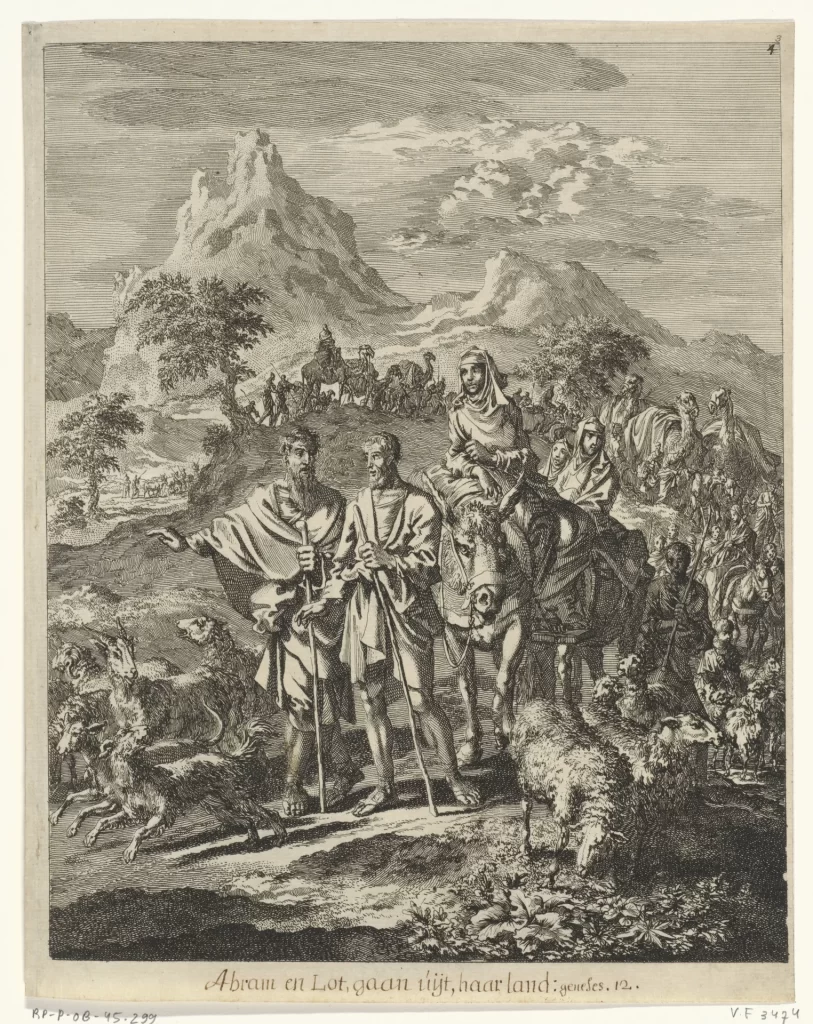
The biblical departure is not that of a boy running away from home. Abram is seventy-five.
Nor is it an adventure undertaken alone. Sarai, Lot, possessions, and other people travel with him. He leaves his father’s household while taking a household of his own.
A patriarch’s decision affects people whose relationship to the command is never narrated.
Sarai makes the journey. Lot makes the journey. The others, named only as a group, make it too.
Genesis does not tell us what any of them says before departure.
Rashi preserves two readings of the people acquired in Haran. One is a religious interpretation: Abraham brought men, and Sarah women, into their faith. The other, which he identifies as the plain sense, concerns acquired male and female slaves.10
The religious reading grants Sarai an active role in forming the community. The household reading reminds us that the migrant patriarch is not simply a powerless individual abandoning every structure of authority.
He leaves one order of belonging while carrying another with him.
A promised land that is already inhabited
Arrival does not complete the promise.
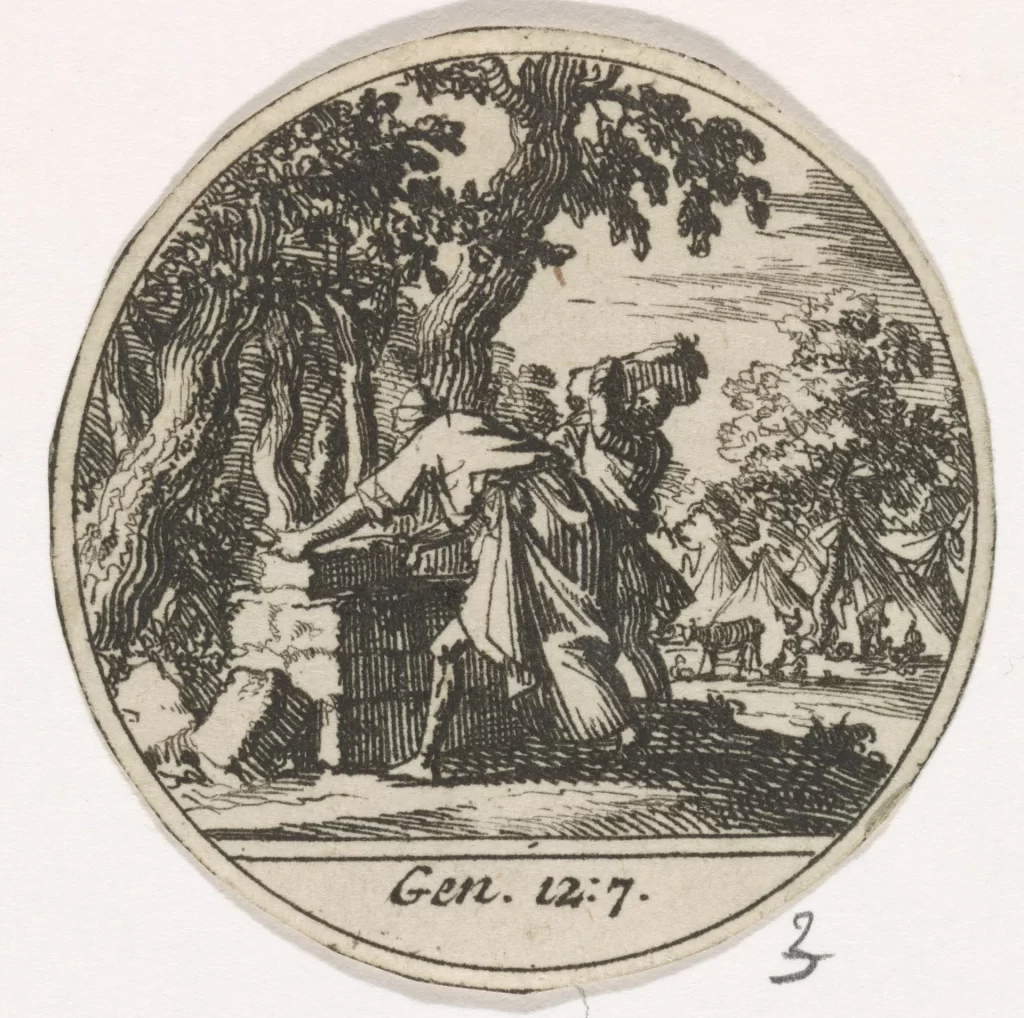
And Abram passed through the land unto the place of Sichem, unto the plain of Moreh. And the Canaanite was then in the land.
And the Lord appeared unto Abram, and said, Unto thy seed will I give this land: and there builded he an altar unto the Lord, who appeared unto him.
And he removed from thence unto a mountain on the east of Bethel, and pitched his tent, having Bethel on the west, and Hai on the east: and there he builded an altar unto the Lord, and called upon the name of the Lord.
And Abram journeyed, going on still toward the south.
— Genesis 12:6–9, King James Version.1
The narrative does not present Canaan as an empty stage awaiting its first meaningful inhabitants. It explicitly states that the Canaanites are there.
The promise concerns Abram’s descendants, but the land already contains other lives.
For now, the narrative does not turn the promise into a campaign of conquest. Abram passes through, receives an appearance, builds an altar, pitches a tent, and moves again.
The difference between arrival and possession is essential. Reaching the destination has not made the future complete.
A great nation has been promised, but the opening problem of the marriage remains. Land has been promised to descendants, but those descendants are not yet before the reader. A great name has been promised, but Abram is still traveling between places whose existence does not begin with him.
His response is worship, not a palace.
The altar marks an encounter. The tent shelters a life still capable of being moved.
The voice that sent Abram never gives its name. The narrator supplies it, the four-letter name YHWH, יְהוָה, printed “the LORD”, and it is the only divine name in the chapter. At the second altar Abram uses it himself: vayiqra be-shem YHWH, וַיִּקְרָא בְּשֵׁם יְהוָה, “and called upon the name of the LORD.” Genesis has used the phrase once before, of the generation of Enos, when “began men to call upon the name of the LORD” (4:26). The rabbis read this name as the attribute of mercy and Elohim, אֱלֹהִים, “God”, as the attribute of judgment (Genesis Rabbah 33:3). The man who came out of a house of other gods begins his worship with the name of mercy.
He has to inhabit the interval between an assurance and its fulfillment.
The name that must become a blessing
The opening promise contains more than personal success.
Abram is not only to be blessed. He is to be a blessing, and the promise extends to the families of the earth. The movement toward one household does not remove the rest of humanity from the story’s horizon.1
That gives the departure a measure beyond the greatness of the departing man.
A founder’s name can become famous because others serve it. The promise places another possibility before Abram: a name whose significance includes what passes through it to others.
Paul reads this line as the first preaching of the gospel: “the scripture, foreseeing that God would justify the heathen through faith, preached before the gospel unto Abraham, saying, In thee shall all nations be blessed.” Both readings carry the promise past the household that hears it. Genesis promises a name and descendants to a man with no child, and its blessing for the nations runs through that family; Paul makes faith, not descent, the way into it, so that “they which be of faith are blessed with faithful Abraham.” The Christ-archetype reading sees the promise’s horizon reached in that widening. The suspicious reading notes where the promise still rests: a blessing meant for every family is placed in the keeping of one household’s head.12
Where the road has reached
At the end of this episode, Abram has neither founded a city nor completed a nation. He has crossed into a land, built altars, and gone on toward the south.
The promise has been spoken to Abram alone. Sarai has walked every stage of the road from Ur, and Genesis has already given the one fact about her on which a promise of descendants depends: “But Sarai was barren; she had no child.” She has not yet said a word.1
Source and translation notes
Biblical narrative. This episode follows Genesis 11:27–12:9, stopping before the famine and journey into Egypt. Biblical quotations use the public-domain King James Version. Joshua 24:2 supplies the separate biblical recollection of the ancestors’ worship of other gods. Genesis itself does not narrate Abram’s idol-breaking childhood.1, 3
Jewish interpretations. Genesis Rabbah 38:13 supplies the shop, shattered images, and confrontation with Terah. Its narrative is paraphrased here, with a brief quotation. Jubilees 12:1–18, quoted in R. H. Charles’s translation, supplies the frightened father, Abram’s destruction of the idol-house, Haran’s death, and the reflection on celestial signs.4, 5
Islamic scripture and commentary. Qur’anic quotations use Marmaduke Pickthall’s translation, first published in 1930. The principal passages are 6:75–79 and 19:42–48. Ibn Kathir’s interpretation of the celestial episode is identified as commentary rather than Qur’anic narration. Qur’an 9:114 later qualifies Abraham’s intercession for his father.6, 7, 9, 13
Names and wording. The explanation of Abram draws on the Brown–Driver–Briggs lexical entry. The discussion of lekh-lekha distinguishes grammar from Rashi’s interpretation; the two readings of the people acquired in Haran likewise follow Rashi’s explicit distinction between interpretive expansion and plain sense. The article retains Abram and Sarai for the Genesis narrative while allowing other sources to use their own forms of the names.2, 10
1. Genesis 11:27–12:9, King James Version. biblegateway.com ↩
2. Brown–Driver–Briggs, ʾAvrām (Strong’s Hebrew 87), “exalted father.” biblehub.com ↩
3. Joshua 24:2, King James Version. en.wikisource.org ↩
4. Genesis Rabbah 38:13, English from The Sefaria Midrash Rabbah (2022). sefaria.org ↩
5. Jubilees 12, translated by R. H. Charles (1917). Verses 1–14 (Terah’s answer, the burning of the idol-house, Haran’s death): sacred-texts.com; verses 15–31 (the watch of the heavens and the departure): sacred-texts.com ↩
6. Qur’an, Surah 6 (Al-An‘am), translated by Marmaduke Pickthall. Verses 74–79. sacred-texts.com ↩
7. Ibn Kathir, Tafsir on Qur’an 6:74–79 (abridged English). quran.com ↩
8. “Sin (mythology),” New World Encyclopedia, for Ur and Harran as the god’s two chief seats and Nabonidus’s devotion to him. newworldencyclopedia.org ↩
9. Qur’an, Surah 19 (Maryam), translated by Marmaduke Pickthall. Verses 41–48. sacred-texts.com ↩
10. Rashi on Genesis 12:1 and 12:5, translated by M. Rosenbaum and A. M. Silbermann. On 12:1: sefaria.org; on 12:5: sefaria.org ↩
11. Virgil, Aeneid 2.707–725, Latin text at The Latin Library; the line quoted is 2.717, translation new. thelatinlibrary.com ↩
12. Galatians 3:8–9, King James Version. ebible.org ↩
13. Qur’an 9:114, translated by Marmaduke Pickthall. sacred-texts.com ↩