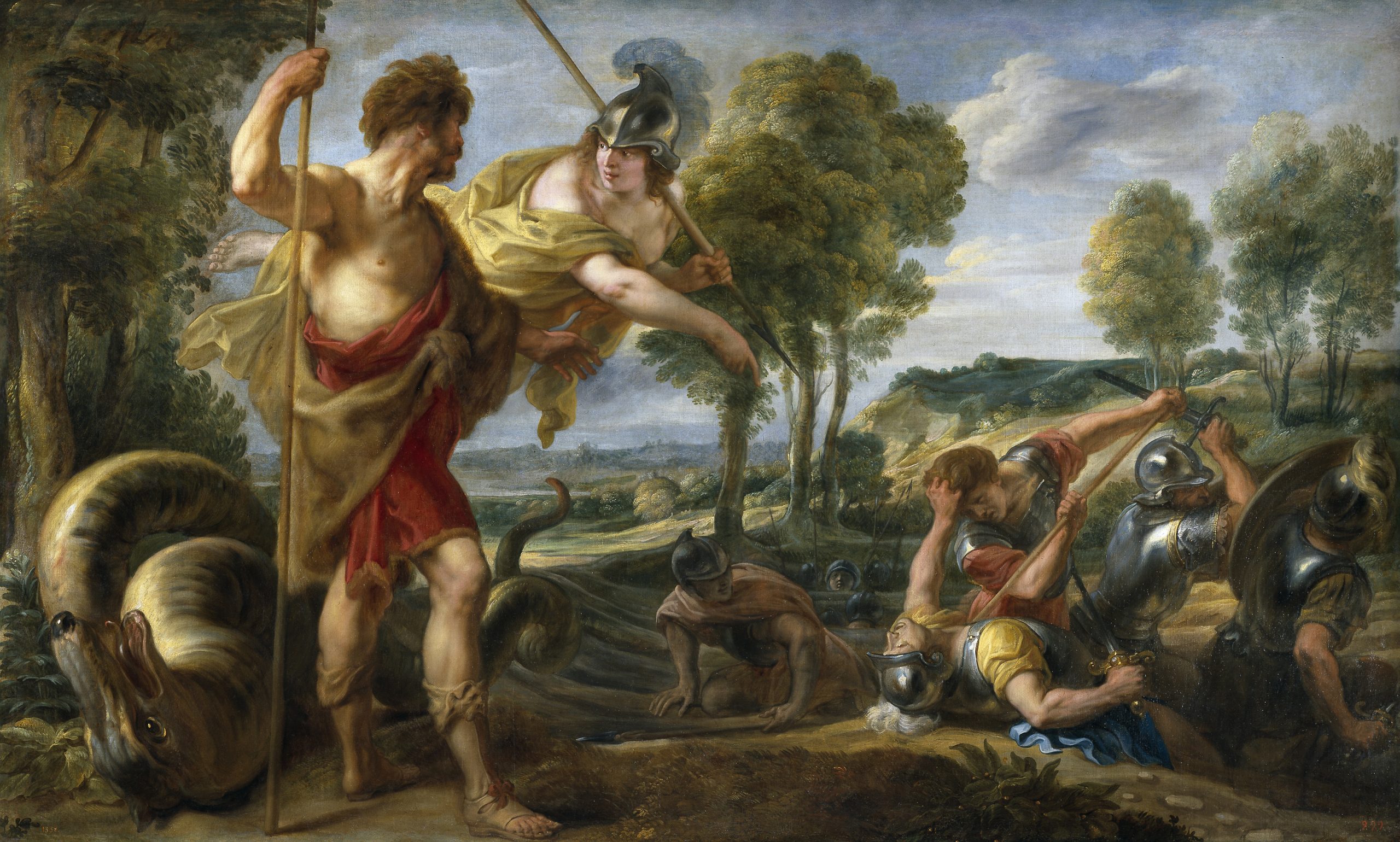
He killed the guardian of the spring. Then he planted what remained.
Cadmus, the Phoenician son of Agenor, leaves home looking for a sister, not a kingdom.1
Europa has disappeared across the sea on the back of a bull. The animal is Zeus in disguise, but the family left behind cannot recover her. Her father, Agenor, sends his sons to search, forbidding them to return without her. Their mother, Telephassa, goes too. The search scatters the family instead of bringing it together.1
Cadmus eventually buries his mother in Thrace. His sister is still missing. He goes to Delphi to ask Apollo where to look next.
The answer does not tell him how to finish the journey. It tells him to begin another.
The main narrative follows Pseudo-Apollodorus’s Library 3.1.1 and 3.4.1–2, in James George Frazer’s public-domain translation. Euripides’ Phoenician Women provides an earlier, BCE witness; selected passages from Ovid supply a different poetic treatment. Quotations retain their translators’ wording. Herodotus adds the tradition of Phoenician letters; Palaephatus supplies an ancient human interpretation of the dragon. The accounts are compared where they differ, rather than silently combined.
The animal that shows him where to stop
When Telephassa died, Cadmus buried her, and after being hospitably received by the Thracians he came to Delphi to inquire about Europa. The god told him not to trouble about Europa, but to be guided by a cow, and to found a city wherever she should fall down for weariness. After receiving such an oracle he journeyed through Phocis; then falling in with a cow among the herds of Pelagon, he followed it behind.
And after traversing Boeotia, it sank down where is now the city of Thebes.
Pseudo-Apollodorus, Library 3.4.1, translated by James George Frazer.2
A bull carried Europa away. A cow leads her brother toward a new home. The first animal breaks the family’s familiar world; the second supplies a place from which another world can begin.
There is no recovery of everything that has been lost. The oracle releases Cadmus from the search, but it does not return his sister or his mother. Read as a story of displacement, the foundation grows out of the recognition that going home is no longer possible on the old terms.
Even his arrival is not marked by a display of mastery. He follows. The future city begins where another creature becomes tired enough to lie down.
Cadmus prepares to honor the gods. Before he builds, he needs water.
The spring already has a guardian
Wishing to sacrifice the cow to Athena, he sent some of his companions to draw water from the spring of Ares. But a dragon, which some said was the offspring of Ares, guarded the spring and destroyed most of those that were sent. In his indignation Cadmus killed the dragon, and by the advice of Athena sowed its teeth.
Pseudo-Apollodorus, Library 3.4.1, translated by James George Frazer.2
The brevity almost conceals the disaster. Men go to draw water for a sacrifice. Most do not return. Before Cadmus can begin the settlement, he must confront the creature that has destroyed his companions.
Ovid gives his response a fuller human voice:
When he entered the grove, and beheld the lifeless bodies, and the victorious enemy of immense size upon them, licking the horrid wounds with bloodstained tongue, he said, “Either I will be the avenger of your death, bodies of my faithful companions, or I will be a sharer in it.”
Ovid, Metamorphoses 3.55–59, translated by Henry Thomas Riley.3
His courage is loyalty before it is glory. He does not abandon the dead or ask others to meet the danger in his place. The heroic reading has something substantial to honor: a leader who will risk sharing the fate of those who followed him.
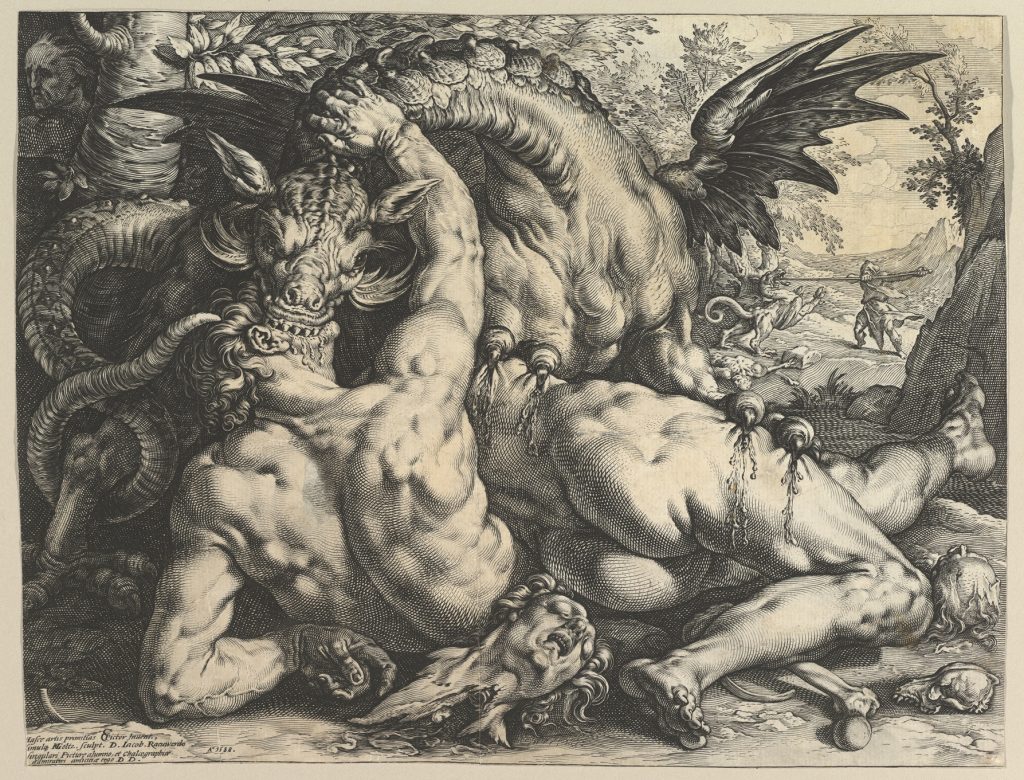
The guardian is dead. Athena now gives Cadmus an instruction that makes the dead creature part of what comes next.
A crop that arrives armed
Athena tells Cadmus to sow the teeth.
The instruction turns the ruined body toward an unexpected fertility. The part that bit and tore will become seed. Cadmus places what remains of the enemy inside the earth, and the earth gives it back in human form:
When they were sown there rose from the ground armed men whom they called Sparti. These slew each other, some in a chance brawl, and some in ignorance. But Pherecydes says that when Cadmus saw armed men growing up out of the ground, he flung stones at them, and they, supposing that they were being pelted by each other, came to blows. However, five of them survived, Echion, Udaeus, Chthonius, Hyperenor, and Pelorus.
Pseudo-Apollodorus, Library 3.4.1, translated by James George Frazer.2
Spartoi, Greek Σπαρτοί, means the “Sown Men.” The name belongs to the verb for sowing. Their identity is inseparable from the act that places them in the ground.4
They emerge already armed. The teeth become men, but retain their capacity to wound. Before the new companions have learned to live together, they know how to kill.
Only five remain to take part in the settlement.
The first peace
Ovid tells the struggle without the stone stratagem. His Cadmus prepares to defend himself, but one of the earthborn men tells him to stay out of their civil war. The warriors kill one another until five remain. Then the poem gives particular attention to the act that stops the fighting:
In a similar manner, too, the whole troop becomes maddened, and the brothers so newly sprung up, fall in fight with each other, by mutual wounds. And now the youths that had the space of so short an existence allotted them, beat with throbbing breast their blood-stained mother, five only remaining, of whom Echion was one. He, by the advice of Tritonia, threw his arms upon the ground, and both asked and gave the assurance of brotherly concord.
The Sidonian stranger had these as associates in his task, when he built the city that was ordered by the oracle of Phœbus.
Ovid, Metamorphoses 3.122–130, translated by Henry Thomas Riley.5
Tritonia is Athena. Her guidance is present not only in the sowing, but also in the ending of the violence.
Echion both asks for peace and offers it. He does not demand a vulnerability that he refuses to share. His weapons touch the ground before his companions can begin the work of building.
This is a different founding gesture from the killing of the dragon. Courage was needed to meet the guardian. Restraint is needed to live with the survivors.
The story gives both gestures a place. Neither can simply do the work of the other.
Victory does not discharge the debt
Apollodorus does not let the dragon’s death become a complete vindication of its killer:
But Cadmus, to atone for the slaughter, served Ares for an eternal year; and the year was then equivalent to eight years of our reckoning. After his servitude Athena procured for him the kingdom, and Zeus gave him to wife Harmonia, daughter of Aphrodite and Ares. And all the gods quitted the sky, and feasting in the Cadmea celebrated the marriage with hymns.
Pseudo-Apollodorus, Library 3.4.2, translated by James George Frazer.6
Cadmus’s anger on behalf of his companions does not cancel Ares’s claim. The future king must serve the god whose creature he killed.
This complicates the familiar picture of the dragon-slayer as someone who removes evil and receives an uncontested reward. Here, the dangerous creature belongs to a sacred relationship. Its defeat leaves an obligation behind.
The story also allows more than endless vengeance. Cadmus lives through a period of service, receives a kingdom, and enters a marriage celebrated by the gods. Reparation gives the conflict a form other than the destruction of everyone connected with it.
Most strikingly, the woman he marries is the daughter of Ares. The god to whom he owes a debt becomes part of his family.6
Harmonia, Greek Ἁρμονία, bears a name associated with joining and fitting together. The ordinary Greek word can describe a fastening or a joint, as well as concord. Harmony is something held together, not necessarily something that has never been divided.7
Her parentage extends the image: she is the daughter of Ares and Aphrodite, war and love. Read symbolically, the marriage offers the founder a relationship to force that is no longer exhausted by opposition. What he could confront only as an enemy must now be encountered as kin.
The union does not make the dead companions or the dead serpent disappear. It makes a future possible without pretending that nothing happened.
Thebes is not completed by a blow. Its beginning requires a debt, a period of service, a pledge of peace, and a joining of families.
The stranger who brought letters
The founder is also remembered as a bearer of knowledge. Herodotus credits the Phoenicians who came with Cadmus with bringing the alphabet to the Greeks:
These Phoenicians who came with Cadmus … brought into Hellas the alphabet
Herodotus, Histories 5.58, translated by A. D. Godley; excerpt with an omission.8
He also describes the neighboring Greeks learning the letters and changing their forms. The gift does not remain a foreign possession. Those who receive it make it their own.
This tradition adds something important to the heroic portrait. Cadmus is associated not only with a place in which people can live, but with a means by which words can outlast the speaker. His arrival brings more than weapons.
A city could remember such a figure with gratitude. That gratitude is the beginning of the suspicious question, not its answer: what has the grateful story made difficult to see?
The land before the founder
Now return to the spring from the other side.
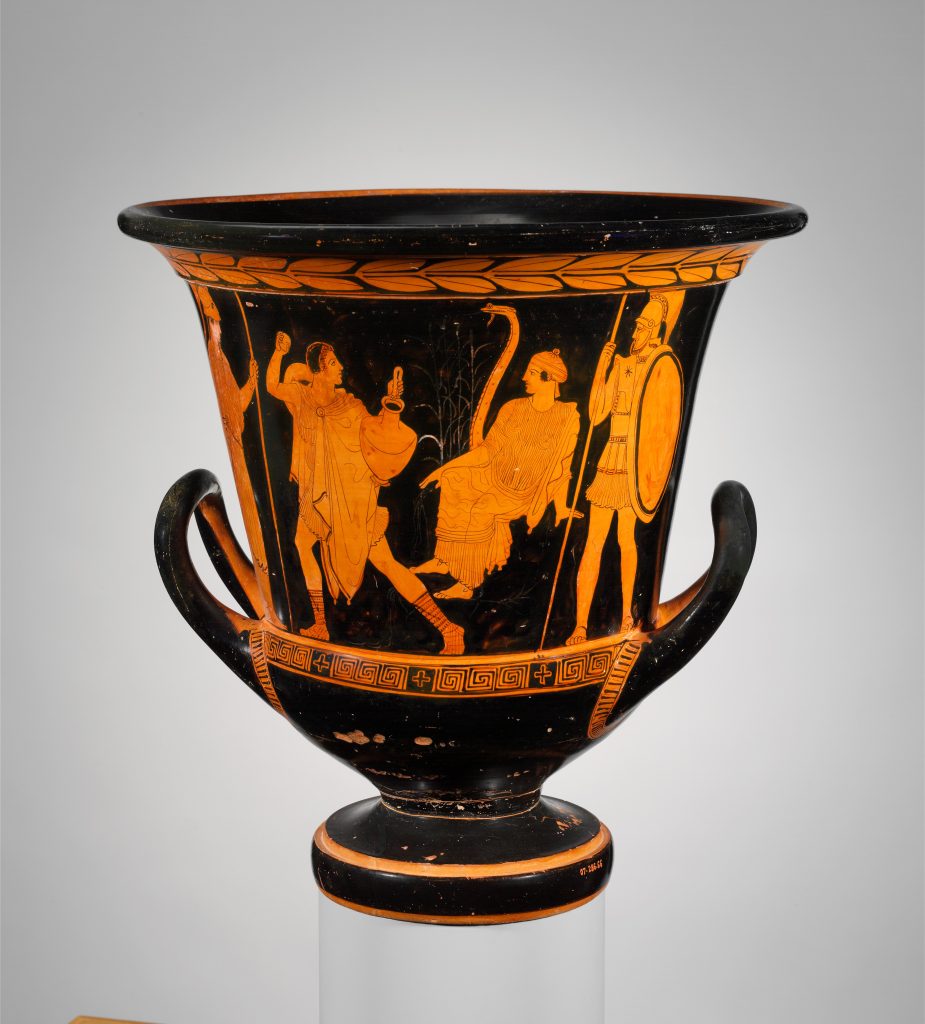
Cadmus is a stranger arriving under an oracle’s direction. The creature he kills belongs to the place already: it guards a named spring, has a relationship to Ares, and leaves a debt that the new ruler must repay. The beginning of Cadmus’s settlement is not the beginning of the land’s meaning.26
Read as a colonizing foundation story, the encounter concerns access to water, the removal of a guardian, and the establishment of foreign authority. Cadmus’s companions have died, but the story of their avenging does not answer an earlier question: who gave the newcomers the right to use what was guarded?
Apollo gives the founder a destination. The guardian does not give him consent. The imperial reading begins with this imbalance: the newcomer’s need becomes the measure by which an older claim is judged.
An ancient reader has already made the passage from monster to human resistance. In On Unbelievable Things, Palaephatus interprets Drakon, Δράκων, “serpent,” as a king of Thebes, son of Ares. His summary is blunt: “Cadmus killed him and became king.” The dead ruler’s friends then fight the newcomer. This is an ancient rationalization of the myth, not a recovered campaign record.9
The value of that reading is not that it settles every detail of the past. It makes visible a human claim that the dragon’s body can obscure. The supposed obstacle to civilization becomes a ruler with supporters; the hero’s victory becomes someone else’s dispossession.
We can ask the same question of a monster without assuming that every monster has one fixed historical identity: whose claim becomes easier to dismiss when the story gives its defender a beast’s body?
In this reading, the serpent can stand for an older authority and the community gathered around it. Its defeat is celebrated as the clearing of danger, while the people who might have called it protection disappear behind the name of the beast.
Cadmus’s courage does not dissolve under this interpretation. It changes its object. The courage that protects his companions can also help a foreign house take possession of a place. A good leader to the newcomers need not be a welcome founder to those who were there before them.
The stranger, the soil, and the stone
The sowing deepens the relationship between conquest and belonging.
Cadmus comes from across the sea. The Spartoi come from the soil beneath his feet. Read as an image of local lineages, their earthborn ancestry gives them a claim the foreigner cannot possess in the same way: the land itself is their parent. Yet the narrative makes their appearance depend upon his act of planting. Their emergence into the founder’s story becomes their apparent emergence into existence.
He has not created the earth. He has taken something from its defeated guardian and used it to produce the companions of his new order.
The dragon’s teeth can therefore signify more than violence reproducing itself. They can signify the strength of a conquered world being broken apart, redirected, and incorporated into another. The founder does not replace everything he encounters. He needs some part of it to survive under a changed arrangement.
Pherecydes’ stone trick gives that reading a precise mechanism. Cadmus provokes the armed men while making them mistake one another for the source of the attack. Their retaliations conceal his intervention. Each immediate enemy stands close enough to be struck; the stranger who set the violence moving remains outside their explanation of it.2
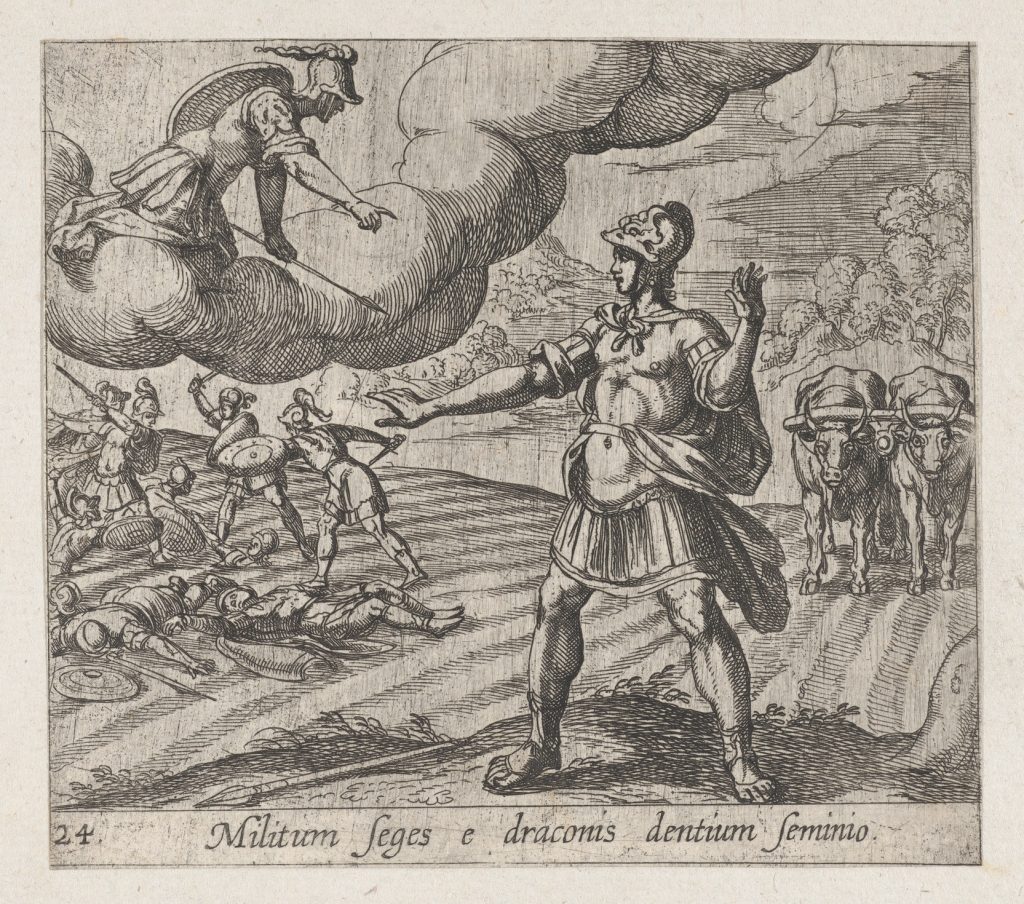
This is divide and conquer within the action of the tale, not merely a label placed upon the outcome. Its effectiveness lies in turning possible opponents into one another’s enemies.
The trick works by mistaken identity: each armed man takes his brother for the one who struck him. It is the first death of that kind in the house of Cadmus. Echion, one of the five who survived the stones, will marry Cadmus’s daughter Agave, and their son Pentheus will be killed by his own mother, who takes him for a lion.
The five survivors then become partners in the foundation. Their cooperation can be genuine while still emerging from a conflict the founder helped create. Peace among the remnant does not make the earlier manipulation disappear.
Ovid’s account locates the beginning of the fighting elsewhere: his Cadmus is told to stay out of the earthborn men’s civil war. The difference changes what the audience can hold him responsible for. In one telling he helps provoke the deaths; in the other he stands beside a conflict that appears to generate itself.5
The accounts invite a question about the memory of foundations: does the victorious stranger arrive to end a quarrel, or does the quarrel become useful to his victory?
Harmonia: agreement on whose terms?
The marriage retains its hopeful meaning. Enemies need some way to become more than enemies, and a future made entirely from retaliation would offer no home to anyone.
But harmony is also an arrangement of power. We should ask who enters that arrangement freely, whose claims it preserves, and whose absence allows it to appear complete.
Palaephatus offers a revealing alternative in the next chapter of his work: after taking Drakon’s kingdom, Cadmus marries Harmonia, presented here as the dead ruler’s sister. This is a different account from her divine parentage in Apollodorus.9
The marriage now permits a dynastic reading. The newcomer becomes attached to the household of the power he displaced. Kinship can help make a takeover appear as continuity.
The familiar genealogy also joins the foreign founder to the earthborn survivors: Apollodorus names Echion as the husband of Cadmus’s daughter Agave. The alliance enters the family, not only the work of building.10
None of this makes affection impossible or reconciliation fraudulent. It shows why those goods cannot be separated neatly from the distribution of authority. A marriage may heal a division and secure a ruling house at the same time.
The service owed to Ares preserves a further limit upon triumph. The new king cannot simply declare the defeated guardian worthless. He must acknowledge the claim that remains after the killing. In a suspicious reading, such acknowledgment can also become part of how a newcomer acquires legitimacy: he approaches the old sacred order, pays what it requires, and becomes acceptable within it.6
The question is no longer whether harmony is better than slaughter. It is whether harmony allows the preceding injuries to be remembered, or requires everyone to call them necessary.
Letters and the memory of victory
The alphabet now returns with a second meaning.
The gift of letters can be real, and the glory attached to its bearer can still shelter a darker beginning. A founding account can move so readily from defeated guardian to established city that the killing appears merely as the necessary first step toward everything the audience values afterward.
Writing gives this problem another medium. The same durable marks can carry a law, preserve a lineage, record an obligation, or repeat a founder’s name. Read alongside the dragon’s death, Cadmus’s association with letters raises the possibility of a victory that continues through the account by which later generations recognize their world.
The founder acquires more than a place in the landscape. He acquires a place at the beginning of its story.
But writing need not remain obedient to that place. The readers who inherit the praise may also preserve the accusation. Herodotus’s account of changed letter forms already gives the receivers an active role in what becomes their own practice.8
This is why the gift should not be dismissed as merely a disguise for domination. Letters can stabilize an authorized account; they can also give its opponents a lasting voice. The means by which a founder is remembered need not remain under the founder’s control.
The earth that receives them twice
Euripides’ Phoenician Women remembers the foundation from within a later Theban crisis. Eteocles and Polyneices, the sons of Oedipus, have failed to reach an agreement over rule. After their hostile encounter, the chorus turns toward Cadmus and the first warriors:11
There lay Ares’ murderous dragon, a savage warder, watching with roving eye the watered glens and quickening streams; him did Cadmus slay with a jagged stone, when he came thither to draw him lustral water, smiting that fell head with a blow of his death-dealing arm; but by the counsel of Pallas, motherless goddess, he cast the teeth upon the earth into deep furrows, whence sprang to sight mail-clad host above the surface of the soil; but grim slaughter once again united them to the earth they loved, bedewing with blood the ground that had disclosed them to the sunlit breath of heaven.
Euripides, Phoenician Women, choral passage at 657–675, translated by E. P. Coleridge.11
The earth becomes mother and grave almost in the same breath. The men enter the light armed, then return to the ground through the wounds they inflict upon one another.
Placed after a dispute between brothers, the old story becomes more than a distant marvel. The tragic setting invites us to hear an echo: shared origin has not prevented shared destruction. The later city possesses houses, ancestry, and institutions, but it can still resemble the field from which its first warriors rose.
The city’s own poetry thus preserves a wound within the celebration of origin. The ancestors do not disappear into a smooth procession toward greatness. They return as a question about what the descendants are doing to one another.
Thebes inherits the first peace. It also inherits the field that made the peace necessary.
Another field: Jason and the teeth
Apollonius’ Argonautica makes the connection explicit. Athena divides the teeth of the serpent killed by Cadmus between Cadmus and Aeetes. Aeetes supplies his share for Jason’s trial in Colchis.12
Medea teaches Jason to throw a stone unseen among the rising warriors. They turn upon one another, and Jason joins in to complete the killing. The outsider’s success depends upon making the hostile force consume itself; his survival is not simply a victory of greater strength.12
Read from the land that possesses the fleece, the heroic quest can become an expedition that overcomes its defenses and carries away its guarded prize. Medea’s part matters: the local king’s daughter makes the stranger’s success possible. The foreign party does not prevail through its own resources alone.12
Cadmus and Jason use comparable tactics, but their projects differ. Cadmus remains to found a settlement with surviving partners. Jason seeks the fleece and departure, not a new throne in Colchis.
The shared suspicious question is what the departing or founding hero’s success requires other people to lose. The difference is what he needs to leave alive.
The founder and those before him
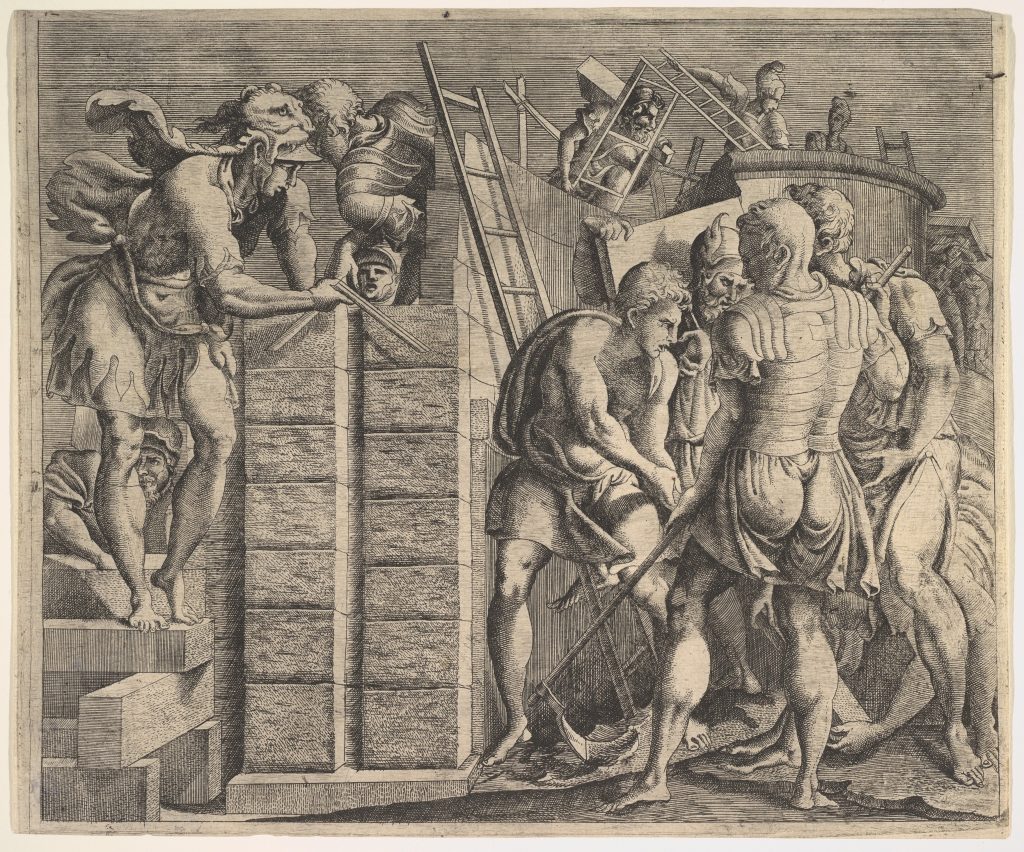
Cadmus does not need to become a coward for the colonial reading to work. His loyalty to his companions, his endurance, and the possibility of a shared civic life remain visible. What changes is the assumption that the benefits his arrival produces settle the justice of how he arrives.
A founder can protect one company while displacing another. He can bring a useful art, acknowledge a sacred debt, and still profit from a conflict he has helped provoke. These are not separate characters concealed beneath the same name. They are different relationships within the same undertaking.
The sympathetic reading asks how people make a home after loss. The suspicious reading asks what happens when making that home requires someone else to lose their place. Neither question should swallow the other.
Echion’s lowered weapon still matters. Without that gesture, the field would remain a battlefield. But the gesture does not turn everyone buried there into someone who willingly made room for the city.
From the city, Cadmus can be remembered as the man who gave the survivors a future.
From the spring, that future begins with a guardian’s death.
The water runs through both stories.
Sources and textual notes
1. Pseudo-Apollodorus, Library 3.1.1 and 3.4.1, James George Frazer, trans. (1921), primary text. This draft follows the account in which Europa is Agenor’s daughter; the compilation also records an alternative parentage. Europa’s removal by Zeus, the search, the prohibition on returning, and Telephassa’s death supply the opening. The Library is a later ancient compilation, not itself a BCE manuscript; Euripides supplies an earlier witness to the foundation. ToposText’s event-date tags are not dates of composition. ↩
2. Pseudo-Apollodorus, Library 3.4.1, Frazer translation, text. The three quotation blocks together reproduce the foundation account, with reading paragraph breaks. The cow is intended as a sacrifice to Athena, and the dragon destroys most of the companions. Its parentage from Ares is attributed as a tradition. The stone-throwing version is explicitly credited to Pherecydes. Pherecydes’ stratagem uses “stones” in the plural and differs from Ovid’s account. ↩
3. Ovid, Metamorphoses 3.55–59, Henry Thomas Riley, trans. (first published 1851), public-domain English text, Book III; Latin. This brief quotation supplies Cadmus’s vow, not the foundation account’s entire factual sequence. Ovid directs the proposed sacrifice to Jupiter, not Athena; his thrown stone fails against the dragon’s armored body, and a spear later kills it. Those details are not silently imported into the main Apollodoran narration. Riley’s synopses and historical explanations are editorial material, not Ovid’s verses. ↩
4. Liddell–Scott–Jones, s.v. σπαρτός, especially the substantival Σπαρτοί, “the Sown-men,” Perseus / Scaife ATLAS. The word is related to σπείρω, to sow. “Sparti” is Frazer’s spelling; narration uses “Spartoi.” The article does not propose an uncertain etymology for Cadmus’s name. ↩
5. Ovid, Metamorphoses 3.115–130, especially 122–130 for the quoted conclusion. Latin; Riley translation. Ovid does not narrate Cadmus’s stone trick against the warriors. Monitu Tritonidis credits Athena’s advice for Echion’s laying down of arms; fraternaeque fidem pacis petiitque deditque gives the reciprocal request and assurance of peace. “Tritonia” is Athena, “Phoebus” Apollo. The interpretation of willing disarmament as a founding gesture belongs to this article, grounded in that sequence. ↩
6. Pseudo-Apollodorus, Library 3.4.2, Frazer translation, text. Frazer’s “eternal year” is immediately explained as eight years of ordinary reckoning. The sentence concerns atonement for the dragon’s slaughter. Athena’s grant of kingship, Harmonia’s parentage, and the divine wedding feast are explicit. Later Theban dynastic episodes, the necklace’s later history, and the eventual transformations of Cadmus and Harmonia are outside this episode’s scope. The Cadmea is the citadel; the article does not assign every later building of Thebes’ walls to Cadmus. ↩
7. ἁρμονία, CLD, Berlin-Brandenburg Academy of Sciences and Humanities; also Logeion. Lexical senses include a means of joining or fastening, joints, and agreement. The marriage as an image of reconciliation is an interpretation, not a claim that the name proves a single original meaning of the myth. ↩
8. Herodotus, Histories 5.57–59, especially 5.58, A. D. Godley, trans., Loeb Classical Library III (1922), public-domain English text. The excerpt omits the parenthesis and intervening description of settlement and other learning. Herodotus attributes the alphabet to the Phoenicians accompanying Cadmus and describes Greek modification of the letters. This is the ancient attribution being interpreted, not a claim that Cadmus invented every form of writing. The discussion of writing and political memory is this article’s analysis. ↩
9. Palaephatus, On Unbelievable Things 3–4. John Brady Kiesling’s 2019 English translation, based on N. Festa’s Greek edition (1902); Greek text. Section 3 supplies the human Drakon and takeover; section 4 supplies the alternative kinship of Harmonia. The seven-word English quotation is attributed to Kiesling. These are ancient rationalizations, kept separate from the literal serpent and divine genealogy in the main narration. They are not treated as independently verified historical reconstructions. ↩
10. Pseudo-Apollodorus, Library 3.4.2, Frazer translation, English text. The genealogy names Agave, daughter of Cadmus, as Echion’s wife. Interpreting this marriage as integration between the founder’s household and an earthborn lineage is analytical; no undocumented marriage negotiation or personal motive is supplied. ↩
11. Euripides, Phoenician Women (Phoenissae), the first choral ode at 638–689, particularly 657–675 for the dragon and sowing; E. P. Coleridge, trans., Internet Classics Archive. The chorus follows the hostile exchange between Eteocles and Polyneices. This translation says Cadmus kills the dragon with a jagged stone, unlike Ovid’s failed stone and successful spear. The quoted phrase “mail-clad host” is retained as printed in the online Coleridge text. Quotation punctuation and paragraphing are normalized without changing the words. Elsewhere in the play, Tiresias invokes Ares’s old grievance in the demand for Menoeceus’s sacrifice; this draft does not turn that later dramatic subplot into a further stage of Apollodorus’s eight-year reparation. ↩
12. Apollonius Rhodius, Argonautica Book III, the delivery of the serpent’s teeth and Jason’s final field trial; R. C. Seaton, trans. (1912), public-domain text. The poet explicitly identifies the teeth as coming from the serpent Cadmus killed at the spring of Ares. Athena apportions them to Cadmus and Aeetes. Medea supplies the stone stratagem, and Jason participates in killing the earthborn host. These teeth are not taken from the separate serpent that guards the Golden Fleece. The comparison is between linked ancient narratives, not a claim of independent cross-cultural convergence. ↩
Images: Jacob Jordaens, Cadmus and Minerva, 1636–1638, Museo Nacional del Prado, Madrid (P001713), public domain, via Wikimedia Commons; the engraving, vase, etching and plate below are open-access works from The Metropolitan Museum of Art, released under CC0 and credited in their captions.